






Executive Overview
Traumatic spinal cord injuries (SCIs) are catastrophic events that alter lives in an instant, carrying long-lasting physical, emotional, and economic burdens for patients and healthcare systems alike. While the immediate consequences of spinal trauma—such as localized paralysis, sensory loss, and autonomic dysfunction—are well-documented, the clinical landscape is frequently complicated by insidious secondary processes. Among the most feared, least understood, and potentially fatal of these complications is Subacute Post-Traumatic Ascending Myelopathy (SPAM).
SPAM is defined as a progressive neurological deterioration that extends significantly above the initial level of spinal injury within the first few weeks following the trauma. Crucially, this deterioration occurs in the absence of mechanical spinal instability or the formation of a post-traumatic syrinx (syringomyelia). Affecting approximately 1% of all spinal cord injury patients, SPAM is an infrequent clinical entity that typically targets young to middle-aged male patients, though female patients are also susceptible. Clinical presentations can be devastating, ranging from upper extremity pain, paresthesias, and progressive muscle weakness to catastrophic respiratory depression, dysphagia, and, in severe cases, brainstem involvement leading to mortality.
Because of its rarity, managing SPAM remains one of the most challenging dilemmas in neurotraumatology. Published literature reveals a complete absence of consensus regarding the efficacy or superiority of any specific medical or surgical intervention. Treatment regimens have historically relied on a hodgepodge of supportive care, surgical decompression, and various corticosteroid protocols—ranging from dexamethasone tapers to high-dose methylprednisolone boluses—without definitive proof that one therapeutic pathway outperforms another.
To shed light on this elusive pathology, researchers at the Hospital Universitari Vall d’Hebron (HUVH) in Barcelona, Spain, recently published a significant case series evaluating three distinct cases of SPAM managed over a seven-year period (2017–2023). Serving as the designated major trauma center and reference point for acute traumatic spinal cord injuries across Catalonia—a region serving a population of 7.9 million—HUVH offers a unique vantage point on severe spinal pathology. Their findings, alongside a rigorous review of global literature, offer vital clues regarding risk factors, diagnostic strategies, and the potential nuances of corticosteroid therapy in halting this relentless neurological decline.
Detailed Chronology: Clinical Encounters at Hospital Universitari Vall d’Hebron
To understand the unpredictable and swift nature of SPAM, one must examine real-world clinical presentations. Between 2017 and 2023, out of 557 acute traumatic spinal cord injury admissions at HUVH, three patients developed confirmed SPAM, accounting for an institutional incidence of approximately 0.54%. Each case presented unique diagnostic hurdles, surgical interventions, medical complications, and therapeutic responses to corticosteroids.
Case 1: The Motorcycling Accident and Cervical Progression
The first case involved a 41-year-old male with a medical history of type I diabetes mellitus who suffered a severe motorcycle accident. Transferred to HUVH for suspected spinal cord injury due to progressive limb weakness, the patient was hemodynamically stable upon arrival. A comprehensive body computed tomography (CT) scan revealed a complex C6-C7 fracture with over 50% anterolisthesis, left facet dislocation, and a right facet fracture, resulting in severe spinal canal invasion.
Initial neurological examinations diagnosed a C5-level spinal cord injury classified as American Spinal Injury Association (ASIA) Impairment Scale (AIS) A—indicating complete motor and sensory loss below the lesion. Cervical magnetic resonance imaging (MRI) confirmed the structural damage, showing a hyperintense focus at the compression site and diffusion restriction from C5 to C7 indicative of cytotoxic edema.
Forty-eight hours post-injury, the patient successfully underwent a closed reduction and C6-C7 arthrodesis without intraoperative complications. However, the postoperative recovery was fraught with medical management challenges. The patient struggled with poor glycemic control and hypertension—exacerbated by a descending dexamethasone taper—alongside episodes of severe hypotension secondary to baclofen administration for spasticity, necessitating a medication switch to tizanidine.
Thirty-five days after the initial trauma, the clinical picture took a sharp, alarming turn. The patient reported severe neck pain, dysesthesias radiating across the neck and upper dorsal regions, and new-onset paresthesias in the upper extremities. A comprehensive neurological assessment revealed a deterioration to a C3 spinal cord injury (AIS A)—representing a perilous two-level ascent above the original injury site.
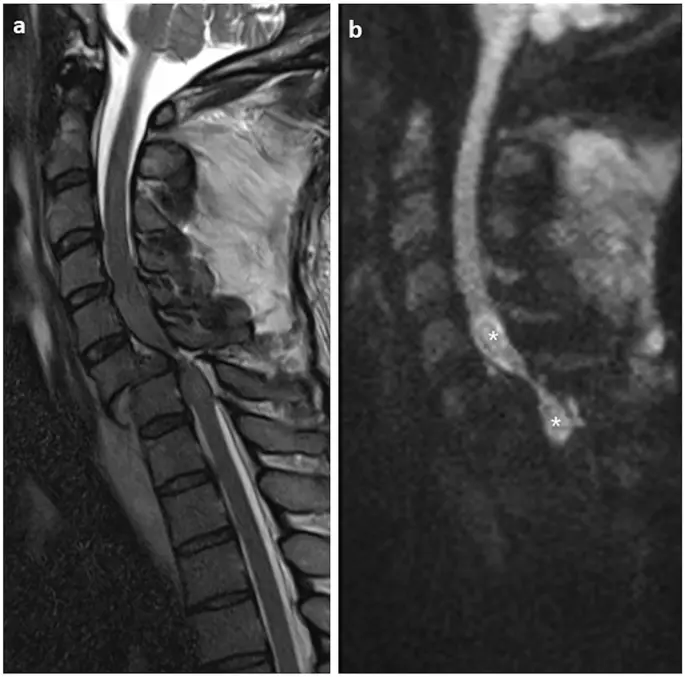
An urgent cervical MRI confirmed the dreaded diagnosis of SPAM, revealing new centromedullary edema that had aggressively ascended all the way to the C1 vertebral level. Clinicians initiated a descending intravenous dexamethasone taper (4 mg administered every 6 hours for 3 days). By the time of discharge, the patient had achieved a modest one-level neurological recovery, though his AIS classification remained unchanged at grade A.
Case 2: Multi-Trauma, Burst Fractures, and Diagnostic Obstacles
The second case underscored how complex systemic trauma can intertwine with spinal pathology. A 45-year-old female smoker with underlying obesity was rushed to the emergency department after being struck by a motor vehicle. She arrived in a state of hemodynamic instability, requiring emergency intubation, blood transfusions, and aggressive vasoactive drug therapy to sustain adequate mean arterial pressure.
A body CT scan painted a picture of widespread polytrauma: a C1 (Jefferson) fracture, a severe burst fracture of the T2 vertebra with significant spinal canal invasion, a basal right pneumothorax, bilateral hemothorax, right lung atelectasis, and a posterior mediastinal hematoma without active hemorrhage. Furthermore, she sustained an open femoral fracture that demanded immediate external fixation.
Once medically stabilized, a cervico-dorsal MRI and physical evaluation confirmed a C7 spinal cord injury (AIS A), accompanied by an extensive spinal cord contusion, thickening, and edema stretching from C7 to T3, alongside hypointense foci indicating microbleeds. Pre-surgical stabilization was further complicated by an episode of diabetic ketoacidosis and the placement of bilateral chest drains.
Forty-eight hours after the accident, surgeons performed a C6-T4 posterior instrumentation and T2-T3 reduction without incident. Yet, the postoperative course remained precarious. The patient required prolonged mechanical ventilation and suffered a sudden desaturation event accompanied by bradycardia, triggered by right basal atelectasis and an apical pneumothorax. This was successfully managed through bilateral drain openings and non-invasive ventilation.
Thirty-nine days post-injury, the patient reported a sudden functional impairment in both upper extremities. Neurological testing revealed a C4 spinal cord injury (AIS A), marking a dangerous three-level ascent. Urgent imaging confirmed SPAM, with centromedullary edema advancing aggressively to C2 alongside signal heterogeneity and microhemorrhages.
Medical teams administered a three-day intravenous methylprednisolone bolus (1 g/day). While the patient did not experience an upgrade in her AIS classification or overall neurological level by the time of discharge, noticeable improvements in localized muscle strength were documented. Notably, she experienced no severe adverse side effects from the high-dose corticosteroid protocol.
Case 3: Workplace Fall and Targeted Methylprednisolone Success
The third case involved a 40-year-old male smoker with type II diabetes mellitus who was transferred to the Vall d’Hebron trauma center following a traumatic workplace fall. Exhibiting lower limb immobility but hemodynamic stability, initial diagnostic workups revealed an unstable T8 burst fracture causing 30–40% spinal canal narrowing and prominent anterior spinal cord compression.
Initial neurological evaluations diagnosed a T7 spinal cord injury (AIS B), confirming incomplete sensory preservation. Dorsal MRI verified centromedullary edema localized to the T7/T8 junction, compounded by posterior epidural lipomatosis and venous plexus ectasia.
Forty-eight hours post-injury, the patient underwent decompressive laminectomy from T7 to T9 coupled with T6-T10 posterior arthrodesis. Intraoperatively, the patient experienced bronchospasm requiring rapid bronchodilator therapy. Postoperatively, massive left lung atelectasis necessitated emergent fibrobronchoscopy and positioning adjustments. He subsequently developed acute respiratory distress syndrome (ARDS), requiring prone positioning and intensive glycemic management.
Extubation was achieved six days post-surgery. However, on the eleventh day post-injury, routine surveillance revealed an alarming neurological decline: his injury level had ascended two segments to T5 (AIS A). An urgent dorsal MRI definitively diagnosed SPAM, mapping ascending centromedullary edema stretching from the conus medullaris all the way up to C7, alongside subacute ischemic edema from T2 to T6.
Unlike the previous cases, this patient was treated with a prolonged seven-day intravenous methylprednisolone bolus protocol (1 g/day). The therapeutic response was encouraging: by the time of discharge, the patient’s neurological status had not only stabilized but improved to a T5 injury with an upgraded AIS classification of grade B, indicating meaningful functional recovery. Like his peers, he tolerated the corticosteroid regimen without major systemic complications.
Supporting Context & Metrics: Epidemiology, Risk Factors, and Pathophysiological Theories
Subacute Post-Traumatic Ascending Myelopathy remains an enigmatic medical condition. While classic textbook literature estimates that SPAM affects roughly 1% of all traumatic spinal cord injury patients, the Vall d’Hebron case series observed an institutional incidence of 0.54% over a seven-year window among 557 evaluated patients.
Epidemiologically, SPAM heavily favors young to middle-aged males, with historical literature reporting a male-to-female predominance ratio of approximately 5:1. The HUVH cohort mirrored this demographic reality closely, featuring two males and one female with a tight mean age range of 40 to 45 years (average age: 42).
Recognized Risk Factors
Clinical literature has successfully mapped several key risk factors predisposing a patient to SPAM:
- Complete Spinal Injury & Thoracolumbar Junction Involvement: Patients suffering severe trauma at the thoracolumbar junction—such as T12 burst fractures—exhibit heightened vulnerability.
- Vascular and Hemodynamic Instability: Asymptomatic or symptomatic low blood pressure critically compromises spinal cord perfusion, setting the stage for ischemic cascades.
- Early Postoperative Orthostatic Mobilization: Premature verticalization or sitting up too quickly after spinal surgery can provoke sudden drops in perfusion pressure within a compromised spinal vascular network.
- Conservative Management: Paradoxically, non-surgical treatment approaches have historically correlated with higher rates of ascending myelopathy, underscoring the vital role of timely surgical decompression.
- Structural Trauma Types: While fracture-dislocations are the most frequently observed triggers in adults, severe burst and compression fractures also frequently instigate the cascade.
Unraveling the Pathophysiology
Despite decades of neurological research, the precise pathophysiological trigger of SPAM remains unproven. Several competing hypotheses attempt to explain why spinal cord edema marches relentlessly upward far beyond the borders of the primary mechanical impact:
- Altered Cerebrospinal Fluid (CSF) Circulation: Supported heavily by researchers like Meagher et al. and Planner et al., disturbances in normal CSF hydrodynamic flow around the injured cord may create localized pockets of stagnation, biochemical toxicity, and pressure gradients that propagate edema.
- Vascular Occlusion and Congestive Ischemia: Thrombosis of critical radiculomedullary feeders—such as the Artery of Adamkiewicz—or microvascular venous thrombosis can lead to progressive, ascending ischemic necrosis.
- Hypotensive Ischemia: Systemic blood pressure fluctuations interacting with localized autoregulatory failure in the spinal cord.
- Secondary Injury Cascades and Apoptosis: Delayed biochemical pathways, including excitotoxicity, free radical generation, lipid peroxidation, and programmed cell death (apoptosis) spreading vertically through white and gray matter tracts.
- Inflammatory and Autoimmune Reactions: An exaggerated secondary neuroinflammatory response triggered by necrotic debris released into the intrathecal space.
Notably, all three patients in the HUVH case series experienced significant systemic complications prior to, during, or immediately following their surgeries—including severe blood pressure oscillations, respiratory crises (atelectasis, pneumothorax, ARDS, and pneumonia), and difficult-to-manage glycemic excursions in diabetic individuals. These systemic hits likely exacerbated microvascular instability within the spinal cord, fueling the ascending edema.
Official Statements and Clinical Insights
The management of SPAM requires multidisciplinary vigilance, combining rapid diagnostic imaging with aggressive supportive and therapeutic protocols. Experts at the Hospital Universitari Vall d’Hebron emphasize that maintaining a high index of suspicion is paramount.
"SPAM is an infrequent yet potentially fatal complication following traumatic spinal cord injury. Because its exact cause remains unclear, clinicians must maintain extreme vigilance," noted the research team in their institutional review. "It should be actively considered whenever a patient experiences unexplained neurological deterioration after a traumatic SCI, as early detection is vital to preventing permanent respiratory failure or brainstem compromise."
The clinical team highlighted the intersection between systemic stability and neurological preservation:
"Cardiovascular risk factors, blood pressure fluctuations, and pulmonary complications heavily contribute to the clinical vulnerability of the cord. This highlights the absolute necessity for close, continuous monitoring of both systemic hemodynamics and granular neurological status during the critical post-injury window."
Regarding therapeutic interventions, the authors remained rigorously objective regarding the limitations of current medical science, noting a stark division in how clinicians approach pharmacological rescue:
"Current literature reveals a wide variety of corticosteroid treatment protocols, yet no single approach has been definitively proven superior. In our limited case series, intravenous methylprednisolone appeared to be associated with more favorable functional outcomes—such as AIS grade improvements—compared to dexamethasone tapers. Nonetheless, our small sample size precludes any firm conclusions, and further extensive research is urgently required to substantiate this potential therapeutic difference."
Future Outlook and Clinical Recommendations
As the medical community continues to grapple with the complexities of traumatic spinal cord injuries, the management of Subacute Post-Traumatic Ascending Myelopathy represents a frontier demanding rigorous, multi-center prospective trials.
Key Takeaways for Clinical Practice
- Mandatory Post-Surgical Surveillance: Neurological assessments using standardized frameworks like the ISNCSCI and AIS must not stop once initial spinal stabilization surgery is complete. The first three to six weeks post-injury represent the peak danger window for SPAM onset.
- Low Threshold for Urgent MRI: Because clinical deterioration can precede or mismatch imaging findings, any patient exhibiting unexplained upper extremity pain, paresthesias, sensory level changes, or motor regression should undergo immediate high-resolution spinal MRI to rule out ascending centromedullary edema.
- Rigorous Systemic Optimization: Aggressive control of mean arterial pressure (avoiding hypotensive troughs), strict glycemic management in diabetic patients, and proactive pulmonary care to prevent atelectasis and ARDS are non-negotiable components of mitigating secondary spinal cord ischemia.
- Standardization of Corticosteroid Protocols: While methylprednisolone bolus regimens showed promising functional recovery in select HUVH cases compared to dexamethasone tapers, large-scale randomized controlled trials are urgently needed to establish standardized, evidence-based guidelines for steroid dosing, duration, and safety profiles.
Ultimately, while SPAM remains a terrifying specter in trauma wards—capable of transforming paraplegia into tetraplegia within hours—advances in rapid MRI diagnostics, intensive multidisciplinary critical care, and refined surgical-medical protocols offer renewed hope. Through rigorous case documentation like that produced by the Vall d’Hebron trauma network, the medical community moves one step closer to demystifying this condition and preserving the fragile neurological integrity of trauma survivors.