







Executive Overview
In a stunning testament to the enduring value of museum archives, a multidisciplinary team of Japanese paleontologists has uncovered four fossilized bones that went entirely unrecognized for approximately thirty years. Unearthed in the early 1990s from strata in Osaka Prefecture, the specimens were initially cataloged alongside broader marine reptile remains and subsequently stored away in the collections of the Natural History Museum, Kishiwada City. Recent preparation work on stubborn rock matrices, paired with modern comparative anatomy, has radically changed the narrative surrounding these ancient fragments.
The newly identified bones include a pristine premaxilla—the tooth-bearing bone at the very apex of the upper jaw—marking the first time this critical cranial element has ever been scientifically confirmed in a Japanese mosasaur specimen. Furthermore, analysis of a rare basisphenoid bone situated near the braincase revealed bizarre, horn-like projections and a total absence of the ventral median groove typically seen in known taxa.
These distinctive morphological anomalies do not conform to any previously described mosasaur species, opening the tantalizing possibility that the fossils represent an apex marine predator entirely new to science. The findings were officially presented on June 27, 2026, at the 177th Annual Meeting of the Palaeontological Society of Japan, hosted at Osaka Metropolitan University. This discovery not only sheds light on the biodiversity of the northwestern Pacific during the twilight of the dinosaurs but also underscores a vital truth for modern paleontology: the next great breakthrough may already be sitting quietly on a dusty museum shelf.
Detailed Chronology: From 1990s Fieldwork to 2026 Breakthrough
The Initial Discovery: 1990–1992
The story of this scientific breakthrough begins more than thirty years ago during a period of active fossil prospecting in the sedimentary rocks of the Izumi Group, exposures that stretch across the Kansai region of Japan. Between 1990 and 1992, field researchers working in the Sobura district of Kaizuka City, Osaka Prefecture, struck upon a deposit rich in Late Cretaceous marine fossils.
Embedded within hard rock nodules were the fragmented remains of a mosasaur—a colossal, predatory marine lizard that once dominated prehistoric oceans. At the time of the excavation, field teams extracted the primary skeletal elements visible on the rock surfaces. These blocks were subsequently transported to the Natural History Museum, Kishiwada City, where they were curated and placed into long-term storage.
In the standards of late-20th-century fossil preparation, removing every millimeter of encrusting matrix from delicate bones was a slow, perilous task often deferred until specialized funding, tools, or research interests aligned. Consequently, several chunks of fossil-bearing rock containing smaller, less obvious skeletal fragments were packed away, remaining untouched and unexamined for decades.
The Decades-Long Hiatus and Technological Shifts
Throughout the 1990s, 2000s, and 2010s, paleontology underwent a quiet revolution. High-resolution computed tomography (CT) scanning, 3D digital photogrammetry, and an exponential expansion of global comparative databases transformed how researchers analyzed fragmented remains.
Concurrently, a massive surge in worldwide mosasaur discoveries—particularly in North America, Europe, and North Africa—created a robust anatomical baseline. Scientists began to map out the subtle variations in skull architecture that separate distinct genera and species.
Despite these global advances, the Japanese specimens languished in their unperturbed matrix blocks in Kishiwada. Because early paleontologists had access to a much sparser comparative fossil record in East Asia, they lacked the contextual framework necessary to decipher the true identity of the smaller, deeply embedded bones. Without modern reference libraries of high-resolution digital scans and detailed osteological descriptions, the obscure fragments simply defied immediate classification.
The Modern Re-Examination and Preparation
The turning point arrived when a collaborative research initiative involving scientists from Okayama University of Science, Tokyo City University, the Natural History Museum of Kishiwada City, and other associated academic institutions decided to revisit the historic Sobura collection.
Armed with advanced preparation techniques, microscopic imaging tools, and decades of accumulated global data, the team returned to the rock matrices that had gone neglected since the early 1990s. As technicians carefully chipped away the surrounding sedimentary rock, they freed four distinct fossil bones that had remained completely hidden during the original 20th-century curation process.
Among these newly exposed elements was the crown jewel of the collection: a remarkably preserved premaxilla. In mosasaur taxonomy, the premaxilla dictates the shape of the snout, the alignment of the premaxillary-maxillary suture, and the hydrodynamic profile of the animal’s hunting apparatus. Finding this bone intact in a Japanese specimen was an unprecedented breakthrough.
Supporting Context & Metrics: The World of Mosasaurs and the Northwest Pacific
Understanding Mosasaurs: The Tyrannosaurs of the Deep
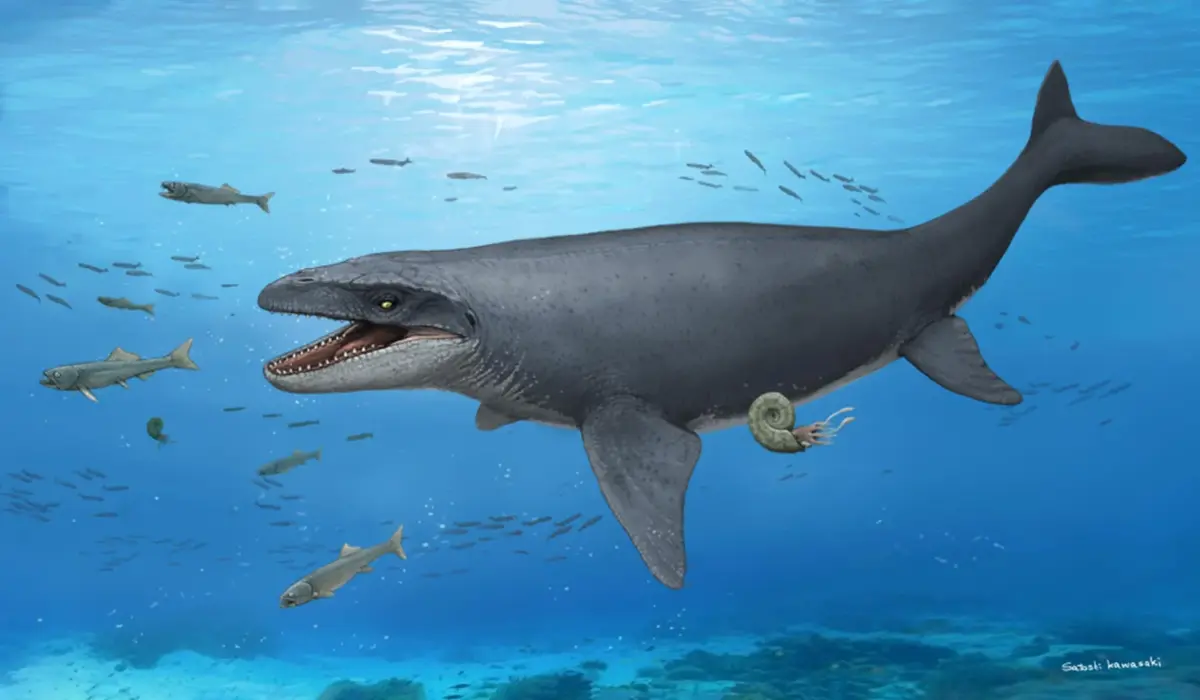
To comprehend the magnitude of this discovery, one must look at the ecological role mosasaurs played during the Late Cretaceous epoch (approximately 98 to 66 million years ago). Far from being simple swimming lizards, mosasaurs evolved into the apex predators of the world’s oceans, supplanting marine plesiosaurs and large predatory fish following the ecological shifts of the mid-Cretaceous.
- Size and Scale: Depending on the genus, mosasaurs ranged from modest hunters measuring 3 to 5 meters (such as Carinodens) to colossal leviathans like Mosasaurus hoffmannii, which could exceed 15 to 18 meters in length.
- Morphological Adaptations: Mosasaurs possessed streamlined bodies, powerful tail flukes, and limbs modified into paddle-like flippers. Their most terrifying evolutionary innovation was a second set of teeth in the roof of their mouths (pterygoid teeth), which ensured that once prey was grasped, it could not escape backward into the gullet.
- Geographic Distribution: Mosasaur fossils have been recovered on every continent, including Antarctica, reflecting a time when high global temperatures and sprawling epicontinental seas created vast, interconnected marine habitats.
The Geological Setting of Osaka Prefecture
The rocks that yielded these fossils belong to the Izumi Group, a thick sequence of Upper Cretaceous marine sedimentary strata deposited in an elongated forearc basin running southwest-northeast through southwestern Japan.
During the Campanian and Maastrichtian stages of the Late Cretaceous—roughly 83 to 66 million years ago—this region of what is now Japan was submerged beneath the northwestern Pacific. Turbidite currents, submarine landslides, and coastal sediment loads regularly swept organic remains into deep-water basins, creating exceptional conditions for fossilization.
However, the tectonic volatility of the Japanese archipelago means that rocks of the Izumi Group are heavily faulted, folded, and compressed. Consequently, vertebrate fossils recovered from these formations are frequently crushed, distorted, or preserved only as isolated fragments embedded in ultra-dense, cement-hard sandstone and mudstone matrices. This geological reality makes the survival of pristine, uncrushed cranial elements like a premaxilla and a basisphenoid exceptionally rare.
Anatomy of a Potential New Species
The taxonomic significance of the newly revealed bones lies in their specific morphological deviations from known mosasaur groups:
- The Premaxilla: This bone anchors the very front of the snout. In the Sobura specimen, the structural contours and suture interfaces do not match the diagnostic traits of widespread genera like Mosasaurus, Tylosaurus, or Plioplatecarpus. Because the snout configuration dictates how a marine predator slices through water and strikes prey, these structural differences hint at a specialized ecological niche unique to the northwestern Pacific.
- The Basisphenoid: Situated near the braincase at the base of the skull, the basisphenoid is a goldmine of taxonomic information. The research team noted that this bone features short, horn-like lateral projections coupled with a complete absence of the ventral median groove. In most documented mosasurs, the ventral surface of the basisphenoid features a distinct median trough or groove for muscular attachment and vascular pathways. Its absence, combined with the horn-like processes, provides a robust anatomical signature that separates this animal from all established taxa.
Official Statements & Expert Perspectives
While the formal peer-reviewed taxonomic description is currently in preparation, the research collective has shared insights regarding the methodology and implications of their work.
"When fossils are first excavated, especially decades ago when our comparative datasets were rudimentary, scientists must prioritize the most prominent, easily identifiable elements," noted a representative from the research consortium during discussions surrounding the archive review. "Bones buried deep within complex matrix blocks are easily missed or set aside for a future that sometimes takes thirty years to arrive."
The inclusion of institutions such as Okayama University of Science and Tokyo City University highlights a collaborative push within Japanese paleontology to re-evaluate historic collections using modern analytical frameworks.
"The discovery of the premaxilla is a historic milestone for Japanese vertebrate paleontology," stated a senior researcher affiliated with the project. "For the first time, we have concrete cranial data from the anterior tip of a Japanese mosasaur snout. When you pair that with the bizarre, horned morphology of the basisphenoid, we are no longer just looking at a regional fragment—we are looking at a smoking gun that points toward biodiversity we have yet to officially name."
Museum curators at the Natural History Museum, Kishiwada City, have emphasized the vital role regional repositories play in global scientific progress. Often overshadowed by massive national institutions, local museums house vast, under-analyzed archives collected by amateur and professional paleontologists alike. This discovery serves as a powerful reminder of the untapped scientific wealth sitting quietly in municipal museum cabinets across the globe.
Future Outlook: The Road Ahead for Japanese Paleontology
The presentation of these findings at the 177th Annual Meeting of the Palaeontological Society of Japan marks the end of the preliminary discovery phase, but the beginning of rigorous taxonomic validation.
Immediate Research Objectives
- Formal Species Description: The research team must now complete a comprehensive osteological monograph comparing the four newly extracted bones against every known mosasaur species globally. If the unique combination of the horned basisphenoid and the atypical premaxilla proves distinct, the team will formally erect a new genus and species.
- Micro-CT Scanning and Internal Analysis: To fully understand the internal vascular and neural pathways of the braincase and premaxilla, researchers plan to subject the delicate bones to high-resolution micro-computed tomography. This non-destructive imaging will reveal internal trabecular structures that are invisible to the naked eye.
- Paleoecological Reconstruction: With a potential new predator identified, paleoecologists can begin modeling the trophic webs of the northwestern Pacific during the Late Cretaceous. Understanding whether this animal hunted ammonites, large fish, or other marine reptiles will clarify how regional ecosystems differed from contemporaneous ecosystems in North America and Tethyan Europe.
Broad Implications for Museum Collections Worldwide
Beyond the specific case of the Kishiwada mosasaur, this breakthrough carries a universal mandate for the global scientific community: revisit the drawers.
In an era of tight research budgets and heavy focus on brand-new field excavations, museum archives remain an underutilized goldmine. Thousands of boxes containing unprepared rocks, ambiguous bone fragments, and "unidentifiable" debris sit in climate-controlled vaults worldwide. As analytical technology advances—ranging from laser fluorescence imaging to AI-assisted bone mapping—historic collections are ripe for secondary discovery.
The 1990s fossil find from Osaka Prefecture demonstrates that the past still holds secrets, waiting patiently for the right tools, the right questions, and the dedication of modern scientists willing to look twice at what was left behind.