









Executive Overview
The field of computational pathology has achieved a landmark milestone with the unveiling of PRISM2, a cutting-edge, slide-level multimodal foundation model developed to address one of digital pathology’s most persistent challenges: case-level clinical inference. While recent years have witnessed transformative advances driven by tile-level foundation models—such as Virchow2, UNI2, and H-Optimus-1—these architectures have remained fundamentally limited when evaluating full patient cases. Patient-level predictions typically require the aggregation of thousands of gigapixel whole-slide images (WSIs), a process that historically demanded extensive data curation and task-specific training architectures vulnerable to overfitting and poor generalization.
PRISM2 shoves past these traditional paradigms. Developed through an unprecedented multi-institutional collaboration and trained on a massive corpus comprising nearly 700,000 distinct clinical reports and 2.3 million WSIs from diverse international health systems, PRISM2 serves as the largest multimodal slide-level pathology foundation model to date. Most remarkably, PRISM2 achieves clinical-grade predictive performance matching FDA-authorized specialty algorithms without requiring task-specific fine-tuning. By leveraging a novel dual-embedding architecture and treating clinical dialogue as a rich supervisory signal, PRISM2 bridges the gap between raw pixel data and complex diagnostic reporting.
Detailed Chronology & Technological Breakthroughs
The Limitations of Tile-Level Aggregation
For years, computational pathology relied on self-supervised learning objectives trained on millions of isolated histopathology tiles. Although models like Virchow2 excelled at feature extraction for cancer detection, subtyping, and biomarker quantification, translating these features to case-level inference presented a structural bottleneck. Conventional workflows forced engineers to build task-specific tile aggregators using weakly supervised learning, an approach notorious for data hunger and poor out-of-distribution robustness.
Recognizing that clinical reality operates at the case and specimen level rather than the isolated tile level, researchers sought a paradigm shift. Prior attempts to build slide-level models utilized image-only scaling, paired molecular data, or clinical report text (such as the original PRISM and TITAN models). However, these efforts frequently stumbled against the extreme heterogeneity and variable information density of real-world pathology reports.
The Architecture of PRISM2: Dual-Embeddings and Clinical Dialogue
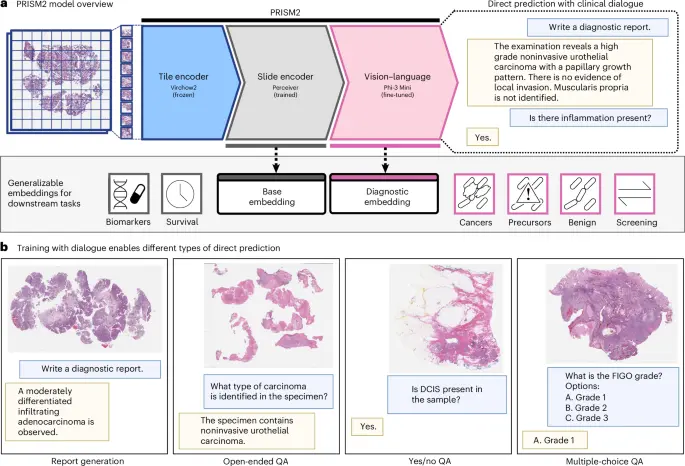
PRISM2 overcomes these barriers through a sophisticated two-stage training approach and a novel dual-embedding architecture:
- Base Embedding: A lightweight, highly generalizable representation derived via a perceiver-based slide encoder that aggregates Virchow2 tile embeddings. This embedding transfers exceptionally well to novel, complex tasks outside the diagnosis-focused training distribution, including biomarker prediction and patient survival modeling.
- Diagnostic Embedding: Derived from the hidden state of a 4-billion-parameter language model (Phi-3 Mini) tuned for clinical tasks such as cancer detection and subtyping.
Rather than deploying the model as a conversational chat agent, PRISM2 uses single-turn clinical dialogue as a powerful supervisory signal. The training pipeline operates in two distinct stages:
- Stage 1: A perceiver-based slide encoder processes up to 100,000 tile embeddings per specimen, aligning slide-level representations with diagnostic summary text using dual objectives—a contrastive objective using BioGPT text embeddings and an autoregressive objective using Phi-3 Mini.
- Stage 2: The slide encoder weights are frozen to protect generalizability, while the language model is fine-tuned on an extensive array of structured question-answering formats. This enables prompt-based inference, allowing clinicians and automated workflows to query the model directly for quantifiable predictions and calibrated probabilities.
Supporting Context & Quantitative Metrics
To validate PRISM2’s capabilities, researchers subjected the model to rigorous evaluations across pan-cancer detection, rare cancer classification, tissue subtyping, prognostic survival analysis, and molecular biomarker prediction.
Prompt-Based Inference vs. Clinical-Grade Products
When evaluated against specialized, commercial clinical algorithms—specifically Paige Prostate (which holds FDA De Novo clearance), Paige Breast, and Paige BLN (Breast Lymph Node, bearing an FDA Breakthrough Device designation)—PRISM2 matched or exceeded their performance without any task-specific retraining:
- Cancer Detection: Using yes/no question-answering prompts, PRISM2 matched Paige Prostate and Paige Breast and decisively outperformed Paige BLN. Older multimodal models like PRISM and TITAN fell short of these clinical benchmarks even after linear probing.
- Pan-Cancer Performance: PRISM2 delivered superior overall performance across nine common and seven rare cancer types.
- Report Completion: PRISM2 demonstrated a robust capability to auto-populate College of American Pathologists (CAP) synoptic worksheets for invasive breast carcinoma biopsies. While fields like histologic type and lymphovascular invasion benefit from probability calibration, the core morphological concepts are flawlessly captured by the model’s underlying semantic representations.
Prognostic and Biomarker Generalization
- Survival Prediction: Evaluated on over 225,000 cases tracking overall survival across nearly 100,000 patients, PRISM2 was fine-tuned on colorectal cancer recurrence-free survival (RFS) and TCGA disease-specific survival (DSS). The resulting PRISM2 survival embeddings outperformed a custom-built survival specialist model, achieving a higher concordance index (C-index) on colorectal cancer RFS.
- Biomarker Screening: Across 10 tissue-specific biomarker datasets (including Prostate AR, Ovarian FGA, Esophagogastric HER2, Colorectal MSI, and Lung EGFR), PRISM2 base embeddings performed at least as well as or better than all competing models, proving that H&E-stained slides can reliably surrogate for costly next-generation sequencing assays.
Official Statements and Institutional Collaboration
The development of PRISM2 reflects a high-stakes, cross-institutional research partnership bridging academic medicine and industry innovators. The underlying retrospective clinical data—comprising slides and reports from Memorial Sloan Kettering Cancer Center (MSK)—underwent rigorous governance and deidentification protocols to ensure patient privacy.
Lead investigators and clinical advisors emphasized the transformative nature of marrying large language model reasoning with gigapixel imaging:
"A complete pathology foundation model encodes the full range of relevant pathologic semantics not only within tiles but also across whole-slide images. By leveraging dialogue as a supervisory signal, we have unlocked a level of generalizability and zero-shot predictive power previously unseen in digital pathology."
Clinical collaborators at MSK noted that the model’s ability to act as a "digital resident"—pre-populating synoptic worksheets, flagging high-risk cases for subspecialist review, and guiding immunohistochemistry orders—marks the dawn of practical, AI-augmented clinical workflows.
Future Outlook & Industry Implications
PRISM2 represents a paradigm shift in how artificial intelligence interacts with pathology data. By moving beyond simple classification tasks to natural language-driven prompt-based inference, the model offers unprecedented flexibility to hospital networks, diagnostic laboratories, and biotechnology firms.
However, researchers acknowledge critical areas for future refinement. While PRISM2 handles single-turn diagnostic QA with exceptional accuracy, full diagnostic report completion remains challenging due to the subjective nature of tumor grading and subtyping. Furthermore, expanding spatial reasoning through position-encoded aggregators and incorporating mixed-magnification analysis will be essential for tasks requiring precise dimensional measurements, such as mitotic event counting.
As diagnostic performance in digital pathology begins to saturate, PRISM2 establishes a new research frontier: scaling multimodal, language-grounded slide representations to revolutionize prognostic oncology, personalized treatment matching, and global healthcare equity.