











Executive Overview
Healthcare access has long been dictated by geography. For millions of patients residing in rural enclaves, inner-city deserts, and medically underserved regions, obtaining a basic diagnostic imaging scan often requires enduring multi-hour commutes, extensive travel expenses, and weeks—if not months—of anxious waiting. Even within state-of-the-art metropolitan medical centers, severe workforce shortages, backlogged patient schedules, and a dwindling pool of specialized sonographers have created profound bottlenecks in the care continuum.
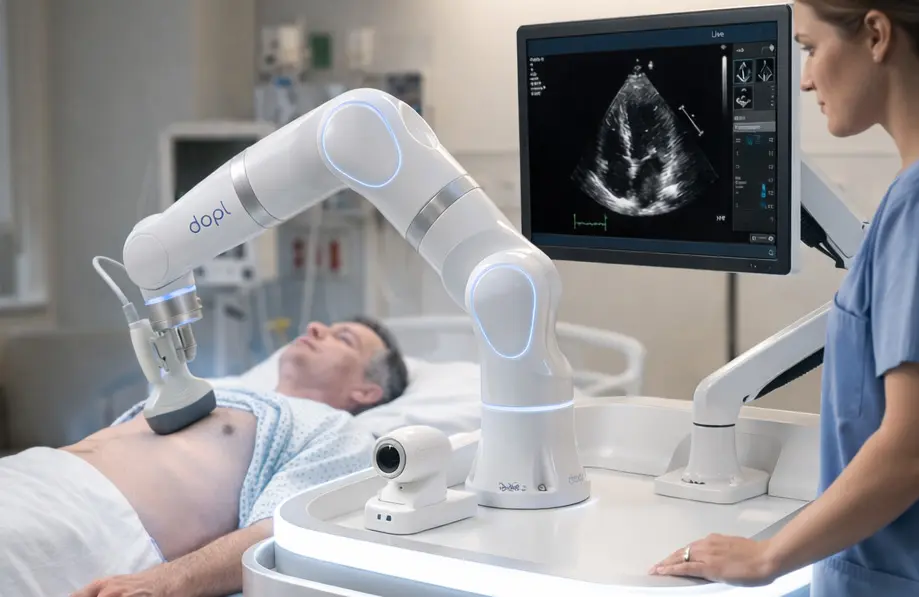
Enter Dopl Technologies. Headquartered in Bothell, Washington, this innovative medical device startup is confronting the global diagnostic bottleneck head-on. Fresh off closing a robust $6.3 million seed funding round, the company is developing a revolutionary platform designed to democratize access to advanced medical imaging. At the center of this initiative is "Traverse," an advanced ultrasound robotics system that empowers remote sonographers to perform safe, highly accurate diagnostic scans from anywhere in the world.
By marrying state-of-the-art software, zero-latency haptic feedback, and off-the-shelf hardware components, Dopl is not merely building a remote ultrasound tool; it is laying the foundational infrastructure for a future defined by fully autonomous and telerobotic healthcare delivery. In an exclusive interview, Dopl Technologies Co-Founder and CEO Ryan James—a former NVIDIA medical AI engineer and health informatics PhD—shared the vision, technical hurdles, and strategic pivots driving the company’s mission to redefine how medicine is practiced on a global scale.
Detailed Chronology: From Minimally Invasive Roots to Diagnostic Innovation
The trajectory of Dopl Technologies is a testament to the agile, iterative nature of modern medical device development. The company’s story did not begin with diagnostic ultrasound; rather, its genesis is rooted deep within the complex, high-stakes realm of minimally invasive surgery and cardiac interventions.
The Early Years: Exploring Minimally Invasive Frontiers
Long before turning its attention to top-of-the-funnel diagnostics, Dopl spent five to seven intensive years researching and experimenting with minimally invasive procedures. The founding team—which included James and two visionary physicians from the University of Washington who shared a mission-aligned passion for expanded care access—focused heavily on advanced endovascular and cardiac treatments.
During this foundational R&D phase, the startup successfully executed remote cardiac catheter ablations in rural hospital settings. These procedures proved that high-level specialist interventions could theoretically be delivered across vast geographical divides, validating the core telerobotic architecture of the company’s underlying software.
The Pivot to Ultrasound: Listening to the Market
Despite the technical triumph of their remote cardiac ablation experiments, direct feedback from clinical partners forced a strategic re-evaluation. When consulting with rural hospital administrators and clinicians, the Dopl team repeatedly heard a sobering reality: while having an electrophysiologist virtually present to perform a complex ablation was undeniably valuable, these remote facilities were facing a much more fundamental, upstream crisis.
"They said, ‘This is great. We would love to have the expertise of an electrophysiologist in our hospital, but we just need basic access to ultrasound because our patients can’t even be diagnosed for a cardiac catheter ablation because we don’t have ultrasound to diagnose them,’" James recalled.
This critical insight catalyzed Dopl’s strategic pivot. The leadership team recognized that true healthcare equity must begin at the top of the diagnostic funnel. Without prompt, accurate imaging, patients cannot be properly triaged, diagnosed, or referred for specialized therapies. By shifting focus to ultrasound, Dopl positioned itself to solve the most immediate, pervasive bottleneck in the medical care chain before scaling back up to complex surgical interventions.
The Present: Securing Capital and Scaling Traverse
With the Traverse robotic ultrasound platform refined and validated, Dopl reached a major corporate milestone by securing $6.3 million in seed funding. This capital injection is fueling the company’s path toward initial market release, regulatory navigation, and the expansion of its engineering and clinical support teams. As Dopl prepares for its commercial rollout, the medtech industry is watching closely, recognizing the startup as a pioneer in the burgeoning field of telerobotic medicine.

Supporting Context & Metrics: The Scale of the Crisis
To truly understand the value proposition of Dopl Technologies, one must examine the staggering metrics governing global healthcare accessibility and workforce distribution.
The Global and Domestic Access Gap
- 5 Billion People: Globally, an estimated five billion individuals lack adequate access to essential healthcare services and timely diagnostic imaging.
- 60 Million Americans: Within the United States alone, approximately 60 million people live in rural communities characterized by extreme provider shortages and limited healthcare infrastructure.
- Urban Delays: Even in major metropolitan areas blessed with world-class medical institutions—such as the University of Washington medical system in Seattle—patients routinely face wait times ranging from three weeks to three months simply to secure a routine ultrasound scan.
The Economics of Workforce Maldistribution
Sonography is a highly specialized skill requiring rigorous training and physical dexterity. Unfortunately, trained sonographers are severely maldistributed, heavily concentrated in wealthy urban medical hubs while rural and community hospitals go unstaffed. This workforce deficit creates a vicious cycle: rural facilities lose patient volume, revenue suffers, and patients experience delayed diagnoses that can transform treatable conditions into catastrophic medical emergencies.
Dopl’s Traverse platform directly alters these economics. By decoupling the location of the sonographer from the location of the patient, hospitals can leverage regional or national pools of imaging experts. A single sonographer sitting in a centralized reading room can seamlessly service multiple rural clinics, dramatically cutting time-to-diagnosis, increasing hospital throughput, and optimizing institutional balance sheets.
Official Statements & Technical Deep-Dive
During his extensive discussions with medical design and technology analysts, Ryan James articulated the underlying philosophy and unique technological architecture that separates Dopl from competing remote imaging ventures.
The "Special Sauce": Software, Connectivity, and Hardware Agnosticism
Many early attempts at robotic telemedicine relied on proprietary, closed-loop ecosystems that forced hospitals to purchase entirely new, expensive suites of hardware. Dopl has taken a radically different approach.
"Dopl’s special sauce is the software and connectivity that connects the remote specialist to devices at the patient bedside and allows them to securely and safely control those devices to deliver care to patients," James explained.
Rather than reinventing the wheel, Dopl leverages robust, off-the-shelf hardware components:
- Robotics: Six- and seven-degree-of-freedom collaborative robots (cobots).
- Controllers: Off-the-shelf six-degree-of-freedom haptic controllers.
- Vision Systems: Traditional RGB cameras alongside advanced RGBD (depth-sensing) cameras.
- Sensors: Integrated force-torque and pressure sensors at the end effector.
While Dopl manufactures proprietary components such as the mobile medical cart and the specialized end-effector bracket that securely attaches standard ultrasound probes to the robotic arm, the platform is designed to be device-agnostic. Initial commercial rollouts will feature a turnkey, all-in-one system bundle (robot, controller, ultrasound machine, and cameras), but the long-term architecture will allow healthcare providers to integrate their existing hospital-owned equipment directly into Dopl’s secure network.
Conquering Latency and Perfecting Haptics
One of the most formidable engineering barriers in telerobotics is latency—the delay between a user’s physical input and the machine’s corresponding action. In a surgical or diagnostic context, even milliseconds of lag can cause disorientation, safety hazards, and clinical error. Furthermore, many competing systems rely on simplistic interfaces like joysticks or video game controllers, which steepen the learning curve for seasoned medical professionals.
Dopl solved this challenge by engineering an immersive, zero-latency haptic experience that mirrors traditional, hands-on clinical workflows.

"What makes Dopl different is we make the remote expert feel like they’re in the room with the patient, scanning like they always have. That not only decreases the barrier for training, it creates this incredible, delightful experience for the remote sonographer."
To achieve this, Dopl utilizes sophisticated computer vision models deployed on the patient-side hardware. These models map the three-dimensional topology of the patient in real time, ensuring that the robotic arm maintains a gentle, anatomically appropriate touch. Force-torque sensors modulate pressure dynamically, ensuring that the patient feels nothing more than a soft, reassuring weight—likened by James to "an apple resting on your chest" during a cardiac scan—while ensuring the robot remains strictly within a safe operational work zone.
Future Outlook: The Next Horizon in Telerobotic Care
As Dopl Technologies establishes its foothold in diagnostic ultrasound, the company’s long-term roadmap extends far beyond imaging. The foundational infrastructure being built today is designed to serve as the universal operating system for telerobotic and autonomous healthcare delivery.
Expanding into Telerobotic Stroke Care and Beyond
The potential clinical applications for Dopl’s platform are vast. Stroke care, for instance, represents an ideal frontier. In acute stroke management, every minute saved equates to brain tissue preserved ("time is brain"). By enabling remote specialists to rapidly guide emergency scans and interventions in rural emergency departments via telerobotics, healthcare providers can dramatically accelerate treatment times and improve neurological outcomes.
Furthermore, James envisions a 10- to 30-year industry evolution where the boundaries of physical location dissolve entirely. By systematically accumulating data from millions of remote telerobotic exams, Dopl’s software is continually learning. Over time, this data accumulation will enable the introduction of semi-autonomous scanning features, eventually paving the way for fully autonomous diagnostic and procedural workflows.
Advice for Medtech Innovators
For entrepreneurs navigating the notoriously challenging venture capital landscape of the modern medical device sector, James offers pragmatic, battle-tested advice. Fundraising in medtech requires resilience, a clear articulation of market size, and an unwavering commitment to clinical utility.
"It can be challenging, but you’ve just got to stick with it," James advises. "There are a lot of people out there who have capital who are investing in medtech. You’ve got to find people like yourself who are passionate about this field and really want to make a difference—and of course, make a lot of money doing it. As long as you can show the big opportunity and how your company is different and that you can reach that opportunity, the money’s there to raise. And then it’s all about execution at that point."
With $6.3 million in fresh seed funding, a visionary leadership team, and a transformative technology poised to bridge the diagnostic divide, Dopl Technologies is well-positioned to execute its grand vision: bringing world-class medical expertise to every corner of the globe, exactly when and where patients need it most.