




Executive Overview
For generations, undergraduate earth science students have been taught a comforting, linear truth about the Earth’s oceans: warm, hyper-saline water from the Indian Ocean spills around the southern tip of Africa—a phenomenon oceanographers call Agulhas Leakage—injecting critical salt into the Atlantic. This infusion acts as the vital spark that feeds the Atlantic Meridional Overturning Circulation (AMOC), a monumental engine within the global ocean conveyor system that dictates weather patterns, thermal distributions, and climate stability across North America, Europe, and beyond.
However, a groundbreaking international study published by a multi-institutional research team spanning the Netherlands, the United States, China, and the United Kingdom has blown this textbook consensus wide open. Utilizing deep-sea sediment cores, microscopic fossil assemblages, and advanced numerical climate models, the researchers have demonstrated that this relationship is far more capricious and complex than previously assumed.
In a finding that has stunned paleoclimatologists, the team discovered that during the late Pliocene epoch—specifically between 3.6 and 2.6 million years ago—the AMOC actually intensified even as Agulhas Leakage dramatically weakened and nearly ground to a halt. This disruption of established dogma reveals that deep-water formation and global ocean overturning can decouple from southern salt supplies under specific climate conditions, forcing the scientific community to reevaluate how planetary circulation systems operate across varying geological epochs.
While the researchers caution against applying these deep-time historical models as a direct predictive blueprint for modern anthropogenic climate change, the study underscores a humbling reality: the mechanics governing the Earth’s oceanic circulation are mutable, shifting dynamically in response to baseline climate states and shifting continental boundaries.
Detailed Chronology: Unraveling the Pliocene Paleoclimate Puzzle
To understand how contemporary oceanographers managed to overturn decades of established climate theory, one must look back nearly four million years to a pivotal window in Earth’s history: the late Pliocene epoch.
The Pliocene Paradigm: A Window into Our Warm Future
Spanning roughly from 3.6 to 2.6 million years ago, the late Pliocene epoch represents a fascinating transitional era in planetary evolution. It featured a short yet sharp glacial event, immediately followed by the mid-Piacenzian Warm Period—a climatic interval when atmospheric carbon dioxide concentrations were roughly comparable to today’s levels, but global temperatures and sea levels were significantly higher.
For paleoclimatologists, this geological epoch serves as a vital natural laboratory. It provides a rare historical analogue for understanding how major Earth systems react as the planet shifts from cooler intervals into extended phases of global warmth. Yet, until recently, tracking the intricate teleconnections between the Indian Ocean, the Southern Ocean, and the North Atlantic during this volatile period remained a guessing game.
Drilling into Deep-Time History
To reconstruct this ancient marine environment, the international research team turned to the archives stored at the bottom of the world’s oceans. Central to their investigation was a marine sediment core harvested from International Ocean Discovery Program (IODP) Site U1475, situated high atop the Agulhas Plateau roughly 500 kilometers south of the South African coastline.
As layers of microscopic shells, wind-blown dust, and organic debris settle onto the ocean floor over millions of years, they create an unbroken, chronological diary of environmental conditions. By extracting these cores, scientists can read the chemical and biological signatures of ancient waters with astonishing precision.
[Southern Ocean Subtropical Front]
        │
        ├── Shifts North (Glacial Event) ──> Weakened Agulhas Leakage ──> Subpolar Conditions at Site U1475
        │
        └── Shifts South (Warm Period)   ──> Enhanced Agulhas Leakage  ──> Warm Indian Ocean Waters Enter Atlantic
Microscopic Clues: Dinocysts and Biomarkers
Within the sediment layers of Site U1475, the researchers meticulously analyzed fossilized microplankton known as dinocysts (dinoflagellate cysts), alongside organic lipid biomarkers. These microscopic organic remains act as ultra-sensitive ecological proxies. Different species of dinoflagellates thrive within strict temperature and salinity parameters; consequently, shifts in the fossil assemblage signal shifts in water mass boundaries.
By mapping changes in these biological populations, the team tracked the historical migrations of the Southern Ocean subtropical front—the boundary separating cold sub-Antarctic waters from warmer subtropical currents.
- When warmer species dominated the sediment record, it indicated that the subtropical front had migrated southward, opening a wide geographic corridor for Indian Ocean waters to "leak" around the African cape into the Atlantic.
- Conversely, an influx of colder species signaled that the front had moved northward, constricting this oceanic valve and choking off the Agulhas inflow.
To cross-verify how the broader Atlantic basin reacted to these shifts, the team developed high-resolution temperature records from Ocean Drilling Program (ODP) Site 625 in the northern Gulf of Mexico. They synthesized these new metrics with previously published data from the equatorial Atlantic, the Caribbean Sea, and the deep North Atlantic, ultimately coupling these geological archives with state-of-the-art numerical climate model simulations.
The Turning Point: When Theory Met Geological Reality
The chronological reconstruction revealed a dramatic sequence of events. Around 3.4 million years ago, the subtropical front began a pronounced northward migration, accelerating sharply during the late Pliocene glacial interval.
Simultaneously, surface temperatures in the Agulhas region plummeted by approximately 3 degrees Celsius, and Site U1475 transitioned into subpolar conditions. The geological proxy data was unambiguous: Agulhas Leakage had experienced a catastrophic collapse, reducing the flow of warm, salty Indian Ocean water into the Atlantic to a relative trickle.
According to the foundational "salt-advection feedback" model, this starvation of saline input should have crippled the AMOC, causing North Atlantic deep-water formation to slow or collapse. Yet, when the researchers analyzed the physical state of the North Atlantic and the deep ocean during this exact window, they found the exact opposite.
Despite the choked valve off the southern tip of Africa, North Atlantic Deep Water (NADW) formation intensified, and lower-latitude overturning circulation strengthened. The basin-wide ocean thermocline—the critical transition layer dividing warm upper waters from frigid deep currents—shoaled, becoming markedly shallower across the entire Atlantic basin. What textbook theory said was impossible was happening in the geological record: the AMOC was roaring ahead while its primary southern salt-feeder lay dormant.
Supporting Context & Metrics: The Anatomy of Ocean Circulation
To fully grasp the magnitude of this discovery, it is essential to examine the physical architecture of the global ocean conveyor system and the specific metrics that define its operation.
The Atlantic Meridional Overturning Circulation (AMOC) Explained
The AMOC is a massive, three-dimensional conveyor belt driven by differences in water temperature and salinity—a process known as thermohaline circulation.
- The Northbound Upper Limb: Warm, salty water travels northward from the tropics along the surface of the Atlantic. As it reaches the high northern latitudes near the Nordic and Labrador seas, it releases massive amounts of heat into the atmosphere, keeping Western Europe significantly warmer than comparable latitudes in North America.
- The Sinking Phase: As this water cools and releases its thermal energy, it becomes dense and heavy. Coupled with high salinity left behind by evaporation and sea-ice formation, the surface water plunges thousands of meters to the ocean floor in a process known as deep convection.
- The Southbound Deep Limb: This newly formed North Atlantic Deep Water (NADW) flows southward along the ocean floor, eventually circulating into the Southern Ocean and upwelling into the Indian and Pacific basins.
+--------------------------------------------------------------------------+
|                     AMOC THERMOHALINE CONVEYOR                           |
|                                                                          |
|   (Warm Surface Flow) ──> Northward ──> High Latitudes (Heat Release)    |
|                                                │                         |
|   (Deep Southbound)   <-- Flow to Abyss <──────- Sink (Deep Convection)  |
+--------------------------------------------------------------------------+
The Agulhas Leakage Valve
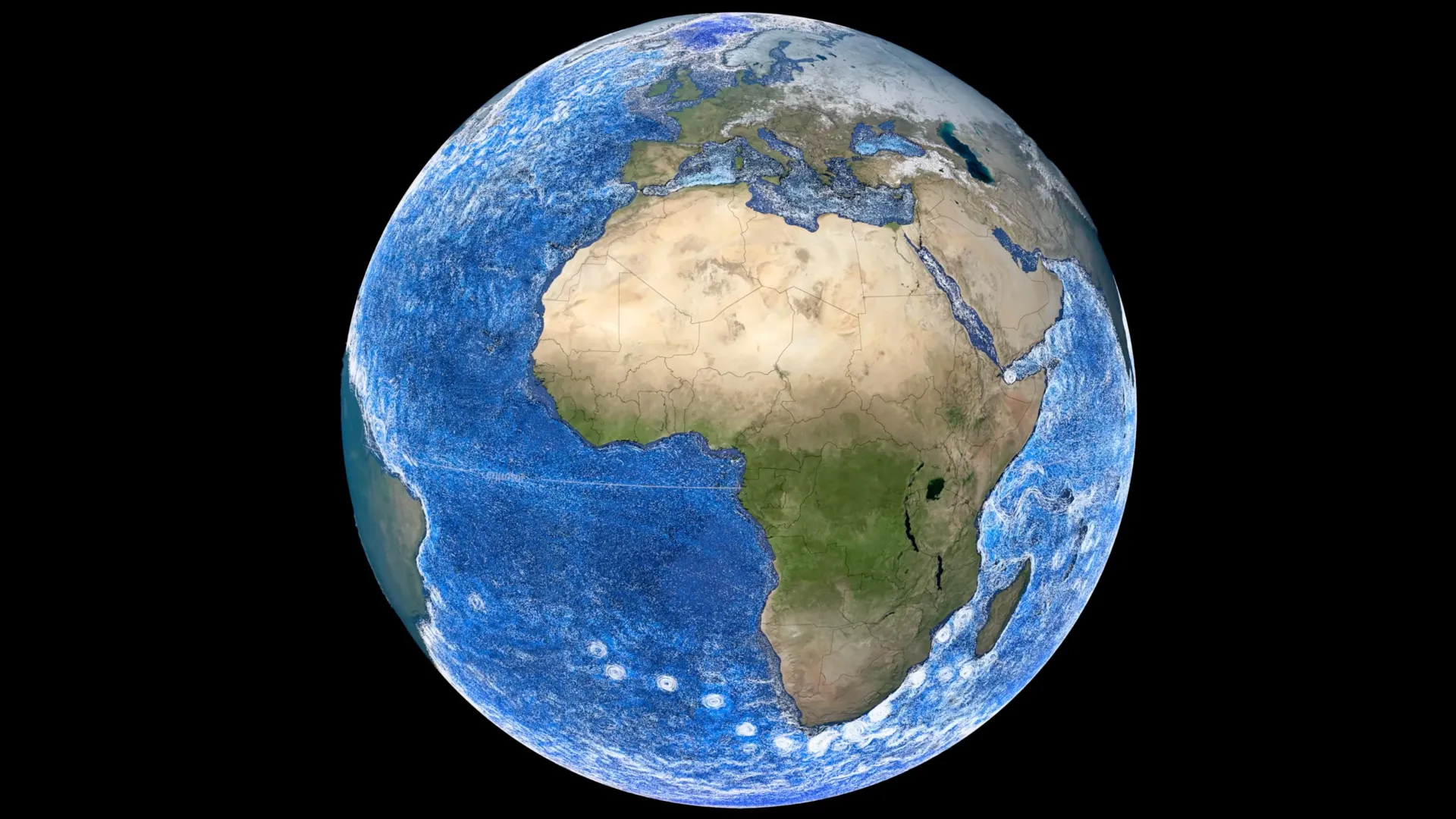
Positioned south of the African continent, the Agulhas Current is the western boundary current of the Indian Ocean. Driven by trade winds, it sweeps down the east coast of Africa before retroflecting back into the Indian Ocean. However, turbulent eddies, rings, and filaments perpetually pinch off from this retroflection loop, escaping around the Cape of Good Hope and injecting warm, saline Indian Ocean water into the South Atlantic.
For decades, oceanographers viewed this "leakage" as a primary pacemaker for the AMOC. The mathematical logic was straightforward: saltier water entering the Atlantic lowers the buoyancy threshold required for surface water to sink in the North Atlantic, thereby maintaining the vigor of the global overturning loop.
Key Metrics of the Pliocene Shift
- Chronological Window: 3.6 to 2.6 million years ago (Late Pliocene epoch).
- Core Site U1475 Location: Agulhas Plateau, ~500 kilometers south of South Africa.
- Temperature Drop: ~3°C cooling in the Agulhas region during the glacial interval.
- Subtropical Front Migration: Significant northward displacement, resulting in near-cessation of warm-water leakage into the Atlantic.
- Overturning Response: Intensified North Atlantic Deep Water formation and a shallower basin-wide thermocline, completely defying traditional salt-advection models.
Official Statements and Expert Perspectives
The implications of this multinational study have reverberated across the paleoclimatology and physical oceanography communities. The research team, drawing on expertise from institutions across Europe and beyond, emphasizes that science must remain adaptable when empirical data confronts cherished dogmas.
"This was basically the first textbook concept, that I learnt when I was a bachelor student. It was surprising to find geological evidence showing that it isn’t universally true. The AMOC can remain strong even when Agulhas Leakage weakens,"
— Dr. Suning Hou, Lead Author (Utrecht University)
The journey to this discovery was incremental, marked by moments of scientific skepticism. Co-author Carolien van der Weijst, a former PhD student at Utrecht University, initially detected this anomalous signal years prior while analyzing a single, isolated sediment core. At the time, the scientific community questioned whether the signal represented a local marine anomaly or a fundamental flaw in data collection.
It was only when the exact same physical signature was extracted from the Agulhas Plateau sediment cores that the researchers understood they were observing a planetary-scale phenomenon.
"When the same pattern was discovered in the Agulhas Plateau, we realized we were looking at a basin-wide reorganization of the ocean thermocline rather than a local anomaly. Then we confirmed this with climate model simulations," explains Prof. Francien Peterse of Utrecht University. "The whole story suddenly made sense."
By pairing empirical proxy data with advanced numerical climate simulations, the team demonstrated that the Atlantic ocean basin is capable of internal reorganization. When local high-latitude processes in the North Atlantic—such as atmospheric cooling, wind stress, and sea-ice dynamics—operate with sufficient vigor, they can independently drive deep-water formation, rendering the system resilient to reductions in external salt supplies from the Southern Hemisphere.
Future Outlook: Implications for Climate Science and Modern Warming
As society grapples with contemporary anthropogenic climate change and the persistent, legitimate fears regarding a potential weakening or collapse of the modern AMOC, studies like this carry profound implications. However, the researchers issue a strict caveat regarding how their findings are interpreted.
Separating Deep-Time Mechanics from Modern Predictions
The conclusions drawn by Hou, Peterse, and their colleagues are anchored in the specific continental configurations, atmospheric greenhouse gas regimes, and orbital mechanics of the late Pliocene epoch. Therefore, these findings must not be treated as a direct forecasting model for how today’s AMOC will respond to near-future global warming.
The modern Earth differs from the late Pliocene in critical ways:
- The Arctic Factor: Today’s AMOC is heavily influenced by massive freshwater pulses streaming from melting Greenland ice sheets and Arctic sea-ice pack. This modern freshening dynamic introduces buoyancy anomalies that did not exist in identical forms during the Pliocene glacial events.
- Rate of Change: Anthropogenic warming is occurring at a hyper-accelerated geological pace, compressing centuries of environmental stress into mere decades—a rate vastly outstripping the gradual, orbital-scale shifts recorded in Pliocene sediment layers.
The Broader Lesson: Rethinking Ocean Dynamics
Despite these differences, the study provides a vital philosophical and methodological shift for climate scientists. The principal takeaway is that the primary feedback mechanisms governing Atlantic overturning are not immutable constants throughout Earth’s history.
Depending on the background climate state, the geographic boundary conditions, and the complex interplay between different ocean basins, the levers that control global circulation can change. While the supply of salty water from the south remains a critical component of ocean dynamics under current conditions, future assessments of the AMOC must look beyond single-variable explanations.
Local and regional processes governing heat loss, deep convection, and wind-driven circulation in the North Atlantic may play an equal—or occasionally dominant—role in determining whether the global conveyor belt stutters or thrives.
As international research initiatives like the European Research Council-funded "OceaNice" project continue to probe the deep archives of our planet’s history, one thing is certain: our understanding of the world’s oceans is still evolving. By listening to the silent, micro-fossilized stories buried beneath thousands of meters of marine sediment, scientists are unlocking a more nuanced, realistic appreciation of the complex machinery that regulates life on Earth.