




In the rapidly evolving domain of digital pathology, artificial intelligence (AI) has emerged as a powerful engine for clinical decision support. From distinguishing between complex cancer phenotypes to flagging microscopic histopathological markers that foreshadow disease progression, deep learning models offer unprecedented capabilities. Yet, the adoption of AI systems in safety-critical medical environments has long been hindered by a fundamental barrier: reliability.
Standard machine learning models typically output a single, deterministic prediction without context, lacking the ability to measure their own uncertainty or control error rates. When these systems are deployed in real-world clinical workflows, they encounter data discrepancies—such as variations in patient demographics, tissue preparation protocols, staining variances, and unforeseen shifts in disease characteristics between development and deployment environments. These distribution shifts can catastrophically compromise diagnostic accuracy.
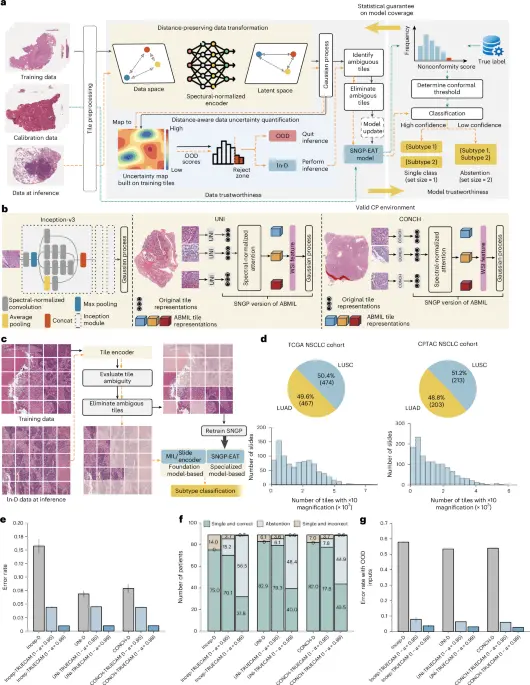
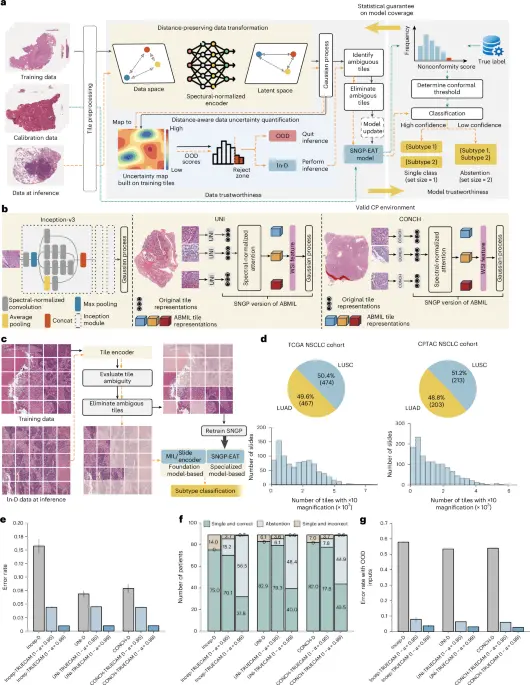
To resolve these pressing vulnerabilities, an international research team has developed TRUECAM (TRustworthiness-focused, Uncertainty-aware, End-to-end CAncer diagnosis with Model-agnostic capabilities). Published in Nature Biomedical Engineering, TRUECAM represents a major leap forward: a formal, mathematically principled, and scalable framework designed to wrap around diverse deep learning architectures, transforming black-box predictions into transparent, statistically guaranteed, and clinically actionable decisions. Tested extensively across more than 20,000 whole-slide images (WSIs)—including multi-institutional non-small-cell lung cancer (NSCLC) cohorts and a 46-class pan-cancer classification benchmark—TRUECAM dramatically reduces error rates, identifies out-of-domain (OOD) inputs, filters ambiguous tissue regions, and provides rigorous error-rate guarantees.
Detailed Chronology & Technical Architecture
The development of TRUECAM addresses three core failures historically associated with medical AI: poor uncertainty quantification, susceptibility to out-of-domain data drift, and the inclusion of noisy, uninformative training signals. To systematically rectify these issues, the researchers constructed TRUECAM as a tri-partite modular architecture that harmonizes data trustworthiness and model trustworthiness.
1. Spectral-Normalized Neural Gaussian Processes (SNGP)
Traditional neural networks struggle with "feature collapse," a phenomenon where out-of-domain or ambiguous inputs are improperly mapped to nearby representations in the latent feature space, generating inflated and unearned confidence scores. TRUECAM integrates a spectral-normalized neural Gaussian process as its foundational feature extractor.
By applying spectral normalization to the network’s hidden weights, the model satisfies a strict bi-Lipschitz condition. This mathematical constraint ensures that distances in the latent space faithfully reflect true geometric distances in the original input data space. Replacing the traditional dense output layer with a Gaussian process approximation (via random Fourier features) allows the model to compute robust, distance-aware uncertainty estimates in a single forward pass—avoiding the prohibitive computational overhead of ensemble-based methods.
2. Elimination of Ambiguous Tiles (EAT)
Digital pathology workflows typically process massive gigapixel whole-slide images by chopping them into hundreds or thousands of smaller tiles, which are then assigned coarse-grained slide-level labels for training. This weakly supervised paradigm inherently injects noise: normal, inflamed, or necrotic tissue tiles are frequently mislabelled as tumors, diluting the supervisory signal.
TRUECAM introduces the Elimination of Ambiguous Tiles (EAT) mechanism. Using $k$-means clustering on SNGP-derived latent representations, the framework evaluates subtype heterogeneity via label assignment entropy. Tiles residing in clusters with high ambiguity—representing non-neoplastic stroma, inflammation, or poorly differentiated regions—are systematically purged from the training and inference pipelines.
Remarkably, EAT exemplifies the "less data, better performance" data-centric AI paradigm. By discarding up to 66% of uninformative tiles, EAT sharpens the supervisory signal, enhances classification accuracy, drastically reduces computational inference burdens, and aligns machine learning attention maps closely with expert pathologist annotations.
3. Conformal Prediction (CP) and Conformal Risk Control (CRC)
While SNGP quantifies uncertainty and EAT filters noisy data, TRUECAM employs Conformal Prediction (CP) to calibrate model outputs and provide a rigorous statistical guarantee on error rates. Rather than forcing a definitive, potentially incorrect diagnosis, CP generates a "prediction set" of likely subtypes (e.g., a set size of 2 indicates an uncertain classification).
By leveraging a calibration dataset separate from training, CP guarantees that the true cancer subtype will be captured within the prediction set at a user-specified coverage level ($1 – alpha$), such as 95% or 99%. When the model lacks sufficient confidence, TRUECAM proactively abstains from rendering a definitive answer, deferring the ambiguous or challenging case to human pathologists. Furthermore, to guard against uncaptured distribution shifts during deployment, TRUECAM pairs CP with Conformal Risk Control (CRC), dynamically adjusting thresholds to maintain valid empirical coverage even when OOD-to-In-Domain data ratios fluctuate wildly.
Supporting Context & Performance Metrics
The efficacy, generalizability, and scalability of TRUECAM were rigorously validated across multiple publicly available and private datasets comprising over 20,000 WSIs. Evaluations spanned specialized models (such as Inception-v3) and state-of-the-art computational pathology foundation models (UNI, CONCH, Prov-GigaPath, and TITAN) paired with advanced multiple instance learning (MIL) algorithms.
Subtyping Accuracy and Error Reduction
In binary NSCLC subtyping tasks distinguishing lung adenocarcinoma (LUAD) from lung squamous cell carcinoma (LUSC) across The Cancer Genome Atlas (TCGA) and the Clinical Proteomic Tumor Analysis Consortium (CPTAC) datasets, TRUECAM-wrapped models achieved striking reductions in error rates:
- When integrated with Inception-v3 at target coverages of $1 – alpha = 0.95$ and $1 – alpha = 0.99$, TRUECAM reduced patient-level error rates by 72.0% and 93.8%, respectively.
- When paired with foundation models like UNI and CONCH, TRUECAM-enhanced architectures consistently outperformed their deterministic baselines, lowering error rates by over 10% even prior to conformal activation.
- In real-world clinical simulations involving a 1:1 mix of in-domain and OOD (non-cancerous lung tissue) inputs, standard deterministic models frequently misclassified normal tissue as cancer. In contrast, TRUECAM reliably intercepted and filtered out OOD inputs before inference while maintaining pristine in-domain performance.
Fairness and Demographic Equity
Medical AI models often exhibit performance disparities across patient demographic groups. TRUECAM demonstrated a profound capacity to enhance fairness without requiring explicit demographic constraints during training.
Evaluated across racial and sexual subgroups, conformalized SNGP-EAT achieved the smallest accuracy gaps and prediction set size discrepancies. At a confidence level of 0.90, TRUECAM reduced racial set-size gaps by up to 42.2% on TCGA and 27.4% on CPTAC, while cutting sex-wise gaps by over 50% to 73%, driving equity metrics close to parity.
Interpretability and Computational Efficiency
Pathology AI adoption relies heavily on clinician trust. TRUECAM provides dual-layer interpretability: tile-level ambiguity filtering followed by attention mapping on high-value diagnostic regions. Blinded pathologist evaluations confirmed that TRUECAM’s low-ambiguity, high-attention regions directly corresponded to established morphological criteria—such as acinar patterns in LUAD and intercellular bridges or keratinization in LUSC.
Computationally, SNGP avoids the heavy inference penalties of Monte Carlo dropout, executing at speeds comparable to deterministic networks. Combined with EAT’s purging of redundant tiles, TRUECAM slashed slide-level inference computation by up to several orders of magnitude, making real-time deployment feasible in resource-constrained medical settings.
Official Statements and Research Implications
The introduction of TRUECAM marks a philosophical shift in how medical artificial intelligence is conceptualized, moving away from rigid, overconfident automation toward collaborative, uncertainty-aware partnership.
"The reliability of medical AI models can be non-trivially compromised by their inherent limitations, such as weak ability in measuring uncertainty and controlling error rates," the researchers noted in their study. "By decomposing the trustworthiness of medical AI into data trustworthiness and model trustworthiness, TRUECAM ensures that AI functions as a reliable assistant rather than an inflexible tool, complementing clinical workflows while mitigating automation bias."
Experts in computational pathology and clinical machine learning have praised the framework’s methodological rigor. By combining distance-aware representation learning with distribution-free conformal prediction, TRUECAM bridges the gap between theoretical machine learning guarantees and messy, real-world clinical pathology environments. The framework’s ability to gracefully abstain on difficult cases reduces cognitive fatigue for pathologists, ensuring that expert human oversight is concentrated precisely where it is most needed.
Future Outlook
While TRUECAM establishes a robust benchmark for trustworthy computational pathology, the research team outlines several key avenues for future investigation:
- Adoption in Conversational and Generative AI Assistants: As medicine transitions toward interactive, vision-language generalist medical AI assistants, integrating TRUECAM’s uncertainty-quantification and risk-control layers into conversational diagnostic tools will be vital for maintaining clinical safety.
- Systematic Distribution Shift Mapping: Although TRUECAM successfully mitigates performance degradation via distribution shift control (DSC), further research is required to root-cause specific inter-institutional variations, staining protocols, and scanner-induced artifacts.
- Hierarchical Tissue Subtyping: Expanding TRUECAM beyond binary and flat multi-class tasks into complex, multi-level decision trees—moving from broad tissue classification down to molecular and genetic subtyping—will test the framework’s ability to prevent error propagation across cascading nodes.
- Prospective Human-in-the-Loop Trials: The ultimate validation of TRUECAM will require prospective clinical deployment. Future studies must examine how pathologists interact with TRUECAM’s abstention triggers and error-bounded prediction sets in real-time hospital environments, measuring direct impacts on diagnostic turnaround times, inter-observer variability, and patient outcomes.
Ultimately, TRUECAM provides a scalable, extensible blueprint for the next generation of medical AI. By treating uncertainty not as a flaw to be hidden, but as critical clinical metadata to be quantified and controlled, TRUECAM paves the way for responsible, safe, and widely trusted clinical AI integration.