











Executive Overview
In the high-stakes environments of intensive care units (ICUs) and operating rooms, seconds matter, and precision is paramount. For decades, clinicians managing critically ill patients have faced an invisible adversary: the limitations of conventional hemodynamic monitoring. While traditional intermittent arm cuffs and invasive arterial lines have served as the foundational tools of modern medicine, they come with significant clinical trade-offs. Intermittent cuffs offer only sporadic snapshots of a patient’s blood pressure, often leaving dangerous gaps during rapidly evolving hemodynamic crises, whereas invasive arterial lines carry risks of infection, thrombosis, and nerve damage.
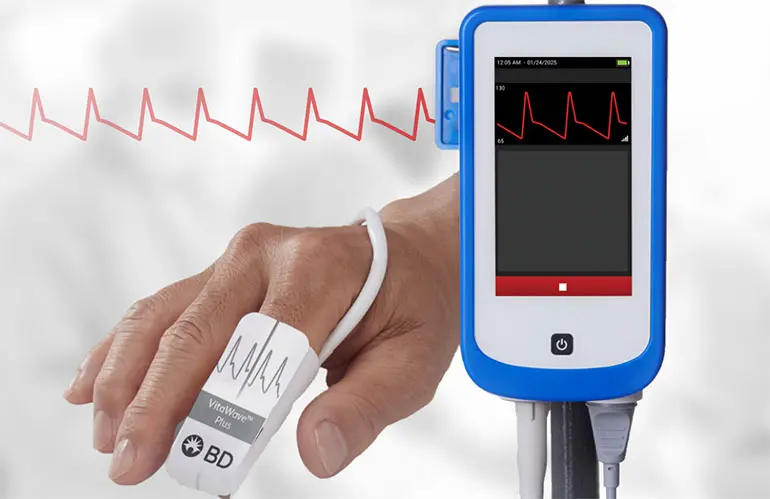
Enter Becton, Dickinson and Co. (BD), a global medical technology leader aiming to fundamentally transform this paradigm. Under the leadership of Tim Patz, Worldwide President of BD’s Advanced Patient Monitoring business, the company has introduced a groundbreaking solution designed to bridge the historical divide between invasive accuracy and noninvasive convenience: the HemoSphere Stream Module and its accompanying VitaWave Plus finger cuff.
This cutting-edge platform provides real-time, beat-to-beat arterial waveform and hemodynamic data noninvasively, bypassing the need for an arterial line while significantly outperforming the error margins of standard arm cuffs. By enabling continuous physiological tracking from the moment a patient is admitted or wheeled into surgery all the way through to discharge, BD is positioning itself at the vanguard of a new era in patient safety and clinical decision-making.
This article explores the engineering marvel behind the HemoSphere Stream Module, the critical healthcare challenges it addresses, the leadership vision driving BD’s Advanced Patient Monitoring division, and what the future holds for continuous, noninvasive acute care technology.
Detailed Chronology: The Evolution of BD’s Advanced Patient Monitoring
To understand the magnitude of BD’s latest launch, it is necessary to examine the trajectory of hemodynamic monitoring and the strategic evolution that brought the company to this milestone.
The Legacy of Acute Care Limitations
For the better part of half a century, the medical community has relied on technologies that were revolutionary for their time but have failed to keep pace with modern physiological demands. The standard pneumatic arm cuff—invented generations ago—remains a staple of clinical practice. However, clinical literature consistently highlights a glaring vulnerability: intermittent arm cuffs in acute care settings can exhibit a margin of error or bias of up to $pm 30%$.
For a stable outpatient, a margin of error of this scale might be manageable. But for a patient undergoing major surgery, experiencing septic shock, or recovering from acute trauma, a 30% blind spot in blood pressure readings can lead to delayed interventions, misdirected pharmacological therapies, and compromised clinical outcomes.
Conversely, the gold standard for continuous tracking has been the invasive arterial catheter (A-line). While A-lines provide real-time, beat-to-beat waveforms, they are inherently invasive, requiring skilled placement, continuous maintenance, and exposing the patient to potential complications such as vascular trauma, bleeding, and localized or systemic infections. Furthermore, A-lines are rarely practical or justifiable outside of the ICU or operating room, leaving patients in general wards or emergency departments vulnerable during inter-departmental transfers.
The Conception of the HemoSphere Stream Module
Recognizing these clinical gaps, BD’s Advanced Patient Monitoring team embarked on a mission to engineer a device that could deliver the continuous, beat-to-beat fidelity of an arterial line without the invasive risks, while simultaneously dismantling the high error rates associated with legacy arm cuffs.
The result of this extensive research and development cycle is the HemoSphere Stream Module. Designed to integrate seamlessly into existing hospital infrastructures, the system utilizes advanced photoplethysmography and vessel-unloading techniques housed within the ergonomic VitaWave Plus finger cuff. By continuously measuring arterial volume changes in the finger, the device translates optical data into a high-fidelity, real-time arterial waveform displayed directly to the clinical team.
Strategic Launch and Market Integration
BD’s commercial rollout of the HemoSphere Stream Module represents more than just a new product launch; it represents a strategic pivot toward ecosystem interoperability. Rather than forcing cash-strapped hospitals to purchase entirely new proprietary monitor networks for every department, BD engineered the Stream Module to be universally agile. By connecting via simple cables to a wide range of pre-existing bedside monitors across various brands and configurations, the technology democratizes high-acuity monitoring. Whether a patient is in the emergency department, a surgical suite, or a step-down unit, clinicians can now access continuous hemodynamic data without procuring specialized infrastructure.

Supporting Context & Metrics: The Clinical Case for Continuous Monitoring
To fully appreciate the clinical value proposition of the HemoSphere Stream Module, one must examine the quantitative realities of acute care medicine and the systemic costs of intermittent monitoring.
The Hidden Dangers of the 30% Margin of Error
Clinical literature is rich with studies documenting the physiological drift and measurement discrepancies inherent in traditional noninvasive blood pressure (NIBP) cuffs when applied to critically ill populations. Vasoconstriction, peripheral edema, arrhythmias, and rapid hemodynamic shifts—common hallmarks of patients in shock or under general anesthesia—frequently confound standard cuff algorithms.
When a clinician relies on a blood pressure reading that deviates by up to 30% from the patient’s true arterial pressure, the downstream treatment decisions are inherently flawed. Administering vasoactive medications, fluid boluses, or antihypertensives based on inaccurate data can precipitate severe adverse events, including:
- Iatrogenic Hypotension: Overcorrecting for artificially elevated readings or failing to recognize sudden drops in perfusion pressure.
- Organ Hypoperfusion: Unrecognized periods of low mean arterial pressure (MAP) that contribute to acute kidney injury (AKI), myocardial infarction, or ischemic stroke.
- Prolonged Length of Stay (LOS): Suboptimal hemodynamic management directly correlates with delayed recovery times, extended ICU stays, and increased overall healthcare expenditures.
The Economic and Operational Burden
Beyond patient safety, hospitals face mounting pressures to optimize throughput and reduce resource utilization. Invasive lines require dedicated sterile placement procedures, nursing time for maintenance, and specialized disposal protocols. When complications arise from invasive lines, hospital liability and care costs escalate sharply.
By offering a noninvasive alternative that matches the continuous data density of invasive lines, BD’s technology addresses both clinical and economic imperatives. Continuous beat-to-beat monitoring allows clinicians to detect hemodynamic instability before overt clinical symptoms manifest, shifting the care paradigm from reactive rescue to proactive prevention.
Official Statements and Leadership Vision
In an exclusive interview with Medical Design & Outsourcing, Tim Patz, Worldwide President of BD’s Advanced Patient Monitoring business, articulated the philosophical and operational core driving the company’s innovation pipeline.
Putting the Patient and Clinician First
When asked to describe the overarching mission of the Advanced Patient Monitoring team, Patz emphasized a deeply human-centric philosophy:
"Big picture, what we do is help clinicians identify what’s going on with the patient. A lot of our patients are either sick in the ICU or they’re under anesthesia in the operating room. Whether it’s hemodynamics or advanced physiology, we provide information to clinicians so they can get patients through this care pathway faster. The information helps you make treatment decisions. The treatment decisions then impact the care. We’re a very patient-focused group. Ultimately, our endgame is to get information to clinicians and improve patient outcomes. Then we celebrate those patients, we get great patient stories and we have a lot of culture built around that."
Disrupting Decades-Old Technology
Addressing the genesis of the HemoSphere Stream Module, Patz did not shy away from critiquing the status quo of medical device evolution. He highlighted the stark contrast between modern computational capabilities and the archaic nature of standard blood pressure measurement:
"When you see the data from traditional blood pressure monitoring, it’s not great. In general, the arm cuff in an acute care patient has probably plus or minus 30% [margin of error/bias], so you can imagine. Our core principle is that we provide information that inevitably will lead to better treatment. If you’re starting with the basis that the information a physician or nurse is getting is 30% off, you have a risk to patients that you could be making a treatment decision that actually is not in line with the numbers that are really happening to those patients… This is widely published within different journals, these error rates."
Patz contextualized this within the broader timeline of medical device engineering:

"We are not trying to bash the technology, but it is a technology that is close to 40, 50 years old. Arm cuff technology is one of the oldest technologies in our space. I think it’s a natural evolution that these products should evolve over time."
Solving the Interoperability Challenge
A major hurdle in modern hospital administration is the "siloing" of medical equipment across departments. Patz explained how the HemoSphere Stream Module was specifically engineered to overcome this logistical barrier:
"The second piece is whether you’re in an emergency room bed, general ward or the operating room, there are different monitors in all these different rooms. Sometimes you don’t have access to the monitoring that’s required to have that high level of care. Stream is unique because it’ll plug into a wide range of compatible bedside monitors, across different brands and configurations, just via cable. It doesn’t require you to have any special connections. Stream is really using the monitoring that exists within any care space. It gives you that continuous need, but also that ability to be agile in the hospital environment you’re in."
Future Outlook: The Continuum of Care and Next-Gen Monitoring
As Becton, Dickinson and Co. continues to roll out the HemoSphere Stream Module and VitaWave Plus finger cuff, the horizon for advanced patient monitoring is expanding rapidly. Tim Patz’s ultimate vision—establishing a seamless continuum of continuous monitoring that follows the patient from the moment of admission or surgery all the way to discharge—is no longer a distant theoretical goal; it is actively taking shape.
Expanding Beyond Acute Care Walls
While ICUs and operating rooms have been the traditional beachheads for high-acuity monitoring, the future points toward the decentralization of critical care. As hospital systems face nursing shortages and capacity constraints, patient monitoring is increasingly extending into step-down units, emergency holding areas, and specialized procedural suites.
Technologies like the HemoSphere Stream Module serve as the foundational building blocks for this transition. By removing the technical barriers associated with invasive lines and proprietary hardware, BD is enabling hospitals to elevate the standard of care across a much broader footprint.
The Role of Data Analytics and Predictive AI
Looking further ahead, the generation of continuous, beat-to-beat arterial waveform data opens the door to advanced artificial intelligence and predictive analytics. When millions of data points are streamed in real-time from devices like the VitaWave Plus cuff, machine learning algorithms can be trained to recognize subtle physiological precursors to catastrophic events—such as hypovolemic shock, sepsis, or respiratory decompensation—long before human eyes can detect visual trends on a monitor.
BD’s hardware innovations are uniquely positioned to feed these next-generation software platforms, creating a closed-loop ecosystem where data is not merely displayed, but intelligently interpreted to guide clinical interventions proactively.
Conclusion
The launch of the BD HemoSphere Stream Module and VitaWave Plus finger cuff marks a watershed moment in medical technology. By confronting the 40-year-old limitations of traditional arm cuffs and eliminating the inherent dangers of unnecessary invasive lines, Becton, Dickinson and Co. has redefined what is possible in noninvasive continuous monitoring. Under visionary leadership and with an unwavering commitment to patient outcomes, BD is successfully turning the aspiration of continuous, hospital-wide physiological tracking into a tangible reality for clinicians and patients alike.