Inside Johnson & Johnson’s Ottava: Engineering the Future of Soft-Tissue Surgical Robotics
Executive Overview
Following a landmark FDA de novo authorization, Johnson & Johnson MedTech officially unveiled its next-generation surgical platform, the Ottava system, at the Society of Robotic Surgery (SRS) annual meeting. Representing the world’s first table-integrated soft-tissue robotic architecture, Ottava is poised to redefine the limits of minimally invasive surgery.
Behind this monumental launch is an intricate narrative of technological triumph, cross-disciplinary systems engineering, and visionary design choices. In an exclusive interview with Medical Design & Outsourcing, Neda Cvijetic, J&J MedTech’s Global Head of Robotics & Digital R&D, pulled back the curtain on the multi-year development cycle of Ottava. From overcoming the physical paradox of stowing complex robotic arms beneath an operating table to integrating a comprehensive digital ecosystem, the Ottava platform signals a paradigm shift in how surgical suites operate.
This deep dive explores the engineering feats, sensor suites, modular software ecosystems, acoustic innovations, and future roadmaps that underpin Johnson & Johnson’s ambitious entry into the surgical robotics market.
Detailed Chronology and Product Development Journey
The path from conceptual blueprint to regulatory clearance was neither linear nor straightforward. Developing a category-defining technology of this magnitude demanded unprecedented ingenuity, steadfast determination, disciplined program management, and functional excellence across every single engineering discipline.
The Table-Mounted Paradigm Shift
Traditional surgical robots rely on floor-standing columns or cart-based systems that consume valuable square footage in already cramped operating rooms (ORs). J&J MedTech’s engineering teams sought to eliminate this spatial inefficiency by anchoring the robotic infrastructure directly into the surgical table itself.
However, this architectural choice introduced a staggering engineering paradox: how to simultaneously achieve full stowage of the multi-jointed robotic arms completely underneath the operating table while ensuring they could deploy with the exact reach, range of motion, and clinical access required for complex soft-tissue procedures.
Solving this conundrum required simultaneous innovations across mechanical, electrical, human factors, and software engineering stacks. The teams had to rethink spatial kinematics, joint sizing, material science, and collision-avoidance algorithms. The result is a seamless transition from a standard operating table to a sophisticated, fully articulated surgical platform at the push of a button.
Supporting Context & Metrics: Architecture and Digital Ecosystems
Motorization and Spatial Intelligence
To transform the physical limitations of a table-mounted arm into a clinical advantage, J&J MedTech made a pivotal architectural decision: every single joint on every robotic arm was built from the ground up to be fully motorized.
Beyond simply executing movement, these motorized joints are embedded with advanced, high-precision sensors. These sensors provide the system with continuous spatial awareness, allowing the arms to compute their precise positions relative to each other, the surgical table, and the patient’s anatomy in real time.
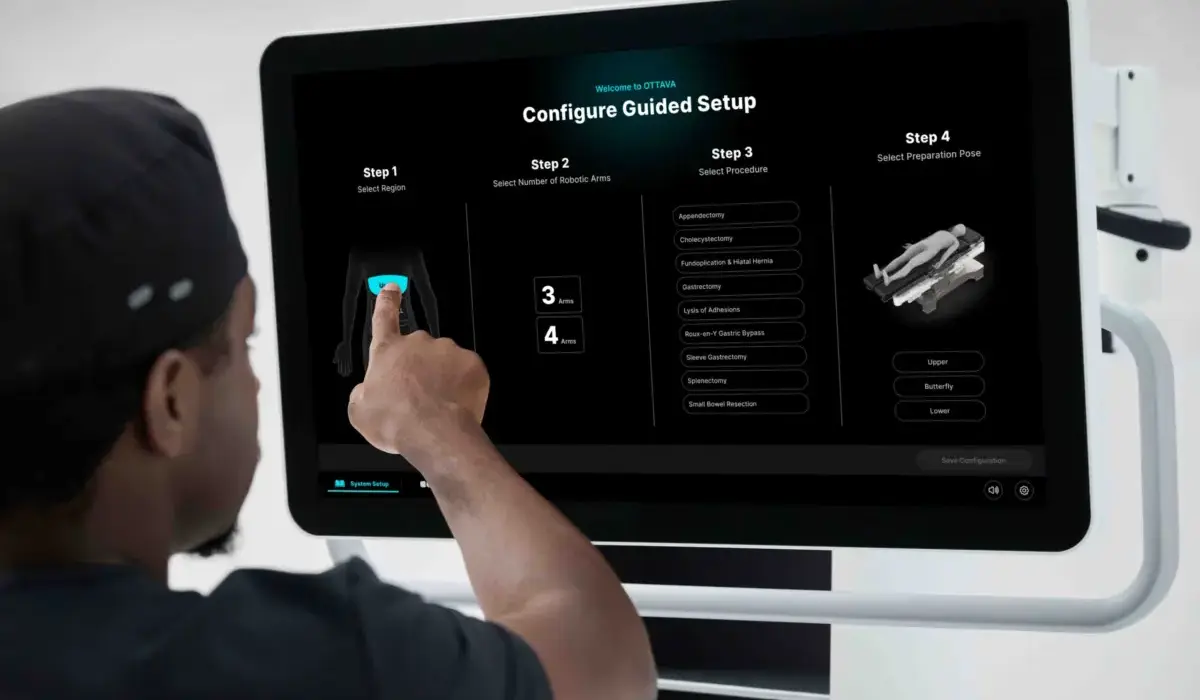
This spatial awareness serves as the foundation for Ottava’s automated capabilities. Rather than forcing surgical teams through cumbersome manual adjustments, Ottava features predefined procedure poses. At the push of a button, the system autonomously deploys and configures its arms into optimal configurations for patient setup, specific procedural steps, or final teardown. Furthermore, this hardware-software co-design ensures that Ottava is primed for a continuous cadence of rapid, over-the-air software updates, expanding its functional repertoire long after initial installation.
The Polyphonic Digital Ecosystem
Modern surgery generates an unprecedented volume of data, yet clinicians have historically struggled to access, curate, and analyze it effectively. Ottava integrates natively into J&J’s Polyphonic digital ecosystem, bridging the gap between hardware execution and data analytics.
Polyphonic serves as an open architecture that connects Ottava’s telemetry, video feeds, and procedural insights alongside existing J&J technologies like the Monarch platform—and crucially, third-party medical devices. The system captures synchronized case videos, operational metrics, and robotic logs, providing surgeons and researchers with post-operative access for independent review, qualitative analysis, and clinical research.
Instrumentation and Haptic Capabilities
Instrument choice remains a cornerstone of surgical success. J&J MedTech plans to integrate its vast, clinically proven Ethicon portfolio directly into the Ottava ecosystem, ensuring surgeons have access to the advanced energy and mechanical cutting tools they already trust.
Regarding force feedback and haptics, the debate within the surgical robotics community remains vibrant. While some argue that direct force feedback is essential for tissue discrimination, others rely on high-definition visualization and visual cues. Cvijetic noted that J&J actively listens to its clinical users to weigh these priorities against other prevailing OR challenges. Crucially, the Ottava hardware platform has been engineered with the inherent capability to incorporate advanced haptic feedback modules in future iterations as clinical consensus and technology mature.
Acoustic Engineering in the Operating Room
Operating rooms are notoriously high-stress, noisy environments filled with beeping monitors, clattering instruments, and verbal communication strains. To combat this cognitive load, J&J’s engineering team collaborated with expert sound designers to craft a unique auditory profile for the Ottava system.
Rather than jarring mechanical whirs or alarming warning tones, Ottava utilizes calming, reassuring soundscapes during its operations. Cvijetic describes the ambient audio profile as instilling confidence in the clinical team—likening the soothing, high-tech auditory experience to that of a luxury spa, designed explicitly to lower cortisol levels and foster a serene environment for high-stakes procedures.
Official Statements and Industry Insights
In her interview with Medical Design & Outsourcing, Neda Cvijetic emphasized the collaborative and pioneering nature of the FDA de novo clearance:
"These teams have built a category-defining, soft-tissue surgical robot, and our regulatory pathway is a testament to that. There is no precedent here… A category-defining path on something so sophisticated and technologically complex, it’s never a purely linear path. It took ingenuity to solve these problems that are unprecedented, it took determination, discipline, commitment, functional excellence in every single area of engineering."
Highlighting the foresight behind the system’s motorized architecture, Cvijetic added:
"That design decision to not only design for stowage and for reach and access, but for motorization, for spatial awareness, gives us the ability to create over time a cadence of differentiated software releases that are very compelling."
On the philosophy of human-centered design—spanning automation, data ecosystems, and acoustic engineering—Cvijetic concluded:
"For us, no matter the type of technology — whether it’s automation, digital ecosystem, or sound — it’s about empowering that human clinical expert in the OR. Sound can be very soothing for humans… I would describe it as a calming, reassuring sound that instills confidence in our system… To me, it sounds like a very soothing, high-tech spa."
Future Outlook
The commercial rollout of the Ottava surgical robotics system marks a monumental turning point for Johnson & Johnson MedTech, solidifying its position as an innovation leader in digital surgery. By successfully marrying a space-saving, table-integrated mechanical design with a robust, open-architecture data ecosystem (Polyphonic) and human-centric design features like soothing acoustic profiles, J&J has set a new benchmark for what a surgical robot can achieve.
As Ottava enters clinical practice following its SRS debut, the medical device industry will be watching closely. With a scalable architecture built for continuous software enhancement, native integration of the Ethicon instrument pipeline, and future-proofed hardware ready for advanced haptic integrations, Ottava is not just a tool for today’s operating room—it is an extensible platform engineered to evolve alongside the needs of modern surgery for decades to come.