






Executive Overview
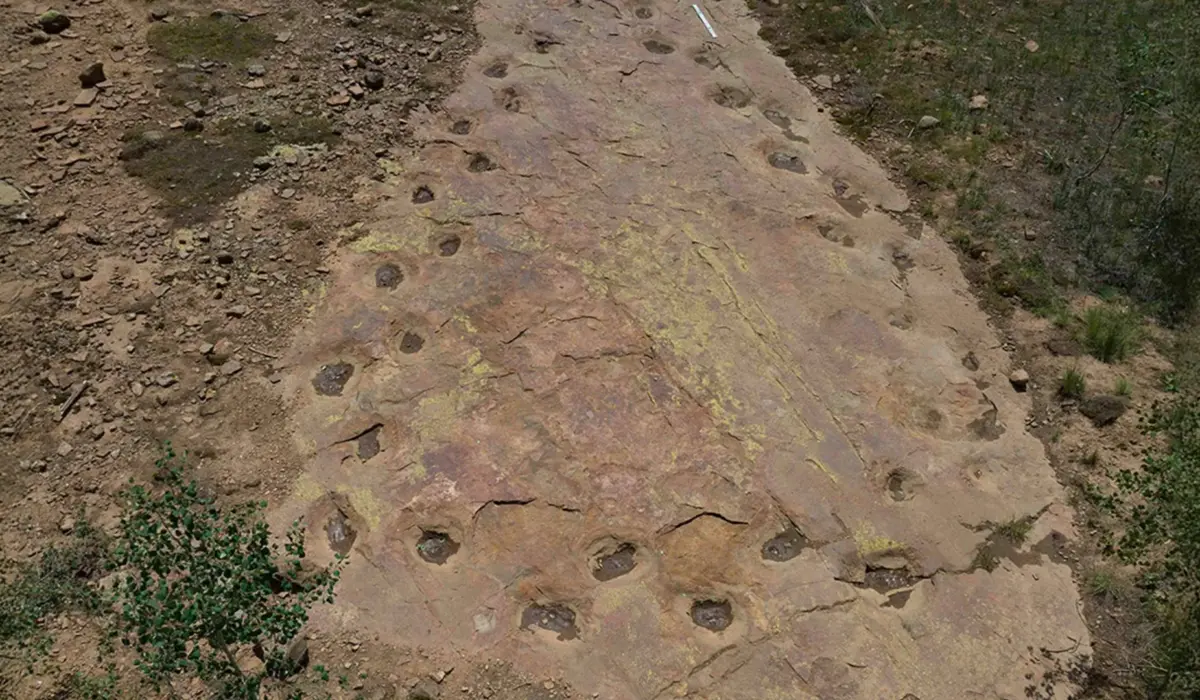
Deep within the rugged terrain of southwestern Colorado, near the historic mountain town of Ouray, a remarkable prehistoric ghost story is etched into the stone. Paleontologists have completed a comprehensive investigation of a rare, continuous, and tightly curving trail of fossilized sauropod footprints that offers an unprecedented, highly intimate look at the locomotive behavior of a colossal dinosaur that lived 150 million years ago.
Dating back to the Late Jurassic epoch, the discovery—situated at the expansive West Gold Hill Dinosaur Tracksite—presents a rare complete loop left behind by a titanic long-necked herbivore, likely a relative of the iconic Diplodocus or Camarasaurus. While animal tracks are frequently found in ancient sedimentary layers across the globe, trackways that curve completely back upon themselves are extraordinarily rare. This twisting prehistoric path has allowed an international team of researchers not only to visualize how a multi-ton creature executed a sharp, 360-degree navigational turn, but also to uncover subtle, highly personal details of its movement, including an asymmetric stride that hints at a lifelong or temporary limp.
The scientific breakthrough was made possible by merging traditional field paleontology with cutting-edge aerial technology. Because the West Gold Hill site spans a massive, difficult-to-navigate area of steep terrain, ground-level analysis alone proved insufficient to capture the true scope of the trail. By deploying high-resolution drones, researchers mapped the more than 130 footprints across the 95.5-meter (approx. 313 feet) trackway, translating them into a millimeter-accurate 3D digital model. This technological synthesis has opened a new window into trace fossil analysis, proving that long-form trackways can preserve nuanced behavioral and physiological data—such as shifting step widths and limb asymmetries—that shorter, fragmented trackways invariably miss. Supported by the U.S. Forest Service, this study fundamentally changes how paleontologists decode the dynamic, everyday lives of Earth’s largest-ever land-dwelling animals.
Detailed Chronology: Unearthing and Decoding the West Gold Hill Loop
The Late Jurassic Landscape: Setting the Stage
To understand the significance of the Ouray trackway, scientists must first reconstruct the environment in which it was formed. Some 150 million years ago, during the Late Jurassic, the American West bore little resemblance to its current topography. Instead of arid deserts and jagged mountain peaks, the region was characterized by vast, sprawling floodplains, meandering river systems, and lush, humid forests dominated by conifers, tree ferns, and ginkgoes.
This verdant ecosystem supported an extraordinary diversity of megafauna, most notably the sauropods—towering herbivores whose body plans defied modern biological expectations. Weighing tens of tons and stretching longer than modern semi-trucks, animals like Diplodocus, Apatosaurus, and Camarasaurus moved through these environments in herds or as solitary foragers, leaving behind massive bones, teeth, and, on rare occasions, the ephemeral impressions of their footsteps.
The mud or fine-grained sand along an ancient watercourse near Ouray captured one such moment. As the giant dinosaur traversed the damp sediment, its massive pillar-like feet compressed the layers beneath it. Through a fortuitous sequence of geological events—rapid drying, gentle sedimentation, and eventual lithification—these impressions were preserved in stone, waiting millions of years for modern instruments to reveal their secrets.
The Challenge of Scale: Approaching the Tracksite
Despite the scientific richness of the West Gold Hill Dinosaur Tracksite, studying it presented formidable obstacles. The sheer size of the footprint trail, stretching over 95 meters and winding across uneven, elevated terrain, made comprehensive documentation from the ground nearly impossible. Researchers attempting to map the trail by hand faced severe visual distortions caused by perspective, steep drop-offs, and the sheer scale of the footprints, which made it difficult to see how individual left and right tracks related to one another over long distances.
Recognizing the need for a paradigm shift in data collection, the research team—led by Dr. Anthony Romilio of The University of Queensland’s Dinosaur Lab and co-authored by Dr. Paul Murphey of the San Diego Natural History Museum—turned to aerial photogrammetry.
The Drone Revolution and 3D Virtual Reconstruction
In recent years, drone technology has revolutionized paleontology and archaeology, allowing researchers to survey inaccessible or sprawling sites with unprecedented fidelity. At West Gold Hill, the team utilized unmanned aerial vehicles to systematically photograph the entire trackway from above, capturing hundreds of overlapping, high-resolution images.
In the laboratory, these aerial images were processed using specialized software to construct a precise, millimeter-accurate three-dimensional virtual model of the entire 95.5-meter trackway. This digital twin allowed Dr. Romilio, Dr. Murphey, and their colleagues to manipulate the data, view the footprints from impossible camera angles, and trace the dinosaur’s precise trajectory without risking damage to the fossilized surface or the safety of the researchers on treacherous ground.
The digital reconstruction immediately yielded a clear narrative. The animal began its journey moving toward the northeast, maintaining a steady, albeit massive, forward momentum. Then, for reasons lost to time, it initiated a sweeping, continuous turn, curving back upon itself in a full loop before straightening out and continuing onward in its original northeastern direction. Within this geometrical anomaly lay a treasure trove of biomechanical data.
Supporting Context & Metrics: Biomechanics, Shifting Strides, and the Limp Hypothesis
Deconstructing the Sauropod Turn
Executing a tight, looping turn is a complex physical challenge for any animal, but for a quadrupedal sauropod weighing upwards of 20 to 40 metric tons, the physics of turning are staggering. Centrifugal forces, joint stress, and the sheer inertia of a massive body require careful coordination of all four limbs.
The Ouray trackway preserves the exact kinematic strategy this giant used to navigate the bend. By analyzing the sequence of more than 130 footprints, the researchers observed how the animal adjusted its inner and outer limbs during the arc. The loop is one of the most continuous and tightly curved sauropod footprint trails ever documented in the global fossil record, offering a rare empirical test for biomechanical models that previously had to rely entirely on computer simulations or theoretical anatomy.
The Myth of Uniform Step Widths
Beyond the curve itself, the high-resolution 3D model allowed the team to analyze subtle variations in the dinosaur’s gait throughout the 95-meter journey. One of the most significant methodological takeaways from the study involves the spacing between the left and right footprints—a metric paleontologists use to reconstruct animal locomotion and body posture.
The team discovered a distinct and pronounced variation in trackway width:
- Narrow Stride Segments: In certain portions of the trail, the left and right footprints were placed relatively close together along the midline, reflecting a narrow-gauge walking style typical of certain sauropods.
- Wide Stride Segments: As the dinosaur moved through other sections, the lateral distance between the left and right feet expanded dramatically, creating a distinctly wide-gauge footprint pattern.
This discovery carries profound implications for trace fossil research. Historically, when paleontologists discovered short segments of fossilized trackways—spanning just a few meters—they often assumed that the measured footprint width remained constant throughout the animal’s journey, characterizing the species by that single snapshot. The Ouray data proves this assumption dangerously misleading. A sauropod’s step placement can change naturally and dynamically as it navigates turns, changes speed, or responds to varying terrain, meaning short trackway samples can easily produce false conclusions about an animal’s standard walking style.
The 10-Centimeter Mystery: Evidence of a Prehistoric Injury?
Perhaps the most intriguing biological detail unearthed during the analysis was a persistent asymmetry in the dinosaur’s stride. When measuring the distance between consecutive footprints, the researchers detected a small but consistent discrepancy between the lengths of the left and right steps, averaging about 10 centimeters (approximately 4 inches).
This 4-inch difference was not a random aberration; it persisted reliably across the trackway, raising an enticing clinical and behavioral question: Did this 150-million-year-old giant walk with a limp?
In modern biometrics, asymmetric step lengths in quadrupeds are classic indicators of musculoskeletal impairment, such as joint pain, arthritis, soft-tissue injury, or a healed fracture in a limb or foot. If a sauropod experiences pain or stiffness in a specific leg, it will often shorten its stride on the affected side to minimize discomfort, simultaneously lengthening the stride of the healthy limb to maintain momentum.
However, scientists remain appropriately cautious. While a limp is a compelling and mathematically supported interpretation, alternative explanations exist. The asymmetry could reflect a behavioral quirk, a slight functional preference for one side over the other (akin to human handedness or footedness), or subtle adaptations to uneven ground conditions during the turn. Nevertheless, the ability to detect a 10-centimeter variation in a creature weighing dozens of tons highlights the staggering analytical power of modern ichnology (the study of fossilized tracks and traces).
Official Statements and Expert Insights
The significance of the West Gold Hill discovery has resonated throughout the global paleontological community, highlighting the power of interdisciplinary collaboration between field scientists and technological innovators.
Reflecting on the unique nature of the trackway, Dr. Anthony Romilio of The University of Queensland’s Dinosaur Lab emphasized the rarity of capturing a dinosaur mid-turn:
"This was left in the Late Jurassic when long-necked dinosaurs such as Diplodocus and Camarasaurus roamed North America," Dr. Romilio stated. "This trackway is unique because it is a complete loop. While we may never know why this dinosaur curved back on itself, the trackway preserves an extremely rare chance to study how a giant sauropod handled a tight, looping turn before resuming its original direction of travel."
Dr. Romilio also highlighted how the physical data shattered conventional assumptions about footprint analysis:
"One of the clearest patterns was a variation in the width between left and right footprints, shifting from quite narrow to distinctly wide. This shift from narrow to wide step placement shows that footprint width can change naturally as a dinosaur moves, meaning short trackway segments with seemingly consistent widths may give a misleading picture of its usual walking style."
Addressing the physiological mystery of the stride asymmetry, Dr. Romilio noted the careful line scientists must walk when interpreting ancient behavior:
"We also detected a small but persistent difference in left and right step lengths, of about 10 centimeters or 4 inches. Whether that reflects a limp or simply a preference for one side is hard to say."
Co-author Dr. Paul Murphey of the San Diego Natural History Museum underscored the logistical hurdles that necessitated the technological leap:
"It has been challenging to document these footprints from the ground because of the size of the trackway," Dr. Murphey explained, detailing the vastness of the West Gold Hill site.
Detailing the technical methodology that unlocked the site’s secrets, Dr. Murphey added:
"We used drones to capture the entire trackway in high resolution. With these images we generated a detailed 3D model, which could then be digitally analyzed in the lab at millimeter-scale accuracy."
The research project was conducted with the vital cooperation and administrative support of the U.S. Forest Service, reflecting a shared commitment to preserving and understanding America’s rich paleontological heritage on public lands.
Future Outlook: A New Standard for Trace Fossil Research
The successful analysis of the Ouray looping trackway marks a watershed moment for vertebrate ichnology. For decades, paleontologists have debated how massive sauropods moved, turned, and interacted with their environments, often forced to rely on fragmentary data or incomplete footprint trails that left significant gaps in the behavioral record.
The methodological framework established by Dr. Romilio, Dr. Murphey, and their team—combining aerial drone photogrammetry, high-resolution 3D modeling, and rigorous statistical analysis of stride metrics—offers a powerful new blueprint for researchers worldwide.
Expanding the Methodology Globally
Long dinosaur trackways exist on every continent, crisscrossing ancient sedimentary beds in places like Texas, Bolivia, Portugal, and Australia. Many of these extended trails have only been partially documented due to logistical constraints, rugged terrain, or financial limitations.
With the deployment of affordable, high-precision drone technology and advanced 3D rendering software, researchers now possess the tools to re-examine these global sites. By applying the Ouray protocols to other long trackways, scientists can begin to answer broader evolutionary and ecological questions:
- Herding Dynamics: Do multiple trackways in a single layer show coordinated turning behavior, indicating complex herd leadership or social structure?
- Pathological Prevalence: Just how common were injuries, limps, and joint pathologies among Late Jurassic megafauna? Systematic measurement of stride asymmetry across multiple trackways could reveal the frequency of predation attempts, intraspecific combat, or environmental hazards.
- Gait Plasticity: How did other dinosaur clades—such as bipedal theropods or armored ankylosaurs—manage sharp turns and changing substrates compared to massive sauropods?
Preserving Deep-Time Histories
As climate change, erosion, and human development continue to threaten exposed geological formations around the world, non-invasive digital documentation techniques like those used at West Gold Hill play a vital dual role. Not only do they unlock new scientific discoveries through millimeter-scale laboratory analysis, but they also create permanent, high-fidelity digital archives of fossil sites that may eventually succumb to natural weathering.
The 150-million-year-old loop near Ouray, Colorado, is far more than a geological curiosity. It is a dynamic, frozen moment in time—a tangible connection to an ancient world where a titanic creature traced a circle in the mud, leaving behind the hidden geometry of its journey and the subtle, poignant echo of an uneven step. Through the marriage of paleontology and modern technology, that ancient footprint trail has finally found its voice, inviting us to look closer at the deep past and reimagining how we understand the everyday lives of Earth’s greatest giants.