









Executive Overview
For generations, the popular imagination has been captivated by the sheer, staggering scale of the dinosaur kingdom. From the thunderous, earth-shaking footsteps of the towering Tyrannosaurus rex to the colossal, botanical-arch architecture of long-necked sauropods like Apatosaurus, these magnificent creatures are universally remembered as the titans of deep time. Yet, while paleontology has spent centuries analyzing the evolutionary pressures that birthed giants exceeding 80 tons, a profound and paradoxical question has lingered at the opposite end of the metric scale: Why did non-avian dinosaurs apparently never become truly small?
A groundbreaking study published in the journal Evolution upends conventional assumptions about prehistoric biology. Led by researchers from the American Museum of Natural History (AMNH) and Princeton University, the research team deployed sophisticated mathematical modeling to scrutinize how vertebrate body sizes evolved across millions of years. Their findings reveal a striking evolutionary anomaly. While fundamental laws of energy use, metabolism, and physiology can successfully account for the range of sizes observed in mammals, modern birds, and turtles, those same biological drivers fail entirely to explain why non-avian dinosaurs steadfastly refused to shrink.
The implications of this study stretch far beyond the dry bones of the fossil record, offering a radical new perspective on prehistoric ecosystems. The researchers propose that an intense ecological tug-of-war—specifically, direct competition with early, hyper-efficient small mammals—erected an invisible barrier that kept dinosaurs out of the mouse-sized and sparrow-sized niches that countless vertebrates dominate today. While popular culture often highlights how dinosaurs suppressed mammalian evolution during the Mesozoic era, this new work suggests a reciprocal pressure: ancient mammals may have effectively boxed dinosaurs out of the miniature world.
By unraveling this evolutionary constraint, scientists are beginning to re-evaluate the complex ecological webs that shaped the rise, reign, and eventual transformation of the dinosaur lineage—culminating in the sole surviving branch of the family tree: modern birds.
Detailed Chronology & Scientific Investigation
To comprehend how researchers arrived at this counterintuitive conclusion, one must trace the step-by-step evolution of the project. The investigation began not in the sun-baked badlands of a fossil dig, but in the realm of theoretical paleobiology and quantitative modeling.
The Modeling Framework
For decades, evolutionary biologists have relied on bioenergetic models to understand why animals grow to the sizes they do. These mathematical structures incorporate variables related to basal metabolic rate, energy intake, thermodynamic efficiency, and reproductive output. The underlying hypothesis is straightforward: natural selection consistently favors body sizes that allow an organism to most efficiently harvest ambient energy from its environment and convert that energy into viable offspring.
When Stephanie Lechki, a postdoctoral fellow at Princeton University and lead author of the study, applied this mathematical framework to various vertebrate groups, the models performed remarkably well. They accurately predicted the size distributions of mammals, turtles, and even certain groups of birds. However, when the algorithms encountered non-avian dinosaurs, the models broke down.
Even when researchers fed the system a wide array of theoretical physiological conditions—testing extreme metabolic rates, varied growth trajectories, and diverse thermoregulatory strategies—the mathematical outputs still insisted that dinosaurs should have been able to evolve into much smaller body sizes. The fact that they did not do so in reality signaled to the team that internal biology alone could not explain the pattern.
Dismissing the "Missing Fossil" Hypothesis
In any paleontological investigation regarding the absence of small specimens, a primary counterargument inevitably arises: the Signor-Lipps effect and taphonomic bias. In plain terms, tiny fossil bones are notoriously fragile. Because the skeletal architecture of a mouse-sized animal is delicate and easily crushed, dissolved, or scattered by scavengers before mineral replacement can occur, microfossils are statistically much harder to find than massive leg bones or thick skulls.
Could a thriving population of tiny, mouse-sized non-avian dinosaurs simply be missing from our museums because their bones disintegrated into the sands of time?
Benson, Lechki, and their colleagues confronted this hypothesis head-on by examining the stratigraphic context of fossil-rich rock formations worldwide. Crucially, many of the very same Cretaceous and Jurassic fossil sites that yield massive dinosaur skeletons also frequently preserve an abundance of other tiny vertebrates. These include delicate fossilized remains of early mammals, small lizards, amphibians, and juvenile crocodilians.
The presence of these fragile, miniature micro-vertebrates proves that the local fossilization environments were fully capable of preserving tiny bone structures. If non-avian dinosaurs the size of mice or sparrows had been widespread and ecologically abundant, their remains would undoubtedly have turned up alongside these other micro-fauna. The complete absence of such specimens outside the bird lineage strongly indicates that genuinely tiny non-avian dinosaurs were either exceptionally rare or simply never existed.
Supporting Context & Metrics: The Scale of the Anomaly
To fully appreciate the bizarre nature of the dinosaur size floor, one must examine the stark quantitative contrasts between non-avian dinosaurs and both their ancient contemporaries and modern descendants.
The Numbers Game
- The Upper Limit: The largest known dinosaurs exceeded 80 tons (160,000 pounds), making them the heaviest terrestrial animals in Earth’s history.
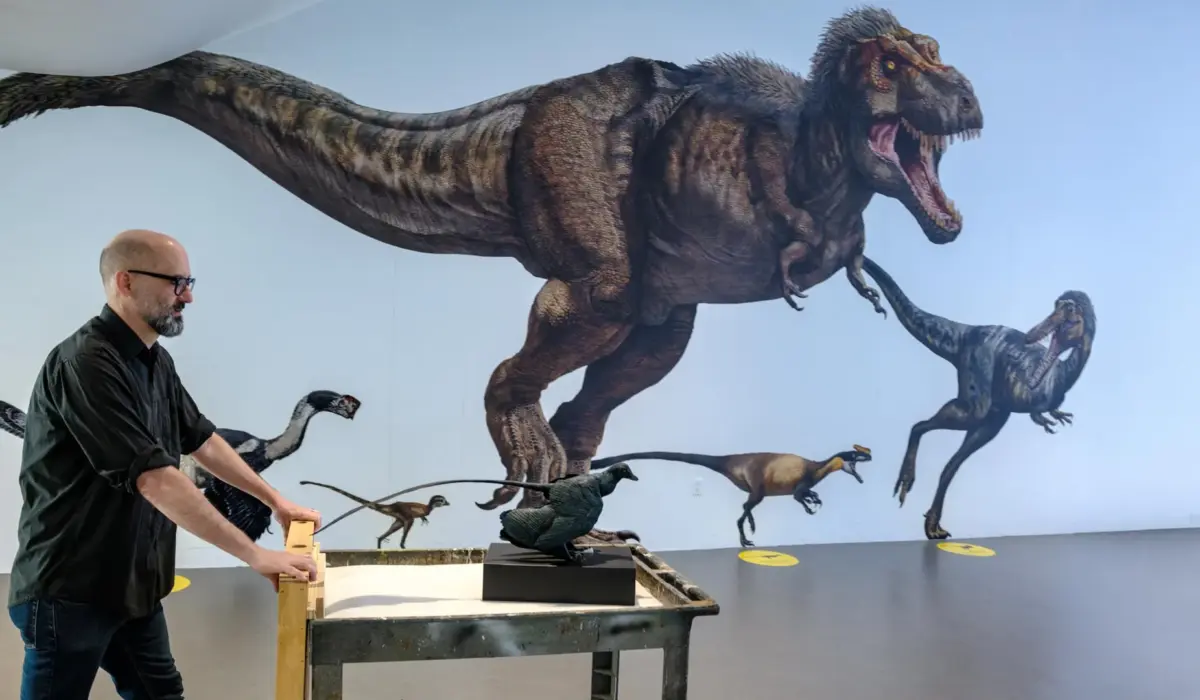
- The Dinosaur Lower Limit: The smallest known non-avian dinosaurs weighed close to 1 pound (approximately 450 grams)—roughly comparable to a large, modern domestic rabbit.
- The Modern Avian Extreme: The bee hummingbird (Mellisuga helenae), the smallest living bird in the world, weighs a mere 1.75 grams. Because birds are living theropod dinosaurs, this demonstrates that the dinosaur lineage could become tiny, but only after a specific evolutionary breakthrough.
- The Mammalian and Reptilian Extremes: The Etruscan shrew—widely recognized as one of the smallest living mammals by mass—weighs approximately 1.8 grams. Even more extreme is the dwarf gecko, which tips the scales at a minuscule 0.15 grams.
+-------------------------------------------------------------------------+
|                  COMPARATIVE MASS OF VERTEBRATE EXTREMES                |
+-------------------------------------------------------------------------+
| Blue Whale / Giant Sauropods     | ~80,000,000+ grams                   |
| Smallest Non-Avian Dinosaurs     | ~450 grams (Rabbit-sized)            |
| Etruscan Shrew (Smallest Mammal) | ~1.8 grams                           |
| Bee Hummingbird (Smallest Bird)  | ~1.75 grams                          |
| Dwarf Gecko                      | ~0.15 grams                          |
+-------------------------------------------------------------------------+
Modern Ecological Dominance
In contemporary ecosystems, tiny animals are not merely present; they form the bedrock of ecological networks. Approximately 75 percent of living mammal species and a staggering 90 percent of living bird species are smaller than the smallest known non-avian dinosaur.
This modern reality underscores just how aberrant the dinosaur lineage was during the Mesozoic. While modern nature teems with microscopic and miniature fauna, the world of the non-avian dinosaur was strictly a medium-to-mega-scale affair.
Official Statements & Expert Perspectives
The research team emphasizes that this discovery bridges a critical gap in our understanding of macroevolutionary dynamics.
"Everyone loves a giant dinosaur," noted Dr. Roger Benson, Macaulay Curator of Dinosaur Paleobiology at the American Museum of Natural History and co-author of the study. "But we decided to look at the other end of the scale. The absence of tiny dinosaurs may be just as interesting as the existence of giant ones. We already knew that dinosaurs prevented mammals from evolving to large sizes before the end-Cretaceous mass extinction. Here we suggest that mammals in turn prevented dinosaurs from evolving to small sizes."
This hypothesis introduces a compelling paradigm of mutual ecological suppression. For decades, textbook descriptions of the Mesozoic portrayed mammals as perpetually scurrying, nocturnal underdogs hiding in the fern-dappled shadows of towering sauropods and apex theropods. While that picture remains partially accurate regarding large body forms, the new mathematical and fossil evidence flips the script for the sub-kilogram world. Early mammals appear to have established an ironclad monopoly on the micro-vertebrate niches, utilizing specialized dentition, high metabolic rates, and burrowing behaviors to successfully exploit the forest floor.
Lead author Stephanie Lechki elaborated on the broader significance of the findings for global biodiversity: "Small animals dominate modern ecosystems. If we want to understand how today’s biodiversity evolved, we need to understand why tiny dinosaurs appear to have been missing."
The Avian Exception: How Flight Broke the Barrier
If non-avian dinosaurs were strictly prohibited from entering the miniature realm, how did birds—which are cladistically categorized as theropod dinosaurs—manage to break the rule so drastically?
The fossil record demonstrates that shortly after birds first branched off from their terrestrial dinosaur relatives during the Early Cretaceous epoch, they rapidly evolved body sizes far below the 450-gram floor that bound their non-avian cousins. According to the research team, this dramatic miniaturization cannot be explained by internal physiology alone.
Instead, the answer lies in a revolutionary biomechanical innovation: powered flight.
Once early avian ancestors took to the air, an entirely unprecedented spectrum of ecological opportunities unlocked before them. Flight allowed these animals to traverse vast geographic distances, escape terrestrial predators with ease, exploit high-altitude nesting sites, and tap into food webs—such as nectar-feeding and high-canopy insect foraging—that were utterly inaccessible to ground-bound terrestrial dinosaurs.
By escaping the crowded, intensely contested forest floors where small mammals held sway, early birds bypassed the ecological gatekeepers. Once airborne, they were biologically and environmentally free to explore body sizes that had been strictly forbidden to every other branch of the dinosaur family tree.
Future Outlook & Ongoing Research
The revelation that dinosaurs faced a hard lower-size limit opens up exciting new frontiers in paleontological research. Future studies will likely focus on high-resolution micro-fossil excavations in under-explored Mesozoic rock strata, aiming to test the boundaries of the team’s mathematical models against newly recovered micro-vertebrate assemblages from Gondwanan landmasses.
Furthermore, paleobiologists plan to integrate stable isotope analysis and sophisticated finite element modeling to reconstruct the metabolic and dietary habits of early mammals alongside small ornithischians and basal theropods. By doing so, scientists hope to pinpoint the exact competitive mechanisms—whether for specific insect prey, seeds, or shelter—that kept non-avian dinosaurs out of the microscopic domain.
Ultimately, this study serves as a humbling reminder that the history of life on Earth is shaped just as profoundly by what did not happen as by what did.
"We have this unusual situation where the ancestors of dinosaurs could be tiny," Benson reflected. "The living descendants of dinosaurs—birds—they can be tiny. But dinosaurs themselves seemed to be forbidden from being tiny. And we don’t really understand that yet, but it’s a question we should continue to explore if we really want to understand dinosaurs and their fascinating biology."