







Executive Overview
Deep beneath the sapphire-blue waters of the Mediterranean Sea, off the rugged coast of Sicily, a scientific instrument operating at a mere fraction of its intended capacity has peered into the cosmic abyss and captured a ghost.
On February 13, 2023, the KM3NeT/ARCA neutrino observatory recorded an event unlike any in the history of multi-messenger astronomy. The detector intercepted a cosmic neutrino carrying an astonishing energy of approximately 220 PeV (peta-electronvolts). To put this monumental figure into perspective, this single subatomic particle packed an energy load more than ten times greater than any high-energy neutrino previously cataloged by humanity. It was an anomaly of staggering proportions—an invisible messenger traversing the vast expanse of the cosmos, carrying secrets from an unimaginably violent birthplace.
For three years, the global astrophysical community has grappled with a profound mystery: Where did this particle come from?
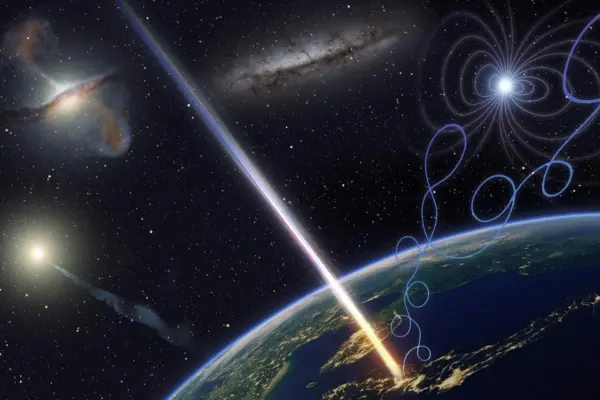
Now, a groundbreaking study published in the Journal of Cosmology and Astroparticle Physics (JCAP) offers a compelling, mathematically rigorous hypothesis. According to an international research team, the record-breaking neutrino may have originated from blazars—some of the most extreme, destructive, and energetic objects in the universe. Powered by ravenous supermassive black holes, these active galactic nuclei shoot colossal, relativistic jets of plasma directly down the cosmic barrel toward Earth.
Yet, confirming this origin story is akin to solving a multidimensional cosmic puzzle without a finished picture. The detection defied easy categorization. It arrived without a corresponding flash of light, gamma rays, or radio waves—the traditional electromagnetic "smoking guns" that astronomers usually rely on to trace cosmic rays back to their sources. Instead, researchers had to approach the mystery with the meticulous rigor of forensic investigators, utilizing advanced open-source simulations and cross-referencing data from the world’s premier astrophysical observatories, including IceCube and NASA’s Fermi Gamma-ray Space Telescope.
This comprehensive report explores the anatomy of this historic detection, the painstaking investigative process undertaken by the KM3NeT collaboration, the compelling case for blazars as the prime suspects, and what the future holds as the Mediterranean’s premier neutrino telescope races toward completion.
Detailed Chronology: The Capture of Event 220 PeV
The Breakthrough on February 13, 2023
The story begins on a winter day in 2023 at the KM3NeT/ARCA (Astroparticle Research with Cosmics in the Abyss) site, anchored thousands of meters below the surface of the Mediterranean Sea. Neutrinos are notoriously difficult to catch. Often dubbed "ghost particles," they possess almost no mass, carry no electrical charge, and interact with ordinary matter so infrequently that trillions of them pass through your body every second without leaving a trace.
To catch even a single high-energy neutrino, scientists must build colossal detectors. KM3NeT achieves this by deploying vast arrays of digital optical modules—sensitive light sensors housed in heavy-duty glass spheres—anchored to the seafloor and held upright by subsurface buoys. When a high-energy neutrino occasionally collides with a water molecule in or near the detector, it produces a secondary charged particle (such as a muon) that travels faster than the speed of light in water, emitting a faint, ethereal blue flash known as Cherenkov radiation. The optical modules capture this light, allowing researchers to reconstruct the trajectory and energy of the original neutrino.
What made the February 13 detection so extraordinary was not just its unprecedented 220 PeV energy level, but the state of the detector itself. At the time of the event, KM3NeT/ARCA was still heavily under construction. Only 21 detection lines were fully operational—representing a mere 10 percent of the observatory’s planned final configuration.
That a partial detector captured an event of this magnitude is a testament to both the sheer luck of observational astronomy and the staggering flux of energy carried by the particle. It was a signal so loud and distinct that it pierced through the background noise of the abyss, demanding the immediate attention of the global physics community.
The Forensic Investigation: Modeling the Invisible
Faced with a data point that shattered existing records, researchers within the massive KM3NeT collaboration—a consortium numbering hundreds of scientists worldwide—knew that standard analytical approaches would not suffice. They adopted a methodology mirroring forensic science at a cosmic crime scene.
With no direct electromagnetic counterpart detected in the immediate window surrounding the event, the team could not simply point a telescope at a bright flash in the sky and declare, "That’s where it came from." Instead, they had to work backward. They started with plausible hypotheses regarding the particle’s origin, constructed advanced numerical simulations, and tested those simulations against real-world observations from multiple independent detectors.
One leading hypothesis was that ultra-high-energy cosmic rays traveling through deep space collided with the cosmic microwave background (CMB)—the faint thermal radiation left over from the Big Bang—thereby generating ultra-high-energy neutrinos through photomeson interactions. Another leading hypothesis pointed toward a diffuse flux generated by a specialized population of extreme astrophysical accelerators.
To test these scenarios, the research team utilized an open-source simulation tool known as AM3. This computational framework allowed scientists to model realistic blazar populations by adjusting key physical parameters, systematically narrowing down how a population of supermassive black holes could account for a singular, ultra-energetic visitor reaching Earth.
Supporting Context & Metrics: Unpacking the Blazar Hypothesis
To understand why scientists zeroed in on blazars, one must first grasp the sheer physics of these cosmic powerhouses.
What is a Blazar?
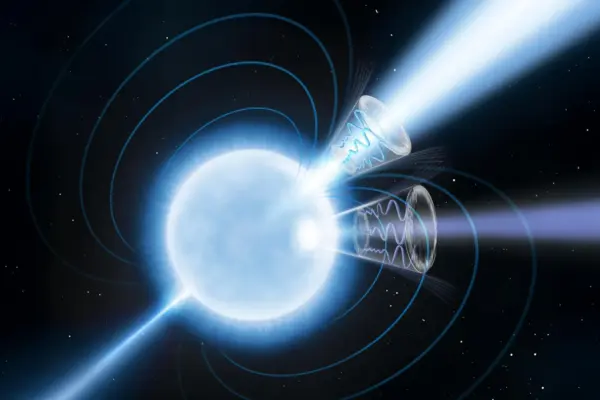
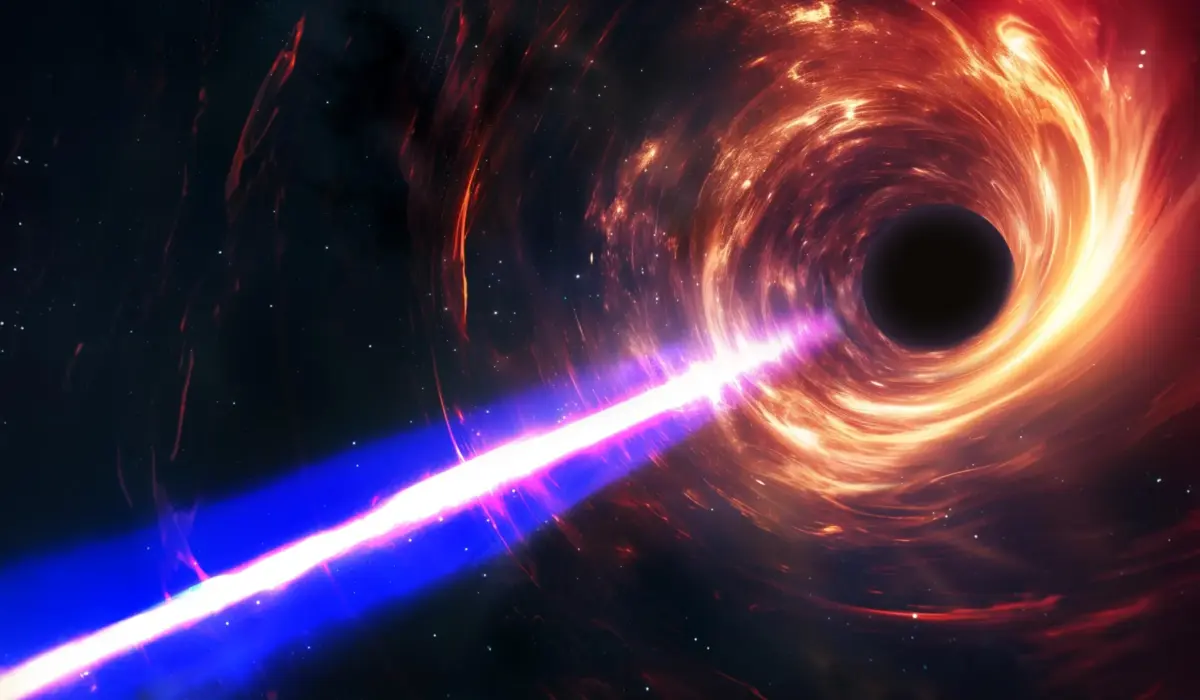
Blazars are a specialized subclass of active galactic nuclei (AGN). At the center of most large galaxies lies a supermassive black hole containing millions or even billions of times the mass of our Sun. As matter spirals inward toward the black hole’s event horizon, it forms a scorching accretion disk of gas and dust. In some galaxies, intense magnetic fields channel a fraction of this infalling matter into tightly focused jets of plasma, which are accelerated to nearly the speed of light and shot outward in opposite directions.
A blazar is simply an AGN whose relativistic jet happens to be pointed directly toward Earth. To a terrestrial observer, the jet acts like a cosmic particle accelerator turned directly into our eyes, amplifying the observed emission across the entire electromagnetic spectrum—from radio waves to gamma rays—and making these objects among the brightest persistent sources in the universe.
The Simulation Parameters: Baryonic Loading and Proton Spectral Index
In their study published in JCAP, the researchers did not just guess that blazars might be responsible; they tested the proposition using rigorous astrophysical modeling via the AM3 tool. Many of the variables in their simulations were anchored to pre-existing observational data, such as:
- Magnetic field strengths within the emission regions.
- The physical size of the emission zones surrounding the central supermassive black hole.
However, the team focused heavily on two critical, highly sensitive parameters:
- Baryonic Loading: This metric measures the ratio of energy carried by protons (baryons) compared to electrons within the relativistic jet. It is a vital factor in determining how efficiently a blazar can accelerate hadrons and, consequently, how many high-energy neutrinos it can produce.
- Proton Spectral Index: This parameter dictates how proton energies are distributed within the accelerator. It governs whether protons can reach the extreme energy thresholds required to spawn a 220 PeV neutrino.
By running thousands of simulation iterations, the team calculated both the expected neutrino production and the corresponding gamma-ray emissions for a realistic population of blazars.
The Missing Electromagnetic Counterpart: Point Source vs. Diffuse Background
One of the most perplexing aspects of the February 13 event was the absence of a matching electromagnetic signal. When astronomers detect high-energy cosmic events (such as the famous IceCube-17090A neutrino linked to the blazar TXS 0506+056), they typically look for a simultaneous flare in gamma rays or X-rays from a specific point in the sky.
In this instance, no such point-source counterpart was identified. As Meriem Bendahman, a researcher at INFN Naples and co-author of the study, notes:
"This does not completely rule out the possibility of a point-like source, but it leads us to consider that our neutrino may come from a diffuse background—that is, from a flux of neutrinos including contributions from many sources."
This realization shifted the scientific consensus. Rather than tracing the particle back to a single, explosive cataclysm at a specific set of celestial coordinates, the data pointed toward a diffuse population model. Under this framework, the neutrino was emitted by a member of a vast, unresolved population of blazars distributed across the universe, blending together into an ambient cosmic background of high-energy particles.
Cross-Referencing IceCube and Fermi Data
To ensure their blazar population model was robust, the researchers performed rigorous cross-checks against data from competing and complementary facilities:
- The IceCube Neutrino Observatory: Located deep beneath the Antarctic ice, IceCube is currently the world’s largest neutrino detector. Interestingly, IceCube has not detected a cluster of similar ultra-high-energy events in the same energy bracket. This negative constraint is crucial: any valid model must explain why 220 PeV neutrinos are exceptionally rare. The blazar population model successfully accommodated this rarity, proving that such extreme events should indeed be sparse.
- NASA’s Fermi Gamma-ray Space Telescope: The team had to ensure that their simulated blazars did not violate known astrophysical boundaries. Specifically, they tested whether the proposed blazar population would overproduce gamma rays, which would conflict with the extragalactic gamma-ray background already mapped by Fermi. The simulation results remained comfortably within the permissible limits set by Fermi’s observations.
Official Statements & Expert Insights
The implications of this study extend far beyond a single data point, touching upon fundamental questions regarding cosmic particle acceleration, magnetic field dynamics, and the behavior of matter under extreme gravitational stress.
Perspectives from the KM3NeT Collaboration
Meriem Bendahman, speaking on behalf of the hundreds of international scientists contributing to the KM3NeT collaboration, emphasized both the excitement and the caution required when interpreting the findings:
"There are several possible explanations for the origin of this particle," Bendahman explains. "For example, it has been proposed that such neutrinos are generated when ultra-high-energy cosmic rays interact with the cosmic microwave background radiation, the residual light from the early Universe. But there is also the possibility that the neutrino originates from a diffuse flux produced by a population of extreme accelerators, such as blazars."
Regarding the validity of the demographic model, Bendahman adds:
"We modeled a realistic population of blazars with physically motivated parameters, and we found that this population of blazars could explain the origin of this ultra-high-energy event, while also being consistent with the constraints that we have regarding the gamma-ray and neutrino observations."
A New Window on Extreme Physics
Astrophysicists have long known that the universe possesses natural particle accelerators that dwarf anything humanity could ever construct at CERN. However, the exact mechanisms by which blazars accelerate protons and atomic nuclei to fractions of the speed of light—while generating particles with energies surpassing 200 PeV—remain fiercely debated.
If the blazar hypothesis holds up under future scrutiny, it will force theorists to revise their models of jet physics. It suggests that these supermassive black-hole engines are capable of tapping into energetic regimes previously thought to be statistically improbable or physically restricted.
Future Outlook: The Complete KM3NeT Detector and Beyond
While the latest study in the Journal of Cosmology and Astroparticle Physics provides a credible and mathematically sound explanation for the 220 PeV event, the scientific community remains properly conservative. A single particle, no matter how energetic, cannot definitively prove an entire astrophysical paradigm.
The Road to Full Construction
Confirmation will require more data—and thankfully, that data is currently being gathered.
At the time of the February 2023 detection, KM3NeT/ARCA operated at just 10% capacity. Construction efforts in the Mediterranean are ongoing. As installation ships deploy additional detection lines on the seafloor, the effective volume and sensitivity of the observatory grow exponentially.
Once fully completed, KM3NeT will feature hundreds of interconnected detection lines spanning cubic kilometers of abyssal water. This expanded scale will provide:
- Enhanced Angular Resolution: Allowing scientists to pinpoint the trajectories of incoming neutrinos with far greater precision.
- Higher Statistics: Enabling researchers to capture more ultra-high-energy events, turning a solitary anomaly into a statistically significant sample size.
- Multi-Messenger Synergy: Strengthening real-time data-sharing agreements with gravitational wave detectors (like LIGO/Virgo/KAGRA) and electromagnetic observatories worldwide.
Conclusion: Redefining Our Place in the Cosmos
As Meriem Bendahman aptly concludes:
"We need more observational data. KM3NeT is still under construction, and we detected this ultra-high-energy neutrino with only a partial configuration. With the full detector and more data, we will be able to perform more powerful statistical analyses and open a new window on the ultra-high-energy neutrino universe."
For centuries, humanity studied the cosmos solely through the light that fell upon our shores. Today, by listening to the ghostly whispers of neutrinos echoing through the dark waters of the Mediterranean, we are embarking on a profound new era of discovery. Whether originating from a sprawling, diffuse web of distant blazars or an entirely undiscovered class of cosmic accelerators, the 220 PeV ghost particle of February 2023 has forever changed our perception of the universe’s most violent and magnificent frontiers.