









Executive Overview
In a milestone achievement for high-energy-density physics, an international research team led by the Helmholtz-Zentrum Dresden-Rossendorf (HZDR) has captured the genesis and evolution of plasma with unprecedented temporal and spatial resolution. By orchestrating a delicate choreography between two ultra-advanced laser systems—an X-ray free-electron laser and a high-intensity optical laser—scientists successfully mapped the ionization process of matter under extreme conditions down to fractions of a trillionth of a second.
The experiment, conducted at the HED-HiBEF experimental station of the European XFEL in Schenefeld, near Hamburg, involved vaporizing a microscopic copper wire into an incandescent plasma featuring temperatures reaching several million degrees Celsius. Utilizing a state-of-the-art "pump-probe" methodology, the team generated a cinematic sequence of the sub-atomic disruption, tracking highly charged copper ions as they formed, multiplied, and eventually recombined in a fraction of a picosecond.
The implications of this breakthrough stretch far beyond fundamental physics. By illuminating the exact mechanisms of laser-matter interactions—specifically the role of high-energy electron waves in driving secondary ionization—this research delivers critical diagnostic tools and empirical data. These insights directly bolster the global pursuit of commercial laser fusion, offering the precise simulation metrics required to design future clean-energy reactors.
Detailed Chronology: Frame-by-Frame Tracking of a Superhot Plasma
To comprehend the volatile beauty of plasma creation, physicists must peer into timescales that defy human intuition. Ionization—the stripping of electrons from atomic nuclei—unfolds across picoseconds. Capturing these transformations requires instrumentation capable of slicing time into intervals measured in femtoseconds (quadrillionths of a second).
The Trigger: Vaporization on a Microscopic Scale
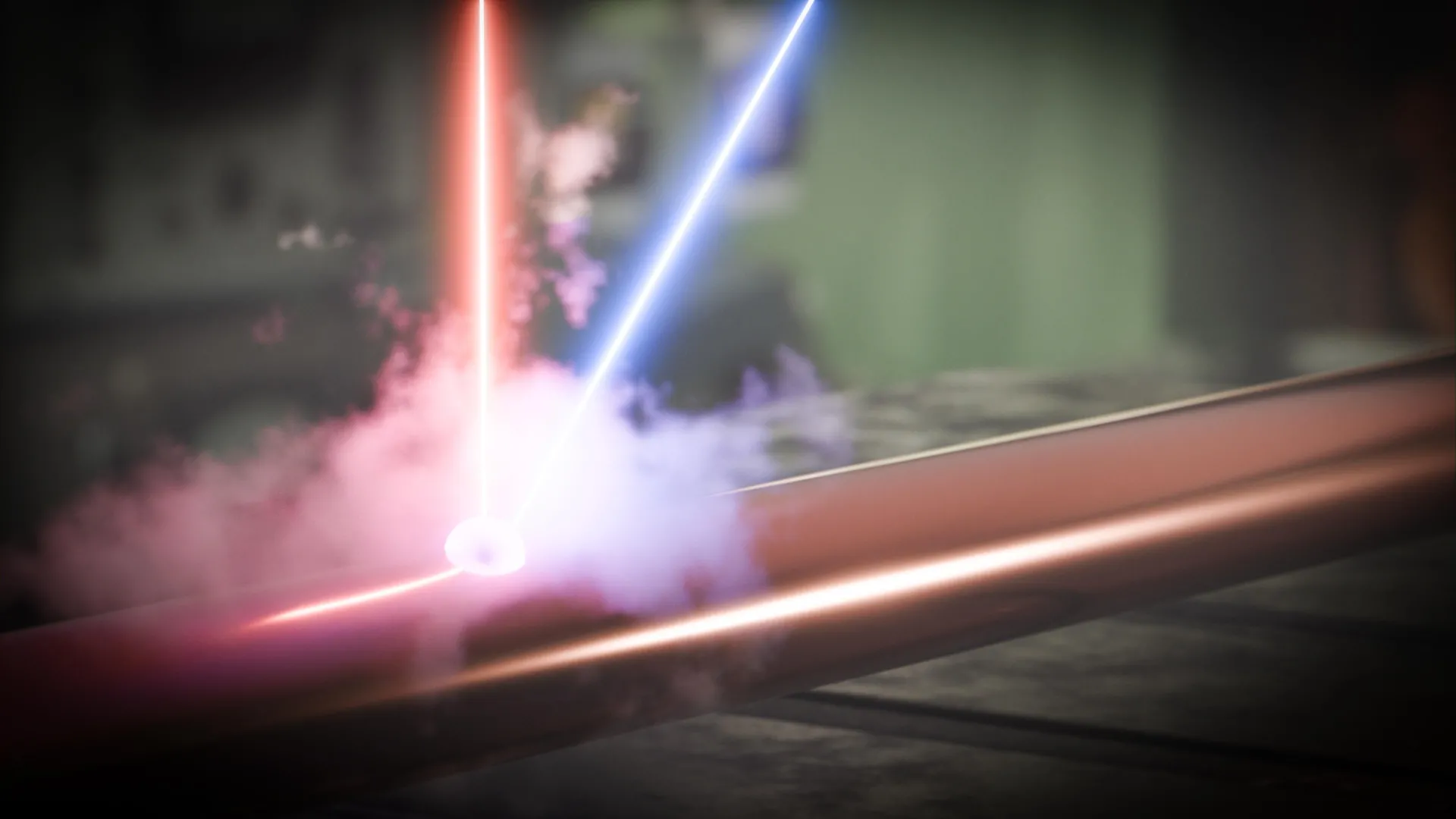
The sequence begins with a microscopic target: a strand of ultra-thin copper wire measuring approximately one-seventh the thickness of a human hair. When the ReLaX optical laser strikes this wire, it delivers an unimaginable concentration of energy—roughly 250 trillion megawatts per square centimeter—compressed into a minuscule spatial footprint for an exceedingly brief moment.
This energetic deluge instantly obliterates the solid structure of the copper, vaporizing the metal and transforming it into an ultra-dense, superhot plasma. The ambient conditions generated within this microscopic fraction of space mimic some of the most violent environments in the universe, typically found near neutron stars or during cosmic gamma-ray bursts.
The Probe: Cinematography with Hard X-rays
To observe the unfolding chaos without disrupting it, researchers deployed a second, synchronized laser pulse generated by the European XFEL. Functioning as an ultra-fast strobe light, this probe pulse emits a hard X-ray flash tuned precisely to the electronic signature of highly charged copper ions known as $textCu^22+$—copper atoms stripped of 22 of their electrons.
By recording how these hard X-rays interact with the plasma via resonant absorption, the scientific team captured a sequential timeline of the plasma’s life cycle. The X-rays prompt the highly charged ions to emit their own distinct X-ray fluorescence, providing an unbroken, real-time telemetry feed of the plasma’s internal population dynamics.
The Rise and Fall of $textCu^22+$ Ions
The resultant data paints a vivid temporal picture of the plasma’s evolution:
- T = 0: The high-intensity optical laser impacts the copper wire, instantly initiating primary ionization.
- T > 0 to 2.5 Picoseconds: $textCu^22+$ ions proliferate rapidly within the plasma matrix, their population swelling as secondary ionization cascades through the material. The concentration peaks precisely at the 2.5-picosecond mark.
- T = 2.5 to 10 Picoseconds: Recombination processes take over. As the supercharged environment begins to cool and electrons are recaptured by stripped nuclei, the population of $textCu^22+$ ions steadily declines.
- T = 10 Picoseconds: The highly charged ions vanish entirely, marking the transition of the plasma back toward lower ionization states.
Supporting Context & Metrics: Decoding the Physics of Extreme States
The experimental success achieved at the European XFEL relies on the seamless integration of distinct yet complementary technological marvels. Understanding the magnitude of this breakthrough requires examining the precise parameters governing the equipment, the physics of electron waves, and the historical challenges of high-energy density (HED) diagnostics.
The Laser Infrastructure
The HED-HiBEF station unites two distinct laser paradigms:
- ReLaX (Relativistic Laser Extreme): A high-intensity optical laser system delivering extraordinarily dense packets of light energy. In this experiment, ReLaX provided pulse durations restricted to approximately 25 to 30 femtoseconds.
- European XFEL: A superconducting X-ray free-electron laser capable of producing high-brilliance, hard X-ray flashes with exceptional temporal coherence.
The convergence of these two systems allows for precise pump-probe synchronization, wherein the optical laser initiates the physical state (the pump), and the X-ray laser interrogates the resulting changes (the probe).
The Mechanics of Electron Waves
What drives the rapid explosion of ionization after the initial laser impact? Computer simulations executed by the HZDR team revealed a nuanced secondary mechanism: the initial laser pulse strips only a localized subset of electrons from the outer shells of the copper atoms.
However, these liberated electrons inherit immense kinetic energy. They propagate through the dense remaining matrix of the wire like a high-energy hydrodynamic wave. As this electron wave washes through the atomic lattice, it acts as a microscopic battering ram, violently knocking additional electrons free from neighboring copper atoms in a cascading chain reaction.
Ultimately, as this energy is dissipated throughout the expanding plasma cloud, the wave loses momentum. The free electrons cool, slowing down sufficiently to be recaptured by the ionized copper nuclei, initiating the recombination phase that eventually restores electrical neutrality to the cooling vapor.
| Parameter | Measurement / Specification |
|---|---|
| Target Material | Copper wire ($sim 1/7$th thickness of a human hair) |
| Laser Power Density | $sim 250text trillion megawatts per cm^2$ |
| Optical Laser Pulse Duration | 25 – 30 femtoseconds |
| Peak Ionization Time | $sim 2.5$ picoseconds post-impact |
| Total Ionization Cycle | $sim 10$ picoseconds |
| X-ray Photon Energy | 8.2 kiloelectronvolts ($textCu^22+$ resonant absorption) |
Official Statements: Perspectives from the Leadership
The significance of the HZDR-led study has resonated widely across the international physics community, drawing praise from principal investigators and facility directors alike.
Dr. Lingen Huang, head of experimentation within HZDR’s Division of High-Energy Density, emphasized the unprecedented clarity the methodology affords:
"These are exactly the conditions provided by the two lasers that have pulse durations of just 25 and 30 femtoseconds—that is, trillionths of a second. In our pump-probe experiment, we exactly measure the temporal development of this stimulated X-ray emission because it shows us how many $textCu^22+$ ions are present in the plasma at any given time."
Prof. Tom Cowan, former director of the Institute of Radiation Physics at HZDR, highlighted the novel role of high-energy electron waves uncovered by the team’s simulations:
"No one has ever looked at this type of ionization so precisely before. The electrons stripped by the initial laser are so energy-rich that they spread out like a wave and knock ever more electrons out of neighboring copper atoms."
Dr. Ulf Zastrau, responsible for the HED-HiBEF experiment station at the European XFEL, underscored the broader technological ramifications for clean energy development:
"This experiment demonstrates how powerful our lasers are and paves the way for future laser fusion facilities—because laser fusion is also based on extremely hot plasmas that are heated up by lasers and the resulting electron waves. Thanks to our new concrete findings, we can now focus on continuing to refine our simulations of these processes."
Future Outlook: Implications for Laser Fusion and Beyond
The successful mapping of femtosecond-scale plasma evolution marks a definitive turning point for high-energy-density physics. As humanity continues its quest to harness nuclear fusion as a virtually limitless, clean-energy source, understanding the complex behavior of laser-heated plasmas is paramount.
In inertial confinement fusion (ICF) and magnetic-confinement hybrid approaches, high-intensity lasers are utilized to compress and heat hydrogen isotopes to temperatures capable of triggering sustained fusion reactions. However, optimizing these systems requires highly accurate predictive computer simulations. Historically, these simulations have been hampered by a lack of empirical, time-resolved data regarding microscopic ionization dynamics and energy transfer via electron waves.
By bridging this empirical gap, the HZDR and European XFEL findings provide researchers with a rigorous benchmark. With precise measurements of ion generation, peak densities, and recombination timelines now established, computational physicists can fine-tune their hydrodynamic and kinetic simulation codes.
Ultimately, these refined models will guide the engineering of next-generation laser fusion reactors, ensuring greater energy efficiency, structural resilience, and control. As experimental facilities continue to push the boundaries of temporal and spatial resolution, insights derived from microscopic copper wires are illuminating the macro-scale path toward a sustainable energy future.