







Executive Overview
While the search for extraterrestrial life on Mars or the subsurface oceans of icy moons like Europa and Enceladus frequently commands public imagination, one of the most profound astrobiology mysteries remains hidden much closer to home. Deep within the geological record of Earth, scientists are racing to solve a foundational riddle: When did the first eukaryotes appear, and how did these microscopic architects lay the structural groundwork for all complex life on the planet?
This inquiry is not merely academic; it addresses a gaping void in our understanding of planetary evolution. For roughly 90 percent of Earth’s history—spanning billions of years—microbial organisms ruled unchallenged. Reconstructing the monumental transition from a world populated exclusively by single-celled microbes to one teeming with vibrant forests, complex animals, and resilient fungi serves a dual purpose. Crucially, it provides astrobiologists with a terrestrial baseline, helping science evaluate the statistical likelihood of complex life emerging elsewhere in the universe.
Led by researchers like Dr. Ross Anderson, a prominent paleontologist at the University of Oxford, modern science is deploying advanced geochemical techniques, field expeditions to remote polar landscapes, and high-resolution microscopy to peer through billions of years of geological alteration. Their mission is to unearth the elusive crown eukaryotes—the ancestral stock of all modern plants, animals, and fungi—and map the exact mechanisms that turned a sterile rock into a living world.
Detailed Chronology of Early Terrestrial Evolution
To comprehend the magnitude of the evolutionary leaps that shaped our planet, scientists must rely on a deep-time timeline pieced together from geochemical signatures, rare fossil deposits, and molecular clocks. The chronology of early Earth charts an agonizingly slow, yet ultimately explosive, rise of biological complexity.
The Dawn of Life and Microbial Monotrophy (>3.5 Billion Years Ago)
Life originated on Earth more than 3.5 billion years ago, during the Archean Eon. For a considerable duration, the biosphere was dominated by anaerobic prokaryotes—simple single-celled organisms lacking a true nucleus. These microscopic pioneers laid the metabolic foundation for everything that followed, slowly altering the chemistry of an alien planet.
The Great Oxidation and Photosynthetic Shift (By ~2.3 Billion Years Ago)
By at least 2.3 billion years ago, cyanobacteria had proliferated globally, driving the Great Oxidation Event. Through oxygen-producing photosynthesis, these organisms flooded Earth’s oceans and atmosphere with free oxygen. This dramatic atmospheric shift poisoned countless anaerobic species, but it unlocked an unprecedented energetic frontier, making complex aerobic respiration possible.
The Emergence of Eukaryotes (By ~1.7 Billion Years Ago)
The first true eukaryotes—cells featuring a membrane-bound nucleus and specialized energy-producing organelles like mitochondria—had emerged by at least 1.7 billion years ago. Recent fossil discoveries in Australia have pushed this timeline further, unearthing eukaryotic microfossils dating back approximately 1.75 billion years. This milestone represented a quantum leap in cellular architecture.
Algal Diversification (At Least 1 Billion Years Ago)
Following the establishment of early eukaryotic cells, multicellularity and primitive algae began to take root at least one billion years ago, though molecular estimates suggest they may have emerged significantly earlier. This era fostered the diversification of photosynthetic eukaryotes, setting the stage for primary production in aquatic ecosystems.
The Rise of Animals and the Ediacaran-Cambrian Pivot (~570 to 540 Million Years Ago)
Animals appeared in the fossil record at least 570 million years ago, paving the way for the Ediacaran/Cambrian transition roughly 540 million years ago. This pivotal junction marked a revolutionary evolutionary shift. The fossil record transitions from predominantly soft-bodied, enigmatic organisms to the Cambrian explosion—an evolutionary burst characterized by animals equipped with high mobility, shells, and mineralized skeletons.
Supporting Context & Metrics: Decoding the Invisible Archive
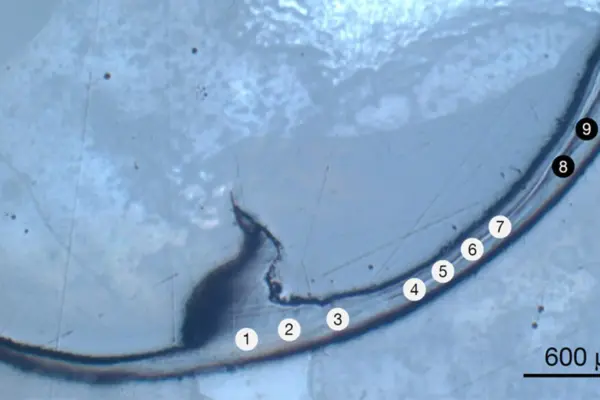
The scientific pursuit of early eukaryotes is fraught with extraordinary technical hurdles. The primary obstacle is the nature of the fossil record itself: organisms living prior to 500 million years ago did not possess shells, bones, or rigid structural skeletons.
Without these hard anatomical parts to resist decay, paleontologists must bypass standard fossil-hunting techniques. Instead, they must seek out exceptionally rare geological environments capable of preserving fragile cells, membranes, and soft organic tissues. Consequently, science has been left with an impoverished data set for roughly 90 percent of Earth’s biological timeline.
The Biological Blueprint of Eukaryotes
What separates eukaryotes from their simpler prokaryotic ancestors is a dramatic leap in structural and functional sophistication:
- The Nucleus: A dedicated membrane-bound compartment that houses and protects the organism’s genomic DNA.
- Organelles: Specialized internal subunits, most notably the mitochondrion, which acts as the cellular powerhouse. Mitochondria generate the chemical energy (ATP) required to sustain larger, more metabolically demanding life forms.
- Multicellular Potential: Eukaryotic architecture provided the genetic and structural flexibility necessary for cells to cooperate, specialize, and eventually form complex multicellular organisms. Every visible plant, animal, and fungus alive today is fundamentally eukaryotic.
Geographical and Geological Metrics
To pierce the veil of deep time, researchers target specific environmental windows where preservation was optimal:
- The Svalbard Archipelago: Located roughly 80 degrees North near Norway, this 100-square-kilometer region exposes ancient shallow-sea sedimentary rocks that preserve delicate microfossils.
- Australian Proterozoic Deposits: Recent breakthroughs in Australia yielded exceptional microfossils preserved in ancient clay-rich strata dating back 1.75 billion years.
- Clay-Rich Environments: Sedimentary deposits rich in fine-grained clay minerals act as natural sealing agents, chemically isolating fragile organic microfossils from circulating groundwater and thermal degradation over billions of years.
Official Statements and Expert Perspectives
The complexity of tracing Earth’s earliest macroscopic ancestors requires interdisciplinary collaboration, uniting paleontologists, geochemists, and astrobiologists. Dr. Ross Anderson of the University of Oxford emphasizes that understanding these microscopic origins is central to deciphering the grand narrative of evolution.
"To reach the common ancestor shared by the plant and animal kingdoms, researchers must look back to around 1.6 billion years ago," explains Dr. Anderson. He categorizes eukaryotes as unequivocally representing "the planet’s first complex life."
Addressing the inherent difficulties of studying an era devoid of structural bones, Anderson notes that modern research has had to pivot from traditional fossil recovery to sophisticated geochemical analyses. By studying the elemental and isotopic composition of ancient rocks, his team can reconstruct the paleo-environments that fostered the earliest evolutionary experiments.
Furthermore, Anderson highlights the direct pipeline connecting terrestrial paleontology with modern space exploration:
"Much of my work involving clay deposits was originally motivated by the search for life on other planets. By learning which environments preserve ancient organisms on Earth, scientists may become better equipped to recognize possible signs of life elsewhere."
This sentiment underscores a broader consensus within the astrobiology community. Earth serves as the sole empirical laboratory we possess for studying the origin and evolution of life. Without a rigorous, quantitative understanding of how single-celled life transitioned to complex multicellularity under terrestrial conditions, humanity lacks the foundational metrics required to accurately evaluate biosignatures detected on distant exoplanets or icy worlds.
Future Outlook: The Next Frontier in Astrobiology
As analytical technologies continue to advance, the field of Precambrian paleontology is poised for a renaissance. The coming decades will likely see a convergence of high-resolution mass spectrometry, non-destructive laser Raman spectroscopy, and machine learning algorithms designed to identify organic micro-structures hidden within complex rock matrices.
Future expeditions will continue to scour remote, vegetation-free landscapes—such as high-Arctic deserts and hyper-arid expanses in Australia—where ancient sedimentary strata remain exposed to the surface. By targeting pristine, under-sampled basins, researchers hope to fill critical gaps in the Proterozoic fossil record, resolving long-standing debates regarding the timing and environmental triggers of eukaryotic diversification.
Ultimately, the quest to uncover the first eukaryotes transcends earthly curiosity. It is an existential endeavor. By decoding the intricate steps that transformed a microbial wasteland into a planet dominated by sentient, complex organisms, science is writing the universal rulebook for life. Whether we search the clay beds of Svalbard or the subsurface brine of Enceladus, the journey toward understanding alien life begins with mastering the ancient, invisible history written in the rocks beneath our feet.