








Executive Overview
In the high-stakes realm of fundamental physics, breakthroughs are rarely born in a vacuum. While some stem from completely novel theoretical frameworks, and others emerge from the invention of entirely new materials, a vast majority of monumental advances occur when researchers combine familiar, mature technologies in utterly unexpected ways. By doing so, they manage to synthesize an instrument far more powerful than the sum of its individual parts.
A multidisciplinary team of researchers spanning ETH Zurich and EPFL (École Polytechnique Fédérale de Lausanne) has recently operationalized this philosophy. Addressing one of the most stubborn bottlenecks in experimental physics—the extreme complexity and prohibitive cost of tracking elusive elementary particles—they have successfully merged light field photography with cutting-edge quantum sensing and artificial intelligence.
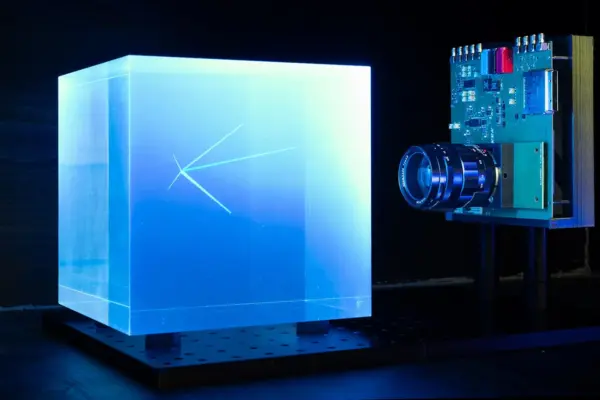
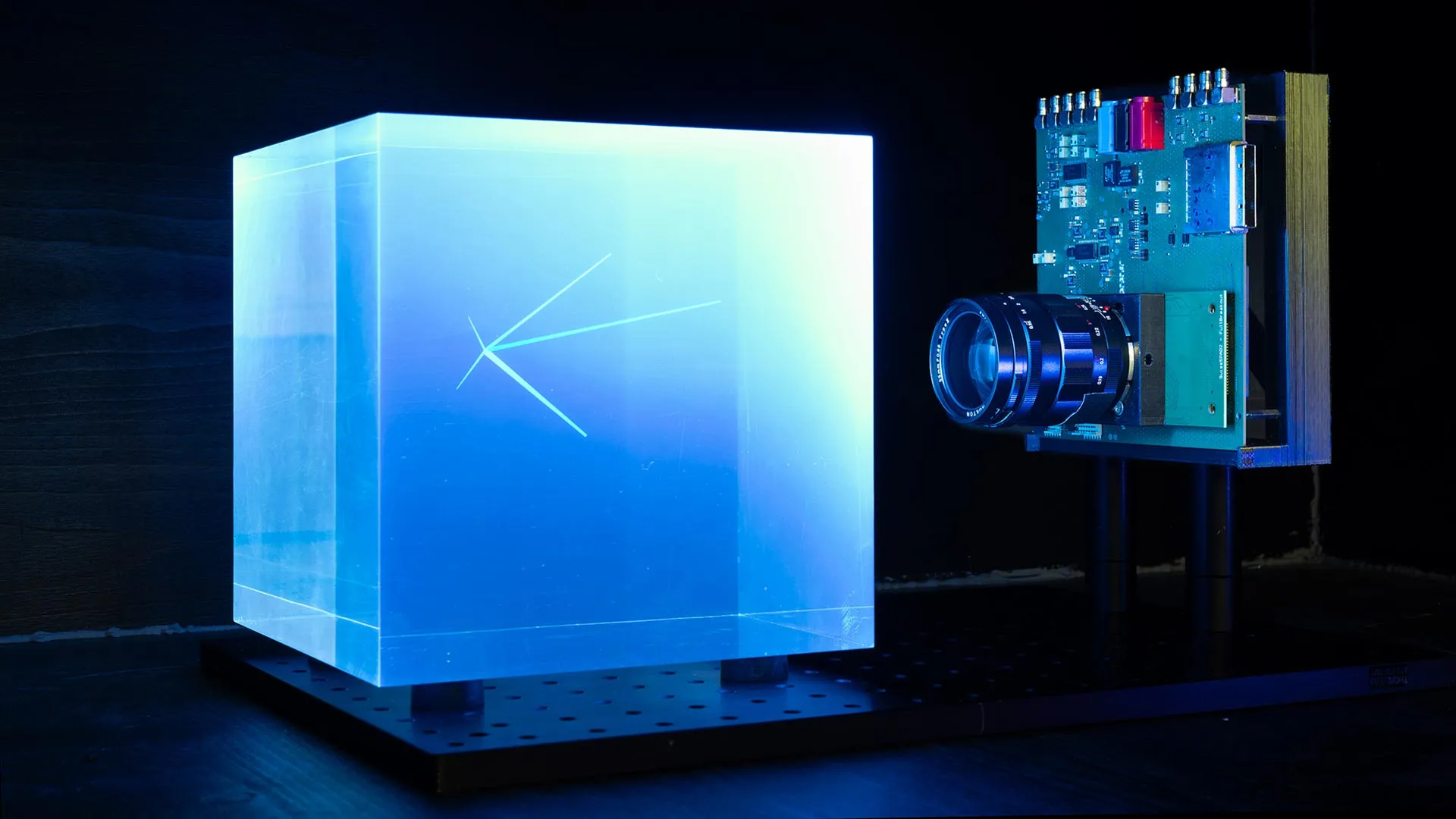
The result of this cross-disciplinary fusion is PLATON: a revolutionary prototype detector capable of performing ultrafast, high-resolution three-dimensional (3D) particle imaging deep within a completely unsegmented, monolithic block of scintillator material.
By bypassing the traditional manufacturing nightmare of slicing detectors into millions of fragile, microscopic cubes and wiring them to thousands of individual optical fibers, the PLATON project promises to democratize the search for weakly interacting particles, such as neutrinos and dark matter candidates. Moreover, with applications already spilling over into medical imaging—specifically Positron Emission Tomography (PET) scanning—this fundamental physics innovation stands poised to reshape industries far beyond the confines of a particle collider.
Detailed Chronology: The Evolution of PLATON
The Scintillator Dilemma
For decades, particle physics experiments have relied on a dependable yet cumbersome method to reconstruct the 3D trajectories of elementary particles: segmentation. When a charged particle streaks through a dense medium known as a scintillator, the material responds by emitting faint, fleeting flashes of visible light. To pinpoint the exact spatial coordinates of the particle’s path, traditional detectors require the scintillator to be physically divided into a vast array of microscopic, active units.
Optical fibers must then be meticulously threaded through or glued to each section, funneling photons to silicon photomultipliers or photomultiplier tubes for counting. While extraordinarily precise, this architectural paradigm scales poorly.
Consider the logistical hurdles of contemporary mega-experiments:
- The T2K Neutrino Experiment (Japan): Utilizes approximately two million individual scintillator cubes coupled with 60,000 optical fibers to create a two-ton sensitive volume.
- LHCb (CERN) and Mu3e (Paul Scherrer Institute): Achieve sub-millimeter spatial resolution by deploying millions of ultra-thin scintillating optical fibers.
While these systems demonstrate the pinnacle of modern engineering, they also highlight a looming technological and financial crisis. Manufacturing, aligning, and reading out millions of discrete components creates a staggering bottleneck. Building larger detectors to capture rare, weakly interacting particles—like neutrinos or elusive dark matter candidates—exponentially inflates the complexity, fragility, and cost of these instruments.
The Interdisciplinary Leap: ETH Zurich Meets EPFL
Recognizing that the field was reaching a structural dead end, a visionary coalition of physicists and engineers decided to rethink particle tracking from the ground up.
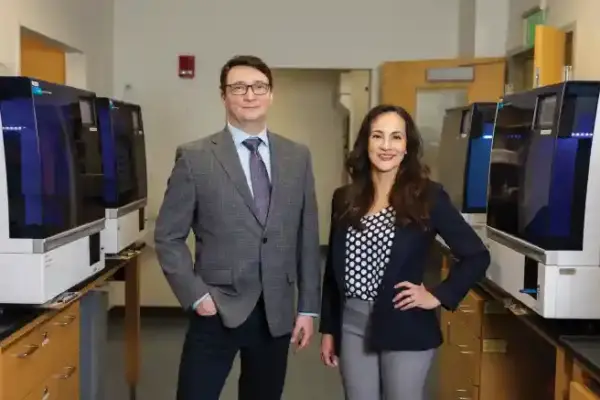
Spearheaded by PhD student Till Dieminger, senior scientist Dr. Saúl Alonso-Monsalve, and Professor Davide Sgalaberna of ETH Zurich, alongside Professor Edoardo Charbon’s Advanced Quantum Architecture Lab at EPFL in Lausanne, the team abandoned the dogma of segmentation. Instead of forcing light through a labyrinth of physical fibers, they asked a radical question: What if we could look inside a completely solid, unsegmented block of scintillator material and use advanced optics to trace the light backward to its exact point of origin?
This conceptual pivot formed the bedrock of the PLATON project, financially backed by the Swiss National Science Foundation. To bring the vision to life, the team forged a crucial industrial partnership with Raytrix GmbH, which helped design and mount a specialized micro-lens array directly onto an advanced sensor.
Prototyping and Laboratory Validation
The culmination of this collaborative effort was the construction and testing of the first functional PLATON prototype. The instrument marries a micro-lens array (MLA) with a state-of-the-art single-photon avalanche diode (SPAD) imaging sensor known as SwissSPAD2, engineered by the EPFL contingent.
In rigorous laboratory trials, the researchers tested PLATON’s spatial resolution under punishingly sparse light conditions. Using a strontium-90 source to generate electrons inside a solid block of plastic scintillator, the team evaluated the system’s ability to detect particle tracks using light levels ranging from several hundred photons down to a mere five detected photons.
The empirical results aligned with astonishing precision against the team’s exhaustive computer simulations. This validation confirmed that their mathematical models accurately represented the photon transport and optical reconstruction capabilities of the unsegmented architecture, clearing the path for scaled-up designs and advanced machine-learning integration.
Supporting Context & Metrics
To truly appreciate the engineering triumph of the PLATON architecture, one must examine the underlying mechanics of light field imaging and quantum photon detection.
Light Field Photography Meets Particle Physics
Plenoptic cameras—commonly known as light field cameras—diverge fundamentally from standard digital cameras. Traditional cameras collapse a three-dimensional world onto a two-dimensional sensor, recording primarily the intensity and color of incoming light while discarding directional data.
A light field camera, conversely, intercepts the light rays using a micro-lens array (MLA) positioned directly in front of the image sensor. Each microscopic lens functions as an independent, miniature camera perspective, capturing not just how much light arrives, but precisely where it landed and the angle at which it traveled. When processed computationally, this rich dataset allows the system to reconstruct depth and map a scene in full 3D space.
[ Incoming Scintillation Light ]
              │
              ▼
    [ Micro-Lens Array (MLA) ]  <-- Captures angle, position, & intensity
              │
              ▼
[ SwissSPAD2 Single-Photon Sensor ] <-- Gated timing, zero-noise photon counting
              │
              ▼
 [ Transformer Neural Network ] <-- Reconstructs 3D particle trajectory
In particle physics, this technology is a natural fit. Scintillation light is inherently faint and scatters through dense materials. By coupling a plenoptic camera to a SPAD array—which boasts the extreme sensitivity required to register individual photons—the PLATON system can resolve minute optical signatures that would otherwise drown in background noise.
Technical Specifications of the PLATON Ecosystem
| System Component | Technology Utilized | Function / Performance Metric |
|---|---|---|
| Scintillation Medium | Monolithic Plastic Block | Eliminates million-fold segmentation; provides dense target volume for particle interactions. |
| Optics | Raytrix Micro-Lens Array (MLA) | Captures directional light fields to enable depth perception and 3D spatial reconstruction. |
| Sensor | EPFL SwissSPAD2 Array | Single-photon avalanche diode technology; provides gated timing and single-photon sensitivity. |
| Data Processing | Transformer Neural Network Architecture | Analyzes spatiotemporal photon correlations to reconstruct particle trajectories with high purity. |
| Spatial Resolution | Sub-millimeter (<1mm) | Achieved in simulated $(10 times 10 times 10)text cm^3$ volumes; scales to multi-meter blocks. |
Furthermore, SwissSPAD2 incorporates gated photon detection. This crucial feature allows the sensor to open its "shutter" exclusively during predefined temporal windows when genuine scintillation light is statistically guaranteed to arrive. Consequently, the system acts as an aggressive digital filter, suppressing random thermal noise, dark counts, and spurious background signals before they ever corrupt the dataset.
The Role of Artificial Intelligence in Particle Reconstruction
Capturing raw light data is only half the battle; interpreting it efficiently requires next-generation computing. Because unsegmented detectors produce complex, overlapping photon patterns rather than neat linear traces in fiber grids, the ETH Zurich team integrated an advanced machine-learning pipeline into PLATON.
Drawing inspiration from the Transformer neural network architectures that power modern large language models, the researchers adapted the technology to process photons instead of words. This custom neural network evaluates spatiotemporal correlations—examining where and when specific photons illuminate the SPAD sensor. By identifying patterns within this multidimensional matrix, the AI can effortlessly disentangle overlapping light fields, accurately reconstructing the momentum, origin, and trajectory of low-energy particles that traditional algorithms would miss entirely.
Simulations demonstrate that a $(10 times 10 times 10)text cm^3$ unsegmented PLATON block running this neural network architecture achieves sub-millimeter spatial resolution while maintaining exceptionally high purity and efficiency in identifying low-momentum proton interactions generated by neutrino events. When modeled at a larger scale—a full cubic meter—the system maintains a spatial resolution of just a few millimeters, matching the performance of state-of-the-art segmented detectors without requiring a single cut, fiber, or adhesive joint.
Official Statements and Expert Perspectives
The convergence of quantum sensing, optical engineering, and artificial intelligence has generated palpable excitement within the European physics community.
Reflecting on the motivations behind the project, Till Dieminger, lead author and PhD student at ETH Zurich, emphasized the sheer logistical necessity of simplifying detector construction:
"When building instruments to hunt for rare, elusive particles like neutrinos, scaling up detector size traditionally meant scaling up manufacturing nightmares. By rethinking how we collect and interpret light, we are proving that you don’t necessarily need to slice a detector into millions of fragile pieces to achieve supreme spatial precision."
Echoing the collaborative nature of the breakthrough, Dr. Saúl Alonso-Monsalve, senior scientist on the team, highlighted the power of cross-disciplinary innovation between materials science, microelectronics, and advanced data processing:
"The integration of single-photon avalanche diode sensors with light field camera geometry unlocks an entirely new dimension in optical tracking. When you couple this hardware with Transformer-based neural networks, you bridge the gap between raw, chaotic photon data and crystal-clear particle physics."
Professor Davide Sgalaberna, head of the research group at ETH Zurich, contextualized the broader implications for high-energy physics infrastructure:
"Particle physics has long battled the trade-off between detector size, resolution, and financial viability. PLATON demonstrates that we can bypass this compromise entirely. Whether we look at compact neutrino detectors or massive collider calorimeters, unsegmented monolithic imaging represents a paradigm shift that will make future experiments far more scalable and economically sustainable."
On the microfabrication and semiconductor side, Professor Edoardo Charbon of EPFL emphasized the vital contribution of quantum image sensing:
"The SwissSPAD2 sensor was designed to push the absolute limits of temporal and spatial photon detection. Seeing it deployed not just in standard machine vision, but as the core optical engine for a revolutionary particle physics detector, validates years of dedicated work in our Advanced Quantum Architecture Lab."
Future Outlook and Broader Applications
As the ETH Zurich and EPFL collaboration looks toward the horizon, their roadmap is divided into aggressive hardware upgrades and expansive real-world deployments.
The Roadmap for PLATON v2.0
Buoyed by the success of their initial proof-of-concept, the research team is already designing the next generation of PLATON hardware. Key improvements include:
- Sub-Nanosecond Time-Stamping: While the current prototype relies on fixed time-gating windows, the upgraded SPAD array will assign an individual, ultra-precise time stamp to every single detected photon. This granular temporal data will dramatically sharpen track reconstruction algorithms.
- Optimized Optical Fields of View: Modifications to the micro-lens array and primary optical path will increase photon collection efficiency, pushing spatial resolution even further into the sub-millimeter regime across larger volumes.
- Full-Scale Neutrino Simulations: With computational resources expanding, the team aims to model full-scale, cubic-meter unsegmented blocks under simulated neutrino beams to finalize blueprints for future underground neutrino observatories.
Beyond the Laboratory: Revolutionizing Medical Imaging
History proves that fundamental physics research rarely stays confined to theoretical laboratories. The World Wide Web was born out of the necessity for data sharing at CERN; cancer-fighting proton therapy grew directly out of particle accelerator physics. PLATON appears destined to follow this illustrious lineage.
Because the underlying technology is fundamentally designed to reconstruct faint, 3D light distributions within scattering media, its applications stretch far beyond collider halls and deep-underground neutrino vats. Recognizing this potential, Dieminger, Alonso-Monsalve, and Sgalaberna have already filed three separate international patents covering the PLATON technology stack for applications in Positron Emission Tomography (PET).
PET imaging relies on detecting pairs of gamma rays emitted indirectly by a radioactive tracer injected into a patient’s body. Current clinical PET scanners face severe limitations in spatial resolution and cost, largely due to the dense packing of discrete scintillation crystals and photomultiplier tubes. By translating the PLATON architecture into medical hardware—pairing unsegmented scintillator rings with advanced light field cameras and proprietary neural networks—next-generation PET scanners could achieve unprecedented spatial precision, drastically reducing scan times, lowering radiation doses, and revealing early-stage physiological abnormalities with previously unattainable clarity.
In sum, what began as an effort to simplify the hunt for ghosts of the subatomic world—neutrinos and dark matter—may soon materialize in hospitals worldwide, saving lives through the power of repurposed light. The PLATON project stands as a shining testament to modern engineering: a reminder that sometimes, the greatest scientific leaps forward require not adding more complexity, but stepping back to see the bigger picture.