






In the rapidly evolving domain of digital pathology, artificial intelligence (AI) has emerged as a powerful engine for clinical decision support. From distinguishing among complex cancer subtypes to detecting subtle histopathological aberrations that foreshadow disease progression, deep learning models offer unprecedented analytical depth. Yet, a formidable barrier continues to impede their safe, routine transition into hospital workflows: a pervasive lack of operational reliability. Conventional medical AI architectures are persistently plagued by fragile uncertainty quantification, unmanaged error rates, and acute vulnerability to domain shifts—discrepancies between the clean, curated data used during model development and the chaotic, varied realities of clinical deployment environments. Variations in patient demographics, tissue acquisition protocols, laboratory staining techniques, and institutional practices frequently degrade model performance, posing latent threats to patient safety.
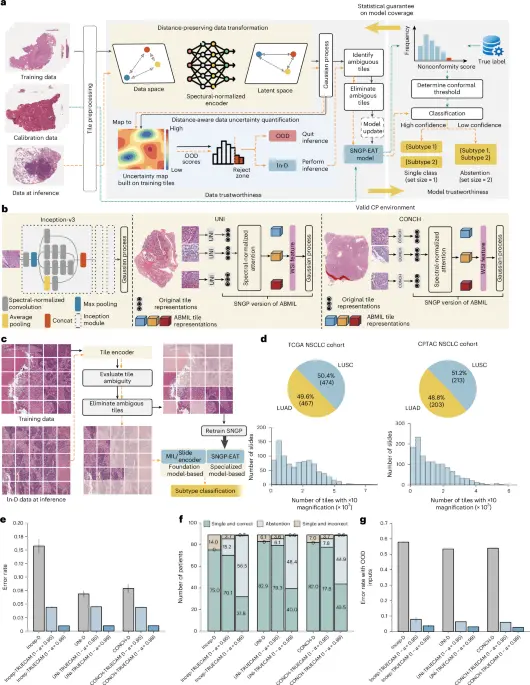
To confront this systemic vulnerability head-on, an international research team has introduced TRUECAM (TRustworthiness-focused, Uncertainty-aware, End-to-end CAncer diagnosis with Model-agnostic capabilities). Formulated as a mathematically rigorous and scalable wrapper framework, TRUECAM is designed to integrate seamlessly with deep learning models of diverse architectures, scales, and clinical purposes. By fundamentally decoupling and systematically addressing both data trustworthiness—ensuring input data conform to training boundaries and eliminating ambiguous slide regions—and model trustworthiness—providing valid confidence intervals and statistically guaranteed error rates via conformal prediction—TRUECAM transforms volatile machine learning predictions into dependable clinical tools.
Extensive evaluations across more than 20,000 whole-slide images (WSIs), encompassing multiple non-small-cell lung cancer (NSCLC) datasets and diverse multi-class pan-cancer cohorts, demonstrate that TRUECAM drastically suppresses error rates, successfully detects out-of-domain (OOD) inputs, fortifies fairness across demographic groups without explicit training bias enforcement, and vastly compresses computational inference burdens. As healthcare systems grapple with the regulatory and ethical imperatives of deploying autonomous algorithms, TRUECAM establishes a new paradigm for reliable, human-in-the-loop medical artificial intelligence.
Detailed Chronology: The Evolution of TRUECAM
The conceptual architecture of TRUECAM emerged from a critical recognition within computational pathology: training deep neural networks to simply output the single "most likely" classification point is fundamentally unsuited for high-stakes medicine. Without contextual confidence measures, clinicians are left flying blind, forced to either accept overconfident misclassifications or reject algorithms entirely due to automation anxiety.
Earlier attempts to remedy this utilized various uncertainty quantification (UQ) methodologies, such as Monte Carlo dropout to gauge classification variance, ensemble methods combining multiple convolutional neural networks, and conformal prediction approaches designed to flag low-confidence outputs. While these methods offered incremental progress, they failed to align simultaneously with three non-negotiable pillars of clinical safety:
- Universal Confidence Calibration: Characterizing confidence consistently across in-domain data, out-of-domain inputs, and intra-slide regions.
- Statistical Error Guarantees: Ensuring that claimed confidence intervals match real-world outcomes while allowing the model to judiciously abstain from making definitive calls on ambiguous cases.
- Computational Tractability: Achieving the above without introducing prohibitive computational overhead that paralyzes real-time clinical workflows.
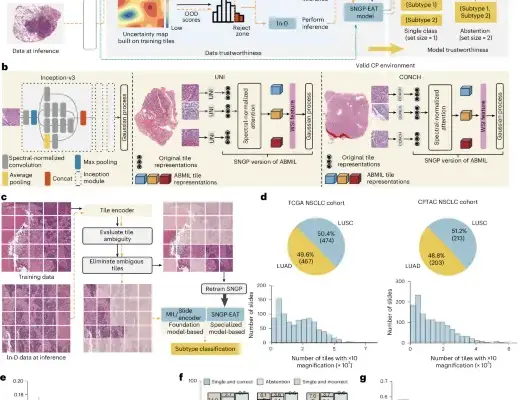
To resolve these compounding limitations, the developers of TRUECAM engineered a cohesive, tri-partite framework uniting spectral-normalized neural Gaussian processes (SNGP), an elimination of ambiguous tiles (EAT) mechanism, and conformal prediction (CP) paired with conformal risk control (CRC).
Phase 1: Establishing Mathematical Groundwork via SNGP
The foundational engine of TRUECAM relies on SNGP. Standard deep neural networks suffer from "feature collapse," a phenomenon where out-of-domain inputs—such as healthy or necrotic tissue submitted by mistake for cancer subtyping—are mapped dangerously close to tumor representations in the latent space, triggering false, high-confidence diagnoses.
SNGP neutralizes this vulnerability by combining two architectural interventions:
- Spectral Normalization: Enforcing bi-Lipschitz constraints across hidden layers, ensuring that relative distances between data points in the original pixel space are faithfully preserved in the latent feature space.
- Gaussian Process Output Layer: Replacing the standard dense classification layer with a random Fourier feature (RFF)-approximated Gaussian process. This end-to-end trainable Bayesian layer endows the model with distance-awareness, allowing it to naturally register high uncertainty when encountering inputs far outside its training distribution.
Phase 2: Refining Supervision through EAT
Whole-slide gigapixel images present a unique computational and supervisory challenge. Typically, thousands of individual tiles are extracted from a single WSI, yet models are trained using only coarse-grained, slide-level diagnostic labels. This introduces massive label noise: non-cancerous regions, normal stroma, or necrosis are inadvertently treated as tumor tissue, diluting the discriminative signal.
TRUECAM resolves this via the Elimination of Ambiguous Tiles (EAT) mechanism. Using k-means clustering mapped onto SNGP-derived latent representations, TRUECAM identifies clusters characterized by high label-assignment entropy—regions where tile classifications lack dominant subtype specificity. By pruning these ambiguous, non-informative tiles during training, the framework sharpens the supervisory signal. During inference, tiles falling within these ambiguous clusters are systematically purged, drastically reducing computational overhead while elevating diagnostic precision.
Phase 3: Bounding Real-World Error via Conformal Prediction
Even with precise uncertainty estimation, raw probability scores remain uncalibrated. TRUECAM addresses this by layering inductive conformal prediction atop the SNGP architecture. Rather than forcing a singular, binary diagnosis, conformal prediction generates a calibrated prediction set (e.g., containing both LUAD and LUSC, or a single definitive subtype).
By leveraging a separate calibration dataset, CP mathematically guarantees that the true cancer subtype will fall within the model’s prediction set at least a pre-specified proportion of the time ($1 – alpha$). When a model encounters a slide with insufficient evidence, its prediction set expands to encompass multiple classes—effectively signaling an abstention. This transforms the AI into a proactive triage assistant, deferring complex or ambiguous cases directly to human pathologists.
Supporting Context & Metrics
To rigorously validate TRUECAM, the researchers conducted exhaustive benchmarking across multiple specialized architectures (such as Inception-v3) and cutting-edge digital pathology foundation models (including UNI, CONCH, Prov-GigaPath, and TITAN) paired with multiple instance learning (MIL) paradigms like ABMIL, CLAM, and TransMIL.
Subtyping Accuracy and Error Reduction
In binary non-small-cell lung cancer (NSCLC) subtyping—distinguishing lung adenocarcinoma (LUAD) from lung squamous cell carcinoma (LUSC)—TRUECAM achieved extraordinary error reductions.
- When applied to Inception-v3 (Incep-TRUECAM) with target error thresholds set at $alpha = 0.05$ and $alpha = 0.01$ (corresponding to true label coverage levels of 95% and 99%), empirical error rates plummeted by 72.0% and 93.8%, respectively.
- At a stringent coverage target of $1 – alpha = 0.99$, conformalized SNGP assigned single correct subtypes to significantly more patients on external validation datasets (such as CPTAC) compared to baseline Monte Carlo dropout models, yielding an 83.7% increase in high-confidence correct classifications.
- Definitive-answer (DA) error rates—the proportion of incorrect single-subtype designations among non-abstaining outputs—dropped to 1.9% at $alpha = 0.01$, translating to roughly 1 error per 100 patients, down from 1 in 8 for uncalibrated models.
Fairness and Demographic Equity
A critical test for medical AI is its performance equity across diverse patient demographics. Evaluations measuring accuracy and prediction set size gaps between racial and sexual subgroups revealed that TRUECAM inherently promotes fairness without requiring explicit equity penalties during training.
- Conformalized SNGP-EAT compressed demographic performance gaps dramatically. At $1 – alpha = 0.90$, compared to baseline conformalized models, TRUECAM reduced the prediction set size gap across racial subgroups by 42.2% on TCGA and 27.4% on CPTAC.
- Set size gaps across sex categories were reduced by 51.6% (TCGA) and 73.0% (CPTAC), pushing performance equity metrics close to theoretical perfection.
Out-of-Domain Detection and Distribution Shift Resilience
Clinical deployment environments inevitably expose models to unexpected data, ranging from staining variations to entirely different tissue types. TRUECAM’s uncertainty- and probability-based OOD scores excelled at identifying foreign inputs before inference.
- In foundation model integrations (UNI and CONCH), uncertainty-based OOD scores achieved stellar AUROC performance of 0.983 and 0.993, respectively, in separating in-domain NSCLC slides from cancer-adjacent normal lung tissue.
- Without OOD detection and conformal risk control (CRC), unexpected OOD data injection caused model empirical coverage to collapse to 0.477 (against a target of 0.95). When paired with CRC, TRUECAM dynamically absorbed residual distribution shifts, maintaining rock-solid empirical coverage tightly bound to the pre-specified target across varying OOD-to-In-Domain contamination ratios.
Computational Efficiency and Scalability
By purging ambiguous and non-diagnostic tiles via EAT, TRUECAM achieved massive computational savings.
- In foundation model settings, EAT allowed models to maintain peak subtyping accuracy while discarding up to 60.0% to 99.9% of non-informative tiles per slide.
- Across five additional non-lung cancer subtyping tasks—ranging from brain tumor classifications to a complex 46-class pan-cancer OncoTree slide-level benchmark—TRUECAM-wrapped models outperformed baseline architectures in 65 out of 80 evaluation scenarios, delivering an average 6.8% reduction in balanced error rates, a 1.2% increase in weighted F1 scores, and a 23.6% reduction in overall inference computing costs.
Official Statements
The development team and independent clinical collaborators emphasized the transformative implications of embedding formal statistical rigor into digital pathology:
"Trustworthiness in medical AI cannot be treated as an afterthought or a secondary metric. By decomposing trustworthiness into data scope alignment and statistically bounded model confidence, TRUECAM bridges the chasm between raw computer vision performance and safe clinical utility," noted the study’s lead computational researchers.
Highlighting the profound operational impact of the EAT mechanism, clinical pathologists involved in the study underscored the alignment between algorithmic focus and human expertise:
"Pathologists do not evaluate gigapixel slides by inspecting every square micron indiscriminately; we home in on diagnostic hot spots while filtering out normal stroma, inflammation, and artifacts. TRUECAM operationalizes this exact cognitive workflow, allowing AI to focus its analytical power where it matters most while gracefully stepping aside on the rest."
Independent reviewers within the computational pathology community further remarked that the integration of conformal prediction provides a much-needed regulatory bridge:
"Regulatory bodies like the FDA demand predictable, bounded error behavior from software-as-a-medical-device (SaMD) applications. Conformal risk control gives developers a mathematical dial to dial in acceptable error rates, transforming opaque neural network outputs into legally and clinically defensible decisions."
Future Outlook
While TRUECAM represents a watershed moment for reliable computational pathology, the research consortium has outlined several pivotal avenues for future investigation:
- Expansion to Conversational and Multimodal Foundation Models: Current evaluations focused primarily on vision-centric and vision-language encoders lacking conversational interfaces. Adapting TRUECAM’s uncertainty and conformal calibration layers to interactive, generative pathology assistants represents an urgent next step.
- Systematic Characterization of Distribution Shifts: Although distribution shift control (DSC) successfully mitigated performance drops on external cohorts like CPTAC, systematically mapping the underlying physiological, staining, and scanner-induced drivers of these shifts will allow for even sharper proactive filtering.
- Hierarchical Multi-Node Tissue Subtyping: Future iterations will test TRUECAM within complex, multi-level decision trees—moving hierarchically from broad organ-level categorization down to fine-grained molecular and genetic subtyping—to prevent error propagation across cascading clinical nodes.
- Prospective Clinical Trials and Human-in-the-Loop Integration: Ultimately, retrospective benchmarking must give way to prospective, real-world clinical trials. Evaluating how pathologists interact with TRUECAM’s abstention triggers, measuring override frequencies, and quantifying actual improvements in diagnostic turnaround times and patient outcomes will dictate the final frontier of clinical adoption.
By harmonizing rigorous uncertainty estimation, data-centric tile pruning, and distribution-free error guarantees, TRUECAM sets a new gold standard for computational pathology—ensuring that artificial intelligence serves not as an opaque oracle, but as a transparent, reliable, and mathematically accountable partner in patient care.