


Executive Overview
If you were tasked with playing a high-stakes game of 20 Questions where the opening inquiry required you to categorize the subject as "animal, vegetable, or mineral," the biological world would usually offer up straightforward answers. Living tissues are traditionally composed of soft, pliable proteins, lipids, and carbohydrates; minerals are categorized as rigid, inorganic crystalline structures mined from the Earth.
However, nature routinely defies human taxonomy. Consider Perinereis cultrifera, an ancient species of predatory marine bristle worm that has survived virtually unchanged for millions of years. This invertebrate hunter possesses jaws that completely blur the boundary between biological tissue and inorganic metal. Built from a specialized composite of structural proteins and metal ions, these mouthparts allow the creature to bite, crush, and consume hard-shelled prey with astonishing mechanical efficiency.
This profound blurring of the material science divide has forced researchers to coin an entirely new classification: bio-metals. Far more than a poetic descriptor, "bio-metal" is emerging as a rigorous area of biophysical research, defined by specific mechanical behaviors, ion-protein structures, and deformation characteristics.
A landmark study published in Biophysics Reviews—a journal by AIP Publishing—by a collaborative team of researchers from TU Wien (the Vienna University of Technology) and the University of Vienna, has taken a deep dive into the jaws of Perinereis cultrifera. By analyzing the atomic and microscopic properties of these biological tools, the research team is not only illuminating how ancient worms hunt, but also laying the groundwork for a revolution in bio-inspired engineering. If human engineers can successfully decode and replicate the design principles of bio-metals, we could soon witness the birth of a new generation of high-performance, sustainable, and adaptive synthetic materials.
Detailed Chronology: Unearthing the Secrets of Perinereis cultrifera
To understand how scientists arrived at the concept of bio-metals, it is necessary to retrace the investigative steps that led researchers from marine biology laboratories to advanced physics computing clusters.
Phase I: Recognizing the Anomaly
For decades, marine biologists and paleontologists recognized that certain invertebrates—including polychaete worms, mollusks, and crustaceans—possessed remarkably hard anatomical features. These tools often included teeth, claws, and jaws capable of puncturing stone or crushing armored prey. Early researchers used descriptive phrases like "metallike biomaterials" or "biomaterials with metal-like properties" to describe substances that exhibited the high tensile strength, stiffness, or electrical conductivity typically reserved for metallurgical alloys.
However, these catch-all terms lacked precision. They did not distinguish between a biological material that merely feels hard and one that deforms, reacts to stress, and shares structural hierarchies with refined metallic elements.
Phase II: The Vienna Collaboration
Recognizing the need for a unified physical framework, researchers at TU Wien and the University of Vienna formed an interdisciplinary team combining expertise in biomechanics, materials science, and atomic-level modeling. They turned their attention to Perinereis cultrifera, a resilient marine bristle worm widely distributed across European coastal waters.
The research team set out to answer a fundamental question: Do these biological jaws merely contain metals, or do they behave like metals under mechanical duress? To find out, the scientists subjected microscopic cross-sections of the worm jaws to a battery of rigorous testing regimes, combining high-resolution chemical imaging with cutting-edge nanoindentation techniques.
Phase III: Mapping the Microscopic Architecture
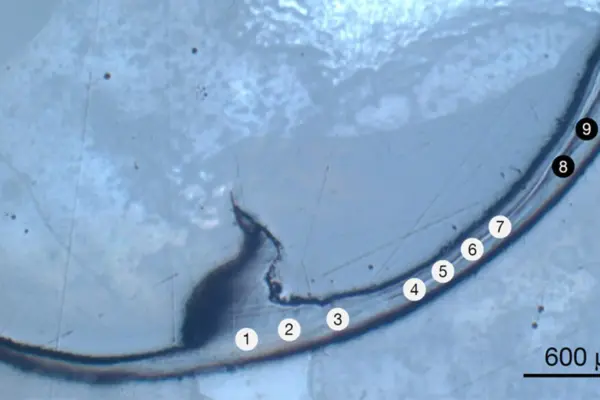
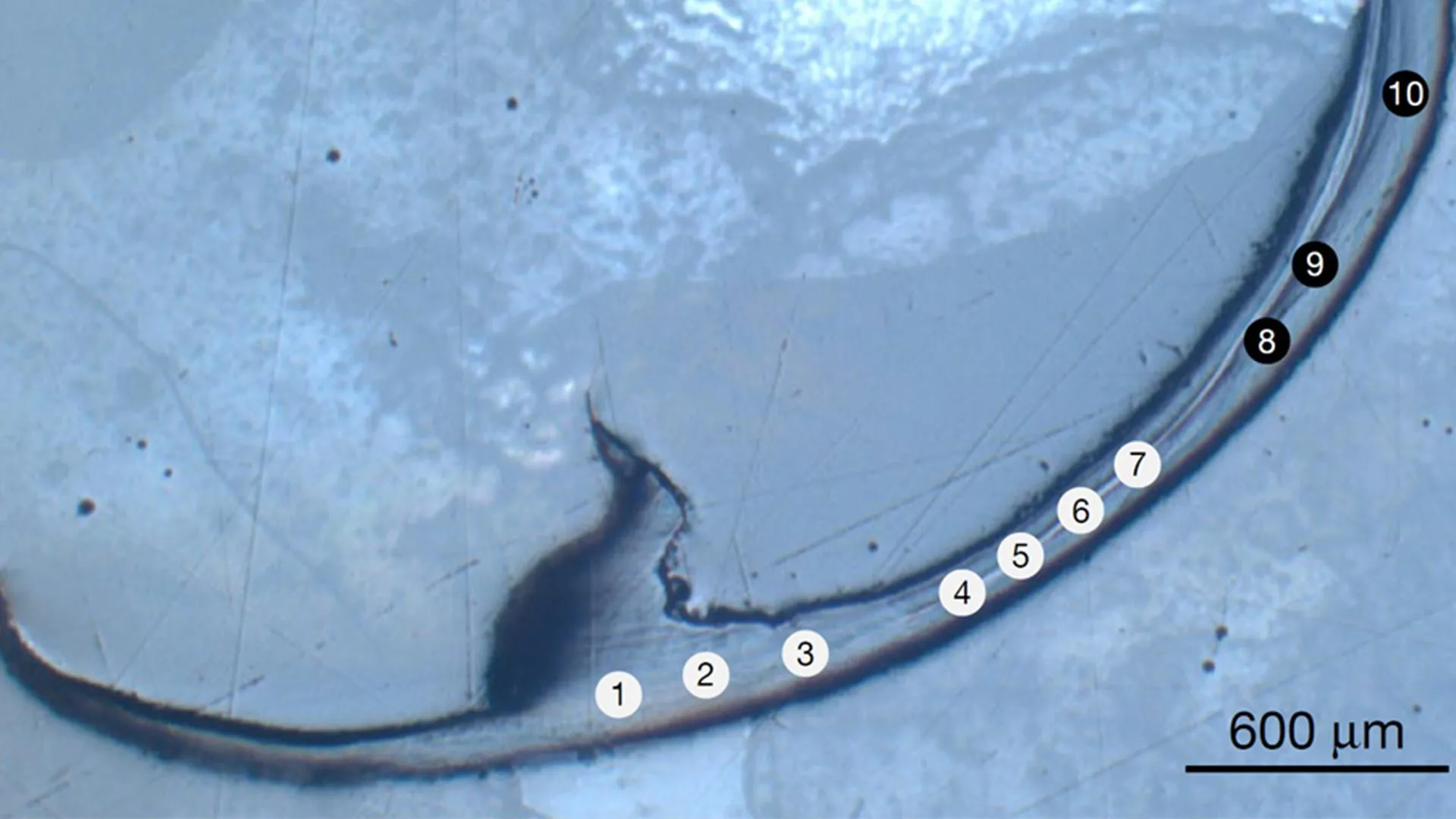
Using nanoindentation—a method that presses a diamond-tipped probe into a material at a microscopic scale with absolute force control—the team mapped the hardness profile across the length of the worm’s jaw.
The empirical data confirmed and expanded upon earlier observations: metal ions (such as zinc and copper) are not evenly distributed throughout the organ. Instead, they are densely concentrated at the razor-sharp tips of the jaws, while the central regions remain softer and more flexible. This gradient design prevents the jaw from shattering upon impact, combining a hard, piercing exterior with a resilient, shock-absorbing base.
Phase IV: Encountering the Nix-Gao Effect
Perhaps the most surprising discovery occurred when the researchers varied the depth of their nanoindentation tests. They observed an unusual mechanical phenomenon previously documented almost exclusively in manufactured, crystalline metals like copper and silver: the Nix-Gao nanoindentation size effect.
This phenomenon dictates that as the area of indentation decreases to microscopic scales, the material paradoxically appears significantly harder to dent. In traditional metallurgy, this occurs because localized strain forces atomic defects (dislocations) to pile up and tangle within the crystal lattice. Finding this exact metallic signature in an organic, protein-rich biological tissue confirmed that the bristle worm jaw was operating under physical rules previously thought exclusive to the foundry.
Supporting Context & Metrics: Defining the Bio-Metal Standard
To appreciate the gravity of the TU Wien and University of Vienna findings, one must examine the precise metrics that separate standard biomaterials from true bio-metals.
The Three Pillars of Bio-Metals
In their foundational framework, the researchers established that a substance must satisfy three strict criteria to be formally classified as a bio-metal:
- Extreme Localized Hardness: The material must achieve Vickers or nanoindentation hardness values comparable to soft-to-moderate industrial metals, facilitated by the incorporation of transition metal ions (such as zinc, copper, or iron) directly into a macromolecular organic matrix.
- Metallic Deformation Responses: The material must exhibit strain-dependent mechanical behaviors—such as the Nix-Gao size effect—where microstructural defect mechanics mirror those found in polycrystalline metallic lattices.
- Hierarchical Ion-Protein Structures: Unlike pure mineral deposits (like calcium carbonate in shells or bones), bio-metals rely on a continuous, cross-linked network where metal ions actively coordinate with structural proteins to dictate both elastic and plastic deformation limits.
| Material Classification | Primary Composition | Structural Hallmark | Key Mechanical Limitation |
|---|---|---|---|
| Standard Biomaterial (e.g., Bone, Antler) | Collagen + Hydroxyapatite | Mineralized composite matrices | Lacks metallic dislocation mechanics and size-dependent hardening. |
| Traditional Metal (e.g., Copper, Silver) | Crystalline metallic elements | Periodic atomic lattices | Heavy, prone to corrosion, lacks biological self-healing or growth capabilities. |
| Bio-Metal (e.g., Perinereis Jaw) | Structural Proteins + Metal Ions | Graded ion-protein coordination networks | Complex to synthesize at industrial scales (currently). |
Beyond Ordinary Metals: Size-Dependent Elasticity
Despite sharing key similarities with copper and silver, the sea worm jaws refused to follow every metallurgical rulebook.
When the researchers analyzed the elasticity of the jaws under varying loads, they uncovered a distinct divergence from standard crystalline metals. While traditional metals display relatively uniform elastic properties across different scales, the bristle worm jaws demonstrated size-dependent elasticity.
This means that the stiffness of the material shifts depending on the scale at which it is stressed—a trait born from the unique interplay between the worm’s structural proteins and its bound metal ions. This discovery proved that bio-metals are not merely "nature’s counterfeit metals," but an entirely novel class of smart, gradient materials engineered by evolution.
Official Statements & Expert Insights
The implications of this research extend far beyond marine biology, offering a tantalizing roadmap for materials scientists, aerospace engineers, and biomedical innovators.
Senior author and researcher Christian Hellmich of TU Wien reflected on the profound nature of these discoveries and the limitations of current scientific understanding:
"Bristle worm jaws also showed size-dependent elasticity. This is a distinguishing feature of bio-metals when compared to standard crystalline metals like copper or silver," Hellmich explained.
While mathematical models successfully mapped how these unusual elastic effects manifest at the atomic level, Hellmich was quick to emphasize that humanity has only scratched the surface of what is possible:
"We are only beginning to understand these natural materials. We plan to extend the experimental database by investigating additional species to refine the theoretical concept and perform dedicated computations, and perhaps most interestingly, to explore the link between genetic interventions and the corresponding material design space."
Hellmich’s enthusiasm underscores the philosophical shift occurring within modern engineering. For centuries, humanity looked to nature for crude shapes—such as bird wings for airplanes or burrs for velcro. Today, researchers are looking to nature for fundamental material recipes, translating biological synthesis into programmable physical performance.
Future Outlook: Engineering the Next Generation of Bio-Metals
As the concept of bio-metals transitions from a theoretical hypothesis to an established pillar of biophysical research, the scientific community is casting its gaze toward future applications. What does a world influenced by bio-metal research look like?
1. Revolutionizing Biomedical Implants
Current metallic implants—such as titanium hip replacements or stainless steel bone plates—often suffer from a phenomenon known as "stress shielding." Because titanium is vastly stiffer than human bone, the surrounding living bone weakens over time due to a lack of mechanical stimulus.
By utilizing the principles of bio-metals, biomedical engineers could design synthetic implants that feature graded stiffness—hard and durable at points of high friction, but gradually matching the elasticity of human bone at the interface. Furthermore, these materials could be engineered to incorporate biocompatible metal ions that actively encourage cellular growth and integration.
2. Sustainable, Low-Energy Manufacturing
Traditional metallurgy is notoriously energy-intensive, requiring massive blast furnaces, toxic chemical baths, and extreme temperatures to melt and cast metals. In stark contrast, marine worms synthesize bio-metals at room temperature, in ambient sea water, using biological blueprints encoded in their DNA.
If genetic and biochemical researchers can decode how organisms shuttle metal ions into specific protein matrices, industrial manufacturing could shift toward room-temperature, bio-synthetic fabrication. Imagine "growing" structural components for aerospace or infrastructure applications using engineered proteins and eco-friendly metallic inputs, drastically reducing the carbon footprint of heavy industry.
3. Expanding the Bio-Metal Catalog
Perinereis cultrifera is merely the first chapter in what promises to be a voluminous library of natural metallurgy. Countless other organisms—from the iron-plated scales of deep-sea hydrothermal vent snails to the magnetic teeth of chitons—likely utilize similar bio-metallic strategies.
As Hellmich and his colleagues at TU Wien and the University of Vienna prepare to expand their experimental database to include additional species, the scientific world stands on the brink of a new era. By bridging the gap between molecular biology and solid-state physics, researchers are proving that the ancient creatures crawling along our ocean floors hold the keys to tomorrow’s most advanced technologies.
In the words of Christian Hellmich, summarizing the driving ethos of this groundbreaking field:
"All this comes with true excitement about the beauty, elegance, and refinement found in and produced by nature."