









Executive Overview
To the casual observer, the Luer connector is a ubiquitous, unassuming piece of medical hardware. For nearly a century and a quarter, this standardized fitting has served as the literal lifeline connecting syringes, catheters, IV lines, and monitoring equipment across global healthcare ecosystems. Yet, for the medical device design engineer, the Luer is a deceptive component. Its apparent simplicity often masks profound complexities in material selection, tolerance stack-up, rigorous regulatory compliance, and lifecycle extractable-leachable profiles.
Consider the real-world scenario of a lead design engineer developing an advanced wearable drug-delivery device. Confident in her approach, she specified the exact Luer lock configuration her team had relied upon for half a decade. Technically, the part still fit. However, she was unaware that her supplier had quietly instituted an unannounced polymer additive modification. This minor material shift altered the connector’s chemical extractable profile, nearly derailing the entire program during late-stage biocompatibility reviews and clinical submittals.
This incident is hardly isolated. Because Luer connectors are so foundational to medical hardware, engineering teams frequently treat them as administrative boilerplate—selecting a part early in the design phase, locking it into the bill of materials, and moving on without a second thought. In modern medical manufacturing, where regulatory scrutiny is intensifying and combination products require unprecedented chemical purity, this historical complacency is a liability.
Engineers must move past basic assumptions about slip versus lock configurations. They must deeply understand the evolving architecture of the ISO 80369 standard series, carefully weigh the nuanced chemical compatibility of high-performance thermoplastics, and rigorously interrogate suppliers regarding material traceability. This comprehensive guide details the practical, mechanical, and regulatory realities of Luer connector selection, offering a roadmap for engineers committed to building safer, more reliable, and fully compliant medical devices.
Detailed Chronology & Historical Evolution
To truly appreciate modern small-bore connectivity challenges, one must look backward to understand how the industry arrived at its current standards. The history of the Luer connector is a fascinating study in iterative design meeting the demands of an industrializing global healthcare market.
The 19th-Century Innovation
The foundational geometry of the modern Luer fitting traces back to 1894, when German instrument maker Hermann Wülfing Lür patented a tapered glass-and-metal syringe tip designed to create a leak-free, easily detachable seal. The defining characteristic of this breakthrough was its precise 6% conical taper (approximately a 1-in-16 angle). This geometric ratio provided just enough wedging friction to hold mating components together under low fluid pressures while allowing clinicians to pull them apart with a simple twist and pull.
Mid-20th Century Standardization and Polymer Adoption
For the first half of the 20th century, Luer fittings were primarily manufactured from glass and machined metals, requiring meticulous cleaning and autoclaving between uses. The post-World War II boom in petrochemicals revolutionized the industry, steering medical manufacturing toward single-use plastics. Injection-molded polymers like polycarbonate, polypropylene, and polyethylene replaced glass and metal.
As hundreds of independent manufacturers began producing plastic Luer fittings globally, subtle variations in manufacturing tolerances emerged. While parts within a single brand’s ecosystem fit well together, mixing components from different vendors often resulted in poor sealing, fluid leakage, or structural cracking due to over-tightening. This interoperability gap prompted the formalization of international standards, eventually leading to the ISO 594 standard, which governed Luer tapers for decades.
The ISO 80369 Paradigm Shift
While ISO 594 successfully standardized dimensions, it did not solve a terrifying clinical hazard: misconnection accidents. Because standard Luer fittings could universally mate with any other Luer fitting, healthcare environments witnessed catastrophic clinical errors. Oxygen lines were mistakenly connected to intravenous lines, enteral feeding tubes were hooked up to peripherally inserted central catheters (PICCs), and intravenous medications were inadvertently delivered via non-vascular pathways.

To eliminate these fatal cross-connection events, the International Organization for Standardization developed the ISO 80369 series. The core philosophy of this standard was revolutionary: create application-specific, non-interchangeable connector geometries that physically prevent cross-device misconnections.
While ISO 80369-7 preserved the traditional Luer geometry for general intravascular and hypodermic applications—introducing much tighter dimensional tolerances and rigorous performance criteria—other parts of the series carved out entirely new, proprietary geometries for neuraxial devices (ISO 80369-6), enteral feeding tubes (ISO 80369-3), and respiratory/anesthesia circuits (ISO 80369-2). This historical transition transformed the Luer from a simple commodity part into a heavily regulated, application-specific engineered interface.
Supporting Context & Mechanical Metrics
Navigating the modern landscape of small-bore connectors requires a granular understanding of mechanical configurations, material properties, and specialty variants.
The Fundamentals: Slip vs. Lock Configurations
Luer fittings are broadly split into two distinct mechanical archetypes:
- Luer Slip Connectors (Luer Taper): These rely purely on friction generated by the 6% conical taper. They are prized for their rapid connect-and-disconnect profile, making them ideal for low-pressure, high-throughput environments such as diagnostic test kits, bench-scale fluid circuits, and fluid sampling assemblies. However, their primary limitation is poor pull-out resistance. Under mechanical vibration, fluid pressure spikes, or lateral strain, a slip connection can easily disengage.
- Luer Lock Connectors: These incorporate a threaded, rotating collar on the male fitting that screws into matching threads on the female receiver. Once fully engaged, the assembly resists both axial pull-out forces and rotational torque. Luer lock is the mandatory default for any clinical application where an accidental disconnection poses an immediate, life-threatening risk—such as high-pressure contrast media injection, intensive care IV therapy, and oncology drug delivery.
+---------------------------------------------------------------------------------+
|                         LUER CONNECTOR SELECTION MATRIX                         |
+--------------------------+---------------------------+--------------------------+
| Metric / Feature         | Luer Slip (Taper)         | Luer Lock                |
+--------------------------+---------------------------+--------------------------+
| Retention Mechanism      | Friction (6% Taper)       | Threaded Collar & Taper  |
| Pull-Out Resistance      | Low to Moderate           | High                     |
| Resistance to Rotation   | None                      | High                     |
| Primary Clinical Use     | Diagnostics, Sampling     | IV Therapy, Infusion     |
| Risk of Disconnection    | Higher under vibration    | Low when fully seated    |
+--------------------------+---------------------------+--------------------------+
The Material Science of Small-Bore Connectors
Choosing the right polymer for a Luer connector goes far beyond basic structural integrity. Engineers must evaluate chemical compatibility, sterilization methods, optical clarity, and extractable profiles:
- Polycarbonate (PC): Offers exceptional impact strength, glass-like optical clarity for visual fluid inspection, and robust compatibility with gamma radiation and EtO sterilization. However, it can be vulnerable to stress cracking when exposed to certain polar organic solvents and harsh lipid emulsions.
- Polypropylene (PP): A cost-effective workhorse offering excellent chemical resistance across a broad pH range. It accommodates multiple sterilization modalities but lacks the optical transparency of PC.
- Polyvinylidene Fluoride (PVDF): A high-performance fluoropolymer utilized when extreme chemical inertness and ultra-high purity are required. While it boasts superior resistance to aggressive solvents and harsh acids, its raw material cost is significantly higher than standard engineering plastics.
- Cyclic Olefin Copolymers (COC/COP): Rapidly emerging as the premier choice for sensitive biologics, gene therapies, and combination products. COC/COP materials offer exceptional moisture barriers, glass-like clarity, and remarkably low extractable and leachable profiles.
Specialty Variants for Complex Engineering Challenges
Beyond standard male and female slip and lock fittings, engineers frequently leverage specialized variants to solve unique mechanical constraints:
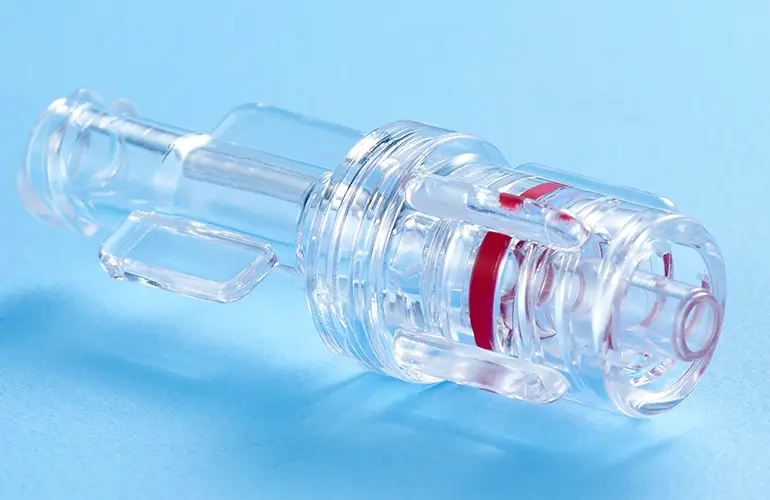
- Valved Luers: Feature an integrated internal check valve that automatically prevents backflow when disconnected, mitigating the risk of fluid leakage or environmental ingress.
- Rotating/Swivel Luers: Designed with a free-spinning collar or joint. When paired with a standard female connector, the swivel joint absorbs torsional stress, preventing the attached tubing from twisting, kinking, or torquing during patient movement or clinician handling.
- Luer-Activated Valves (LAVs): Needle-free, closed systems that open upon mechanical engagement with a male Luer and automatically reseal upon separation. Governed increasingly by standards like ANSI/AAMI CN27:2021, modern swabbable LAVs feature smooth, wipeable surface geometries that inhibit microbial colonization at the injection site.
Regulatory Frameworks & Official Standards
The regulatory environment governing medical connectors is exceptionally stringent. Designing a device without mastering these frameworks guarantees regulatory pushback, costly design iterations, and delayed market entry.
ISO 80369 Series Compliance
As detailed previously, the ISO 80369 standard is the definitive benchmark for small-bore connectors. For design engineers working within infusion therapy, vascular access, and subcutaneous drug delivery, ISO 80369-7 is the operative standard.
It is vital to recognize that compliance with ISO 80369-7 is not guaranteed simply by using a legacy Luer geometry. The standard imposes much tighter dimensional tolerances, stricter peak-stress limits during engagement, and rigorous hydraulic/pneumatic leak testing protocols. Engineers must verify that their component suppliers perform batch-level testing to prove compliance with these heightened mechanical thresholds.

Furthermore, engineers must monitor adjacent standards within the family. For example, ISO 80369-2 (governing breathing systems and driving gases) continues to see evolving market adoption. As regulatory bodies like the U.S. Food and Drug Administration (FDA) and European notified bodies harmonize their guidance documents with the broader ISO 80369 framework, device-specific standards are increasingly amended to mandate compliance.
Biocompatibility and Extractables/Leachables (ISO 10993)
Regulatory agencies view fluid path components as direct-contact materials subject to exhaustive toxicological risk assessments under the ISO 10993 series.
A critical vulnerability in device development is failing to account for post-manufacturing chemical migrations. Even if a polymer raw material is classified as USP Class VI, the injection molding process, thermal histories, mold release agents, masterbatch colorants, and gamma sterilization cycles can generate novel extractables.
Engineers must demand comprehensive Extractables and Leachables (E&L) profiling data from their component suppliers. This data must be generated using clinically relevant extraction solvents that mimic the drug formulation or biological fluid the device will actually transport.
Future Outlook & Industry Recommendations
As medical devices evolve toward smarter, more connected, and highly individualized form factors—such as smart wearable injectors, ambulatory pumps, and complex combination products—the role of the small-bore connector will undergo profound transformation.
1. The Rise of Smart and Connected Fluid Paths
Future iterations of fluid delivery systems will increasingly demand intelligent connectivity. While traditional mechanical Luers will remain vital, the integration of embedded RFID tags within connector collars for automated drug verification, anti-counterfeiting, and automatic infusion parameter loading is on the horizon. Engineers must design housings capable of accommodating micro-electronics without compromising the structural integrity of the Luer taper.
2. Advanced Biocompatible Polymers
The shift toward biologic-based therapeutics, monoclonal antibodies, and cell therapies will accelerate the phase-out of legacy polymers prone to protein adsorption or chemical leaching. Materials such as specialized medical-grade COP/COC blends and fluoropolymers will transition from niche selections to mainstream standards, challenging suppliers to offer lower molecular migration profiles and superior shelf-life stability.
3. Actionable Best Practices for Design Engineers
To mitigate risk and ensure seamless product development, engineering teams should implement a proactive sourcing checklist when evaluating Luer components:
- Audit the Full Material Formulation: Never rely solely on generic polymer names. Obtain complete disclosures of all colorants, slip agents, plasticizers, and stabilizers used in the compound.
- Demand Complete Regulatory Support Files: Ensure the supplier provides verified access to drug master files (DMFs), biocompatibility summaries, and ISO compliance declarations.
- Account for Tolerance Stack-Up Early: Do not assume components from different suppliers will mate seamlessly. Conduct worst-case dimensional tolerance stack-up analyses and physical mating tests during preliminary prototyping.
- Establish Robust Second-Sourcing: Document alternative suppliers early in the design cycle. Verify whether dimensional variations between secondary sources require separate design validation or risk re-assessments.
By treating the Luer connector not as an afterthought, but as a critical engineering sub-system worthy of rigorous technical analysis, design teams can safeguard their programs against regulatory delays, material failures, and clinical risks—ensuring safety and reliability from the benchtop to the bedside.