








Executive Overview
In the sprawling, sun-drenched expanse of the Gulf of California, the ocean’s most formidable apex predators have once again demonstrated their astonishing cognitive capacity and behavioral plasticity. Orcas (Orcinus orca), celebrated globally for their complex social structures and highly specialized, culturally transmitted hunting tactics, have long fascinated marine biologists. From cooperative wave-washing to exhaustively coordinated attacks on blue whales far exceeding their own mass, killer whales continuously push the boundaries of mammalian intelligence. Now, an international team of researchers has formally documented a brand-new behavioral strategy: high-speed, precision-coordinated ramming used to deliberately shatter prey.
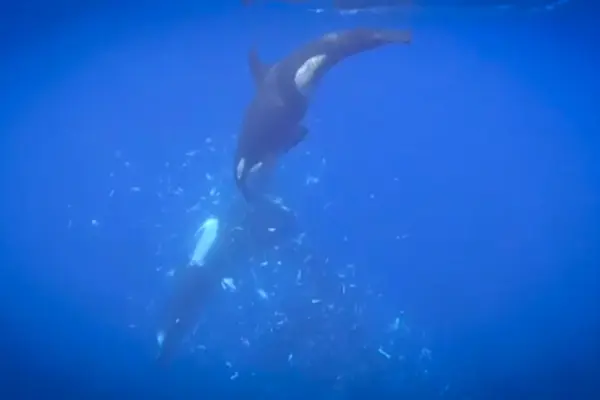
According to a groundbreaking study recently published in Frontiers in Ethology, marine scientists observed orcas manipulating and tearing apart sharp-tail sunfish using a kinetic processing method never before recorded in scientific literature. The mechanics of this newly uncovered behavior are as calculated as they are violent: one orca acts as a stationary anchor, securing the heavy carcass by its tail fin, while a second adult orca accelerates from a distance, slamming into the buoyant prey at high velocity. The resulting impact shatters the sunfish’s tough, gelatinous tissues into thousands of microscopic and macroscopic fragments, scattering the organic material across the water column.
This meticulously executed maneuver serves multiple potential purposes, ranging from the pragmatic socialization and feeding of developing juveniles to complex nutritional processing and, quite possibly, sheer aquatic playfulness. As marine science continually uncovers the nuanced behaviors of these iconic cetaceans, this discovery underscores just how much remains unknown about the complex traditions and innovations thriving beneath the surface of the world’s oceans.
Detailed Chronology of the Discoveries
The documentation of this novel behavioral phenomenon did not happen overnight; rather, it represents the careful collation of rare field observations captured more than a year apart in the rich, biodiverse waters of the Gulf of California.
The July 2024 Index Event
The first documented instance of this high-speed processing strategy occurred in July 2024. Dr. Kathryn Ayres, a lead researcher and scientist with the ocean conservation non-profit Beneath The Waves, was in the field observing a local pod of orcas. The group included several mature adults alongside a curious, energetic juvenile.
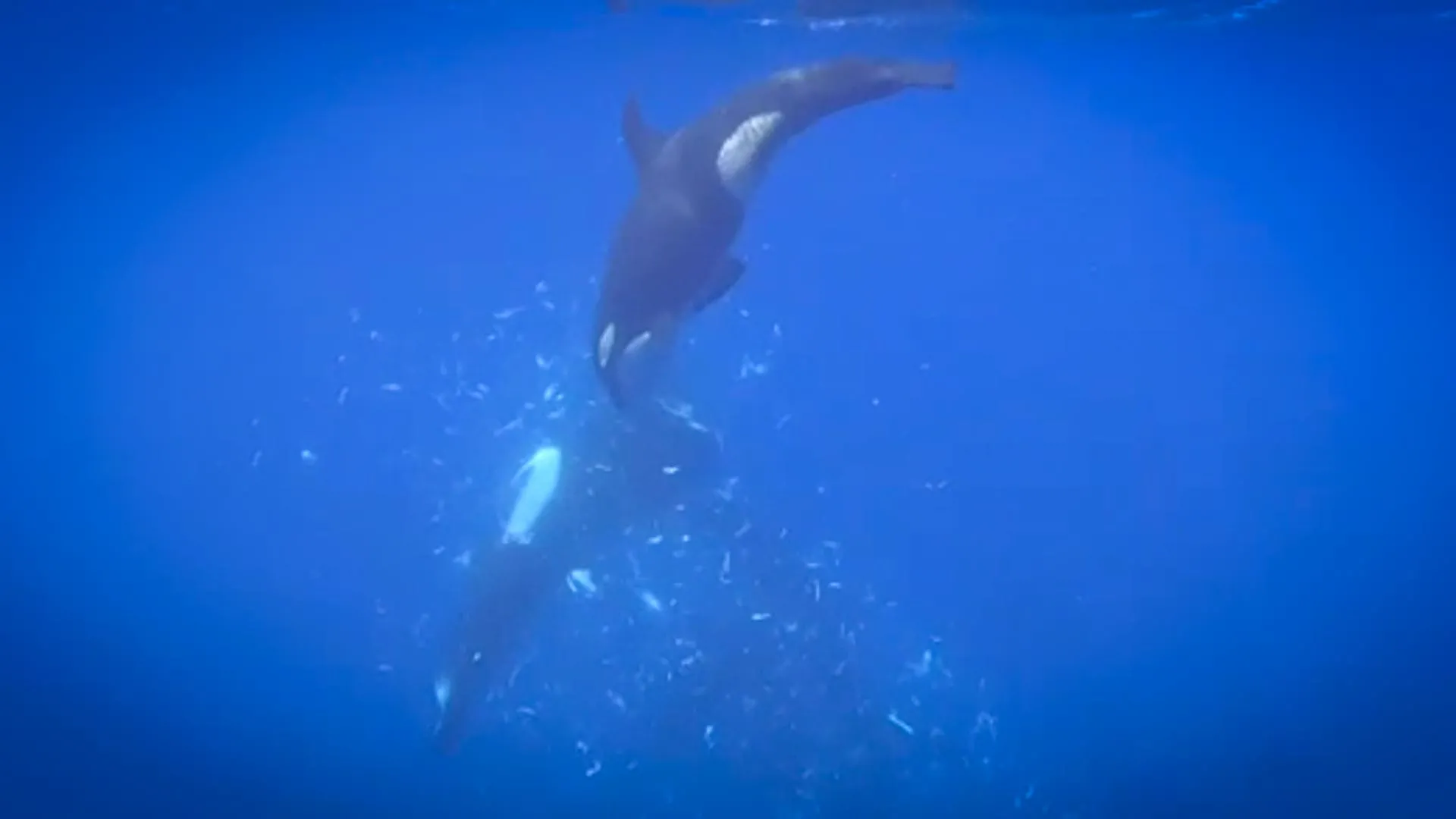
The pod had already successfully dispatched a sharp-tail sunfish—a substantial marine animal—and was in possession of the deceased carcass. Rather than simply tearing into the flesh using their powerful jaws, the orcas exhibited a stunning display of cooperative choreography. An adult female gripped the dead sunfish firmly by its massive tail fin, utilizing the anatomical structure as a secure handle to keep the buoyant, awkward body steady against the ocean currents.
Simultaneously, an adult male orca retreated to a distance, gathered significant momentum, and charged directly toward the anchored duo at high speed. Just fractions of a second before impact, the female released her hold on the sunfish. The charging male struck the stationary target dead-center, generating a kinetic shockwave so intense that the sunfish’s unique structural tissue instantly disintegrated into countless floating fragments.
Following the collision, the juvenile orca darted eagerly through the water column, consuming the smaller, easily digestible pieces of floating tissue. Meanwhile, the adult orcas fed on the remaining primary carcass, leaving the cloud of scattered micro-fragments behind in the wake of their feast.
The September 2025 Confirmation
For marine biologists, a single observation is an intriguing anomaly; a repeated observation begins to define a cultural tradition. That validation arrived in September 2025, when wildlife videographer and researcher Héctor Franz successfully filmed a second, near-identical event in the same general marine region.
Franz’s footage captured the exact same behavioral sequence down to the finest detail: the deliberate holding of the sharp-tail sunfish by one pod member, the strategic retreat and high-speed acceleration of a second individual, the split-second release of the prey, and the catastrophic impact that fragmented the carcass. This subsequent recording proved that the July 2024 incident was not a one-off fluke or an erratic accident, but rather a deliberate, culturally shared technique passed between individuals within the Gulf of California orca population.
Supporting Context & Metrics: Anatomy, Ecology, and Mechanics
To truly understand why orcas employ such an explosive, high-energy method to process their meals, one must examine the unique biological properties of their prey and the marine environment they share.
The Anatomy of the Sharp-Tail Sunfish
Sunfish (Molidae) are among the most bizarre and massive bony fishes in the ocean. They can easily exceed three meters in length and scale up to a staggering 2,000 kilograms (approximately 4,400 pounds). While they regularly traverse various depths of the pelagic zone—frequently plunging into the freezing twilight depths in search of siphonophores and jellyfish—they are frequently forced to return to the surface layers.
At the surface, sunfish engage in vital maintenance behaviors: basking in the sun to passively regulate their body temperature after deep, cold dives, and inviting seabirds or cleaner fish to rid them of ectoparasites. Unfortunately, this sunbathing behavior makes them highly vulnerable to surface predators like orcas, for whom sunfish represent a preferred, highly reliable caloric source in the Gulf of California.
However, consuming a sunfish is no simple task. Unlike typical teleost fish, sunfish lack a conventional tail and possess a thick, tough, gelatinous outer layer known scientifically as the capsule. This rubbery dermal layer and skin house a rich, complex microbiome unique to the species.
The Physics of Kinetic Disintegration
When an orca hits a dead sunfish at high velocity, the physics involved radically alter the structure of the prey. The gelatinous capsule and underlying tissues do not merely tear; under a high-speed blunt-force collision, they shatter.
Researchers note that this specific tissue fragmentation has, to date, only been recorded in sharp-tail sunfish. Other, larger sunfish species possess different structural densities and dermal compositions that may not fracture as readily under similar kinetic stress. The sharp-tail sunfish’s unique response to impact suggests an evolutionary mismatch or, conversely, an ecological niche that these specific orcas have learned to exploit with pinpoint precision.
Furthermore, when the sunfish’s capsule breaks apart, the microbial taxa residing within its skin and gelatinous layers disperse directly into the surrounding seawater. This sudden release alters the local nutrient composition of the water column and forces immediate, close-range contact between the sunfish microbiome and the foraging orcas. Scientists theorize that this intimate exposure to diverse microbial communities could potentially offer unique nutritional advantages, immunological stimulation, or other physiological benefits that researchers are only beginning to conceptualize.
Official Statements and Expert Analysis
The implications of these observations stretch far beyond simple predation mechanics, offering a fascinating window into cetarean sociology and cognitive development.
Dr. Kathryn Ayres, the first author of the study published in Frontiers in Ethology, emphasized the collaborative nature of the events and the sheer adaptability of killer whale behavior:
"We document how one orca holds the sunfish and lets go just before another orca hits it at high speed, causing the tissue to break apart into thousands of pieces," Dr. Ayres explained. "We think this may help younger orcas feed more easily, or it could also just be for fun. Orcas are known for playing with their food."
The element of parental investment and cultural transmission is a cornerstone of orca behavioral ecology. In pods around the world, adults routinely modify their hunting and feeding practices to accommodate and instruct calves and juveniles, who must learn the complex arts of survival over many years.
"Orcas often tear apart prey and share it with other members of the group, including calves and juveniles," Dr. Ayres noted, highlighting the dual purpose of the high-speed ramming strategy. By shattering the bulky, rubbery carcass into manageable, bite-sized fragments, the adults effectively pre-process the meal, allowing the developing juvenile to feed without struggling against the tough, unwieldy outer capsule of the adult sunfish.
At the same time, researchers remain cautious not to over-intellectualize every action through a purely survivalist lens. Cetaceans—particularly top-tier marine predators with high encephalization quotients—exhibit complex play behaviors that serve to hone motor skills, build social bonds, and relieve stress. The possibility that the high-speed ramming is executed purely for the tactile thrill and social cohesion of play aligns perfectly with historical observations of killer whales interacting with seals, rays, and fish.
Future Outlook and Ongoing Research
Despite decades of intensive marine mammal research, killer whales continue to shatter human assumptions about animal intelligence, culture, and adaptability. Each discovery acts as a humbling reminder of how much remains hidden beneath the ocean’s surface.
Moving forward, marine biologists face several key challenges in studying this newly documented behavior. Foremost among them is individual identification. Scientists currently do not know whether the exact same individual orcas participated in both the July 2004 and September 2025 events, or if this technique is practiced by multiple distinct pods within the Gulf of California.
Answering these questions will require a concerted effort to capture high-resolution identification photographs during future field encounters. Specifically, researchers need clear, unobstructed views of dorsal fins—which often feature unique nicks, scars, and growth patterns—as well as the distinctive white eye patches that serve as natural fingerprints for individual killer whales.
"Collecting good identification photographs whenever possible is key: we are still seeing new techniques of how orcas hunt and process their prey," Dr. Ayres concluded. "They’re one of the most iconic marine predators in the world, yet they continue to surprise us."
As global marine ecosystems face mounting pressures from climate change, overfishing, and habitat degradation, understanding the adaptive behaviors and cultural traditions of apex predators like the Gulf of California orcas becomes increasingly vital. Their resilience, ingenuity, and capacity for innovation are testaments to the complexity of marine life—and a compelling call to action for the continued protection and exploration of our planet’s oceans.