








Executive Overview
In the sprawling, sun-drenched waters of the Gulf of California, the ocean’s most formidable apex predators have once again confounded marine biologists with their staggering behavioral complexity. Orcas (Orcinus orca), universally recognized for their sophisticated communication systems, culture-sharing, and diverse cooperative hunting techniques—ranging from wave-washing seals off Antarctic ice floes to intentionally stranding themselves to snatch sea lions along Patagonian beaches—have added an entirely novel entry to their behavioral repertoire.
For the first time in formal scientific literature, researchers have documented a precision hunting and food-processing strategy wherein killer whales utilize high-speed kinetic impact to deliberately shatter their prey. The target of this explosive maneuver is the sharp-tail sunfish, a massive, gelatinous pelagic creature that can measure up to three meters in length and scale a staggering 2,000 kilograms.
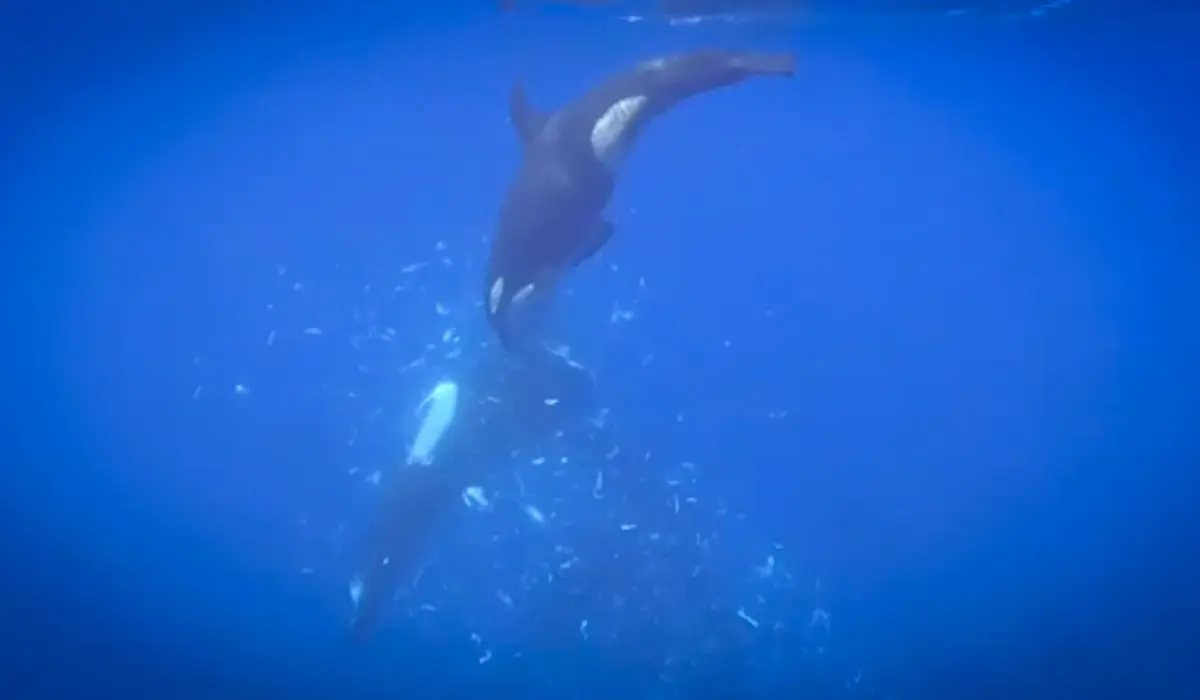
Captured across two distinct, meticulously observed events separated by more than a year—one in July 2024 and another in September 2025—the behavior involves a coordinated, tactical ballet between adult orcas. One whale acts as a living anchor, gripping the sunfish by its heavy tail fin to hold the massive carcass completely steady. A second orca then accelerates from a distance, hurtling toward the stationary target at high velocity and striking it with bone-crushing force. The collision instantly pulverizes the tough, gelatinous tissue of the sunfish, reducing the prey into thousands of floating micro-fragments.
This newly classified "ram-processing" methodology shatters long-held assumptions regarding how marine mammals manipulate heavy, unwieldy prey after a kill. While scientists are still parsing the exact evolutionary drivers behind the phenomenon—hypothesizing everything from parental investment and juvenile weaning strategies to microbiome exchange and simple ludic (playful) behavior—the discovery underscores the sheer adaptability and intelligence of Orcinus orca. Published in the journal Frontiers in Ethology and led by Dr. Kathryn Ayres of the non-profit ocean conservation organization Beneath The Waves, this revelation proves that even after centuries of human observation, the ocean’s top predators still hold profound secrets.
Detailed Chronology of the Encounters
To fully understand the mechanics and implications of this unprecedented marine phenomenon, marine biologists have closely analyzed the step-by-step documentation captured during the two recorded encounters in the Gulf of California.
The July 2024 Encounter: The Initial Discovery
The behavior first came to light in mid-summer 2024. Dr. Kathryn Ayres and her research team were tracking a localized pod of orcas in the nutrient-rich, deep waters of the Gulf of California. The pod had successfully engaged, subdued, and killed a sharp-tail sunfish. Rather than immediately consuming the carcass in a standard mammalian feeding frenzy—which typically involves gripping, shaking, and tearing chunks of flesh away with their interlocking teeth—the orcas engaged in a highly choreographed sequence that initially baffled observers.
According to video footage and field notes, a mature female orca firmly gripped the dead sunfish by its broad, spade-like tail fin. This anatomical anchor point provided a secure, slip-resistant handle on the otherwise unwieldy, disc-shaped body of the fish. With the heavy carcass completely immobilized by the female, a large adult male orca retreated a short distance, oriented himself toward the stationary target, and surged forward at high velocity.
The male struck the suspended sunfish dead-center at a tremendous closing speed. The resulting kinetic impact sent a visible shockwave through the water column. Instead of merely denting or displacing the carcass, the sheer force of the collision shattered the sunfish’s gelatinous, dense tissue, instantly disintegrating the structure into thousands of floating particles and smaller fragments that bloomed outward like an underwater cloud.
Following the impact, a juvenile orca within the pod immediately darted into the debris field, easily consuming the smaller, bite-sized fragments drifting in the current. Meanwhile, the adult orcas fed on the remaining core parts of the carcass, ultimately leaving the scattered, finely minced tissue fragments behind to disperse into the pelagic ecosystem.
The September 2025 Confirmation: Héctar Franz’s Footage
For over a year, researchers debated whether the July 2024 event was a bizarre, isolated anomaly—an eccentric quirk exhibited by a single pod or perhaps even a singular, opportunistic moment of play. However, those questions were definitively answered in September 2025, when underwater photographer and researcher Héctar Franz captured a second, remarkably similar event on film in the same geographic region.
The September 2025 footage revealed an identical behavioral sequence down to the finest details. Once again, an adult orca anchored the sharp-tail sunfish by its tail fin, holding it steady against the pelagic currents, while a second pod member executed a high-speed ramming maneuver. The kinetic strike shattered the sunfish’s outer capsule and internal tissue layers into a localized cloud of debris, which was subsequently fed upon by younger members of the pod.
This second documented instance transformed what was once viewed as an isolated curiosity into a documented, repeatable cultural behavior—a learned culinary and processing technique passed down or shared among orcas inhabiting the Gulf of California. Because researchers were unable to definitively confirm whether the exact same individual orcas participated in both events—due to the absence of clear, high-resolution identification photos of dorsal fins and distinctive eye-patch pigmentation patterns—the scientific community remains eager to secure additional footage to determine if this behavior is widespread across the broader regional population or restricted to a specific family lineage.
Supporting Context & Metrics: Anatomy, Ecology, and Mechanics
To appreciate why orcas would invent a high-speed ramming technique to process a sunfish, one must examine the unique biological and ecological profile of both the predator and its prey.
The Anatomy of the Sharp-Tail Sunfish (Masturus lanceolatus)
Sunfish belonging to the family Molidae are among the most bizarrely shaped and physically imposing creatures in the pelagic realm. Sharp-tail sunfish can exceed three meters in length and scale up to a colossal 2,000 kilograms (4,400 pounds). Unlike streamlined teleost fish built for high-speed bursts, sunfish are compressed laterally, lacking a true caudal fin; instead, they possess a rounded rudder-like structure known as a clavus, flanked in the sharp-tail species by an elongated central projection.
Ecologically, sunfish occupy a unique niche. They traverse various ocean depths, diving deep into mesopelagic zones to forage on gelatinous zooplankton, siphonophores, and jellyfish. However, they frequently ascend to the surface waters to rest, recover from deep dives, thermoregulate by basking in the sun’s rays, and invite cleaner fish and seabirds to rid their massive bodies of ectoparasites. It is during these vulnerable surface-basking intervals that sunfish become prime targets for opportunistic pelagic predators like orcas.
Despite their immense size, sunfish lack conventional scales. Instead, their bodies are encased in a remarkably thick, dense, and elastic gelatinous layer often referred to as the "capsule," beneath which lies a tough, sandpaper-like skin. This gelatinous structure makes traditional biting and tearing difficult for mammalian carnivores, as the rubbery, dense tissue resists clean dental punctures.
The Physics of "Ram-Processing"
The innovation of ramming represents a fascinating adaptation to the physical properties of sunfish tissue. When a 2,000-kilogram fish is suspended and struck by an adult orca moving at high velocity, the kinetic energy transferred into the target is immense.
Orcas are heavily muscled, highly hydrodynamic apex predators capable of astonishing bursts of speed. By utilizing one pod member as a stationary vice—gripping the tail fin—the orcas neutralize the sunfish’s natural ability to drift or deflect the blow. The second orca can thus deliver a hyper-targeted, high-momentum kinetic blow that maximizes structural failure within the prey’s gelatinous matrix.
This mechanical destruction solves a significant foraging challenge: how to dismantle an animal that is too large to swallow whole and too rubbery to easily partition with standard mammalian teeth. By turning kinetic energy into a biological food processor, the orcas bypass the need for prolonged, exhaustive tearing.
Official Statements and Scientific Analysis
The discovery has generated intense excitement within the global marine biology community, sparking peer-reviewed discourse and media interest. Dr. Kathryn Ayres, lead author of the study published in Frontiers in Ethology and a prominent scientist at Beneath The Waves, has offered critical insights into the dual nature of this behavior.
"We document how one orca holds the sunfish and lets go just before another orca hits it at high speed, causing the tissue to break apart into thousands of pieces," explained Dr. Ayres during interviews following the study’s release. "We think this may help younger orcas feed more easily, or it could also just be for fun. Orcas are known for playing with their food."
Nutritional Access and Parental Investment
One of the leading hypotheses put forward by the research team centers on parental investment and the socialization of juveniles. In complex mammalian societies, weaning and transitioning young calves to solid food require deliberate parental scaffolding. Calves and juveniles lack the jaw strength, dental wear patterns, and spatial coordination required to independently break down tough, massive prey items.
"Orcas often tear apart prey and share it with other members of the group, including calves and juveniles," Dr. Ayres noted. By reducing a 2,000-kilogram sunfish carcass into a suspension of bite-sized, floating micro-fragments, adult orcas effectively pre-digest or pre-process the meal, democratizing access to high-energy lipids and proteins for the pod’s youngest and least experienced members.
The Microbiome Hypothesis: An Unexpected Twist
Beyond simple caloric provisioning, the researchers have raised an intriguing biochemical hypothesis involving the sunfish’s unique physiological makeup. Sunfish possess a specialized gelatinous capsule and skin layer that host a distinct, highly localized microbiome—a complex community of bacteria and microorganisms adapted to the pelagic environment.
When the sunfish tissue is explosively fragmented by the orcas’ high-speed impacts, these microbial taxa are instantly dispersed into the surrounding marine water column, fundamentally altering its local nutrient composition. Furthermore, this intense physical fragmentation dramatically increases the contact surface area between the sunfish’s unique microbiome and the external environment—and, crucially, the feeding orcas themselves.
While speculative, researchers suggest that this direct, intimate exposure to novel microbial strains during feeding could offer subtle physiological advantages, ranging from nutritional supplementation to potential immune regulation or gut microbiome conditioning. In a broader ecological sense, it demonstrates how apex predators act as ecosystem engineers, actively redistributing nutrients and biological material through innovative feeding mechanics.
Play, Culture, and Cognitive Complexity
It is impossible to discuss orca behavior without acknowledging their capacity for leisure and culture. Orcas possess the second-largest brains in the marine mammal kingdom, characterized by a highly convoluted cerebral cortex associated with complex problem-solving, emotional processing, and social traditions.
Marine mammalogists have long documented instances of orcas "playing with their food"—tossing seals into the air, rolling juvenile porpoises back and forth between pod members without eating them, or playing games of kelp-tug-of-war. The ram-processing of sunfish may well bridge the gap between utility and recreation. What begins as an innovative hunting or processing technique can easily be co-opted by intelligent, bored juveniles into a social game, reinforcing pod bonds, refining motor skills, and perpetuating cultural traditions across generations.
Future Outlook: Unanswered Questions and the Path Ahead
While the documentation of sunfish ram-processing in the Gulf of California represents a milestone in marine behavioral ecology, it simultaneously opens a Pandora’s box of scientific inquiries that will require years of dedicated research to resolve.
Identifying the Actors: The Need for Photo-Identification
A primary frontier for future research is tracking individual orca participation. Because the Gulf of California hosts distinct, sometimes transient pods of killer whales, marine biologists must capture high-resolution imagery of dorsal fin nicks, scars, and distinctive white or grey eye-patch pigmentation patterns.
"Collecting good identification photographs whenever possible is key," emphasized Dr. Ayres. "We are still seeing new techniques of how orcas hunt and process their prey. They’re one of the most iconic marine predators in the world, yet they continue to surprise us."
Determining whether this ram-processing technique is exclusive to a specific matriarchal lineage or widely distributed across multiple pods will reveal how rapidly complex cultural innovations spread through killer whale societies.
Species-Specific Prey Dynamics
Another pressing question involves the sunfish themselves. To date, this extreme tissue fragmentation via high-speed impact has only been formally documented in sharp-tail sunfish (Masturus lanceolatus). Other, larger or heavier sunfish species—such as the massive ocean sunfish (Mola mola or Mola alexandrini)—possess different dermal and skeletal structures.
Scientists are eager to discover whether sharp-tail sunfish tissue possesses unique structural or biomechanical properties that make it uniquely susceptible to shattering under high-impact trauma, or if orcas apply similar kinetic processing techniques to other large, gelatinous marine organisms across the globe.
Conservation and Management Implications
As marine ecosystems face unprecedented pressures from climate change, overfishing, and shifting ocean temperatures, understanding the intricate ecological relationships between apex predators and their prey becomes increasingly critical. Orcas are sentinel species of ocean health; their behavioral innovations reflect shifting prey availability and ecosystem dynamics.
The documentation of ram-processing serves as a powerful reminder of how much remains unknown about the inhabitants of our blue planet. It highlights the urgent need for continued, non-invasive observational research, acoustic monitoring, and photographic census efforts in regions like the Gulf of California. As long as researchers continue to watch, listen, and document, the ocean’s most intelligent predators will undoubtedly continue to rewrite our understanding of marine animal behavior.