









EXECUTIVE OVERVIEW
In a remote, rugged expanse of Canada’s Northwest Territories, a team of international paleontologists has unearthed an exceptionally rich and pristine fossil cache. This groundbreaking discovery offers an unprecedented lens into the dawn of complex multicellular life. Documented in the journal Science Advances, the research details a treasure trove of Ediacaran biota—mostly soft-bodied organisms that thrived on ancient marine floors more than half a billion years ago.
Led by researchers at the American Museum of Natural History (AMNH) and Dartmouth College, the study focuses on a fossil-bearing strata exposed within the Mackenzie Mountains. The site has yielded over 100 high-grade specimens representing a remarkable diversity of bizarre, extinct marine life forms. Among them are six distinct genera never before documented in North America, alongside specimens radiometrically or stratigraphically dated to approximately 567 million years ago.
This unexpected antiquity pushes back the localized appearance of the famed "White Sea" ecological assemblage by 5 to 10 million years, aligning these North American fossils with the timeline of older global assemblages. More profoundly, the structural sophistication of these organisms—spanning early locomotion, coordinated mass reproduction, and distinct anatomical symmetry—suggests that critical biological innovations like animal movement and sexual reproduction occurred significantly earlier than previously realized. Furthermore, the deep-water depositional setting of these fossils challenges long-held orthodoxies regarding where complex animal ecosystems first bloomed, pointing to the stable, abyssal depths of the ancient ocean rather than sunlit shallow coasts as the cradle of early animal evolution.
DETAILED CHRONOLOGY: A WINDOW 567 MILLION YEARS INTO THE PAST
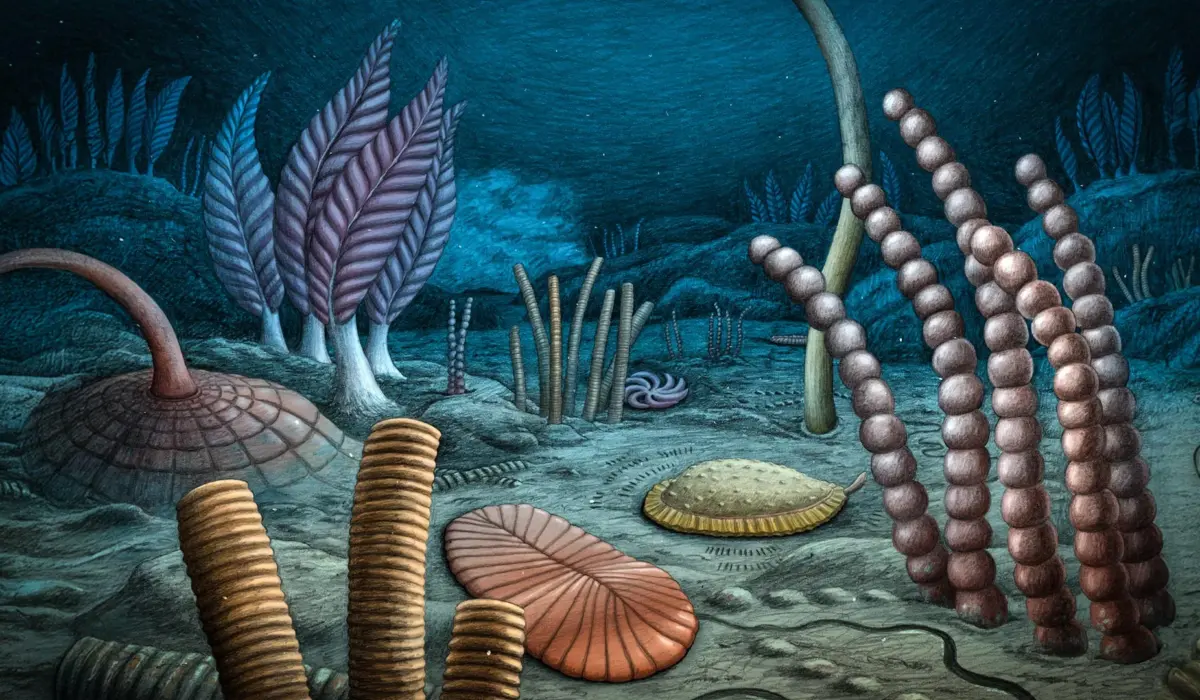
To comprehend the magnitude of the Mackenzie Mountains discovery, science must cast its gaze back across deep time to an era when Earth was unrecognizable. For roughly three billion years following its formation, the planet was a microbial domain dominated by single-celled organisms, cyanobacterial mats, and fluctuating atmospheric chemistry. Then, during the Ediacaran period (spanning from roughly 538 to 575 million years ago), the evolutionary trajectory of the biosphere accelerated violently. Microscopic life gave way to macroscopic, multicellular entities large enough to be seen with the naked eye, featuring organizational complexities and behaviors that prefigure modern animal lineages.
The Three Great Assemblages of the Ediacaran
Paleontologists historically partition the Ediacaran period into three successive evolutionary epochs, or assemblages, defined by distinct fossil communities preserved in strata across the globe:
- The Avalon Assemblage (575–559 million years ago): Characterized by fractal, frond-like organisms that anchored themselves to the seafloor, representing some of the earliest experiments in large-scale multicellularity.
- The White Sea Assemblage (559–550 million years ago): Marked by an explosion in morphological diversity, introducing mobile organisms, bilateral symmetry, worm-like crawlers, and complex disk-shaped or segmented body plans. Until now, White Sea fossils had been cataloged extensively across Europe, Asia, and Australia, but remained conspicuously absent from North America.
- The Nama Assemblage (550–538 million years ago): The final chapter of the Ediacaran, featuring mineralizing organisms and skeletal precursors that bridged the gap into the explosive diversification of the Cambrian period.
The Discovery in the Mackenzie Mountains
The newly uncovered Canadian site upends the neat chronological boundaries separating these assemblages. Situated on the traditional, ancestral lands of the Sahtú Dene and Métis peoples—whose leadership granted crucial guidance and permissions for the scientific expeditions—the site was investigated as part of a multi-decade effort to map the region’s complex stratigraphy.
Led in part by Dartmouth associate professor Justin Strauss, who has spent 15 years studying the geology of northwestern Canada, the team identified fossiliferous layers tucked deep within the Mackenzie Mountains rock succession. When the researchers analyzed the specimens and the surrounding sedimentary matrix, they realized they were staring at a classic White Sea community. However, radiometric and stratigraphic indicators revealed that portions of this assemblage date back roughly 567 million years.
This age places the Canadian specimens squarely within the temporal window of the older Avalon assemblage, effectively blurring the lines between these purported evolutionary stages. The discovery demonstrates that the ecological experiments typically assigned to the middle Ediacaran were already underway much earlier in North America, operating in ecological niches that scientists previously assumed were barren of such complex life.
SUPPORTING CONTEXT & METRICS: ANATOMY OF AN ANCIENT MENAGERIE
Because most Ediacaran organisms predated the evolutionary invention of hard body parts—such as mineralized shells, carapaces, and bones—their preservation required extraordinary, near-miraculous environmental conditions. Typically, soft tissues rot or are consumed by scavengers long before fossilization can occur. At the Mackenzie site, however, fine-grained siliciclastic sediments gently blanketed the seafloor, capturing the delicate impressions of organisms before decay could erase them.
The resulting fossil record displays an astonishing array of body plans that defy easy categorization within modern taxonomic frameworks, alongside others that serve as the foundational roots for extant phyla.
Key Genera Uncovered at the Canadian Site
- Dickinsonia: Often described by paleontologists as resembling a quilted bathmat or an organic pancake, Dickinsonia was a flat, bilaterally symmetrical organism that glided across the ancient seafloor. Devoid of a mouth, gut, or internal organs, it absorbed nutrients directly through its lower surface by consuming microbial mats and algae. Its presence in the deep-water Canadian strata highlights the adaptability of these early macro-organisms.
- Funisia: Taking the form of tube-shaped, modular organisms that grew in dense clusters of similarly sized individuals, Funisia provides science with its oldest direct fossil evidence of synchronized sexual reproduction. Researchers hypothesize that these colonies released gametes into the water column en masse—a reproductive strategy identical to that utilized by modern-day reef-building corals.
- Kimberella: Sporting a muscular foot used for creeping across sediment and a rasping feeding apparatus to scrape up food, Kimberella is widely recognized as an ancestral relative of modern mollusks (snails, clams, and octopuses). Furthermore, the discovery of well-preserved specimens at the site bolsters the hypothesis that Kimberella may represent the oldest known bilaterian—a member of the dominant animal lineage defined by front-to-back and left-to-right symmetry, which encompasses over 99% of all living animal species today.
- Eoandromeda: A radially symmetric organism featuring eight distinct, spiraling arms, Eoandromeda is interpreted by evolutionary biologists as an early relative of modern ctenophores, or comb jellies, showcasing the rapid diversification of complex neural and muscular architectures during this epoch.
Quantitative Metrics of the Find
- Age of Specimens: Up to 567 million years old, pushing the White Sea assemblage timeline back by 5 to 10 million years.
- Taxonomic Diversity: Over 100 distinct fossils cataloged during the initial excavations, featuring six major groups never before identified within North American borders.
- Stratigraphic Potential: The fossil-bearing beds are buried beneath hundreds of feet of continuous rock strata, indicating that the current collection represents only a fraction of what remains entombed in the Mackenzie Mountains.
- Global Distribution: Bridges a major geographic gap, confirming that the White Sea ecosystem was truly global, now verified across every continent except Antarctica.
OFFICIAL STATEMENTS & PERSPECTIVES
The significance of the discovery has resonated deeply throughout the global paleontological community, framing the transition from a microbial Earth to an animal-dominated world in stark relief.
Dr. Scott Evans, assistant curator of invertebrate paleontology at the American Museum of Natural History and lead author of the study, emphasized the profound shift in scale and capability represented by the Ediacaran biota:
"For 3 billion years, life on Earth was dominated by microbes. Then, all of the sudden, we get these strange-looking marine animals big enough to see and capable of behaviors we would find familiar today. If we want to understand this transition, when life first became large, complex, and unmistakably animal, this new site has tremendous potential."
Addressing the surprising antiquity and ecological context of the fossils, Evans noted how the specimens force a reassessment of evolutionary geography:
"These results suggest a pattern where evolutionary innovation begins in deeper environments and later spreads toward the coast. We think of the deep ocean as a dark, inhospitable place, but it is also relatively stable, with few fluctuations in things like temperature and oxygen essential to most animal life. This stability may have provided key opportunities to support early animal life."
Co-author Justin Strauss, associate professor of Earth and Planetary Sciences at Dartmouth College, highlighted the geological uniqueness of the Mackenzie Mountains section, noting that the discovery validates years of persistent field exploration:
"Not only is this new site highly diverse, but also it is from a part of the rock succession where we have previously lacked fossil remains. This is really exciting. Given our understanding of the regional geology in northwestern Canada, there is great potential here to revisit our understanding of Ediacaran Earth history."
FUTURE OUTLOOK: DEEP-WATER CRADLES AND CONSERVATION
The revelation that complex animal ecosystems may have originated in the stable, deep-water environments of the Ediacaran ocean—subsequently radiating outward into shallow, sun-drenched coastal shelves—inverts the traditional paradigm of marine evolution. Historically, biologists assumed that shallow seas, with their high primary productivity, acted as the primary engines for evolutionary novelty. The Canadian findings suggest, however, that the abyssal quietude of offshore marine environments offered a buffered sanctuary where fragile, soft-bodied organisms could safely experiment with multicellularity, motility, and complex reproductive cycles without facing the volatile temperature and salinity shifts common to shallow waters.
As research moves forward, the scientific consortium—which includes contributing authors Erik Sperling from Stanford University and Kimberly Lau from The Pennsylvania State University—plans to return to the Mackenzie Mountains. Backed by grants from NASA’s Exobiology program and the U.S. National Science Foundation (NSF), the team aims to scale the hundreds of feet of overlying rock strata to chart how these communities evolved over millions of years leading up to the Cambrian explosion.
Crucially, the preservation of this heritage remains a collaborative priority. In an agreement that honors both scientific stewardship and indigenous sovereignty, the recovered fossils will eventually be housed in the permanent collections of the Prince of Wales Northern Heritage Centre in Yellowknife, Northwest Territories. There, they will remain accessible for future generations of researchers, serving as a permanent testament to the dawn of animal life discovered in the remote peaks of Canada’s north.