










Executive Overview
Deep beneath our feet, nearly 2,200 kilometers (1,370 miles) below the crust, an ocean of liquid iron churns in a perpetual, high-temperature tempest. For generations, geophysicists have relied on ground-based magnetic observatories and theoretical physics to model this chaotic realm, long assuming that the large-scale circulation within Earth’s outer core followed a relatively sluggish, steady, predominantly westward drift.
That long-standing consensus has now been shattered.
According to a groundbreaking study published in the Journal of Studies of Earth’s Deep Interior, researchers analyzing nearly three decades of satellite and ground-based data have uncovered a staggering anomaly: in 2010, a massive subterranean river of molten metal deep beneath the equatorial Pacific Ocean violently reversed direction. Abandoning its historic westward path, this continent-sized expanse of liquid iron began streaming powerfully eastward.
This unexpected subterranean U-turn was brought to light through an unprecedented synthesis of satellite measurements spanning from 1997 through 2025. By utilizing high-precision orbital data from the European Space Agency’s (ESA) esteemed Swarm and CryoSat missions, alongside historical datasets from Germany’s CHAMP satellite and Denmark’s Ørsted mission, scientists have constructed the most detailed high-resolution dynamic map of Earth’s deep interior ever achieved.
The findings are rewriting textbooks. Rather than a stable, slowly evolving system, Earth’s outer core exhibits a level of turbulence, volatility, and rapid adaptability that scientists previously thought impossible. The Pacific flow reversal not only challenges foundational models of core dynamics, but it also hints at hidden, profound connections linking the liquid outer core to the solid inner core below and the rocky mantle above. While this celestial engine room operates entirely out of reach—posing no direct threat to human life or surface climate—decoding its erratic behavior is vital. The churning of this molten core generates the protective geodynamo, the invisible magnetic shield that guards Earth from the relentless barrage of solar radiation and cosmic rays.
Detailed Chronology: The 2010 Pacific Reversal and the Evolution of Deep-Earth Data
To understand the magnitude of the 2010 event, one must first look at how scientists track a phenomenon occurring thousands of kilometers beneath solid rock. Because direct physical sampling of the core is an impossibility—temperatures rival the surface of the Sun, and pressures are millions of times greater than at sea level—researchers must act as planetary physicians, diagnosing internal health by reading the faint magnetic "pulse" that escapes to the surface.
For decades, variations in Earth’s geomagnetic field pointed uniformly toward a dominant westward circulation pattern within the outer core. This motion is driven by complex magnetohydrodynamic processes: as thermal and compositional buoyancy forces drive the molten iron upward and downward, the rotation of the Earth (the Coriolis effect) twists these currents into aligned, large-scale structures.
However, the baseline of observation changed dramatically in the late 1990s and 2000s with the advent of dedicated geomagnetic satellite constellations.
- 1999–2006: Denmark’s Ørsted mission provides unprecedented global mapping of the magnetic field from space.
- 2000–2010: Germany’s CHAMP satellite offers long-term, highly stable tracking of magnetic fluctuations, allowing geophysicists to refine models of core-mantle boundary interactions.
- 2010: Beneath the equatorial Pacific Ocean, a sweeping, broad expanse of iron-rich fluid abruptly shifts gears. The weak westward flow that had defined the region for decades collapses, replaced almost overnight by a robust, highly concentrated eastward current.
- 2013: ESA launches the three-satellite Swarm constellation. Operating in precise, coordinated polar orbits, Swarm is specifically designed to untangle the complex web of magnetic signals originating from the core, crust, oceans, ionosphere, and magnetosphere.
- 2017: A secondary phenomenon, known as a "geomagnetic jerk"—an abrupt, sharp change in the second time-derivative of the magnetic field—registers globally, further alerting researchers to rapid instabilities in the deep interior.
- 2020–Present: Analysis of continuous Swarm data indicates that the powerful eastward flow beneath the Pacific has begun to lose momentum, peaking and subsequently weakening, which raises profound questions about whether the 2010 event was a transient spike, a multi-year oscillation, or the dawn of a permanent new state.
By stitching together this multi-decade tapestry, the research team—led by Frederik Dahl Madsen of the University of Edinburgh’s School of Geosciences—was able to isolate the 2010 Pacific reversal from background noise, proving that deep-Earth dynamics can pivot on a decadal timescale.
Supporting Context & Metrics: Unraveling the Geodynamo
To truly appreciate the significance of this discovery, it is essential to examine the underlying mechanics of Earth’s interior and the metrics that enable scientists to "see" through solid rock.
The Anatomy of Earth’s Core
Earth is stratified into distinct geological layers:
- The Crust & Mantle: Extending from the surface down to roughly 2,900 kilometers, composed mostly of solid silicate rocks.
- The Outer Core: A roaring, turbulent shell of liquid iron and nickel mixed with lighter elements, spanning from about 2,900 km down to 5,150 km beneath the surface. Temperatures here range from 4,000°C to over 5,000°C.
- The Inner Core: A scorching hot ball of solid iron-nickel alloy roughly the size of Pluto, resting at the absolute center of the planet.
The Geodynamo Engine
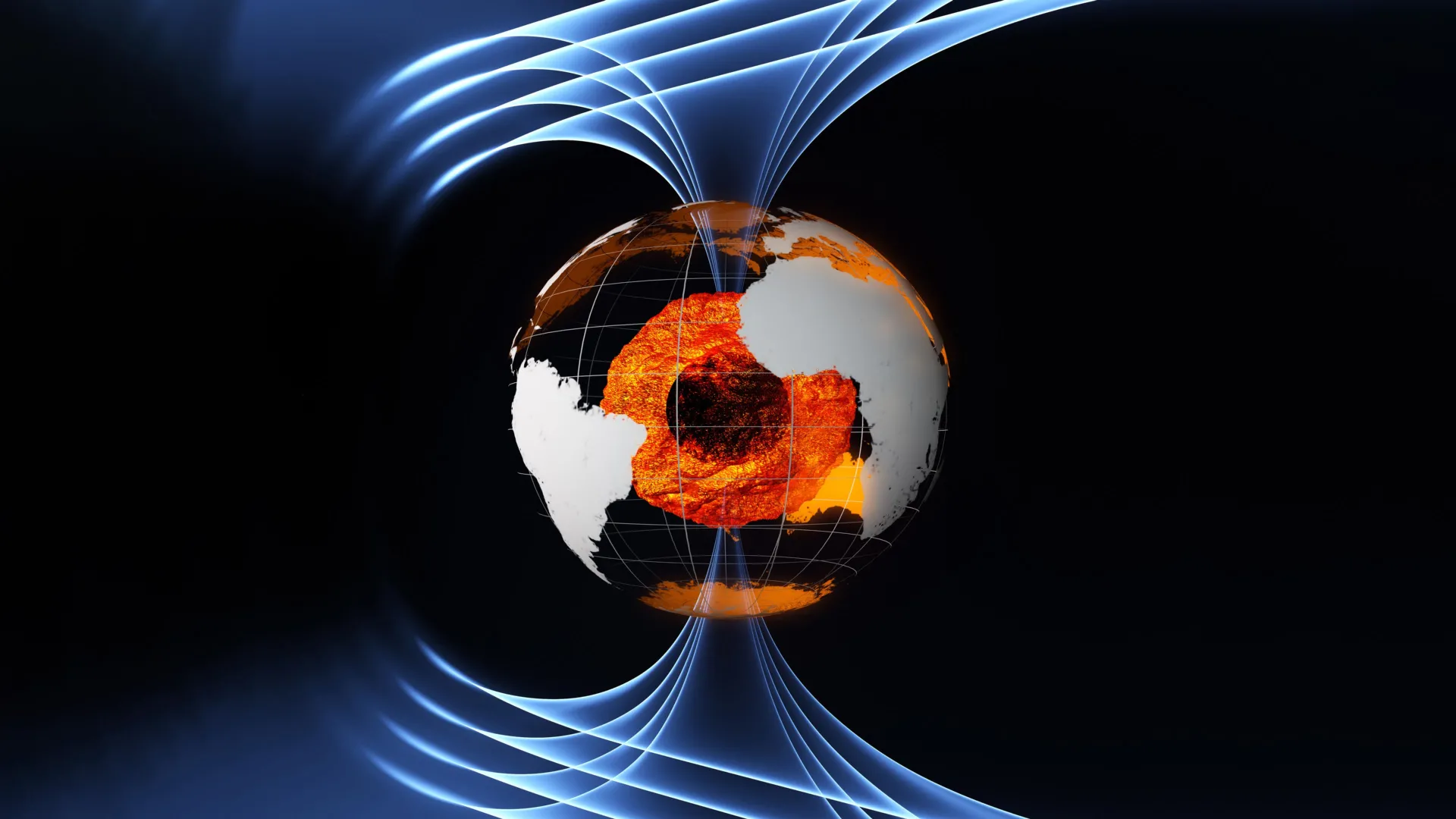
The outer core’s liquid metal is an exceptional electrical conductor. As thermal energy escapes from the scorching inner core toward the cooler mantle, convection currents develop. Coupled with Earth’s rotation, these swirling columns of liquid iron act as a self-sustaining dynamo, converting kinetic energy into magnetic energy. This process creates the geomagnetic field.
While the general dipolar structure of this field remains consistent, its local variations change constantly. Satellites measure these variations with incredible sensitivity. Each satellite in the ESA Swarm constellation carries absolute scalar magnetometers and vector field magnetometers capable of resolving tiny fractions of the magnetic field with nanotesla precision.
By filtering out external noise—such as solar storms interacting with the ionosphere—scientists use these orbital measurements to mathematically invert the magnetic field back to the core-mantle boundary, effectively producing an MRI scan of Earth’s deepest regions. The discovery of wave-like accelerations and rapidly shifting fluid structures during the Pacific anomaly demonstrates that the outer core is governed by complex magneto-Coriolis waves, which can transfer momentum across vast fluid bodies with surprising velocity.
Official Statements and Expert Perspectives
The implications of the Pacific flow reversal have resonated strongly throughout the international geophysics community. Experts point out that this discovery fundamentally alters our understanding of how Earth’s layers interact.
Lead author Frederik Dahl Madsen of the University of Edinburgh emphasized the mystery surrounding the longevity and triggers of the event:
"The large-scale flow reversal beneath the Pacific raises new questions about the behavior of Earth’s deep interior. Scientists now want to understand whether the reversal represents a short-lived fluctuation, part of a repeating oscillation, or a new stable equilibrium for core circulation. Continued monitoring will be essential to determine how the flow evolves over the coming years."
Madsen also highlighted a tantalizing correlation with Earth’s absolute center, noting that the rise of the eastward flow in 2010 coincided with anomalous behavioral shifts observed in the solid inner core via seismology and geodesy:
"We hypothesize that these changes in the deep interior are associated with the changes in flow beneath the Pacific."
From the mission operations perspective, Anja Stromme, ESA’s Swarm Mission Manager, stressed the irreplaceable value of long-term orbital infrastructure:
"Although Swarm was launched after the dramatic reversal event of 2010, it has provided high-precision data that tell us about Earth’s inner core in the period that followed. Importantly, Swarm provides continuous global coverage over many years, allowing scientists to track how core dynamics evolve over time rather than relying only on ground-based magnetic observatories. Long-duration satellite magnetic measurements allow researchers to follow changes in the geodynamo in near-real-time and improve models of Earth’s magnetic field evolution."
Echoing these sentiments, ESA Swarm Mission Scientist Elisabetta Iorfida underscored how the findings challenge dogmatic assumptions about core stability:
"This study shows that regional changes can emerge rapidly within just a decade. The findings may also help scientists investigate possible interactions between Earth’s outer core, inner core, lower mantle and, therefore, give more insights into the core-mantle boundary, which is a critical region for deep Earth dynamics. As the magnetic field continues to evolve, satellite missions are providing an increasingly detailed view of the dynamic processes unfolding deep inside our planet, revealing that Earth’s core may be far more variable and complex than once believed."
Future Outlook: Why Deep-Earth Dynamics Matter Today
While the turbulent ballet of liquid iron unfolding 2,200 kilometers below the Pacific poses zero physical hazard to humanity—it will neither trigger earthquakes at the surface nor alter our weather patterns—it holds immense theoretical and practical importance.
Protecting Technological Infrastructure
The primary product of the core’s churning outer liquid layer is our planet’s magnetic shield. This invisible bubble extends tens of thousands of kilometers into space, deflecting deadly solar winds, coronal mass ejections, and galactic cosmic rays. Without it, Earth’s atmosphere would have long been stripped away, rendering surface life impossible.
Even minor fluctuations in the geodynamo impact modern technological systems. Rapid shifts in the core’s magnetic field propagate upward, causing subtle alterations in near-space weather dynamics. These changes directly affect:
- Navigation and Aerospace: Commercial aviation, maritime shipping, and satellite constellations rely heavily on accurate geomagnetic models (such as the World Magnetic Model) to calibrate compasses and GPS systems.
- Power Grids and Communications: Geomagnetic variations can induce electrical currents in long-distance transmission lines and disrupt high-frequency radio communications.
The Road Ahead for Geophysics
The revelation that regional flow structures in the outer core can reverse within a single decade opens an entirely new chapter in planetary science. Researchers are now racing to update numerical geodynamo simulations to account for these rapid, localized instabilities.
In the coming years, the synergy between archival satellite datasets—stretching from Ørsted and CHAMP to Swarm—and next-generation orbital concepts will be paramount. As the eastward flow beneath the Pacific continues to wane, scientists will watch closely to see if the system snaps back to its historical westward state or transitions into an entirely new dynamic regime.
Ultimately, this discovery serves as a humbling reminder of how much remains to be learned about the world beneath our feet. Earth is not a static rock floating quietly in space, but a living, breathing engine of fire and metal—one whose deepest secrets are finally being dragged into the light by the watchful eyes of satellites in orbit.