









Executive Overview
In the relentless global quest to decouple chemical manufacturing from fossil fuel dependency, the scientific community has long cast an envious eye toward nature’s most abundant yet stubborn aromatic polymer: lignin. Constituting up to 35% of the dry weight of agricultural and forestry waste biomass, lignin is arguably the largest untapped renewable reservoir of aromatic chemicals on Earth. Yet, its sheer abundance has been paradoxically matched by its recalcitrance. For decades, the complex, highly cross-linked, and heterogeneous molecular architecture of lignin has resisted cost-effective, scalable degradation, consigning millions of tons of agricultural byproducts and paper-mill black liquors to low-value thermal utilization or landfills.
Now, a monumental stride forward has been achieved. In a study recently published in the prestigious journal ACS Catalysis, an international research consortium—featuring key contributions from Dr. Christopher Parlett, Xinyue Zhou, and Yutao Jiang from the Department of Chemical Engineering—has unveiled a pioneering catalytic technology. This novel system hinges on a highly efficient "single-atom catalyst" (SAC) capable of dismantling lignin’s robust chemical bonds with unprecedented precision under remarkably mild conditions.
By anchoring isolated ruthenium atoms within a nitrogen-doped carbon matrix, the research team has successfully bridged the gap between fundamental molecular-level observation and industrial-scale applicability. Not only does this catalyst convert model lignin compounds into high-value chemicals like phenol with near-quantitative efficiency, but it has also proven its mettle on raw, heterogeneous biomass extracted directly from forestry and agricultural streams. This breakthrough promises to pave a viable highway toward a circular, bio-based chemical economy, replacing petroleum-derived inputs with renewable, carbon-neutral alternatives for fuels, polymers, and advanced materials.
Detailed Chronology of the Discovery
The journey toward this landmark publication in ACS Catalysis represents the convergence of advanced materials science, high-resolution atomic characterization, and sophisticated computational chemistry. To understand the significance of the team’s breakthrough, it is necessary to trace the developmental milestones that brought single-atom catalysis from theoretical chemistry into the realm of practical biomass valorization.
The Challenge of Recalcitrance: A Historical Bottleneck
For decades, researchers attempting to depolymerize lignin faced a persistent dilemma. Conventional heterogeneous catalysts—typically composed of metal nanoparticles dispersed on porous supports—exhibited frustrating limitations. Because only the surface atoms of these nanoparticles participate in chemical reactions, a vast majority of the expensive precious metal remains trapped and unutilized in the nanoparticle core. Furthermore, these multi-atom clusters often lack the site-specific uniformity required to selectively cleave specific linkages within lignin without promoting runaway side reactions, such as coke formation or undesired repolymerization.
Recognizing these inefficiencies, the international research team set out to engineer a catalyst that would maximize atom utilization while offering pinpoint control over the cleavage of strong carbon-oxygen (C–O) and carbon-carbon (C–C) bonds.
Designing the Single-Atom Architecture
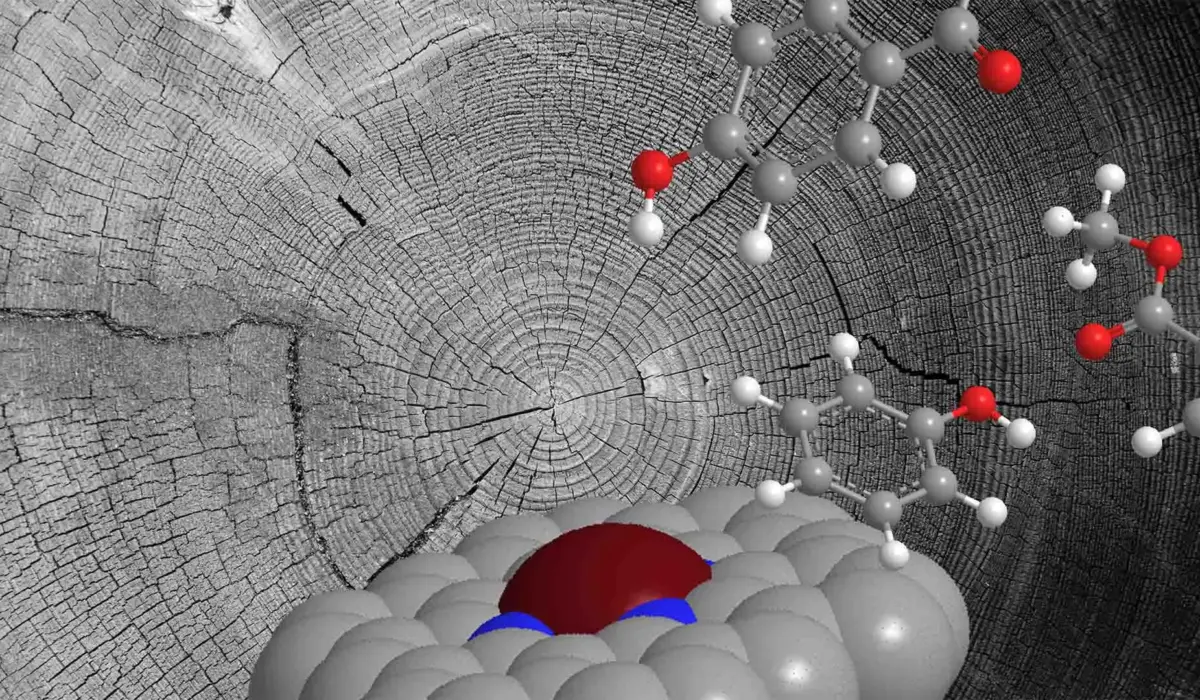
The core innovation centers on the precise immobilization of individual ruthenium atoms onto a nitrogen-doped carbon support. Unlike conventional nanoparticle catalysts where metal atoms aggregate into clusters, this single-atom approach ensures that every single atom of the scarce and costly ruthenium is fully exposed and active.
Through rigorous synthesis and advanced characterization techniques, the team identified and optimized a specific atomic configuration: the Ru-N₄ site. In this localized environment, a central ruthenium atom is coordinated symmetrically by four surrounding nitrogen atoms embedded within the carbon framework. This unique electronic configuration acts as the epicenter for catalytic activity, possessing the distinct electronic properties needed to adsorb and activate molecular oxygen ($O_2$) without requiring extreme temperatures or pressures.
Unraveling the Reaction Pathway
One of the most profound achievements of the study was not merely that the catalyst worked, but that the researchers could prove how it worked down to the individual atomic scale. Historically, the exact active sites responsible for lignin bond cleavage remained shrouded in ambiguity, making rational catalyst design an exercise of trial and error.
By combining rigorous laboratory experiments with advanced density functional theory (DFT) computational modeling, the team mapped the degradation mechanism step-by-step:
- Oxygen Activation: The isolated Ru-N₄ sites capture and activate ambient oxygen molecules from the reaction medium.
- Reactive Oxygen Generation: This activation converts the oxygen into highly reactive oxygen species (ROS) in close proximity to the catalytic center.
- Targeted Cleavage: These transient, highly reactive species attack the robust inter-unit linkages of the lignin polymer—specifically targeting the robust C–O ether bonds and stubborn C–C bonds that hold the macromolecular network together.
- Controlled Fragmentation: The large, intractable lignin macromolecules are systematically snipped into manageable, high-value aromatic monomers and oligomers.
Transitioning from Model Compounds to Real Biomass
A common pitfall in academic catalysis research is the reliance exclusively on simple, idealized "model compounds" that fail to reflect the chaotic, heterogeneous nature of real-world waste streams. The research team deliberately bridged this translational gap.
Following successful optimization using model dimers and trimers, the team subjected their ruthenium single-atom catalyst to raw lignin extracted from diverse agricultural and forestry feedstocks. The catalyst triumphed over this real-world test, efficiently breaking down complex, crude industrial lignins into clean, functionalized aromatic building blocks. This milestone shifted the technology from a laboratory curiosity to a industrially viable platform.
Supporting Context & Metrics: The Lignin Opportunity
To fully appreciate the weight of this scientific advance, one must examine the macro-level economic and environmental landscape surrounding biomass, waste streams, and chemical manufacturing.
+-------------------------------------------------------------------------+
                    THE LIGNIN UPVALUATION PIPELINE
+-------------------------------------------------------------------------+
 [ Agricultural & Forestry Waste ] ---> Up to 35% Lignin Content by Weight
               │
               ▼
 [ Solubilized / Raw Lignin Extraction ]
               │
               ▼
 [ Ru-N₄ Single-Atom Catalyst System ] ---> Mild Conditions (No Harsh Reagents)
               │
               ▼
 [ Targeted Cleavage of C-O & C-C Bonds ] via Reactive Oxygen Species
               │
               ▼
 [ High-Value Aromatic Products ] --------> Phenol, Fuels, Plastics, Resins
+-------------------------------------------------------------------------+
The Biomass Surplus
Every year, agricultural operations, wood-processing plants, and paper mills generate hundreds of millions of tons of lignocellulosic biomass. Cellulose and hemicellulose—the carbohydrate fractions of this biomass—have historically received the lion’s share of attention, finding applications in paper production, bioethanol, and packaging materials.
Lignin, by contrast, has been treated as an industrial afterthought. Comprising a complex, random three-dimensional phenylpropane polymer network, it was traditionally burned in recovery boilers simply to generate low-grade process heat for pulp mills. Utilizing this immense carbon resource as a chemical feedstock has long been considered the "Holy Grail" of biorefinery research.
Quantifying the Efficiency Gains
The metrics associated with the new ruthenium single-atom catalyst underscore its disruptive potential:
- Atom Economy: By isolating metal atoms individually, the system achieves near 100% atom efficiency for the ruthenium component, drastically reducing the mass loading of noble metals required per unit of converted biomass.
- Conversion Rates: Under optimized laboratory and bench-scale testing, the catalyst routinely achieves near-total conversion of model lignin compounds.
- Product Selectivity: Rather than reducing lignin to an unmanageable sludge of randomized tar and char, the process yields clean, high concentrations of valuable monomeric aromatics, chief among them phenol—a critical industrial precursor for resins, adhesives, engineering plastics, and pharmaceuticals.
- Process Severity: Traditional lignin depolymerization often demands extreme thermochemical conditions, including hydrogen pressures exceeding 50 atmospheres and temperatures upwards of 300°C, frequently necessitating hazardous chemical additives. The new protocol operates under exceptionally mild conditions, bypassing the need for high-pressure hydrogen gas lines and aggressive, corrosive reagents.
Official Statements and Expert Perspectives
The implications of this breakthrough extend far beyond the immediate confines of the chemistry laboratory. Leaders of the research team have emphasized both the foundational scientific leap and the broader translational vision for sustainable manufacturing.
Reflecting on the atomic-level precision achieved in the study, Dr. Christopher Parlett, Lecturer in Chemical Engineering and co-author of the research, emphasized the paradigm shift in catalyst design:
"Understanding exactly how these catalysts work at the atomic level allows us to design better materials for converting renewable resources into valuable chemicals. For too long, catalysis in biomass upgrading has relied on empirical observation rather than targeted design. By decoding the precise role of the Ru-N₄ site, we are opening the door to predictive catalyst engineering—building materials atom by atom to perform specific, highly difficult chemical transformations."
Co-investigators Xinyue Zhou and Yutao Jiang echoed these sentiments, pointing out that the versatility of the nitrogen-doped carbon support opens up expansive combinatorial possibilities. By tweaking the local coordination environment of the single metal atoms, researchers can potentially fine-tune catalytic activity to target specific chemical bonds within different classes of biomass polymers, ranging from softwoods to hardwoods and herbaceous agricultural residues.
Industry analysts have similarly noted that the shift toward milder reaction conditions significantly de-risks the eventual scale-up of the technology. Lower operating temperatures and pressures translate directly into lower capital expenditure (CapEx) for reactor vessels and reduced operational expenditure (OpEx) for energy input, making biorefinery integration economically compelling for commercial partners.
Future Outlook: Toward a Circular Bio-Economy
The publication of this study in ACS Catalysis marks the end of one chapter and the urgent beginning of another. As the research team transitions from fundamental mechanism validation to pilot-scale engineering, several strategic pathways emerge for the future of sustainable chemical manufacturing.
1. Scaling and Reactor Engineering
Moving from batch-reactor testing in glass vessels to continuous-flow tubular reactors represents the next critical milestone. Continuous processing is vital for industrial adoption, allowing refineries to process continuous streams of black liquor or organosolv lignin extracted from regional pulp mills and agricultural biorefineries.
2. Multi-Metal and Alloy Single-Atom Systems
While ruthenium has demonstrated exceptional efficacy in activating oxygen and cleaving robust bonds, researchers are already looking toward earth-abundant alternatives. Investigating whether similar single-atom coordination geometries can be achieved with cheaper, more sustainable transition metals—such as iron, cobalt, or nickel—could dramatically slash the raw material costs of the catalyst itself, rendering the entire process even more economically viable.
3. Integration into Existing Petroleum Refineries
The ultimate vision for lignin upcycling is not to construct isolated bio-refineries in a vacuum, but to integrate them seamlessly with existing chemical infrastructure. Phenol and other aromatic building blocks derived via single-atom catalysis can be directly fed into established chemical supply chains, serving as drop-in replacements for petrochemical equivalents in the production of resins, polycarbonates, epoxy plastics, and sustainable aviation fuels (SAFs).
4. Rewriting the Linear Economy
Society’s reliance on fossil-resource extraction operates on a fundamentally linear, take-make-dispose model that drives planetary climate disruption. By harnessing technologies like the ruthenium single-atom catalyst, humanity moves closer to a fully closed-loop circular economy. Agricultural wastes, forestry residues, and industrial byproducts are systematically captured, structurally dismantled at the atomic scale, and rebarned into high-value functional materials.
In summary, the breakthrough reported by the Department of Chemical Engineering research team is much more than an incremental academic advancement. It is a masterclass in precision materials engineering that transforms a stubborn industrial headache—lignin recalcitrance—into a boundless, renewable foundation for the green chemical industry of tomorrow.