






Executive Overview
Long before the first terrestrial footprints scarred the ancient mud, and hundreds of millions of years prior to the reign of the dinosaurs, the shallow marine basins of Earth thrived in an alien, flourishing marine ecosystem. Among the primary architects of these early Paleozoic coral reefs were crinoids—sessile, stalked echinoderms distantly related to modern starfish and sea urchins. Superficially resembling delicate underwater lilies swaying in prehistoric currents, crinoids were remarkably successful organisms, anchoring themselves to the seafloor and filtering nutrients from primordial waters.
However, the biological legacy they left behind is notoriously incomplete. Because the fossilization process overwhelmingly favors calcified structures like skeletal plates, columnals, and calyxes, the vast majority of our understanding of crinoid biology is derived from skeletal fragments. Soft tissues—such as skin, muscular networks, internal organs, and delicate feeding appendages—routinely decompose within hours or days of an organism’s death, leaving an impenetrable barrier between modern scientists and the daily realities of ancient life.
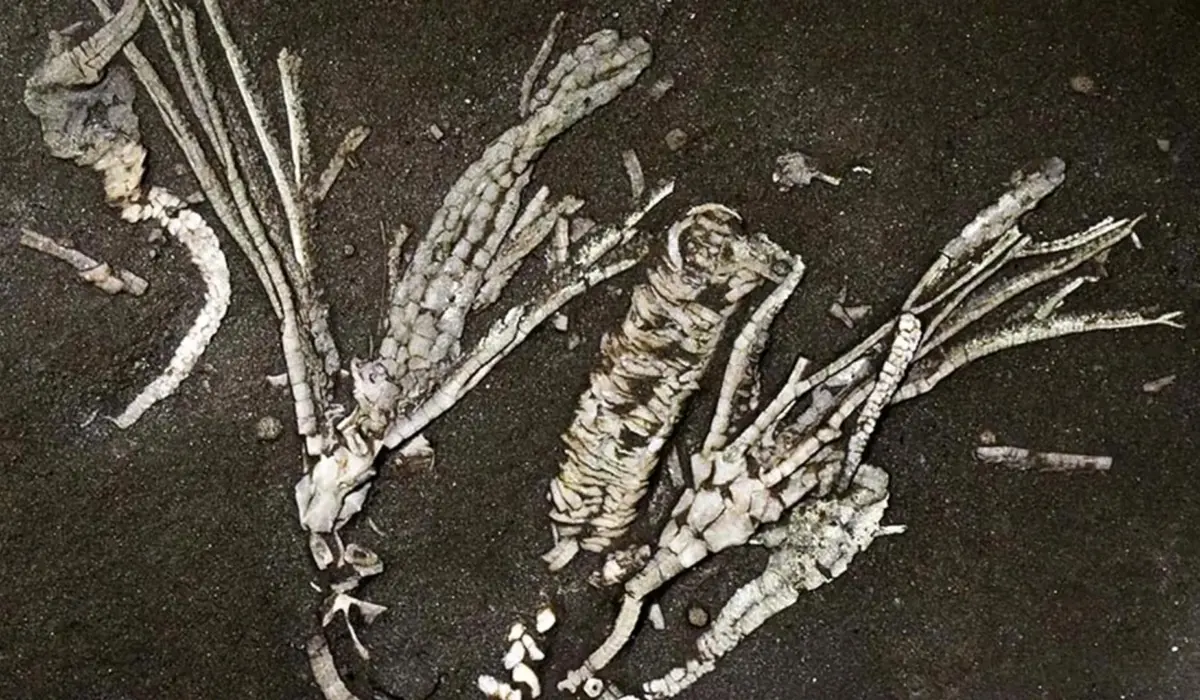
This paradigm has shifted dramatically due to a groundbreaking study published by paleontologists at the University of Oklahoma (OU). Examining a specimen of the Ordovician crinoid species Dendrocrinus simcoensis, researchers have unveiled a paleontological marvel: exceptionally preserved soft tissues, specifically delicate tube feet, dating back over 450 million years. Housed for years within the unassuming archives of Montréal’s Musée de paléontologie et de l’évolution—a small, community-funded institution—this specimen represents the oldest known fossilized crinoid soft tissue ever discovered.
Out of millions of cataloged crinoid fossils worldwide, this marks only the second time in paleontological history that soft tissues have been definitively identified in this group. More than 200 million years older than the earliest known dinosaur remains, this "one-in-a-million" discovery provides unprecedented clarity into ancient feeding strategies, evolutionary adaptations, and the ecological dynamics of Paleozoic oceans. Furthermore, the discovery underscores the irreplaceable value of global museum archives, proving that revolutionary scientific breakthroughs often lie quietly in storage drawers, waiting for the right combination of modern technology, sharp expertise, and inquisitive minds.
Detailed Chronology and the Mechanics of Exceptional Preservation
To fully appreciate the magnitude of the Dendrocrinus simcoensis discovery, one must examine the timeline of discovery, the precise anatomical features preserved, and the exceedingly rare geological circumstances required to prevent organic decay.
The Anatomy of the Extraordinary Specimen
The focal point of the OU research team’s investigation is a fossil assigned to Dendrocrinus simcoensis, a species that inhabited the shallow seas of the Ordovician period more than 450 million years ago. While paleontologists have long possessed a robust framework of the species’ skeletal morphology—its calcium carbonate calyx (head) and flexible stem segments—the newly analyzed specimen preserves the creature’s delicate tube feet.
In crinoids, tube feet (podia) are microscopic to sub-millimeter anatomical structures lining the arms and pinnules. These delicate appendages are critical for survival: they generate water currents, trap suspended organic micro-particles, and transport food toward the central oral groove. Because they are composed entirely of soft, pliable organic matter without rigid mineralized bracing, their preservation in the fossil record is virtually unheard of.
When Dr. Lena Cole and Dr. David Wright—assistant curators of invertebrate paleontology at the Sam Noble Oklahoma Museum of Natural History—closely examined the specimen during a research excursion to Montréal, they realized they were looking at structural details previously thought lost to deep time.
The Geology of a Natural "Vacuum-Sealer"
The survival of organic structures across four and a half millennia requires a geological anomaly. Organic decay is typically driven by microbial activity, scavenging, and oxygen exposure immediately following death. For soft tissues to survive intact, the surrounding environment must act almost instantaneously as a natural refrigerator, vacuum-sealer, or chemical preservative.
[Organism Dies]
       │
       ▼
[Rapid Burial / Anoxic Environment] (Halts microbial decay & scavenging)
       │
       ▼
[Mineral Replacements / Pyritization / Carbonization] (Locks tissue structure in place)
       │
       ▼
[450 Million Years of Deep Geological Stability]
       │
       ▼
[Discovery in Museum Archive via Advanced Analysis]
In the case of this Dendrocrinus simcoensis specimen, rapid burial in fine-grained sediment likely created an anoxic (oxygen-depleted) microenvironment. This lack of oxygen starved aerobic bacteria of the resources needed to break down complex organic polymers. Over subsequent epochs, low-temperature chemical replacements—potentially involving minute mineral films or early-stage authigenic mineralization—encased the fragile tube feet in a protective mineral matrix, effectively freezing the biological architecture in stone before decay could erase it.
Supporting Context, Metrics, and Comparative Analysis
The statistical rarity of this find places it in an elite tier of paleontological discoveries. Contextualizing the specimen through comparative metrics reveals just how improbable its survival and subsequent identification truly are.
Statistical Metrics of Crinoid Preservation
- Geological Age: Over 450 million years old (Middle to Upper Ordovician).
- Comparative Temporal Scale: Approximately 200 million years older than the earliest known dinosaur species (Eoraptor or Herrerasaurus of the Late Triassic).
- Fossil Abundance vs. Soft-Tissue Recovery: Out of the millions of fossilized crinoid specimens cataloged across global museums and private collections, this specimen represents only the second known instance of preserved soft anatomy.
- Institutional Scale: The Sam Noble Oklahoma Museum of Natural History houses over one million invertebrate paleontology specimens alone, highlighting the immense volume of unmined data resting in institutional care worldwide.
Evolutionary Divergence and Functional Morphology
By analyzing the morphology, spacing, and size of the preserved tube feet, Drs. Cole and Wright were able to draw direct comparisons between ancient crinoids and their modern-day marine descendants (such as sea lilies and feather stars).
In modern biology, an organism’s feeding apparatus acts as a direct evolutionary response to its immediate environmental pressures. Just as mammalian tooth morphology provides immediate clues regarding whether an animal was an herbivore, carnivore, or omnivore, the structural arrangement of a crinoid’s tube feet illuminates its specific ecological niche.
When the researchers compared the Ordovician Dendrocrinus simcoensis tissues with those of extant crinoid species, the anatomical disparities were profound. The ancient species exhibited structural configurations fundamentally distinct from anything observed in modern seas. This stark divergence demonstrates that early crinoids utilized diverse, highly specialized hydrodynamic feeding strategies that evolved significantly as Paleozoic marine ecosystems underwent major shifts in nutrient availability, predator pressures, and water chemistry.
Official Statements and Academic Insights
The implications of the research extend far beyond crinoid taxonomy, offering a window into the broad adaptive evolution of early animal life. The lead researchers shared critical perspectives on the discovery:
"After an animal dies, soft tissues like skin, eyes, or internal organs are the first things to decay," explained Dr. Lena Cole, OU paleontologist and assistant curator of invertebrate paleontology at the Sam Noble Oklahoma Museum of Natural History. "Most fossils are only made up of hard parts like bones, teeth, or shells. Soft tissues are only preserved when the environment acts almost like a natural refrigerator or vacuum-sealer—conditions that are incredibly rare."
Emphasizing the sheer improbability of the find, Cole noted:
"Preservation like this is truly one in a million. Crinoid fossils number in the millions, and this is only the second time soft tissues have ever been found. Comparisons with living crinoids show that the anatomy of this ancient species was very different. This gives us new insight into how crinoids evolved and how their feeding strategies changed over hundreds of millions of years."
Co-author Dr. David Wright, also an OU paleontologist and assistant curator at the Sam Noble Museum, underscored the immense temporal gap bridged by the fossil:
"It’s incredible these soft tissues have survived more than 450 million years. For reference, these soft tissues are more than 200 million years older than the oldest dinosaur."
Discussing the functional utility of the discovery, Wright added:
"Since crinoid tube feet are used for feeding, you can think of them in a similar way to how we think about teeth in mammals. Differences in their structure tell us about what kinds of environments a species lived in and how it fed. Fossilized remains of long-extinct species can show features well outside the range of variation we see in living species. By comparing ecological ways of life for extinct and modern species, we can understand how patterns of adaptive evolution have changed through time and what factors shaped the modern biosphere."
The Hidden Power of Museum Archives
While the public imagination often associates major paleontological breakthroughs with rugged expeditions beneath desert suns or cliffside excavations in remote badlands, the Dendrocrinus simcoensis discovery highlights a parallel truth: some of the most profound scientific discoveries are already sitting quietly indoors.
The specimen had spent years quietly archived within the collections of Montréal’s Musée de paléontologie et de l’évolution, a modest institution sustained entirely through community contributions and local dedication. Its true scientific significance remained unrecognized until crinoid specialists Dr. Cole and Dr. Wright performed a rigorous, hands-on examination during a collaborative research trip.
"New fossil discoveries ultimately come from fieldwork, but museum collections play a significant role in this kind of integrative research," Wright observed. "We don’t always know the full significance of the specimens we collect. New technologies, ideas, or expertise often find surprising ways to utilize existing specimens to make new discoveries."
Cole echoed this sentiment, emphasizing the social and financial ecosystem that keeps foundational scientific data intact:
"This discovery highlights the importance of museum collections and the community support that keeps them alive. Without the dedication of many people caring for these collections, this research would never have been possible."
Future Outlook and Ongoing Research
The successful analysis of the Dendrocrinus simcoensis soft-tissue specimen marks the beginning of a broader technological and investigative push within invertebrate paleontology.
As imaging technologies evolve—incorporating high-resolution micro-CT scanning, laser-stimulated fluorescence, and advanced chemical microscopy—paleontologists are increasingly equipped to re-examine legacy collections with microscopic precision. These tools allow researchers to probe internal structures, trace organic residue, and map molecular degradation pathways without destroying irreplaceable samples.
At the Sam Noble Oklahoma Museum of Natural History, where the invertebrate paleontology collections house upwards of one million specimens and continue to grow annually, the philosophy of open, global accessibility remains paramount.
"This is why we work to make our collections accessible to researchers around the world," Wright concluded. "There are simply too many fossils to study over one person’s career. There’s more than a lifetime’s worth of discoveries waiting to be found."
As researchers worldwide gain access to these vast, under-explored archives, the 450-million-year-old tube feet of Dendrocrinus simcoensis serve as a powerful reminder: the history of life on Earth is still being written, often by looking backward into the very drawers we thought we knew best.