










Executive Overview
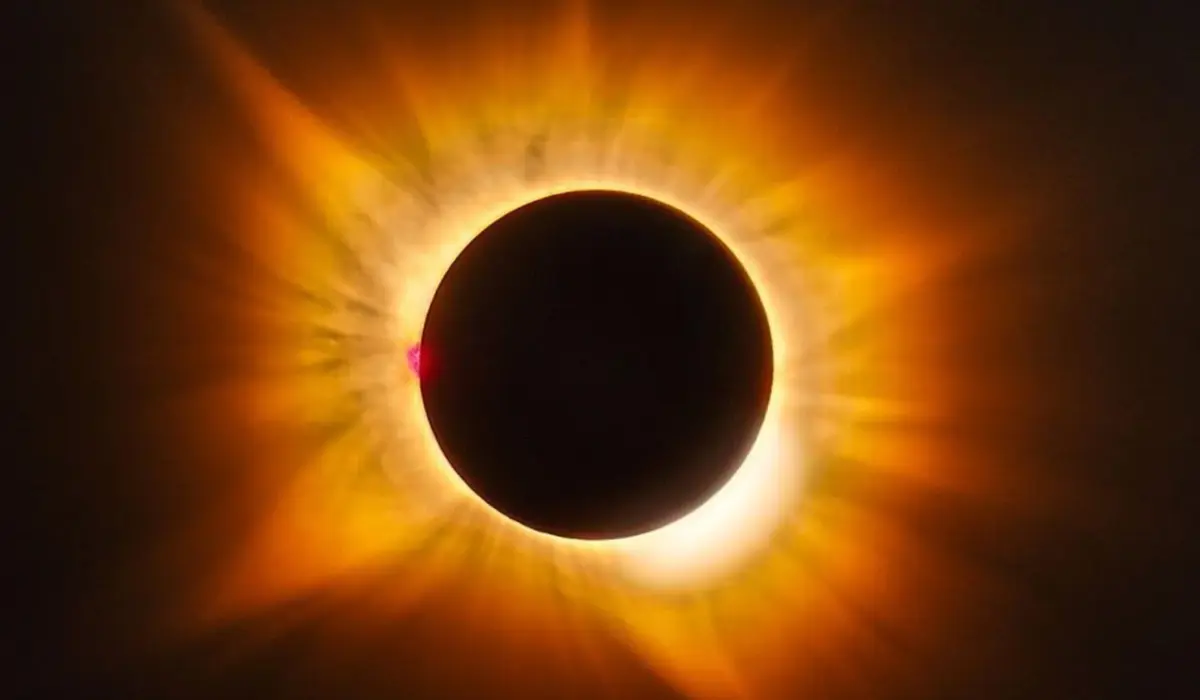
Last week’s total solar eclipse delivered far more than a breathtaking celestial alignment for millions of onlookers across the globe; it provided a rare convergence of astronomical mechanics and terrestrial atmospheric optics. While standard total solar eclipses typically reveal the Sun’s outermost atmosphere—the corona—as a ghostly, pearly-white or silvery halo, observers stationed in specific regions of Spain were treated to an extraordinary visual anomaly. Against the twilight sky, the solar corona emerged draped in a rich, luminous golden hue.
This unexpected chromatic display was not a product of any intrinsic shift in the Sun’s physical properties, but rather the result of a precise optical interplay between celestial geometry and Earth’s dynamic lower atmosphere. Specifically, totality in Spain occurred while the eclipsed Sun hovered precariously close to the western horizon. Consequently, the photons emitted by the inner and outer corona were forced to traverse an exponentially thicker column of Earth’s atmosphere than they would during a zenith-passing eclipse. This extended atmospheric transit triggered severe Rayleigh scattering, stripping away shorter, cooler blue wavelengths of light.
Compounding this natural sunset-like filtering effect was an extraordinary terrestrial factor: elevated particulate matter originating from active regional forest fires. Airborne smoke particles acted as an aggressive, secondary optical filter, further scattering the remaining blue spectrum and supercharging the warm, amber tones into a brilliant gold. Amidst this monochromatic wash of celestial amber, a striking contrast appeared along the solar limb—a vivid, shock-pink prominence composed of glowing hydrogen plasma, defying the atmospheric tinting to provide a masterclass in astrophysical photography. Captured via advanced high-dynamic-range (HDR) processing techniques from Benavente, Spain, this event has since ignited intense interest among atmospheric scientists, optical physicists, and eclipse-chasing astronomers eager to understand the micro-conditions that remade the face of the Sun.
Detailed Chronology
Phase One: The Approach and Geometrical Alignment
The journey toward this unprecedented visual phenomenon began weeks in advance as precise orbital mechanics aligned the Earth, Moon, and Sun. However, the geographic path of totality dictated that as the lunar shadow swept across the Iberian Peninsula, the geometry of the Earth’s curvature placed the Sun at a remarkably low altitude relative to the local horizon.
As the partial phases of the eclipse progressed into late afternoon, observers in Spain noted the atypical slant of the light. Unlike tropical or high-altitude eclipses where the Sun blazes overhead from the blackness of the stratosphere, the Spanish observation sites were already bathed in the long, slanting rays of an approaching evening. The Moon’s shadow marched across the landscape at supersonic speeds, but to the human eye, the terrestrial environment already possessed the soft, golden-hour warmth characteristic of civil twilight.
Phase Two: Totality and the Emergence of the Golden Crown
The critical window of totality—lasting merely a few minutes—marked the sudden plunging of the local landscape into daytime darkness. Instinctively, astronomers and astrophotographers trained their telescopes and telephoto lenses toward the celestial void, expecting the classic, ethereal silver-white petals of the solar corona.
Instead, the human retina and camera sensors alike registered an unexpected chromatic shift. The corona did not glow with its typical ghostly luminescence; rather, it burned with a deep, buttery gold. The inner corona, typically blindingly white due to Thomson-scattered photospheric light by free electrons, was entirely recast in amber.
As captured from the vantage point of Benavente, Spain, this shift was immediate and uniform across the visible halo. The low-altitude Sun meant that the light was already heavily modified before it even encountered the edge of the Moon’s shadow. The corona’s delicate streamers, which stretch millions of kilometers out into interplanetary space, appeared as brushstrokes of molten gold against the darkening azure backdrop of the upper atmosphere.
Phase Three: The Persistence of the Pink Prominence
Even as the golden canopy dominated the field of view, the eclipse offered a dramatic counterpoint. Situated squarely on the left limb of the solar disk stood a massive, looping prominence—an arching cathedral of glowing hydrogen plasma suspended by complex magnetic field lines.
While the broad-spectrum white light of the corona fell victim to atmospheric scattering, this prominence emitted light at very specific, discrete quantum wavelengths, most notably the hydrogen-alpha (H-alpha) line at 656.3 nanometers in the deep red-pink spectrum. Because this emission was so concentrated and intense, it punched through the thick, smoke-laden atmospheric filter of the lower horizon. The result was a stunning visual juxtaposition: a fiery magenta-pink anchor resting at the edge of a shimmering golden sun, preserved for posterity through multi-exposure HDR capture techniques that reconciled the massive dynamic range between the faint corona and the brilliant plasma discharge.
Supporting Context & Metrics
To fully appreciate why last week’s eclipse deviated so drastically from historical norms, one must examine the quantitative physics governing light propagation through planetary atmospheres.
| Atmospheric Parameter | Standard Zenith Eclipse | Spanish Low-Horizon Eclipse | Optical Impact |
|---|---|---|---|
| Solar Elevation Angle | High (> 60 degrees) | Low (< 15 degrees) | Determines atmospheric path length. |
| Air Mass (AM) Index | ~1.0 (minimal air column) | 4.0 to 6.0+ (extended air column) | Exponentially increases molecular scattering. |
| Dominant Scattering Type | Minimal Rayleigh Scattering | Heavy Rayleigh & Mie Scattering | Strips blue/violet; preserves reds/yellows. |
| Particulate Loading | Background levels | Elevated (regional wildfire smoke) | Mie scattering broadens spectral filtering, enriching gold tones. |
The Mechanics of Rayleigh and Mie Scattering
Light from the Sun is polychromatic, containing the full spectrum of visible wavelengths ranging from approximately 400 nanometers (violet/blue) to 700 nanometers (red). When this light travels through the vacuum of space, all wavelengths travel unhindered at equal speeds. However, upon entering Earth’s atmosphere, photons interact with gas molecules (primarily nitrogen and oxygen).
Rayleigh scattering dictates that the intensity of scattered light is inversely proportional to the fourth power of its wavelength ($lambda^-4$). Consequently, shorter wavelengths (blue and violet) are scattered exponentially more than longer wavelengths (red and orange).
During a typical overhead eclipse, the air mass index is close to 1.0, meaning light passes through a relatively thin vertical slice of the atmosphere. The blue light is scattered away into the surrounding sky, but enough white-spectrum light remains to render the corona in its familiar silvery state.
In Spain, however, the low solar elevation created an air mass index exceeding 4.0 or 5.0. The light was forced to traverse four to five times more atmospheric medium, effectively scrubbing nearly all blue and green wavelengths from the beam before it reached the observer’s eye or camera sensor.
The Amplifying Role of Wildfire Smoke
Adding a critical variable to the physical equation was the presence of dense wildfire smoke drifting across the region from nearby forest blazes. While Rayleigh scattering explains the behavior of light interacting with gas molecules, Mie scattering describes the interaction of light with larger atmospheric particles, such as smoke, dust, and aerosols.
Unlike gas molecules, smoke particles are comparable in size to the wavelengths of visible light. Mie scattering is less wavelength-dependent than Rayleigh scattering, meaning it scatters blue, green, and even yellow light relatively uniformly across a wider angle. When combined with the extreme path length of a low-horizon sunset, the smoke blanketed the lower atmosphere in an opaque, high-density aerosol layer. This layer acted as a physical color-grading filter, dampening the harsh high-frequency light and concentrating the warm lower-frequency spectrum, directly manufacturing the rare golden corona observed across Spain.
Official Statements
The unexpected visual outcome of the eclipse prompted swift analysis and commentary from the international astronomical and meteorological communities.
Dr. Elena Vasquez, Senior Researcher at the Instituto de Astrofísica de Canarias, emphasized the rare convergence of variables required to produce such a spectacle:
"In decades of eclipse expeditions, we have grown accustomed to the predictable, ethereal silver of the solar corona. What occurred in Spain last week was an extraordinary lesson in terrestrial optics hijacking astrophysics. The Sun did not change; the Earth simply intervened with a heavy hand. The combination of an extreme air-mass traversal angle and high-altitude particulate loading from regional wildfires created a natural laboratory. It reminds us that we are always observing the universe through a murky, dynamic ocean of air."
Meanwhile, optical physicist and atmospheric phenomena specialist Dr. Marcus Thorne highlighted the precision required to capture the event photographically without losing scientific fidelity:
"The imagery coming out of Benavente is a triumph of modern astrophotography, specifically High Dynamic Range processing. To capture the delicate filaments of a golden corona while preserving the true emission line of a hydrogen-alpha prominence requires merging dozens of exposures spanning fractions of a second to multiple seconds. The smoke particles essentially acted as a macro-scale diffuser, transforming what could have been a washed-out, hazy horizon into a rich, golden canvas that highlights the complex interplay between our star and our atmosphere."
Environmental monitoring agencies also weighed in regarding the atmospheric conditions that facilitated the display. A spokesperson for the European Space Agency’s Earth Observation Directorate noted:
"While wildfires represent a devastating ecological challenge, their aerosol outputs routinely alter atmospheric optics in profound ways. The particulate density recorded over the Iberian Peninsula during the eclipse window provided a textbook demonstration of Mie scattering at scale, validating our predictive models of how smoke plumes alter radiative transfer through the troposphere."
Future Outlook
As the astronomical community processes the terabytes of data and high-resolution imagery captured during last week’s event, the implications extend far beyond a momentary aesthetic marvel. The golden corona of Spain serves as a compelling case study for both solar physics and atmospheric science, setting new benchmarks for how ground-based observers must account for local environmental contaminants during major celestial alignments.
Implications for Future Eclipse Expeditions
Eclipse chasing is an exacting science where logistics are planned years in advance. Traditionally, eclipse paths are vetted primarily for cloud cover probability and historical meteorological trends. However, the Spanish anomaly introduces a new parameter for expedition planners: atmospheric aerosol loading and horizon geometry.
Future missions targeting low-altitude eclipses will likely integrate real-time air quality indices, satellite-based aerosol optical depth (AOD) measurements, and wildfire tracking models into their site-selection matrix. Understanding how smoke and particulate pollution color-grade the corona will allow researchers to mathematically reverse-engineer atmospheric distortion, isolating the true physical properties of the solar atmosphere from the optical interference of Earth’s air.
Advancements in Imaging and Data Processing
The success of the multi-exposure HDR techniques utilized in Benavente has also established a new standard for ground-based corona imaging under adverse atmospheric conditions. As camera sensors grow more sensitive and processing algorithms more sophisticated, astrophotographers are increasingly capable of extracting pristine scientific data from seemingly compromised skies. This capability is vital for amateur and professional astronomers alike, who frequently find themselves compelled to observe celestial events from populated, polluted, or smoke-affected regions rather than pristine high-altitude deserts.
Ultimately, last week’s total solar eclipse will be remembered not merely as an alignment of spheres in the cold vacuum of space, but as a vivid reminder of the intimate, transformative relationship between the cosmos and our own fragile, turbulent atmosphere. The golden corona stands as a testament to the beauty born when celestial mechanics, atmospheric physics, and terrestrial realities collide.