








Executive Overview
In a remote, rugged expanse of Canada’s Northwest Territories, a team of international researchers has unearthed an exceptionally rich and pristine fossil deposit that is poised to fundamentally rewrite our understanding of the dawn of complex animal life on Earth. Documented in the journal Science Advances, the discovery centers on the Ediacaran biota—an enigmatic collection of predominantly soft-bodied, multicellular organisms that flourished on ancient marine seafloors more than half a billion years ago.
Led by paleontologists and Earth scientists from the American Museum of Natural History (AMNH) and Dartmouth College, the study details the excavation of over 100 remarkable fossils embedded within the ancient rock layers of the Mackenzie Mountains. The site preserves specimens dating back approximately 567 million years. Crucially, this age pushes back the timeline for key biological milestones—such as coordinated animal locomotion and sexual reproduction—by an estimated five to ten million years.
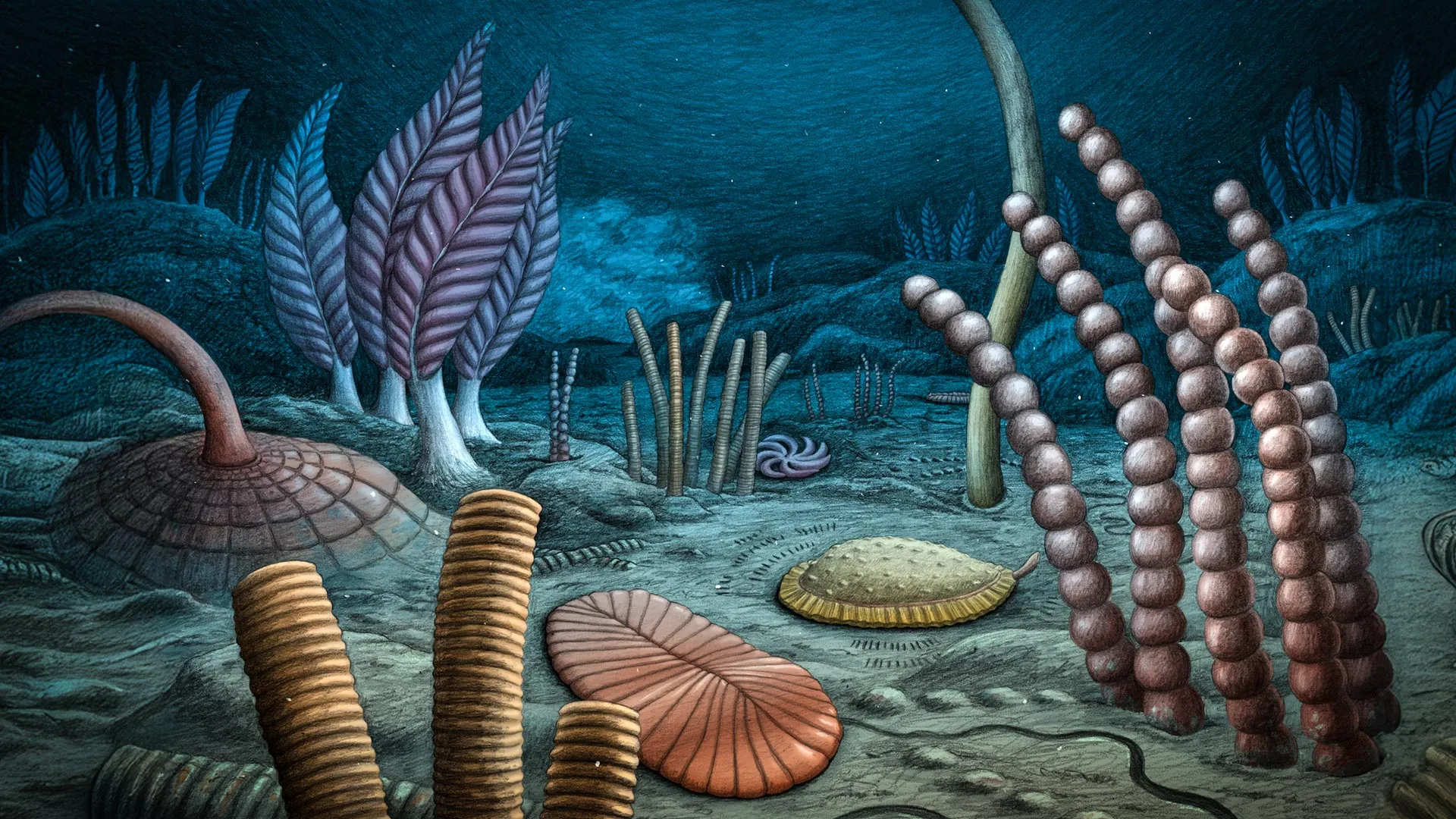
Furthermore, the discovery marks the first time that the distinct "White Sea" ecological assemblage of Ediacaran organisms has been documented in North America. Featuring an array of bizarre, alien-like life-forms—including the pancake-shaped, mat-absorbing Dickinsonia, the tube-dwelling, sexually reproducing Funisia, and the muscular-footed mollusk relative Kimberella—this unprecedented fossil window offers scientists a rare glimpse into the pivotal evolutionary transition when life on Earth shifted from microscopic dominance to large, complex, and behaviorally sophisticated multicellular organisms.
Detailed Chronology and Geological Context
To understand the magnitude of the discovery in the Mackenzie Mountains, one must look back into the deep geological history of the Precambrian Earth. For the first three billion years of planetary history, the biosphere was almost exclusively the domain of single-celled microbes. Then, during the Ediacaran period, a profound evolutionary explosion occurred. Life burst forth into macroscopic, multicellular forms that populated the world’s ancient oceans, leaving behind a fragile, fleeting fossil record.
The Three Great Ediacaran Assemblages
Historically, paleontologists have categorized Ediacaran organisms into three distinct evolutionary groups, or assemblages, demarcated by their appearance in the global stratigraphic record:
- The Avalon Assemblage (575–559 million years ago): Characterized by early branching, fractal-like organisms found prominently in sites such as Newfoundland, Canada, and the UK.
- The White Sea Assemblage (559–550 million years ago): A more diverse and behaviorally dynamic group featuring early bilaterians, motile organisms, and complex colonial structures. Prior to the Canadian discovery, these fossils had been documented extensively across Europe, Asia, and Australia, but remained conspicuously absent from North America.
- The Nama Assemblage (550–538 million years ago): The final chapter of the Ediacaran, featuring heavily mineralized or skeletal forms that bridge the gap into the subsequent Cambrian explosion.
The Mackenzie Mountains Breakthrough
The newly discovered fossil site rests on the traditional, ancestral lands of the Sahtú Dene and Métis peoples, whose guidance and collaborative permission were instrumental to the research team. Building upon nearly a decade and a half of regional geological mapping led by Dartmouth associate professor Justin Strauss, scientists realized they were dealing with something extraordinary when they breached an unmapped rock succession in northwestern Canada.
The team identified more than 100 high-grade fossils, encompassing six distinct taxonomic groups never before recorded on the North American continent. Most astonishing, however, was the radiometric and stratigraphic dating of the site. Several of the fossil-bearing strata date to roughly 567 million years ago. This places them squarely within the timeline traditionally reserved for the older Avalon assemblage, while simultaneously housing the characteristic fauna of the younger White Sea community.
Because these fossiliferous layers are capped by hundreds of feet of largely unexplored sedimentary rock, researchers believe the site represents an ongoing bonanza of paleontological data, with vast numbers of undiscovered specimens waiting to be brought to light.
Strange Creatures From an Ancient Seafloor
The Ediacaran organisms preserved in the Northwest Territories bear little resemblance to modern fauna, presenting an anatomical catalogue that reads like speculative science fiction. Because these creatures evolved long before the advent of shells, bones, or mineralized teeth, their soft tissues were entirely unsuited for normal fossilization. Only rare, catastrophic environmental conditions—such as rapid smothering by fine-grained volcanic ash or microbial mats sealing sediment—allowed their delicate forms to be imprinted in the rock.
Dickinsonia: The Seafloor "Bathmat"
Among the most iconic finds at the site is Dickinsonia, a flat, bilaterally symmetrical organism characterized by a segmented, quilted upper surface. Moving slowly across the ancient seabed, Dickinsonia possessed no mouth, gut, or internal organs. Instead, it absorbed nutrients directly from bacterial and algal mats through its entire lower surface. Described by lead author Scott Evans as resembling a biological "bathmat" or "pancake," these specimens provide critical insights into early mobility and nutrient acquisition.
Funisia: Pioneers of Sexual Reproduction
Funisia represents one of the most consequential discoveries in evolutionary biology. A stationary, tube-shaped organism that grew in dense clusters of similarly sized individuals, Funisia yields the oldest direct fossil evidence of sexual reproduction in the animal kingdom. Much like modern reef-building corals, these colonial organisms likely engaged in mass spawning events, simultaneously releasing eggs and sperm into the water column to maximize reproductive success.
Kimberella and Eoandromeda
The site also yielded preserved specimens of Kimberella, a creature equipped with a muscular foot that allowed it to creep along the substrate and scrape up food. Widely interpreted by evolutionary biologists as an early evolutionary cousin of modern mollusks (such as snails and clams), Kimberella may also hold the title of the oldest known bilaterian—an animal possessing a distinct front, back, top, bottom, and symmetrical left and right sides. This fundamental body plan is shared by more than 99 percent of all animal species alive today.
Additionally, researchers recovered Eoandromeda, an eight-armed, spiraling organism widely considered to be an ancestral relative of modern ctenophores, or comb jellies.
Supporting Context, Metrics, and Research Significance
The implications of the Canadian discovery extend far beyond regional paleontology, challenging long-held assumptions about where and how early animal ecosystems developed.
Redefining Bathymetric Paradigms
Historically, paleontologists linked the diverse White Sea assemblage primarily to shallow, sunlit coastal environments. However, the sedimentological and geochemical data gathered from the Mackenzie Mountains indicate that these organisms thrived in significantly deeper, offshore marine environments.
This finding offers powerful support for a provocative new hypothesis in evolutionary paleontology: that early animal innovation may have originated in deep-water marine settings before gradually migrating into shallow coastal waters—the exact inverse of evolutionary patterns seen in later geological eras.
| Research Metric / Parameter | Details & Data Points |
|---|---|
| Geographic Location | Mackenzie Mountains, Northwest Territories, Canada (Traditional lands of Sahtú Dene and Métis) |
| Estimated Fossil Age | Approximately 567 million years old |
| Assemblage Classification | White Sea Assemblage (First documented occurrence in North America) |
| Taxonomic Diversity | Over 100 cataloged specimens; 6 previously unrecorded groups in North America |
| Key Genera Identified | Dickinsonia, Funisia, Kimberella, Eoandromeda |
| Primary Institutional Partners | American Museum of Natural History (AMNH), Dartmouth College, Stanford University, Penn State |
| Core Funding Sources | NASA Exobiology Grant (#80NSSC25K7024), U.S. National Science Foundation (NSF) |
The deep ocean, while dark and devoid of sunlight, offered a remarkably stable environment. Unlike shallow coastal zones prone to violent storms, temperature swings, and salinity fluctuations, deep marine habitats maintained consistent levels of oxygen and temperature. This ecological stability may have provided the critical environmental buffer necessary for delicate early animals to experiment with complex multicellularity, movement, and reproduction.
Official Statements and Expert Perspectives
The collaborative nature of the research and the sheer scale of the discovery have drawn widespread acclaim from the global scientific community.
"For 3 billion years, life on Earth was dominated by microbes," noted Dr. Scott Evans, lead author of the study and assistant curator of invertebrate paleontology at the American Museum of Natural History. "Then, all of a sudden, we get these strange-looking marine animals big enough to see and capable of behaviors we would find familiar today. If we want to understand this transition, when life first became large, complex, and unmistakably animal, this new site has tremendous potential."
The collaborative effort bridges field geology and advanced paleontology, drawing on deep institutional partnerships. Dr. Justin Strauss, co-author and associate professor of Earth and Planetary Sciences at Dartmouth College, emphasized the exploratory nature of the breakthrough:
"Not only is this new site highly diverse, but also it is from a part of the rock succession where we have previously lacked fossil remains. This is really exciting. Given our understanding of the regional geology in northwestern Canada, there is great potential here to revisit our understanding of Ediacaran Earth history."
The research team also featured contributions from leading geobiologists, including Dr. Erik Sperling of Stanford University and Dr. Kimberly Lau of The Pennsylvania State University. Financial and logistical backing was provided by competitive grants from NASA’s Exobiology program (#80NSSC25K7024) and the U.S. National Science Foundation (NSF Frontier Research in Earth Science grants).
Future Outlook and Conservation
As the initial phase of extraction concludes, the focus shifts toward preservation, curation, and future expeditions. In a commitment to honoring the cultural and geographical heritage of the discovery, the newly recovered fossils are slated to become a permanent part of the scientific collection at the Prince of Wales Northern Heritage Centre in Yellowknife, Northwest Territories, ensuring they remain accessible for future generations of Canadian and international researchers.
Looking ahead, the research team is already planning return expeditions to the Mackenzie Mountains. Because the fossil-bearing strata are overlaid by hundreds of feet of unexplored rock, geologists anticipate that continued excavation will yield not only additional specimens of known Ediacaran genera, but potentially entirely new species that could further bridge the evolutionary gap between microbial Earth and the complex ecosystems of the Cambrian explosion.
Ultimately, this remote Canadian ridge has transformed into one of the most vital paleontological archives on the planet, offering modern science an unprecedented lens through which to view the very first chapters of animal history.