










By Stephanie Alwais, Qosina
Executive Overview
To the uninitiated, the Luer connector is a ubiquitous, unassuming piece of medical hardware. For decades, it has served as the silent workhorse of fluid pathways, IV lines, and diagnostic assemblies. However, for medical device design engineers, treating these standard components with casual familiarity is a high-stakes gamble.
Consider a recent scenario involving a design engineer developing an ambulatory wearable drug delivery system. Relying on a Luer lock configuration her team had successfully implemented across legacy projects for five years, she assumed it was a turnkey solution. Technically, the geometry fit. Yet, a silent, unannounced material modification by the component supplier subtly altered the polymer’s extractable profile. This oversight went unnoticed until a late-stage biocompatibility review nearly derailed the entire regulatory submission timeline.
This real-world misstep underscores a vital truth in modern medical device design: while Luer connectors are foundational, their selection demands rigorous scrutiny. As regulatory standards tighten, material science evolves, and device miniaturization accelerates, engineers must look beyond basic mechanical compatibility. Navigating the modern landscape of small-bore connectors requires a comprehensive understanding of ISO standards, extractables, material traceability, and specialized variants. This guide provides a strategic framework for medical device engineers to optimize connector selection, mitigate risk, and streamline time-to-market.
Detailed Chronology and Historical Evolution
To understand the engineering constraints of modern Luer fittings, it is helpful to examine their origins and the regulatory framework driving their evolution today.
1894: The Birth of a Geometry
The small-bore connector standard traces its roots back to 1894, when German physician and instrument maker Hermann Wülfing Lüer patented a taper design characterized by a precise 6% gradient. Originally designed for glass syringes, this geometry allowed for a reliable, snug friction fit that could be easily joined and separated. Over the ensuing century, this 6% taper became the global standard for fluid transfer across virtually every medical specialty.
The Era of ISO 594 and the Risk of Misconnection
For decades, the physical requirements of these fittings were governed by the ISO 594 standard. While ISO 594 effectively standardized dimensions for interchangeability, it created a dangerous vulnerability in modern clinical environments. Because the same universal Luer geometry was utilized across disparate clinical delivery systems—intravenous lines, enteral feeding tubes, regional anesthesia, and neuraxial pathways—catastrophic misconnections occurred. Clinicians could inadvertently connect an intravenous line to an epidural catheter or an enteral feed to a vascular access port, leading to severe patient injury or death.
The Introduction of ISO 80369: Redefining Small-Bore Connectors
Recognizing the clinical risks associated with universal connector geometries, the International Organization for Standardization (ISO) developed the ISO 80369 series to replace ISO 594. The foundational strategy of ISO 80369 is straightforward: eliminate the possibility of cross-connection by designing application-specific, non-interchangeable connector geometries. Under this framework, components designated for one clinical application are physically prevented from mating with connectors from another.

- ISO 80369-7: The operational standard for the majority of engineers working in drug delivery, general infusion therapy, and vascular access. It preserves the classic Luer geometry while imposing vastly more rigorous dimensional tolerances and performance requirements. Consequently, legacy components that merely claimed compliance with older standards do not automatically satisfy ISO 80369-7.
- ISO 80369-2: Governing respiratory and gas delivery applications, this standard has seen a gradual, deliberate rollout. Published in late 2024 and expanding through 2025, market adoption remains in progress. Engineers designing anesthesia workstations, ventilators, or respiratory support equipment must account for ISO 80369-2 compliance, particularly as device-specific standards undergo revision to explicitly reference the ISO 80369 architecture.
The Basics: Slip, Lock, and Mechanical Realities
Luer fittings are divided into two primary mechanical configurations, each serving distinct operational niches within medical device design.
+--------------------------------------------------------------------+
|                         LUER CONFIGURATIONS                        |
+----------------------------------+---------------------------------+
|          LUER SLIP (Taper)       |           LUER LOCK             |
+----------------------------------+---------------------------------+
| • Friction-fit mechanism         | • Threaded external collar      |
| • Rapid connection/disconnection | • High pull-out & torque resist |
| • Low-pressure applications      | • Critical clinical pathways    |
| • Diagnostic & bench-scale loops | • IV therapy & drug delivery    |
+----------------------------------+---------------------------------+
Luer Slip Connectors
Luer slip (or Luer taper) connectors rely entirely on frictional engagement between the male taper and the female receiving port. They excel in applications requiring rapid assembly and disassembly where operational pressures are low. Diagnostic test kits, fluid sampling assemblies, and bench-scale laboratory flow circuits frequently utilize Luer slip fittings.
However, their mechanical limitation is pull-out resistance. Under mechanical vibration, repeated handling, or lateral shear stress, a friction-fit slip connection can inadvertently disengage, making them wholly inappropriate for pressurized or critical-care fluid paths.
Luer Lock Connectors
Luer lock connectors augment the traditional 6% taper by incorporating a threaded collar on the exterior of the male fitting, which engages with matching threads on the female component. Once fully threaded and seated, the assembly resists both linear pull-out forces and rotational torque. Luer lock is the default design choice for any application where unintended separation carries clinical risk, including high-pressure infusion therapy, targeted drug delivery, and interventional cardiology.
Tolerance Stack-Up and Mating Validation
Both slip and lock configurations are manufactured in male and female variants. A frequent pitfall for design teams is sourcing mating components from different contract manufacturers without verifying interface tolerances. Tolerance stack-up at the Luer interface can lead to fluid leaks, cracking under excessive tightening, or failure to achieve a reliable seal. Engineers must physically test how their chosen connectors mate during the prototype phase rather than relying solely on computer-aided design (CAD) models.
Material Selection: Beyond Mechanical Fit
Choosing the correct polymer for a Luer connector involves balancing mechanical performance, chemical resistance, sterilization compatibility, and extractable/leachable profiles.
+--------------------------------------------------------------------+
|                   POLYMER SELECTION MATRIX                         |
+-------------+---------------------+--------------------------------+
| Material    | Key Advantages      | Typical Application            |
+-------------+---------------------+--------------------------------+
| PC          | Clarity, strength   | Visual fluid inspection        |
| PP          | Cost-effective, chem| General-purpose fluid paths    |
| PVDF        | Extreme purity/chem | Aggressive solvents, purity    |
| COC / COP   | Ultra-low leachables| Biologics, combination products|
+-------------+---------------------+--------------------------------+
Polycarbonate (PC)
Polycarbonate offers exceptional mechanical strength, high optical clarity for visual fluid inspection, and robust compatibility with gamma sterilization. It is a staple for transparent housings and fluid collection reservoirs.
Polypropylene (PP)
Polypropylene delivers reliable chemical resistance across a broad spectrum of reagents and is generally more cost-effective than engineering thermoplastics like PC. It accommodates multiple sterilization modalities, making it ideal for high-volume, single-use disposable sets.

Polyvinylidene Fluoride (PVDF)
When fluid lines involve aggressive solvents or demand the absolute highest level of chemical inertness and purity, PVDF is frequently specified. While carrying a higher unit cost, its resistance to chemical degradation surpasses standard thermoplastics.
Cyclic Olefin Copolymers (COC/COP)
As biologic drugs and advanced combination products proliferate, COC and COP materials have surged in importance. Their near-zero extractable and leachable profiles prevent chemical interactions with sensitive therapeutic formulations, protecting product stability over shelf-life storage.
The Imperative of Traceability
Material traceability must be verified during the initial sourcing phase. Engineers must secure complete documentation detailing the exact base polymer, colorants, plasticizers, and processing additives used by the manufacturer, alongside comprehensive regulatory support files. Discovering a missing material declaration during design verification can halt an FDA submission.
Specialty Variants for Complex Engineering Constraints
Standard configurations do not solve every architectural challenge. Several specialized Luer variants are engineered to address unique operational demands:
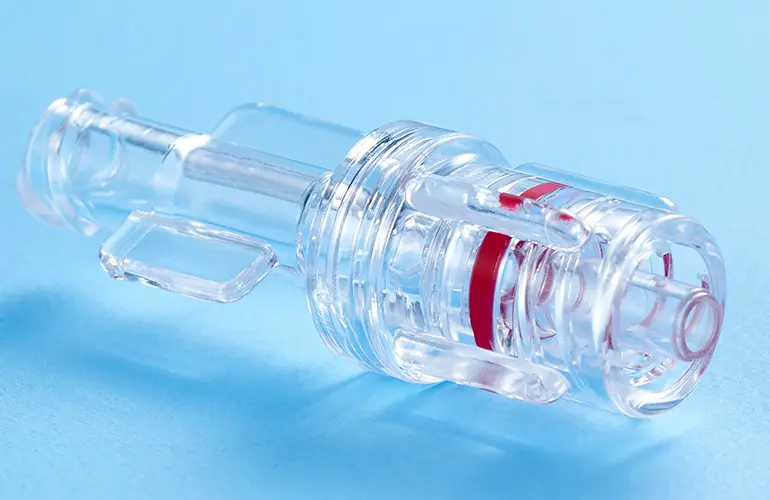
- Valved Luers: Equipped with an internal check valve, these components prevent retrograde fluid flow when the circuit is disengaged, mitigating the risk of contamination or fluid leakage in open ports.
- Color-Coded Luers and Rings: Designed for multi-line delivery systems, color-coded rings assist clinicians in rapidly identifying fluid pathways, reducing administration errors in crowded clinical environments.
- Swivel Luers: Featuring a joint that rotates freely during initial engagement, swivel Luers simplify alignment in tight spaces and eliminate torsional stress on attached tubing during connection.
- Rotating Male Luers: Unlike standard locks, the threaded collar on a rotating male Luer remains free to spin even when fully seated. This continuous rotation prevents kinking and twisting in ambulatory or wearable devices where patient movement is frequent.
- Closed Luer Lock Valves (LAVs): These needle-free, swabbable connectors open automatically upon engagement and seal shut upon separation. Governed by standards such as ANSI/AAMI CN27:2021, modern LAV designs extend the sealing mechanism flush to the surface to prevent microbial ingress at injection and sampling sites.
Design Integration Considerations and Supplier Vetting
Successfully integrating Luer connectors into a medical device requires addressing several critical technical factors early in the development lifecycle:
- Sterilization Validation: Confirm that the chosen connector material can withstand your device’s terminal sterilization method (e.g., EtO, gamma irradiation, electron beam, or autoclaving) without experiencing embrittlement, discoloration, or degradation of the 6% taper geometry.
- Torque and Usability: Evaluate the tactile feedback of the connector. Ergonomic grip ribs or textured collars are essential for clinicians wearing surgical gloves or patients with impaired dexterity using home-care devices.
- Flow Dynamics: Assess whether the internal bore diameter of the connector creates unintended flow restriction or dead volumes that could trap air bubbles or therapeutic agents.
Essential Questions for Component Suppliers
Before finalizing a bill of materials and adding a Luer component to an approved vendor list, engineering teams should demand written clarification on the following points:
- What are the complete material constituents, including proprietary colorants, mold-release agents, and additives, and is a Drug Master File (DMF) or regulatory support file accessible?
- What validated sterilization methods have been performed on this exact component family, and what lot-to-lot manufacturing controls ensure dimensional consistency?
- What statistical dimensional tolerance data is available specifically for the male and female 6% Luer taper geometry?
- Is there a documented extractables and leachables profile generated using clinically relevant solvents and exposure durations?
- Is a verified, fully documented second-source supplier available, and do minor dimensional variations between sources require separate functional qualification?
Future Outlook
The Luer connector has endured as a cornerstone of medical device engineering for more than a century. For the vast majority of fluid-path applications, this longevity is a testament to its elegant, reliable design. However, the engineering work is shifting from passive selection to active risk management—demanding meticulous oversight of material science, strict adherence to evolving ISO standards, and proactive supplier auditing.
As global regulatory bodies continue to roll out and enforce application-specific standards like the ISO 80369 series, conversations surrounding small-bore connectors will only grow more rigorous. Medical device design engineers who master this standard architecture, maintain rigorous material transparency, and design for real-world usability will be best positioned to navigate future regulatory landscapes and deliver safer, more reliable products to the market.