






Executive Overview
In the rapidly evolving landscape of modern healthcare, diagnostic pathology stands at a historic crossroads. For over two decades, the field has been transformed by computer vision and artificial intelligence (AI), moving progressively from rudimentary pixel extraction to highly sophisticated deep neural networks capable of automated slide scanning, tumor triage, and immunohistochemical quantification. Yet, a fundamental barrier has persistently hindered their integration into high-stakes clinical workflows: the "black box" problem.
Traditional machine learning models deliver diagnostic labels with high statistical accuracy, but they fail to articulate why. In clinical settings—where every diagnostic decision must be meticulously defended before hospital tumor boards and rigorously scrutinized by regulatory bodies—opaque predictions are a non-starter. Pathologists require transparent, evidence-based justifications that align with established medical morphology.
Enter RECAP-PATH (REasoning and Classification via Automated Prompting in PATHology images), a groundbreaking framework developed to solve this exact dilemma. By cleverly combining multimodal large language models (MLLMs) with an iterative, two-phase prompt optimization algorithm, RECAP-PATH delivers high-accuracy diagnoses accompanied by detailed, pathologist-aligned justifications. Operating entirely through standard API calls without requiring model weight modifications or resource-intensive white-box access, this framework heralds a new era of audit-ready, human-interpretable artificial intelligence in clinical pathology.
Detailed Chronology: The Evolution Toward Explainable Medical AI
Phase 1: From Handcrafted Features to Deep Neural Networks
The digital transformation of pathology laboratories began modestly. Early computational tools relied heavily on handcrafted features—measuring basic tissue textures, color histograms, and cellular shapes to assist human experts. However, these techniques lacked generalizability.
The subsequent dominance of deep learning revolutionized the field. Automated algorithms gained the capacity to scan digitized whole-slide images at an unprecedented scale, prioritizing urgent cases and standardizing biomarker scoring. Despite these operational efficiencies, the core issue of interpretability remained unresolved. Post-hoc explainability methods, such as attention maps, concept activation vectors, and influence functions, offered only fragmented, surface-level insights. Often plagued by coarse saliency maps and high susceptibility to artifacts, these methods failed to provide the fine-grained auditability necessary for regulatory compliance and everyday clinical trust.
Phase 2: The Emergence and Limitations of MLLMs
Concurrently, the rise of multimodal large language models (MLLMs)—such as GPT-4o, Gemini, and various open-source architectures—introduced advanced image-understanding and in-context learning capabilities. Researchers quickly recognized that these models could theoretically diagnose medical images through visual question answering and prompt-based workflows.
However, generic MLLMs out-of-the-box frequently faltered in specialized domains like histopathology. Their explanations were often unstructured, weakly grounded in actual morphological features, and plagued by run-to-run inconsistencies. Recognizing that raw computational power alone could not bridge this clinical divide, researchers set out to build a systematic architecture that harnesses high-resolution visual inputs and long multimodal contexts to enforce structured, step-by-step reasoning.
Phase 3: The Birth of RECAP-PATH
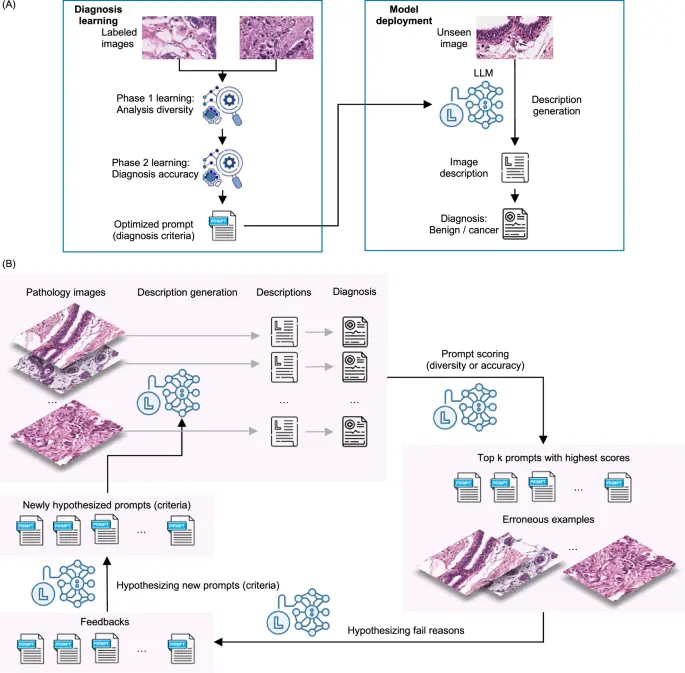
RECAP-PATH was designed to bridge the chasm between raw statistical prediction and expert clinical validation. Rather than treating the MLLM as an unguided oracle, the RECAP-PATH framework implements a novel "think-and-speak" stage.
Guided by a description-generation prompt enriched with foundational histopathological features, the MLLM first drafts a detailed account of the tissue image, explicitly evaluating the diagnostic significance of observed features. Next, it jointly evaluates this generated textual evidence alongside the original image to render a final, highly accurate prediction.
To ensure these descriptions are clinically precise, RECAP-PATH employs an automated, error-driven prompt optimization mechanism. When the model misclassifies a training example, the framework captures the failure mode, prompts the model to reflect on its error, and iteratively refines the prompt instructions. This loop continues across two distinct phases—first maximizing conceptual diversity and terminology richness, and subsequently locking down diagnostic accuracy.
Supporting Context & Metrics: Unprecedented Performance Across Diverse Benchmarks
To validate its robustness, RECAP-PATH was rigorously tested across multiple prominent, publicly available histopathology datasets, including BRACS (Breast Cancer Surveillance), BACH (Breast Cancer Histology), and SICAPv2 (Prostate Cancer Gleason Grading).
The Two-Phase Learning Dynamics
The learning trajectory of RECAP-PATH is uniquely non-monotonic, reflecting its deliberate two-phase design:
- Phase 1 (Diversification): The framework purposely prompts the MLLM to explore a broad semantic and conceptual space. By introducing alternative morphological perspectives, rare biomedical terminologies, and varied interpretive lenses, classification accuracy dips slightly. However, this phase successfully expands the reasoning pathways.
- Phase 2 (Optimization): The framework filters and refines this pool of candidate prompts based on their real-world diagnostic performance against a small training set of as few as 100 labeled examples. Accuracy rises sharply within the first few iterations, converging in roughly six rounds.
Quantitative Milestones and Comparisons
- Binary and Multiclass Precision: On breast pathology binary tasks (normal versus invasive carcinoma), RECAP-PATH consistently achieved greater than 90% accuracy, rivaling supervised upper bounds established by linear classifiers trained on contrastive language-image pre-training (CLIP) embeddings (which hit 92.5%), while vastly outperforming manual in-context learning baselines (86.0%) and automated prompt engineering benchmarks like APE (88.0%).
- Subtype Triage: In complex tasks like distinguishing ductal carcinoma in situ (DCIS) from invasive carcinoma (IC), the model attained true positive rates of 0.85 and 0.90, respectively.
- Cross-Dataset Generalization: Applied to prostate cancer patch-level Gleason grading (SICAPv2), RECAP-PATH successfully adapted its internal prompts to identify hallmark features such as cribriform architecture, infiltrative growth patterns, and nuclear pleomorphism, demonstrating that its optimization mechanism transcends single-organ boundaries.
- Model Agnosticism: Validated across closed-source APIs (Gemini 2.0 Flash, GPT-4o) and open-source, privacy-preserving architectures (Qwen2.5-VL-72B-Instruct), the framework proved highly versatile, consistently elevating baseline prediction accuracy without requiring internal weight fine-tuning.
Official Statements and Expert Perspectives
The development team and clinical collaborators emphasize that RECAP-PATH redefines the very nature of AI explainability in medicine.
"Traditional AI asks clinicians to trust a black box because its statistical metrics look promising," notes lead research collaborators. "RECAP-PATH flips this paradigm. By forcing the model to articulate the morphological evidence—citing invasion phenotypes, architectural organization, nuclear atypia, and stromal context—before it renders a verdict, we turn reasoning itself into an auditable, verifiable signal."
To ensure clinical relevance, the research team integrated an expert-in-the-loop validation pipeline. Three board-certified pathologists conducted blinded evaluations of the MLLM-generated image descriptions, grading them on clinical coherence, precision, and histopathological correctness.
Feedback from these expert evaluations was fed directly back into the prompt optimization loop. Consequently, pathologist-guided optimization boosted the clinical coherence ratings of the generated narratives by nearly 20%.
As participating pathologists observed during blind trials, the optimized model successfully moved past superficial artifacts. When evaluating a normal breast tissue sample, the MLLM correctly identified organized tubular architecture, uniform gland size, and abundant cytoplasm. Conversely, when examining invasive carcinoma, it autonomously highlighted malignant indicators such as marked nuclear pleomorphism, prominent nucleoli, and aggressive stromal invasion.
Future Outlook and Clinical Integration
Despite its remarkable successes, the research team is transparent about the current limitations and the roadmap ahead. Because generative models inherently carry a risk of hallucinating visual details, the generated descriptions are strictly intended to serve as verification tools for expert clinicians, rather than infallible records of internal neural pathways. Furthermore, because optimized prompts remain dataset-specific, future iterations will explore slot-based calibration to enable rapid cross-cohort adaptation without re-running entire optimization cycles.
Looking forward, the most critical frontier is moving beyond Region of Interest (ROI) patch crops to full Whole-Slide Image (WSI) pipelines. Integrating RECAP-PATH into slide-level frameworks will test its scalability against the massive computational demands and tissue aggregation challenges inherent to real-world pathology labs. Additionally, as vendor-hosted APIs present risks of software updates and version drift, ongoing efforts will stress-test locally deployed open-source models to guarantee long-term reproducibility and ironclad patient data privacy.
Conclusion
RECAP-PATH demonstrates that artificial intelligence and clinical interpretability do not have to be opposing forces. By treating reasoning as an optimizable parameter, this framework successfully bridges the gap between state-of-the-art computer vision and the rigorous standards of evidence-based medicine. As healthcare systems look toward the future, RECAP-PATH paves the way for AI tools that are not only computationally powerful, but fundamentally transparent, trustworthy, and ready for the clinical frontline.