





Rare cancers represent a profound challenge in modern oncology. While individually uncommon, they collectively account for 20% to 25% of all human malignancies. Because reference cases are scarce and clinical expertise is unevenly distributed, diagnosing these complex tumors accurately and promptly is notoriously difficult. This vulnerability is especially acute in pediatric oncology, where over 70% of diagnoses involve rare tumors that demand precise, timely subtyping to guide effective treatment protocols.
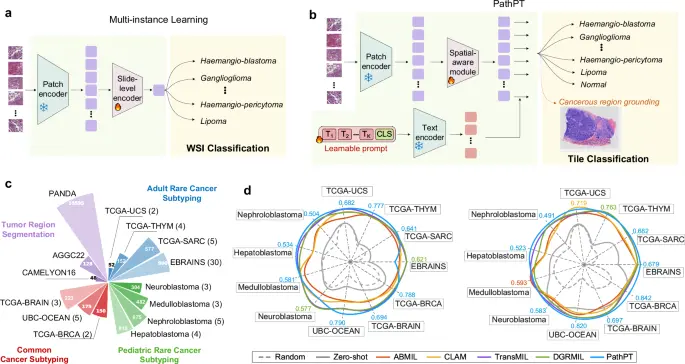
To bridge this diagnostic gap, an international team of researchers has introduced PathPT, an advanced framework designed to harness pre-trained vision-language (VL) foundation models for rare cancer subtyping under strict few-shot learning conditions. Moving away from traditional multi-instance learning (MIL) architectures that rely solely on static visual features, PathPT incorporates spatially-aware visual aggregation, task-adaptive prompt tuning, and zero-shot grounding to transform weak slide-level labels into fine-grained, tile-level supervision.
Evaluated across eight rigorous rare cancer benchmarks spanning 56 distinct subtypes and 3,958 whole-slide images (WSIs) from multiple medical centers—alongside standard common cancer and segmentation datasets—PathPT consistently outperforms established baseline models. By bridging the semantic divide between pre-trained multi-modal models and the intricate realities of clinical histopathology, this breakthrough promises to democratize expert-level diagnostic accuracy for underserved regions and specialized clinics worldwide.
Detailed Chronology: The Evolution of Vision-Language Models to PathPT
The Limitations of Traditional Multi-Instance Learning
For years, the predominant paradigm for adapting vision-language foundation models to computational pathology has been multi-instance learning (MIL). Frameworks such as Attention-Based MIL (ABMIL), Clustering-Constrained Attention Multiple Instance Learning (CLAM), TransMIL, and Diverse Global Representation MIL (DGRMIL) operate by extracting tile-level visual features from whole-slide images and training classifiers under slide-level supervision.
While these models advanced automated slide classification, they suffered from two critical shortcomings:
- Visual Isolation: MIL pipelines rely exclusively on visual encoders, completely bypassing the rich semantic and cross-modal reasoning capabilities built into modern textual encoders.
- Coarse Spatial Guidance: Slide-level supervision provides minimal spatial feedback, severely hindering a model’s ability to isolate fine-grained, region-specific morphological patterns essential for rare cancer subtyping.
The Inception of PathPT
Recognizing these architectural bottlenecks, researchers developed PathPT to unify multi-modal prior knowledge with few-shot adaptability. Rather than treating vision-language models as static feature extractors, PathPT introduces three foundational innovations:
- Spatially-Aware Visual Aggregation: Utilizing a lightweight aggregator that explicitly captures both short- and long-range dependencies across tissue regions, the framework maps complex morphological patterns critical for rare tumor identification.
- Task-Adaptive Prompt Tuning: PathPT replaces static, hand-crafted language templates with learnable textual tokens optimized end-to-end to align with true histopathological semantics.
- Tile-Level Pseudo-Labeling: Leveraging the zero-shot grounding abilities inherent in advanced VL foundation models, PathPT automatically transforms weak slide-level labels into fine-grained tile-level pseudo-labels. This drives precise spatial learning, markedly boosting both classification accuracy and cancerous region grounding performance.
Supporting Context & Metrics: Rigorous Multi-Center Validation
To substantiate PathPT’s clinical viability, the research team established a comprehensive benchmarking matrix comprising eight rare cancer benchmarks (four adult and four pediatric), three common cancer datasets, and three pixel-level segmentation benchmarks.
Adult Rare Cancers: EBRAINS and TCGA Cohorts
Testing on the EBRAINS digital brain tumor atlas—which features 30 distinct rare brain tumor subtypes—revealed striking performance gaps. Traditional zero-shot classifiers hovered between 0.1 and 0.4 in balanced accuracy (BACC). While state-of-the-art MIL frameworks using advanced backbones like KEEP improved performance up to 0.650 in a 10-shot setting, PathPT-KEEP surpassed all competitors, achieving a median BACC of 0.679 (a 0.271 absolute gain over zero-shot baselines, $p < 0.001$).
Similar robustness was validated across TCGA rare tumor cohorts, including TCGA-SARC (sarcomas), TCGA-THYM (thymomas), and TCGA-UCS (uterine carcinosarcomas), where 5-shot and 10-shot fine-tuning with PathPT yielded average BACC scores reaching up to 0.707.
Pediatric Oncology and Cross-Center Generalization
Pediatric tumors present extreme data scarcity challenges. Evaluating 1,232 WSIs from Xinhua Hospital (spanning nephroblastoma, hepatoblastoma, medulloblastoma, and neuroblastoma) demonstrated that PathPT consistently outpaced standard MIL frameworks in 1-shot and 5-shot regimes.
To test external generalization, the team deployed models trained exclusively on the Xinhua cohort directly onto 1,048 WSIs from Shanghai Children’s Medical Center (SCMC) without additional optimization. Despite severe domain shifts in scanning hardware, staining protocols, and institutional practices, PathPT maintained robust performance—surpassing zero-shot baselines significantly. For instance, on SCMC neuroblastoma cases, training-free direct inference via CONCH reached a BACC of 0.727 (compared to 0.531 in zero-shot). Furthermore, utilizing cross-institutional weight initialization allowed rapid adaptation with minimal SCMC training data, proving that PathPT’s prompt mechanisms capture universally transferable diagnostic patterns.
Common Cancers and Pixel-Level Segmentation
The framework’s versatility extended seamlessly to common malignancies, including the UBC-OCEAN ovarian cancer dataset and TCGA breast and brain cancer benchmarks, achieving top-tier BACC scores of 0.820 (UBC) and 0.769 (TCGA) in 10-shot settings.
In pixel-level segmentation evaluations across CAMELYON16, PANDA, and AGGC22 datasets, PathPT demonstrated exceptional spatial precision. In AGGC22, the framework boosted Dice scores from 0.239 (zero-shot) to 0.618 (5-shot) using the KEEP backbone, comfortably outperforming conventional linear probing and standard context optimization (CoOp) baselines.
Official Statements and Institutional Insight
The study, coordinated by prominent research institutions including Shanghai Jiao Tong University School of Medicine and Xinhua Hospital, underscores a philosophical shift in computational pathology.
Principal investigators emphasize that the primary barrier to AI deployment in rare oncology is not a lack of neural network depth, but a misalignment between pre-trained representations and domain-specific clinical semantics. By shifting the focus from architectural complexity to semantic alignment via prompt optimization, PathPT provides a blueprint for resource-efficient medical AI.
Furthermore, comprehensive failure-mode analyses conducted alongside senior pathologists revealed that PathPT significantly reduces classification errors across difficult categories, such as histological grading confusion, structural tumor heterogeneity, and molecular subtype differentiation (e.g., IDH-mutant versus IDH-wildtype glioma).
Institutions involved in the ethical oversight and study design—including Xinhua Hospital (Approval XHEC-C-2025-015-1) and Shanghai Children’s Medical Center (Approval SCMCIRB-K2025320-1)—confirmed that all retrospective analyses of archived pathological specimens complied strictly with institutional guidelines and international ethical standards. Source datasets, including the newly curated pediatric KidRare repository, have been made accessible via platforms like Hugging Face and GitHub to foster open scientific collaboration.
Future Outlook: The Horizon of Interpretable, Few-Shot Diagnostics
The success of PathPT signals a major turning point for the future of digital health. Several key trajectories emerge from this milestone:
- Democratizing Expert-Level Diagnostics: By requiring as few as 1 to 10 training samples per subtype, PathPT enables regional and underserved hospitals—where rare cancer cases are rarely seen consecutively—to deploy high-performance diagnostic tools customized to local staining and operational nuances.
- Restoring Clinical Interpretability: Unlike opaque "black box" attention pooling mechanisms in traditional MIL, PathPT preserves a direct spatial linkage between WSI predictions and tile-level grounding. Pathologists can visually audit AI outputs against their own morphological criteria, satisfying the vital prerequisite of clinical trust.
- Open-Set Adaptability: Because cancer classification is an evolving field continuously expanding with novel molecular and histological discoveries, PathPT’s parameter-efficient prompt tuning allows continuous updates and rapid adaptation to new disease definitions without requiring massive computational retraining cycles.
- Broad Biomedical Generalization: Beyond histopathology, PathPT’s core philosophy—unlocking robust multi-modal reasoning through semantic prompt optimization rather than exhaustive parameter fine-tuning—serves as a scalable template for other data-scarce medical specialties, including radiology, dermatology, and rare genetic disorders.
As these tools transition from bench to bedside, frameworks like PathPT ensure that the scarcity of rare cancer data is no longer a barrier to swift, accurate, and life-saving patient care.