








Executive Overview
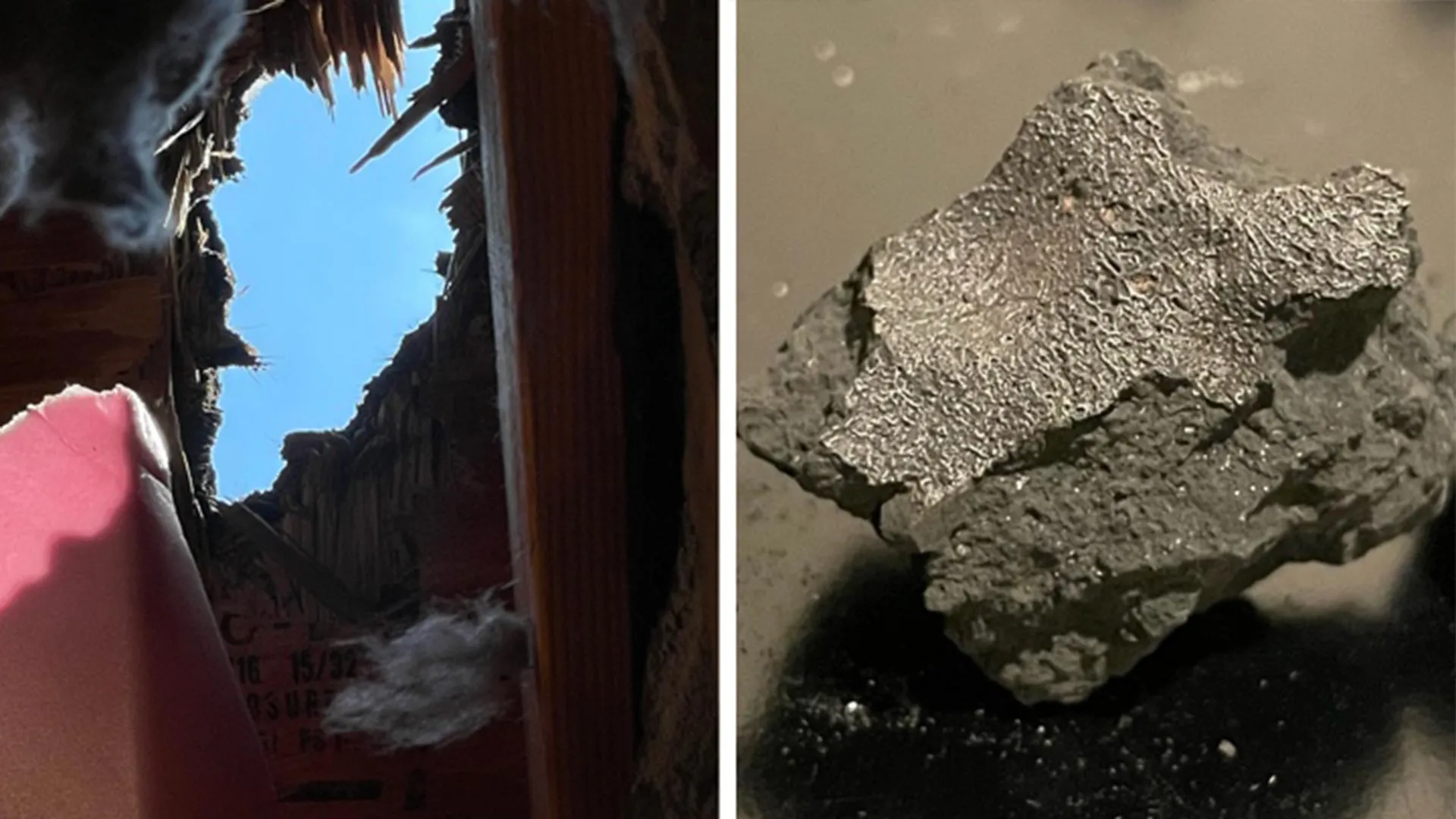
On a bright, cloudless afternoon on July 16, 2024, a fiery intruder from the deep solar system tore through the skies above the New York City metropolitan area. Traveling at an astonishing 32,000 miles per hour (14.4 kilometers per second), the meteor—roughly the size of a heavy airline baggage pack—disintegrated in a brilliant flash and a concussive sonic boom. While thousands across five states looked up in awe, one suburban homeowner in Hillsborough, New Jersey, experienced a far more intimate introduction to the cosmos when a two-pound fragment of the ancient rock punched squarely through his roof.
Now, following an exhaustive international forensic investigation published in the journal Science Advances, scientists reveal that this cosmic interloper is far more than a mere celestial oddity. Classified as an exceptionally rare CM1/2 carbonaceous chondrite, the Hillsborough meteorite has provided researchers with unprecedented physical evidence of concentrated salty fluids—ancient brines—near the surface of a primitive proto-planet.
By combining the quick-thinking actions of the homeowner, high-speed atmospheric tracking cameras, and state-of-the-art laboratory analysis, an interdisciplinary team of astrophysicists, cosmochemists, and astrobiologists has linked the New Jersey meteorite to samples returned directly from space by robotic missions like JAXA’s Hayabusa2 and NASA’s OSIRIS-REx. The findings not only offer a fresh window into the watery past of primitive asteroids but also strengthen the prevailing theory that space-faring rocks delivered crucial organic molecules and the molecular ingredients of life to the early Earth.
Detailed Chronology: From the Asteroid Belt to a Suburban Master Bedroom
The Descent and Sonic Boom
The sequence of events on July 16, 2024, began millions of miles away in the low-lying regions of the asteroid belt, but its terrestrial finale played out in a matter of seconds. Entering Earth’s atmosphere in broad daylight, the fragile space rock was subjected to immense aerodynamic pressures. As it plummeted southward, passing just west of the Statue of Liberty, the thermal and physical stress caused the meteor to fragment violently.
The disintegration produced a powerful shockwave. Approximately 60 eyewitnesses spanning New York, New Jersey, Connecticut, Rhode Island, and Pennsylvania reported the streak of light to the American Meteor Society (AMS). Meanwhile, residents in 16 localized areas across New York and New Jersey reported feeling a distinct concussive boom rattle their homes and windows.
American Meteor Society operations manager Mike Hankey detailed how the trajectory was reconstructed:
"Our cameras in Northford, Connecticut, and Douglassville, Pennsylvania, as well as a doorbell camera in Wayne, New Jersey, captured the meteor, and from that we measured its trajectory. The path traced back to low in the asteroid belt."
By the time the rock descended to an altitude of 22 miles (35 kilometers), it had completely vanished from visual range, breaking down into a descending trail of rubble. Doppler weather radar systems at Newark Airport briefly captured this invisible debris cloud—an elongated trail of falling pebbles stretching from Staten Island across the state line into New Jersey.
The Impact in Hillsborough
The trailing edge of this debris field terminated over Hillsborough, New Jersey, where the heaviest surviving fragments were predicted to make landfall. Fate intervened at a residential property when the largest surviving chunk of the asteroid struck the home directly.
The homeowner recalled the dramatic moment of impact:
"I was at home at the time, heard a loud crash and found a hole in the ceiling of the master bedroom. I smelled a strong sulfur-like odor and saw many black fragments along with debris and black dust that covered my bed, carpet and surrounding areas."
Recognizing the potential scientific value of the dark, strange-smelling debris and acting with remarkable composure, the homeowner immediately secured the scene. Donning disposable gloves to prevent human contamination, he meticulously collected the meteorite fragments using aluminum foil and safely stored them in glass jars.
This swift, disciplined containment proved vital. According to lead author and meteor astronomer Peter Jenniskens of the SETI Institute and NASA’s Ames Research Center, this immediate field preservation yielded "the most pristine CM1/2 meteorites we know of."
Supporting Context & Metrics: Rarity and Laboratory Analysis
A Rare Mineralogical Classification
When the fragments arrived at advanced laboratory facilities, analysis revealed that the rock belonged to a primitive meteorite family known as CM-type carbonaceous chondrites. The designation "CM" honors the Mighei meteorite, which famously fell in Ukraine in 1889.
However, coauthor Mike Zolensky, a meteoriticist at NASA’s Johnson Space Center in Houston, noted that the Hillsborough specimen displayed anomalies. Portions of the meteorite had undergone significantly more extensive alteration by liquid water on their parent asteroid than scientists typically observe in standard CM2 carbonaceous chondrites. Consequently, researchers classified the rock as a CM1/2 carbonaceous chondrite, placing it squarely between the petrographic CM1 and CM2 categories.
To understand the magnitude of this discovery, consider the statistical rarity:
- Total Observed CM-Type Falls: The Hillsborough event represents only the 22nd recorded and verified fall of a CM-type meteorite in human history.
- CM1/2 Subtype Rarity: It is only the second witnessed fall of a CM1/2 carbonaceous chondrite ever documented. The sole historical precedent was the Kolang meteorite, which fell in North Sumatra, Indonesia, in 2020.
- Unprecedented CM1 Status: While weathered CM2 samples are relatively common in collections, no pristine CM1 meteorite fall has ever been directly observed prior to this.
Clues from Ancient Asteroid Brines
The scientific community has long debated the role water played in the geochemical evolution of primitive asteroids. Until recently, researchers relied heavily on remote meteorite discoveries or pristine samples retrieved from space missions—such as JAXA’s Hayabusa2 return from asteroid Ryugu and NASA’s OSIRIS-REx return from asteroid Bennu. Both mission datasets revealed substantial evidence that briny, salty fluids once pooled beneath the surfaces of those parent bodies.
In the Hillsborough meteorite, Zolensky and colleague JangMi Han identified small, salt-rich CM1 fragments. This discovery provides a direct terrestrial parallel to the Ryugu and Bennu samples. It strongly suggests that the material originated near the surface of its parent asteroid—a zone where liquid water periodically pooled, evaporated, and left behind increasingly concentrated deposits of salt minerals.
Researchers are currently cataloging the specific salt compounds within the meteorite to draw direct comparisons with the extraterrestrial materials brought back by robotic space probes.
Official Statements and Expert Insights
The interdisciplinary collaboration behind the Science Advances publication brought together leading minds from across the global scientific community. Their published insights shed light on both the chemical mechanics of the asteroid and its broader implications for planetary science.
On the Asteroid’s Surface Processes:
Lead author Peter Jenniskens emphasized the uniqueness of the find:
"A forensic study of the fragments revealed that they contained preserved bits from near the surface of a primitive asteroid where it experienced concentrated salty fluids—a process not previously known from this type of proto-planet world."
On Organic Chemistry and Prebiotic Ingredients:
Cosmochemist Queenie Chan of Royal Holloway University of London and biogeochemist Nana Ogawa of the Japan Agency for Marine-Earth Science and Technology focused on the organic inventory of the rock:
"Isotope studies of carbon and nitrogen suggest that primitive carbonaceous chondrites, including CM-types, delivered organic matter to the early Earth. The Hillsborough meteorite contained 1.8% by weight of carbon and 0.07% of nitrogen, and had carbon and nitrogen isotopes typical for CM-type meteorites."
Advanced organic mass spectrometry conducted by Phil Schmitt-Kopplin of Technical University Munich revealed complex interactions between soluble organic compounds and mineral structures:
"A high fraction of compounds were the product of organic chemistry with minerals. We do not know if these magnesium organic compounds were contributed by brine chemistry or were simply left over from earlier impact shock processes."
Astrobiologist Danny Glavin of NASA’s Goddard Space Flight Center highlighted the significance of the detected amino acids:
Our analysis indicates that the meteorite’s complex assortment of amino acids formed inside its parent body, supported heavily by internal briny chemistry. This adds weight to the theory that CM-type bodies supplied early Earth with the molecular building blocks necessary for life.
On the Preservation and Future Curation:
Denton Ebel, curator at the American Museum of Natural History in New York City—where portions of the meteorite will eventually find a permanent home—expressed profound gratitude for the dramatic delivery:
"We are thrilled that nature delivered such a precious asteroid sample on our doorstep."
Future Outlook: Unlocking the Prebiotic Blueprint
The implications of the Hillsborough meteorite extend far beyond the borders of New Jersey or the display cases of the American Museum of Natural History. As laboratories worldwide continue to scrutinize the pristine fragments, the research points toward several critical avenues for future study:
- Comparative Cosmochemistry: By matching the specific salt mineralogy and amino acid profiles of the Hillsborough meteorite with samples retrieved from asteroids Ryugu (Hayabusa2) and Bennu (OSIRIS-REx), scientists can validate whether different regions of the solar system share uniform pathways of aqueous alteration.
- The Role of Brines in Prebiotic Synthesis: Highly concentrated brines are now recognized as vital chemical reactors. They can keep vital nutrients like phosphate dissolved in aqueous solution while simultaneously promoting complex reactions between organic compounds and precipitating minerals. Understanding these reactions provides a clearer picture of how non-living chemical systems crossed the threshold into prebiotic organization.
- Refining Impact Models: High-definition tracking data captured by doorbell cameras and regional sensor networks during the July 16 event have given atmospheric physicists precise metrics on how fragile carbonaceous bodies fragment under atmospheric entry stress. This data will improve models used to track and assess potential near-Earth objects in the future.
Ultimately, the Hillsborough meteorite serves as a humbling reminder of our cosmic connectivity. A fragment of rock born billions of years ago in the distant asteroid belt crossed paths with Earth on a quiet summer afternoon, crashing through a suburban ceiling to deliver a pristine time capsule. Thanks to rapid human intervention and modern analytical science, this fiery message from the deep solar system is now helping humanity decode the ancient chemical recipes that made life on Earth possible.