








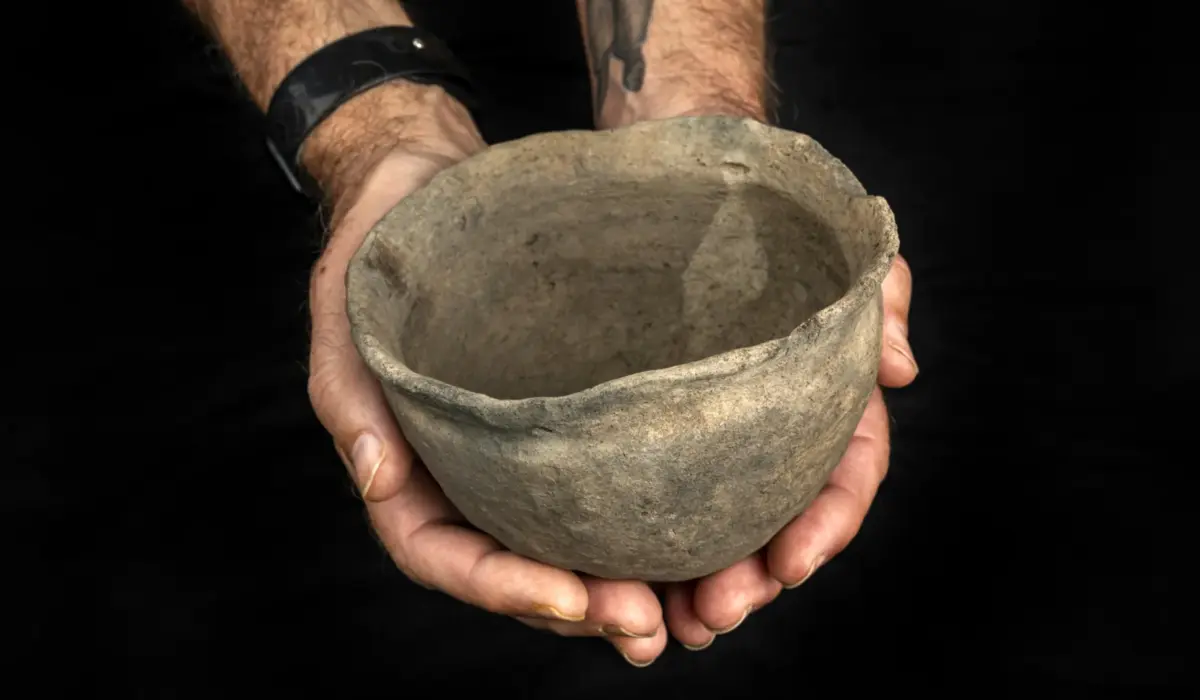
Deep beneath the wooded terrain of northwest Gainesville, Florida, a quiet convergence of ancient Indigenous history and modern academic discovery has yielded a rare archaeological prize. Excavating a centuries-old site known as Mission San Francisco de Potano, undergraduate students from the University of Florida (UF) recently uncovered a small, entirely intact clay vessel crafted approximately 400 years ago. Measuring small enough to fit comfortably within the palm of an adult’s hand, the pot features a simple, undecorated rim and a smooth, dull gray surface. While modest in appearance, its unbroken preservation is an extraordinary anomaly in terrestrial archaeology, offering a tangible link to the Potano-Timucua people who inhabited the region during a period of monumental cultural collision.
For Gifford Waters, collections manager for historical archaeology at the Florida Museum of Natural History, the discovery represents a career first. While complete artifacts are occasionally recovered from marine shipwrecks or specialized burial contexts, finding an unbroken piece of earth-bound indigenous pottery is virtually unheard of. Soil pressure, centuries of agricultural disturbance, weather cycles, and modern construction typically fracture such fragile items long before they see the light of day.
Yet, this artifact did more than merely survive the elements; it sat nestled within the enigmatic footprint of a Spanish-made structure at the core of a pivotal 17th-century mission site. Alongside thousands of other fragmented artifacts—including Native American pottery shards, glass beads, animal bones, and Spanish hardware—this tiny vessel anchors a broader academic investigation into trade, migration, survival, and adaptation. As researchers parse the spatial relationships between the pot and its subterranean surroundings, the discovery illuminates the nuanced daily lives of the Potano and their complex interactions with European colonizers.
Detailed Chronology
To fully understand the significance of the recovered vessel, one must trace the turbulent history of the Potano-Timucua people and the colonial framework that ultimately reshaped their ancestral lands. The chronology of Mission San Francisco de Potano is a narrative defined by displacement, cross-cultural friction, and ultimate abandonment.
Pre-Contact Origins and Forced Relocation (Pre-1585 to 1606)
Long before European flags flew over North America, the Potano flourished as a distinct regional subgroup of the larger Timucua-speaking linguistic and cultural group. Their ancestral homelands originally spanned the fertile landscapes situated roughly between present-day Payne’s Prairie and Orange Lake. However, the geopolitical landscape of La Florida shifted dramatically with the encroachment of Spanish explorers and military forces.
In 1585, Spanish pressure compelled the Potano to relocate from their primary historic settlements. Driven northward into the area that would later become northwest Gainesville, the community sought stability while navigating the encroaching shadow of European imperial ambitions. This forced migration disrupted centuries-old patterns of land use and trade, setting the stage for deep cultural integration—and subjugation—that would define the subsequent century.
Establishment of the Mission (1606–1700)
As part of a concerted strategy to pacify and consolidate control over indigenous populations in interior Florida, Spanish authorities dispatched a Catholic friar to the Potano village in 1606. This marked the formal birth of Mission San Francisco de Potano, positioning it among the earliest of more than 100 missions that Spain would establish over the next hundred years.
At its zenith, the settlement maintained a distinct demographic balance. The village was home to several hundred indigenous Potano residents, while the mission compound itself typically housed a single European official: the resident friar. For a century, this rural outpost operated as a crucible of cultural exchange. Indigenous traditions adapted to the introduction of European goods, Catholic liturgical practices, and new political hierarchies, even as the Potano maintained vital elements of their ancestral heritage.
Conflict, Militarization, and Abandonment (1700–1706)
By the dawn of the 18th century, the geopolitical stability of Spanish Florida began to fracture under intense pressure from British colonial expansion in the Carolinas and their allied native militias. Historical records indicate that as British-backed raids on Spanish missions escalated, authorities stationed a small military garrison at Mission San Francisco de Potano to bolster its defenses.
Despite these defensive measures, the mission’s viability plummeted. In 1706, the settlement was permanently abandoned. Its structures were left to decay, and over the span of a few generations, physical traces of the once-vibrant community vanished beneath the encroaching Florida underbrush, remaining hidden until agricultural and archaeological interest revived in the mid-20th century.
Supporting Context & Metrics
The excavation site, managed jointly by Waters and Charles Cobb—curator of historical archaeology at the Florida Museum of Natural History—serves as an active outdoor classroom for university students. Operating through a rigorous weekly field course during the spring semester, students employ precise archaeological methodologies to peel back the layers of the past.
Excavation Framework and Methodology
Fieldwork at Mission San Francisco de Potano is organized with meticulous precision:
- Grid System: The site is mapped out using a network of 1-by-1 meter (approx. 3-by-3 foot) excavation squares.
- Stratigraphic Extraction: Students utilize mason’s trowels, brushes, and small hand tools to carefully shave away sediment, ensuring every layer of soil is documented.
- Spatial Mapping: Every recovered item is logged not merely as an isolated object, but in strict relation to its geographic coordinates and surrounding soil context.
This spatial awareness is critical. As researchers emphasize, an artifact’s physical placement often tells a more compelling story than the object itself. For instance, the concentration of various animal bones—including those of freshwater fish, turtles, and wild turkey—in a localized zone allowed researchers to definitively identify a communal cooking area and refuse pit.
Quantitative Overview of the Site
Since systemic academic excavations began at the mission in 2006, the site has yielded a vast repository of data:
- Total Recovered Artifacts: Over 7,000 distinct items cataloged.
- Pottery Shards: Native American ceramic fragments constitute the vast majority of the collection, reflecting the heavy indigenous demographic presence.
- Colonial Trade Goods: Recovered items include European glass beads, iron nails, musket side plates, and firearm rear sights.
- Faunal Remains: Thousands of bone fragments detailing the dietary habits and local resource exploitation of the mission’s inhabitants.
The Mystery of the Unbroken Pot
The discovery of the intact pot within the footprint of an unverified Spanish structure introduces fresh interpretive challenges. Measuring small enough to cup in one’s hand, the vessel presents several physical anomalies:
- Absence of Burn Residue: Unlike typical cooking ceramics that bear heavy soot and interior charcoal scaling from direct flame exposure, this pot is clean, suggesting it was not used for boiling food over an open fire.
- Possible Alternative Uses: While it lacks cooking scars, faint thermal discoloration hints that it may have been exposed to heat during its initial kiln firing or perhaps placed adjacent to a hearth to keep individual portions warm.
- Deliberate Deposition: Given that functional pottery was a valuable commodity, its careful placement inside a structural pit raises questions of intentional burial, ritual abandonment, or hurried concealment during times of military stress.
Adding to the complexity, students shortly thereafter uncovered fragments of a second, significantly larger ceramic vessel nearby. Characterized by a rough, foreign texture, this second piece did not match local Potano traditions. Archaeologists hypothesize it arrived via regional trade networks from St. Augustine or present-day Jacksonville, or was brought by an immigrant native resident moving into the settlement, underscoring the dynamic mobility of people and goods in early 18th-century Florida.
Official Statements
The unexpected discovery has generated substantial excitement within the academic community, prompting reflections on the unpredictable nature of historical fieldwork and the profound human narratives embedded in mundane objects.
"It’s very unique. Typically, we find things that were broken and discarded," noted Gifford Waters, collections manager for historical archaeology at the Florida Museum of Natural History. Highlighting the rarity of the find, Waters added, "You don’t leave things behind that you can still use, so why was this purposefully put into a pit?"
Reflecting on the technical difficulties of terrestrial excavations compared to marine archaeology—where shipwrecks frequently preserve intact goods—Waters emphasized the sheer fragility of earthen sites. Soil shifts caused by root growth, agricultural plowing, and centuries of tectonic and weather-related compaction routinely crush buried ceramics.
Discussing the broader cultural implications of the site’s artifact distribution, Waters observed:
"During the later years of this mission, folks from different parts of Florida and Native Americans from different areas moved into and around the site. It’s really neat to see these differences and connections in the artifacts. It shows both the persistence and change of traditions over time."
Furthermore, Waters underscored the paramount importance of context in modern archaeology, noting that the true value of the tiny pot lies not merely in its pristine physical condition, but in where it rested:
"What tells us the most is not just the artifacts but the evidence of activities. Knowing that we have a bunch of pieces of bone at the site is great, but the fact we know that nearly all of them came from one spot tells us it was a cooking area and trash pit. It’s not just artifacts themselves but where they were on the site, how they were distributed and what they were associated with that tells the story."
Future Outlook
As the spring academic term concludes and laboratory analysis ramps up, the work at Mission San Francisco de Potano is far from over. The excavation site continues to serve as an indispensable training ground for the next generation of anthropological researchers, while senior curators prepare for the next phases of deep historical inquiry.
Upcoming Research Objectives
- Structural Identification: Archaeologists plan to expand excavation trenches around the mysterious Spanish-built structure where the pot was discovered. Confirming whether the building served as a military barrack for the 18th-century garrison or fulfilled another administrative purpose remains a top priority.
- Ceramic Micro-Analysis: The intact pot and the newly recovered shards of the larger, trade-derived vessel will undergo advanced laboratory testing—including ceramic petrography and residue analysis. These techniques aim to pinpoint the exact clay sources and chemical signatures of the vessels, verifying trade routes and manufacturing techniques.
- Digital Archiving and Mapping: Museum staff are integrating field data into high-resolution Geographic Information Systems (GIS) spatial models. This digital preservation will allow researchers to visualize artifact clusters, structural post-holes, and refuse pits in three dimensions, providing unprecedented insight into the layout of the 17th-century village and mission footprint.
Ultimately, the palm-sized clay pot bridges a 400-year chasm, reminding contemporary observers of the resilience, daily routines, and intricate social networks of the Potano-Timucua people. As University of Florida students return to the dirt squares of Gainesville in future semesters, every trowel stroke brings a forgotten chapter of American history back into focus, transforming fragmented dust into a living testament of human endurance.