











Executive Overview
Artificial intelligence has rapidly transformed from a futuristic ambition into a foundational infrastructure across modern biomedical sciences. Among these technological leaps, Biomedical Foundation Models (FMs)—massive AI architectures pre-trained on unprecedented volumes of unlabeled biological and clinical datasets—have emerged as the new benchmark. In computational pathology, self-supervised learning has scaled up to encompass millions of Whole Slide Images (WSIs) and billions of model parameters. The resulting architectures boast exceptional capabilities, demonstrating expert-level performance in pan-cancer classification, rare cancer detection, and the automated prediction of critical molecular biomarkers like MSI, HER2, and EGFR directly from routine histology slides.
Yet, beneath these glittering benchmark achievements lies a profound vulnerability. A comprehensive multi-institutional study recently published in Nature Communications exposes a critical, systemic issue: current digital pathology foundation models lack robustness against technical variability across medical centers.
Caused by differences in biopsy acquisition, tissue preparation, staining protocols, and whole-slide scanning, these non-biological "batch effects" do not reflect underlying medical realities. However, because self-supervised learning algorithms are engineered to capture any underlying variance in training data, FMs inadvertently encode these technical signatures. Consequently, downstream AI systems risk mistaking hospital-specific artifacts for biological signals—leading to dangerous "Clever Hans" shortcut learning, unreliable diagnostics, and catastrophic generalization failures when deployed in real-world clinical environments.
Detailed Chronology: Unraveling the Robustness Crisis
As the race to develop larger, more capable computational pathology models accelerates, the scientific community has faced an escalating benchmarking crisis. Measuring the actual capabilities of these models while isolating genuine biological improvements from technical noise has proven exceptionally difficult.
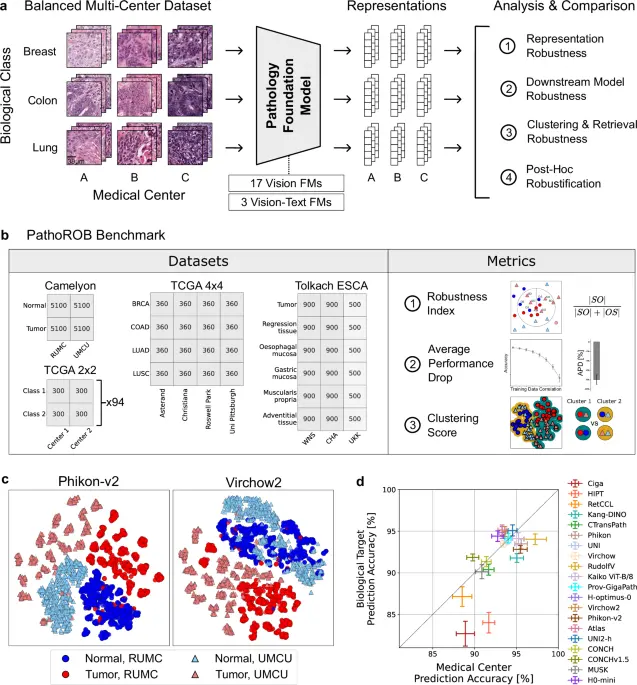
To systematically address this bottleneck, an international team of researchers developed PathoROB, a comprehensive, multi-center benchmark specifically designed to measure pathology foundation model robustness against non-biological variations. Analyzing 20 of the most prominent histopathology foundation models—ranging from small-scale vision transformers to massive image-text architectures—the researchers traced how technical variance degrades both representation spaces and downstream output reliability.
1. Evaluating Representation Spaces
The investigation began by evaluating how foundation models organize data in their embedding spaces. Utilizing balanced multi-center datasets, the researchers discovered that most models prioritize technical signatures over biological truths. For instance, t-SNE visualizations revealed that models like Phikon-v2 organize their representation spaces primarily by medical center origin rather than tissue pathology. Conversely, while advanced models like Virchow2 split primarily by biological information (normal vs. tumor), their embeddings still retained strong, detectable signatures of the originating hospital.
2. Exposing "Clever Hans" Downstream Failures
The research team then simulated real-world clinical deployment by training downstream supervised classifiers on data with varying degrees of correlation between medical centers and disease targets. As artificial spurious correlations increased (simulating imbalanced multi-site training data typical of rare disease cohorts), downstream generalization performance collapsed across all models. In Camelyon tumor detection tasks, tumor detection accuracy plummeted from over 92% down to 53% for fully correlated training data.
When deployed on unseen whole-slide images, non-robust models exhibited systematic, alarming blind spots—misidentifying unequivocal tumor tissue as normal purely because of its hospital of origin, or completely failing to highlight critical malignant lesions.
3. Testing Mitigation Frameworks
Recognizing that retraining massive foundation models from scratch is economically and computationally prohibitive, the team investigated post-hoc robustification strategies. They evaluated three distinct interventions:
- Data Robustification (DR): Applying Reinhard stain normalization to eliminate color and contrast variations in image space.
- Representation Robustification (RR): Implementing ComBat empirical Bayesian batch correction directly on extracted feature vectors.
- Training Robustification (TR): Utilizing Domain-Adversarial Neural Networks (DANNs) during downstream model training to penalize the use of medical center features.
While stain normalization and ComBat batch correction significantly boosted representation robustness metrics, they also exposed the deep entanglement of biological and technical signals within the embedding spaces—highlighting that naive artifact removal risks stripping away genuine biological nuances.
Supporting Context & Metrics
To quantify these phenomena, the study introduced rigorous metrics that redefine how foundation models are audited:
- The Robustness Index ($mathcalR$): Ranging from 0 (completely non-robust) to 1 (fully robust), this metric measures the relative dominance of biological over technical features in local embedding neighborhoods. Averaged across datasets, foundation model scores ranged widely from 0.446 to 0.861, indicating that up to 55% of local neighborhoods were dictated by hospital artifacts rather than biology.
- The Clustering Score: Evaluating the global organization of embedding spaces, this score penalizes clusters driven by medical centers while rewarding biologically coherent groupings. Most unrobust models scored near zero, proving that unsupervised clustering (used for discovering novel disease subtypes) frequently groups hospitals rather than pathologies.
- Average Performance Drop (APD): Tracking the degradation of downstream model accuracy under distribution shifts, this metric confirmed a strong Spearman rank correlation ($rho = 0.904, p < 10^-8$) between high representation robustness and stable out-of-domain generalization.
| Metric / Evaluation Dimension | Key Finding / Trend |
|---|---|
| Model Scale vs. Robustness | Larger self-supervised learning (SSL) models trained on more diverse datasets showed a strong positive correlation with robustness, though none achieved perfection. |
| Vision-Language Supervision | Image-text models (e.g., CONCH, CONCHv1.5) exhibited higher baseline robustness than vision-only models of comparable accuracy, suggesting language guidance helps suppress confounding technical artifacts. |
| ComBat Batch Correction | Dramatically improved the robustness index across models (up to +28% on average) but occasionally degraded downstream performance by inadvertently stripping entangled biological signals. |
Official Statements & Expert Insights
The implications of these findings have sent ripples through the computational pathology and machine learning communities, prompting critical reflection on validation standards.
"Foundation models might be expected to provide more robust information thanks to their large and diverse pre-training datasets," the study’s authors note. "However, the self-supervised learning methods applied to pre-train pathology FMs are designed to capture any differences in the data, which includes technical variation."
Experts emphasize that the standard practice of evaluating foundation models purely on clean, homogenous benchmarks creates a dangerous illusion of clinical readiness.
"Our work demonstrates the importance of including robustness criteria in FM development, FM alignment, or downstream model training," the researchers stress. "In high-stakes biomarker and outcome prediction, where model validation is typically even more challenging than for routine diagnostic tasks, relying on unrobust representations invites catastrophic failures."
Furthermore, the study engages with the nuanced debate surrounding demographic and technical biases in general-purpose embeddings. While some argue that removing information risks erasing subtle subpopulations tied to specific medical centers, the authors counter that in rare disease diagnostics—where multi-site data pooling is mandatory—robustified representations remain an absolute prerequisite for patient safety.
Future Outlook and Strategic Recommendations
As computational pathology transitions from experimental research to widespread clinical integration, the PathoROB benchmark and its underlying findings establish an urgent roadmap for the field:
- Mandatory Robustness Benchmarking: Future foundation model iterations must incorporate multi-center robustness evaluations as a core standard during pre-training and validation, rather than relying exclusively on in-distribution accuracy.
- Advanced Post-Hoc Alignment: Moving beyond brute-force stain normalization, future research must harness advanced explainable AI, sparse autoencoders, and vision-language instruction tuning to surgically disentangle biological signals from technical confounders.
- Cross-Disciplinary Translation: Because batch effects and technical artifacts plague biomedical imaging and omics data alike, the PathoROB framework offers a scalable blueprint to secure foundation models across radiology, genomics, and digital pathology.
Ultimately, achieving clinically trustworthy artificial intelligence requires more than scaling parameter counts and dataset sizes. By confronting and correcting the hidden fragilities within embedding spaces, the biomedical AI community can build resilient, equitable, and truly reliable diagnostic tools for the future.