





Executive Overview
For more than three decades, the world has been captivated by the frozen remains of Ötzi the Iceman, Europe’s oldest natural mummy. Discovered by German tourists in the Ötztal Alps along the Austrian-Italian border in September 1991, the Copper Age hunter has provided unprecedented insights into prehistoric human anatomy, diet, toolmaking, and pathology. Yet, beneath his leather garments, tattooed skin, and remarkably preserved internal organs lies an even more complex, hidden universe: a dynamic, evolving microbial ecosystem.
In a landmark study recently published in the scientific journal Microbiome, an international team of researchers detailed a groundbreaking effort to untangle the complex web of microorganisms inhabiting Ötzi. By employing multi-layered sampling techniques and advanced genetic sequencing, scientists successfully differentiated between the ancient microbes that lived inside the Iceman during his lifetime and those that colonized his body post-mortem. This colonization occurred across two distinct phases: during millennia of being frozen in a glacial tomb, and throughout the more than thirty years of modern laboratory conservation that followed his discovery.
The findings challenge the long-held assumption that ancient mummies are static, sterile historical relics. Instead, researchers have demonstrated that Ötzi is a thriving biological system. Among the most startling discoveries is the identification of a resilient community of cold-adapted yeast species that likely hitched a ride from the glacier thousands of years ago—and have survived on the mummy into the modern era. Furthermore, analysis of his ancient gut flora has reinforced how vastly different the human microbiome was over five millennia ago compared to modern industrialized populations, offering a unique baseline for human evolutionary biology.
Beyond historical and anthropological revelations, this microbiological deep-dive carries tangible modern implications. The resilient psychrophilic (cold-loving) yeasts discovered on the mummy possess unique metabolic capabilities—including the ability to metabolize industrial compounds like phenol. These organisms could eventually unlock novel, energy-efficient applications in modern biotechnology, such as low-temperature industrial fermentation. As researchers continue to monitor and protect the Iceman at the South Tyrol Museum of Archaeology, this study marks a vital leap forward in understanding how ancient organic remains interact with their environments over geological and modern timescales.
Detailed Chronology
To comprehend the significance of the recent microbiological findings, it is essential to trace the journey of Ötzi the Iceman from his fatal encounter in the high Alps to his current high-tech quarantine at the South Tyrol Museum of Archaeology.
The Final Days and Entombment (c. 3300 BCE)
Sometime around 3300 BCE, a 45-year-old man—roughly 160 centimeters tall and weighing about 50 kilograms—was ambushed and fatally wounded in the Tyrolean Alps. An arrowhead lodged in his left shoulder caused catastrophic internal bleeding, and a severe blow to the head ultimately sealed his fate. Left in a rocky gully high in the mountains, his body was rapidly covered by wind-blown snow and accumulating glacial ice.
As freezing temperatures gripped the corpse, metabolic processes ceased, locking his final meals, his internal organs, and the rich bacterial flora of his digestive tract into a cryogenic stasis. For over five millennia, the shifting glacier acted as both a preservation chamber and a selective filter, introducing trace environmental elements while keeping wholesale decay at bay.
The Accidental Discovery (September 1991)
On September 19, 1991, German mountaineers Helmut and Erika Simon stumbled upon the exposed torso and head of a human body protruding from a melting high-altitude ice field at Tisenjoch. Initially mistaken for a modern mountaineering accident, the recovery operation quickly escalated when authorities realized the remains were ancient. During the tumultuous recovery process, a 1991 soil sample was secured from the discovery site—a crucial baseline specimen that would decades later help scientists isolate environmental microbes from ancient ones.
The Era of Modern Conservation (1991–Present)
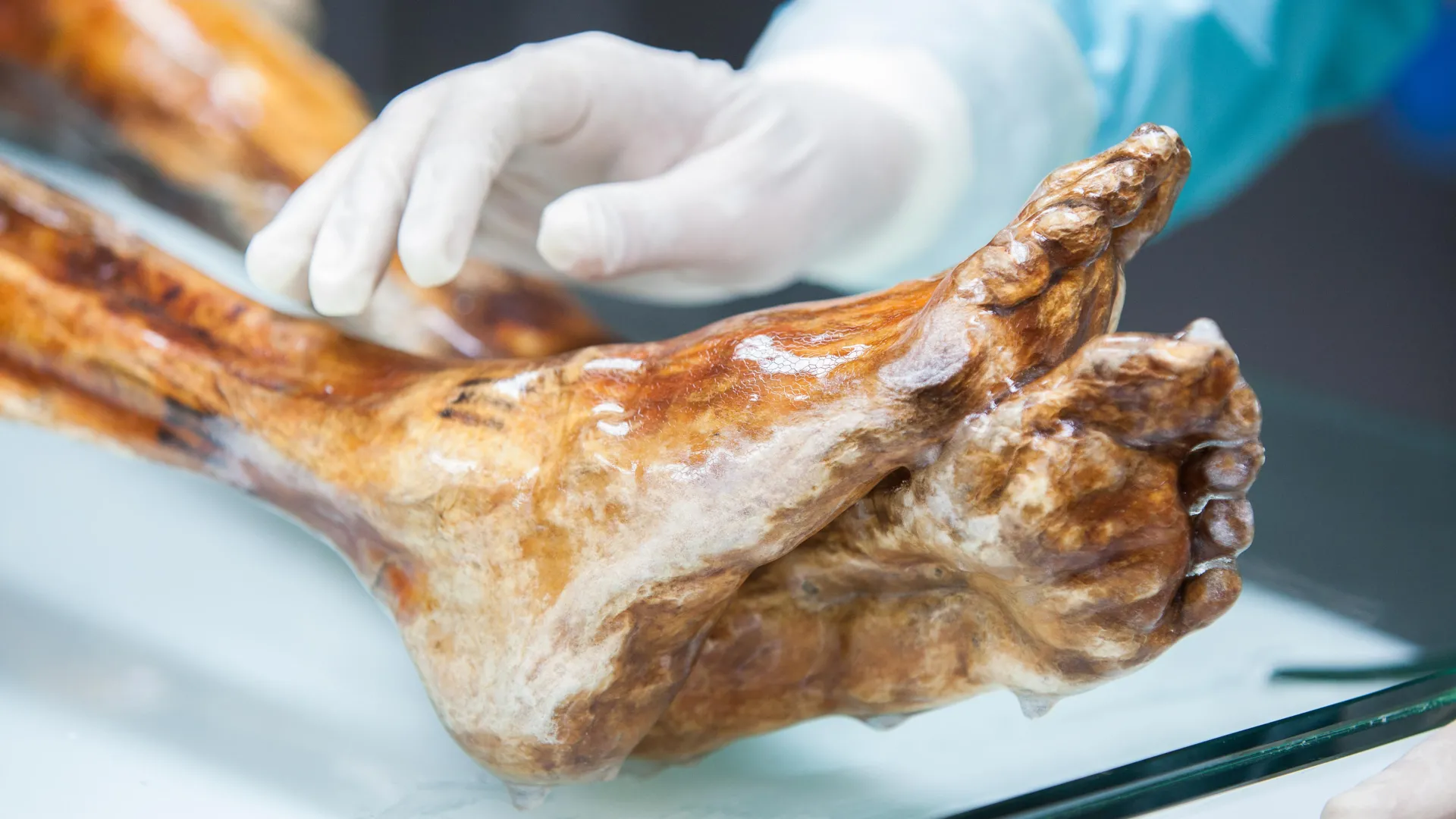
Transferred to specialized facilities in Italy, Ötzi became the subject of intense multi-disciplinary scientific scrutiny. Housed in a dedicated cold-storage cell at the South Tyrol Museum of Archaeology in Bolzano, Italy—maintained at a precise minus six degrees Celsius and high relative humidity—the mummy has been subjected to various conservation protocols.
In the immediate aftermath of his recovery, conservators faced the threat of modern mold and fungal overgrowth. To combat this, they applied chemical treatments, including phenol, to sterilize the skin’s surface. While successful in halting fungal blooms, these treatments inadvertently introduced novel chemical stressors and, as recent research shows, potential nutrient sources that shaped the mummy’s modern microbial landscape.
The Breakthrough Genetic Investigations (2019–Present)
While early research focused primarily on Ötzi’s weapons, clothing, and genetic ancestry, his microbiome remained largely unexplored until a pivotal 2019 study conducted in collaboration with Eurac Research. That project successfully mapped the bacterial DNA within his intestinal tract and stomach contents, revealing a surprisingly intact prehistoric gut flora.
Building directly upon that foundation, the latest study published in Microbiome expanded the investigative scope. Researchers utilized advanced genetic profiling across a wide array of samples—ranging from surface ice and meltwater to deep tissue swabs—to distinguish the ancient biological signatures from contemporary microbial interlopers.
Supporting Context & Metrics
The complexity of Ötzi’s microbiome required a meticulous methodological approach. By evaluating diverse specimen types, the research team could construct a comprehensive microbiological map of the mummy’s internal and external environments.
Sampling Methodology and Scope
To determine the origin of every microorganism detected, the scientific team gathered and analyzed multiple sample categories:
- Surface Ice and Meltwater: Collected directly from the exterior and interior melt zones of the mummy to capture active, water-borne, or ice-associated microbes.
- Targeted Swabs: Numerous swabs gathered from various cutaneous and internal locations to isolate localized microbial colonies.
- Archival Tissues: Previously sequenced DNA data from intestinal tracts and stomach contents, providing insights into the Iceman’s last meals (including Alpine ibex and red deer meat) and associated digestive bacteria.
- Control Soil Samples: A pristine soil sample taken from the original 1991 recovery site, which had remained frozen since its collection, serving as an environmental baseline to track glacial microbes.
Unraveling the Prehistoric Gut Microbiome
The genetic recovery from Ötzi’s intestinal tract provided a rare window into Copper Age human biology. Comparative genomic analysis revealed that the Iceman’s gut flora closely mirrors the few other known microbiomes extracted from early human populations. Crucially, many of these bacterial strains are virtually absent in contemporary humans residing in modern industrialized societies, where diets, antibiotic use, and sanitation have drastically altered internal ecosystems.
This divergence underscores how the human body’s internal ecology has shifted over millennia. Ötzi provides an invaluable benchmark for understanding the natural, unadulterated state of the human gut before the advent of industrialization and modern medicine.
Cold-Adapted Yeasts and Phenol Metabolism
One of the study’s most unexpected triumphs was the discovery of specialized, cold-adapted yeast species (psychrophilic yeasts) residing in skin samples, internal meltwater, and stomach contents. Genetic testing established that these strains bear close evolutionary relationships to yeasts discovered in extreme environments such as Antarctica, validating the theory that they originated in the Alpine glacier.
Fascinatingly, the detection of both heavily degraded ancient DNA and pristine modern DNA indicates that these microorganisms are not merely dead biological debris. They are actively surviving under the South Tyrol Museum’s storage conditions (minus six degrees Celsius, high humidity), likely operating in a state of metabolic dormancy or slow adaptation.
Furthermore, laboratory analysis revealed that three out of the four identified yeast species possess the genetic machinery required to break down phenol. This metabolic trait explains how these organisms managed to survive post-recovery interventions: the phenol applied in the 1990s to remove surface mold served not as a poison, but as an unexpected food source, inadvertently feeding the resilient fungal strains.
Official Statements
The implications of these findings have resonated deeply across the international scientific and preservation communities. Key researchers and institutional directors have emphasized the paradigm shift in how mummies must be studied and managed.
Frank Maixner, director of the Institute for Mummy Studies at Eurac Research, underscored the active, continuous nature of the mummy’s internal ecosystem:
"We see continuity here. These yeasts have accompanied Ötzi on his long journey through the millennia. The results show that the mummy is not a static relic, but a dynamic biological system."
Mohamed S. Sarhan, a microbiologist and lead author of the study, highlighted the unique dual nature of the samples recovered during the investigation:
"A mummy’s microbiome is unique because we are dealing with microbes that are over 5,000 years old and, at the same time, with modern microbes that have been introduced since the discovery."
Addressing the ongoing challenges of preservation, Elisabeth Vallazza, director of the South Tyrol Museum of Archaeology, emphasized the necessity of constant vigilance:
"The mummy’s conservation conditions are very stable today. Close microbiological monitoring ensures that the mummy suffers no damage. But further research and full conservation efforts are certainly needed to preserve it for many more generations."
Echoing the need for continued scientific inquiry into natural mummification, conservation expert and co-author Marco Samadelli noted:
"The conditions under which glacial mummies are preserved are not yet fully understood. This study expands our knowledge in this area."
Future Outlook
As science marches forward, the insights gained from Ötzi’s microbiome extend far beyond the display cases of Bolzano. The intersection of archaeology, microbiology, and industrial biotechnology points toward a promising horizon.
Advancing Conservation Protocols for Ancient Remains
Understanding how microorganisms interact with ancient organic materials under sub-zero storage conditions provides conservationists with actionable data. By mapping which microbes are dormant versus active, and identifying which past treatments inadvertently sustained unwanted biological agents, museums can refine their preservation strategies. This ensures that Ötzi—and potentially other newly discovered glacial or permafrost remains—can be protected from structural and biological degradation for centuries to come.
Industrial Applications of Psychrophilic Microorganisms
Perhaps the most surprising frontier opened by this research lies in industrial biotechnology. Cold-adapted microorganisms are uniquely evolved to execute biochemical reactions at temperatures that would render standard industrial enzymes sluggish or inactive.
Biotechnologists are increasingly interested in psychrophilic enzymes and yeasts for applications that require low-temperature processing, such as specialized fermentation, bioremediation, and green chemical manufacturing. These processes can operate at ambient or chilled temperatures, drastically cutting the energy demands traditionally required for industrial heating.
Through Ötzi, a tragedy of the Copper Age has become a wellspring of modern innovation. As interdisciplinary teams continue to decode the microscopic life clinging to his 5,000-year-old frame, the Iceman proves that even in death, his journey of discovery is far from over.