Redefining the Operating Room: Inside Johnson & Johnson MedTech’s Groundbreaking Ottava Surgical System
Executive Overview
The landscape of modern minimally invasive surgery underwent a paradigm shift with the official unveiling of Johnson & Johnson MedTech’s Ottava surgical robotics system. Showcased at the Society of Robotic Surgery (SRS) annual meeting following a landmark FDA de novo authorization, Ottava introduces the world’s first table-integrated soft-tissue robotics architecture.
For years, the surgical robotics market has been dominated by bulky, standalone cart-based systems that crowd the operating room, demand extensive manual setup, and present logistical bottlenecks for clinical teams. Ottava shatters this mold. By seamlessly integrating its robotic arms directly into the operating table—while preserving the ability to completely stow them out of sight when not in use—Johnson & Johnson has engineered a category-defining solution.
Behind this monumental engineering feat is a multidisciplinary triumph. In an exclusive interview, Neda Cvijetic, J&J MedTech’s Global Head of Robotics & Digital R&D, shared the intricate journey of bringing Ottava to life. From solving unprecedented mechanical challenges in arm stowage and spatial motorization to introducing pioneering digital ecosystems and unexpected sensory touches like spa-grade calming audio design, Ottava represents a quantum leap in surgical tech. This article explores the depth of Ottava’s architecture, the technical hurdles overcome during its development, its data integration capabilities via the Polyphonic ecosystem, and what the future holds for the next generation of robotic surgery.
Detailed Chronology and Development Journey
Building a category-defining medical device from the ground up is never a linear path. For the engineering teams at Johnson & Johnson MedTech, the journey of developing Ottava required navigating uncharted waters, solving unprecedented problems, and demanding functional excellence across every single engineering discipline.
The Genesis of a Paradigm Shift
The conceptualization of Ottava began with a core clinical frustration: operating rooms are crowded, and traditional robotic systems consume valuable floor space, requiring cumbersome repositioning between procedures. J&J MedTech’s vision was to eliminate the cart entirely by anchoring the robotics into the surgical table itself.
However, translating this vision into a viable medical product presented a staggering engineering paradox. The robotic arms needed to be robust, fully articulated, and capable of complex soft-tissue procedures, yet compact enough to fold completely away beneath the surgical table when manual access to the patient was preferred.
Overcoming the Stowage and Reach Paradox
According to Cvijetic, the single most challenging engineering hurdle was achieving simultaneous, full-extent stowage under the table while guaranteeing uncompromising reach and clinical access once deployed.
Solving this required a harmonious convergence of mechanical, electrical, human factors, and clinical workflow engineering, coupled with advanced software stacks. The team realized early on that a purely mechanical linkage would fall short of the precision required. Consequently, they made a foundational design choice: every single joint of every robotic arm was motorized.
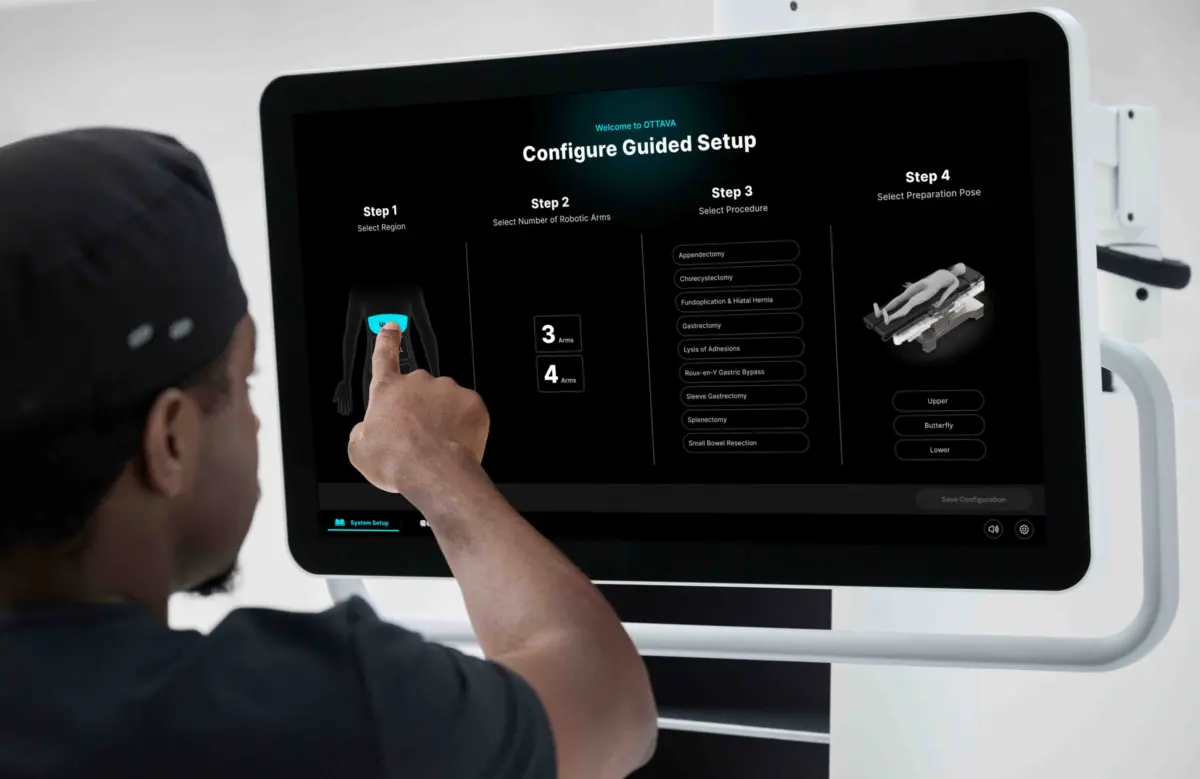
By motorizing the arms and embedding high-precision spatial awareness sensors into the hardware, J&J transformed a purely mechanical challenge into a digital triumph. This enabled the implementation of predefined procedure poses. At the push of a button, Ottava’s arms can autonomously deploy, transition into precise clinical configurations, or gracefully stow away during setup, intraoperative workflows, and teardown.
Supporting Context & Metrics: Architecture, Spatial Awareness, and Data
Ottava is much more than a mechanical marvel; it is an intelligent, data-driven surgical platform designed to integrate effortlessly into the modern hospital ecosystem.
The Power of Spatial Intelligence
To achieve seamless automation and precision choreography, Ottava relies on advanced spatial awareness systems. The robotic arms are equipped with proprietary sensors that maintain real-time awareness of their own positions relative to each other, the operating table, and the patient.
While J&J guards the exact nomenclature and proprietary specifics of these sensors to protect its intellectual property, the functional output is undeniable. The system constantly cross-references real-world physical telemetry with rich simulation data, enabling the robotic arms to calculate safe, optimal trajectories dynamically.
The Polyphonic Digital Ecosystem
Modern surgery generates an immense volume of data, yet much of it remains siloed. Ottava solves this by plugging directly into Johnson & Johnson’s Polyphonic digital ecosystem—a unified platform designed to connect insights, video feeds, telemetry, and procedural data across the entire surgical pathway.
Open Architecture: Notably, Polyphonic is not restricted solely to Ottava. It integrates data from other J&J innovations, such as the Monarch platform, and remains open to third-party devices.
Postoperative Access: Surgeons and research teams gain immediate access to synchronized case videos, operational metrics, and robotic telemetry for independent analysis and quality improvement.
Multimodal Data Capture: Beyond spatial coordinates and advanced visualization cameras, Ottava incorporates robust audio and environmental data collection capabilities, ensuring a comprehensive record of every case.
Official Statements and Technical Insights
During our exclusive discussion, Neda Cvijetic elaborated on the philosophy driving Ottava’s design, addressing everything from regulatory milestones to the nuanced debate surrounding haptic feedback and acoustic engineering.
On Regulatory Precedent and Team Ingenuity
Reflecting on the FDA de novo authorization, Cvijetic emphasized the unprecedented nature of the achievement:
"These teams have built a category-defining, soft-tissue surgical robot, and our regulatory pathway is a testament to that. There is no precedent here… A category-defining path on something so sophisticated and technologically complex, it’s never a purely linear path. It took ingenuity to solve these problems that are unprecedented, it took determination, discipline, commitment, functional excellence in every single area of engineering."
On Continuous Software Innovation
By embedding motorization and spatial intelligence from day one, J&J has future-proofed the platform. Cvijetic highlighted how this unlocks continuous future enhancements:
"That design decision to not only design for stowage and for reach and access, but for motorization, for spatial awareness, gives us the ability to create over time a cadence of differentiated software releases that are very compelling."
Addressing the Haptic Feedback Debate
Haptic feedback—the tactile sensation of tissue resistance transmitted back to the surgeon’s console—remains a subject of vigorous debate in surgical robotics. When asked about Ottava’s approach to force indication and customer feedback, Cvijetic noted:
"We listen to our customers a lot and we pay attention to the new technologies that are out there in the field, and that’s going to continue being the case. We’re going to continue listening, continue innovating based on their feedback… On the instrumentation in general, we have a full intention to make our full Ethicon pipeline available on Ottava."
When pressed on whether Ottava can be upgraded with haptic capabilities in the future, Cvijetic confirmed directly:
"We have that capability."
Calming the Operating Room: The Sound of Innovation
Perhaps one of the most surprising design elements of Ottava is its acoustic profile. Recognizing that the modern OR can be an intensely stressful, high-noise environment, J&J enlisted expert sound designers to craft auditory cues for the system.
Cvijetic explained the philosophy behind this acoustic integration:
"For us, no matter the type of technology — whether it’s automation, digital ecosystem, or sound — it’s about empowering that human clinical expert in the OR. Sound can be very soothing for humans. It’s a very calming sound. The OR can be a very busy, noisy environment. I would describe it as a calming, reassuring sound that instills confidence in our system… To me, it sounds like a very soothing, high-tech spa."
Future Outlook
The commercial rollout of Ottava following its SRS debut and FDA clearance marks the beginning of a new chapter for Johnson & Johnson MedTech. By addressing the fundamental spatial limitations of traditional robotic carts, J&J has lowered the operational barrier to entry for hospitals considering robotic programs.
Looking forward, the roadmap for Ottava is defined by expansion and software agility. With the promise of integrating the entire Ethicon instrumentation pipeline, hospitals can expect a familiar, trusted suite of surgical tools adapted for robotic precision. Furthermore, because Ottava was architected from inception as a digitally native platform, future software iterations will continuously introduce advanced automation features, refined procedural poses, and deeper AI-driven analytics via the Polyphonic ecosystem.
As adoption scales across healthcare systems globally, Ottava is positioned not just as a tool for performing surgery, but as a comprehensive ecosystem that elevates surgical performance, enhances team communication, and humanizes the operating room environment.