


Executive Overview
Where, when, and how did life first spark on Earth? These enduring questions stand at the very foundation of modern biological inquiry, bridging geochemistry, biochemistry, and evolutionary theory. Now, a groundbreaking study published in Science Advances by an international consortium of researchers—anchored by the Institute of Molecular Evolution at Heinrich Heine University Düsseldorf (HHU)—has provided a radical new perspective on the dawn of biology.
By comprehensively mapping a network of 420 core metabolic reactions, the research team has decoded the chemical stepping stones used by the Earth’s earliest cells to synthesize the fundamental building blocks of existence. More provocatively, the data challenges the long-held consensus of a single, unified emergence of free-living cells. Instead, by tracing the historical divergence of enzymes during the ancient split between bacteria and archaea, the researchers have uncovered compelling evidence that free-living cells may have originated independently twice.
This monumental discovery suggests that while all known cellular life shares a single, universal genetic code, the transition from primitive, vent-bound chemical networks to autonomous, independent living cells occurred along two distinct, parallel tracks. It is a revelation that reframes our understanding of abiogenesis—the natural process by which life arises from non-living matter—and suggests that the spark of life may not have been a singular, highly improbable accident, but a chemically driven inevitability that found its footing more than once.
Detailed Chronology: From Mineral Scaffolds to Autonomous Life
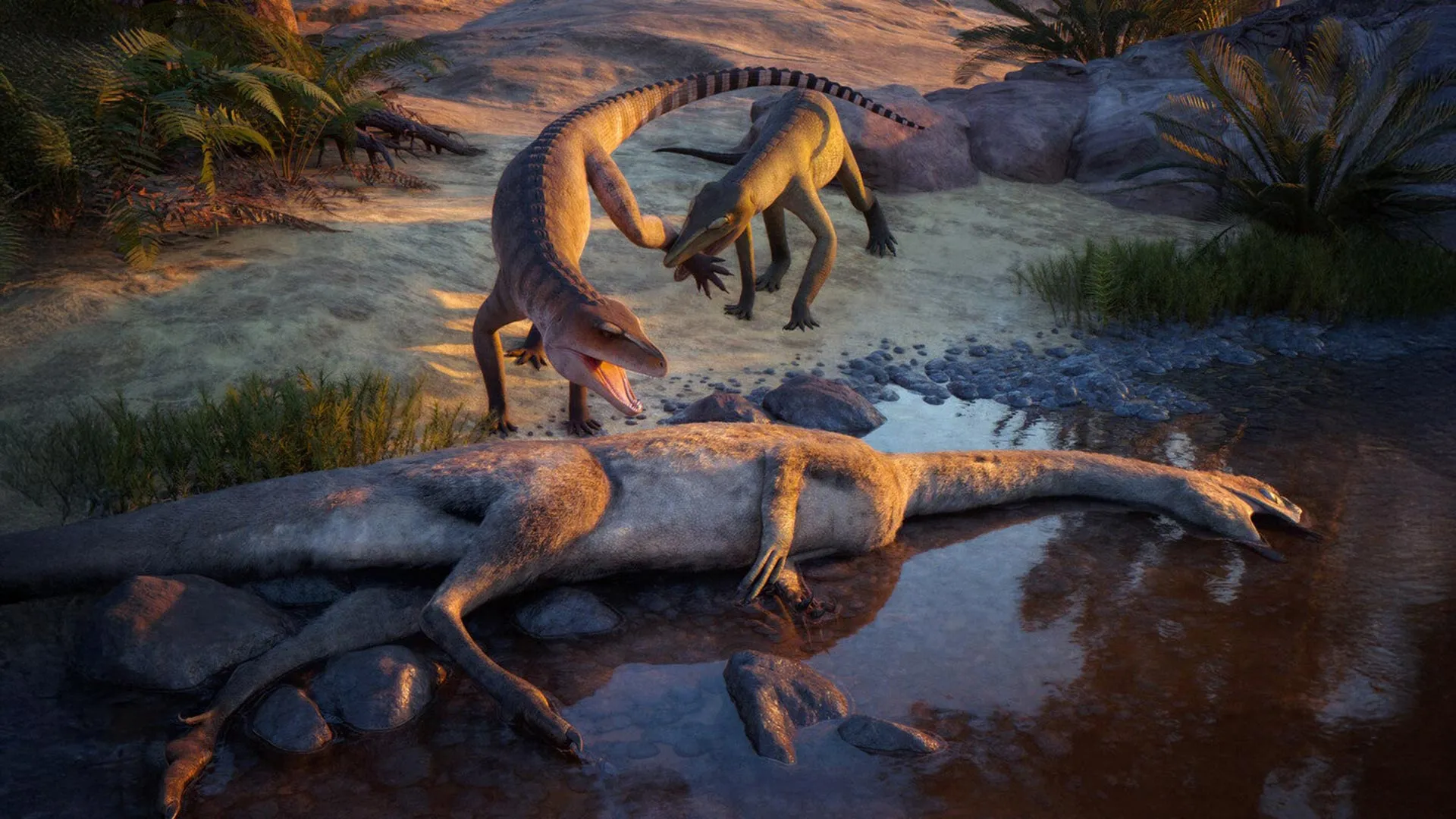
To visualize the Earth approximately 4万 (4 billion) years ago is to look upon an alien landscape. The planet was volatile, shrouded in a primordial atmosphere, and dominated by a global ocean pierced by scorching hydrothermal vents. If an observer could travel back to witness the genesis of biology, they would not see a uniform soup of fledgling life. Rather, the scene would likely feature two distinct experimental prototypes of primitive cellular existence struggling to break free from the mineral confines of the ocean floor.
[4 Billion Years Ago: Geochemical Stage]
   │ (Reactions driven entirely by crustal metals in hydrothermal vents)
   ▼
[The LUCA Phase: Hybrid Catalysis]
   │ (Metals and primitive enzymes working in tandem; LUCA has ~50% of metabolic enzymes)
   ▼
[Evolutionary Divergence]
   │ (Bacteria and Archaea split; independently invent distinct enzymes for identical tasks)
   ▼
[Dual Origins of Free-Living Cells]
   │ (Independence from vents achieved separately: One genetic code, two origins of life)
Natalia Mrnjavac, a biologist at the University of Düsseldorf and lead author of the study, paints a vivid picture of this era: "We would see two very different kinds of cells emerging—pioneer bacteria and pioneer archaea—making their first attempts at life outside the confines of a hydrothermal vent."
To reconstruct this epoch, Mrnjavac and her colleagues did not merely analyze isolated metabolic pathways or cherry-pick advantageous genes. Instead, they performed an exhaustive, holistic examination of genomes, protein structures, and chemical reaction networks. Their focus was the complete ensemble of 420 chemical reactions that cells utilize to manufacture essential biological components—such as amino acids, RNA bases, and vitamins—from the inorganic materials abundantly available on the early Earth, including molecular hydrogen ($H_2$), ammonia ($NH_3$), and carbon dioxide ($CO_2$).
The Hybrid Era of LUCA and Geochemical Scaffolding
These 420 chemical reactions form the backbone of what scientists define as metabolism. Remarkably ancient, these reactions are conserved across almost all contemporary life to a degree that rivals the conservation of the genetic code itself. Yet, when the research team looked closer at the catalysts driving these reactions, they encountered a profound paradox.
The enzymes responsible for executing these metabolic steps do not show the same deep evolutionary conservation across the great divide that separates bacteria and archaea.
"The surprise is that the enzymes that catalyze those reactions are not conserved across the evolutionary divide that separates bacteria and archaea," explains Professor William Martin, senior author of the study. "We found that the last universal ancestor of all cells, LUCA, possessed enzymes for only about half of the reactions of metabolism. The other half was catalyzed by metals in the environment where LUCA arose."
This revelation indicates that the earliest metabolism relied far more heavily on its geological surroundings than modern cells do. In the primordial environment of hydrothermal vents, transition metals embedded in the Earth’s crust acted as natural catalysts.
Harun Tüysüz, an inorganic chemist from the Max-Planck-Institut für Kohlenforschung and the IMDEA Materials Institute in Madrid, emphasizes the efficiency of these mineral catalysts: "Metals that naturally occur in hydrothermal vents can replace a surprisingly large number of enzymes in metabolism."
Echoing this, Joseph Moran of the University of Ottawa, an international pioneer in using metals to substitute for enzymes and cofactors in metabolic reactions, notes: "The closer we look, the more clearly we can see that early biochemical evolution was a hybrid of enzymatic and metal catalysts."
The Four-Stage Evolution of Biological Catalysis
Based on their network reconstructions, the research team successfully mapped out a four-stage chronological sequence detailing how biological catalysis evolved from pure geology to pure biology:
- Pure Geochemical Catalysis: The earliest phase, where all precursor synthesis was driven entirely by inorganic metal surfaces within the Earth’s crust and hydrothermal systems.
- The Hybrid LUCA Stage: A transitional phase represented by the Last Universal Common Ancestor (LUCA), where biological enzymes shared the metabolic workload equally with environmental metal catalysts.
- The Divergence Phase: Bacteria and archaea split down separate evolutionary pathways. As they drifted away from their original mineral environments, each lineage began independently replacing environmental metal catalysts with newly evolved, genetically encoded enzymes.
- Autonomous Cellular Independence: Both lineages perfected parallel sets of enzymes to perform identical essential metabolic tasks, severing their reliance on hydrothermal vents and fully stepping into the realm of free-living, self-sustaining cellular life.
This parallel evolution was the critical catalyst. By independently inventing distinct enzymes to perform the same vital chemical jobs, bacteria and archaea bypassed the limitations of their local geography. They could now pack their metabolic machinery inside self-manufactured lipid membranes and wander out into the open oceans.
Supporting Context & Metrics: Unlocking the 420-Reaction Puzzle
Reconstructing a metabolic network comprising 420 highly interconnected reactions is not merely a biological challenge; it is a monumental computational and mathematical puzzle. Many of the same intermediate compounds participate in multiple parts of the system simultaneously, creating feedback loops and complex dependencies that obscure the historical order of appearance.
To solve this, the Düsseldorf team partnered with computational network experts Professor Mike Steel from the University of Canterbury in New Zealand and Professor Daniel Huson from the University of Tübingen.
By applying advanced algorithmic methods to analyze the complexity of the network, the team was able to arrange metabolic reactions along a gradient from the simplest, most thermodynamically favored reactions to the most complex biosynthetic pathways. This sequence reflects the chronological order in which these chemical transformations likely integrated into the fabric of emerging life.
"The first question is whether or not a unique order exists for these reactions," Professor Steel remarks. "Once we could prove that there is one, the algorithm to order them became tractable."
Solving the Ancient Energy Crisis
Another profound hurdle in understanding early life has been the energetic paradox. Modern cells rely almost exclusively on adenosine triphosphate (ATP) to drive thermodynamically unfavorable metabolic reactions. However, ATP is an exceptionally complex molecule whose synthesis inside modern cells requires sophisticated machinery, including multi-subunit ATP synthase enzymes. ATP would not have been freely floating in the ancient oceans or hydrothermal vents.
What powered life before ATP? The research team identified a stunning geochemical solution, pointing to a novel energy source at the absolute origin of metabolism.
Manon Schlikker of the Düsseldorf team explains: "We have identified a new source of energy at metabolic origin."
That source is palladium, a rare transition metal that occurs naturally in hydrothermal vents and has long been recognized by industrial chemists for its catalytic prowess. Schlikker and her colleagues discovered that phosphite—a reduced form of phosphorus naturally present in hydrothermal environments—can react with organic compounds in the presence of palladium, driving metabolic phosphorylation reactions overnight in plain water.
"When we react phosphite, a form of phosphorus that naturally occurs in hydrothermal vents, with organic compounds, we get metabolic phosphorylation reactions overnight in water," Schlikker notes. "Phosphite and palladium replace ATP and enzymes; it’s amazing, and it makes early evolution a lot easier to grasp."
This geochemical mechanism provides a tangible, highly plausible explanation for how proto-metabolic pathways secured the necessary activation energy long before biological energy-currency molecules like ATP ever evolved.
Official Statements and Academic Insights
The implications of this multinational, multi-disciplinary study stretch far beyond evolutionary microbiology, touching upon philosophy, astrobiology, and the definition of life itself. The collaboration brought together top-tier minds across disparate fields, uniting the Max Planck Society, international universities, and specialized materials institutes.
Professor William Martin summarizes the ultimate takeaway of the research with characteristic clarity:
"The new data leave only one conclusion. The bacterial and archaeal lineages made the transition to the free-living state independently. Only free-living cells are alive. Let’s call it by name: we are looking at one origin of the genetic code, but two origins of life."
This distinction—separating the origin of the universal genetic code from the physical emergence of free-living, cellular autonomy—resolves long-standing debates in evolutionary theory. It explains how all cellular life can utilize the exact same triplet nucleotide code and fundamental translation machinery while simultaneously displaying fundamentally divergent structural and enzymatic strategies in their core metabolism.
Natalia Mrnjavac highlights the ingenuity of the evolutionary process during this bifurcation:
"We can see cases where the ancestors of bacteria and archaea independently evolved structurally distinct enzymes to catalyze the same essential metabolic reaction; such parallel inventions could have paved the way to the independent emergence of free-living bacteria and archaea."
By demonstrating that nature found two distinct molecular pathways to cross the threshold from chemistry to biology, the study paints a picture of life not as a fragile, singular miracle, but as a robust planetary imperative driven by the relentless thermodynamic gradients of the early Earth.
Future Outlook: Implications for Astrobiology and Synthetic Biology
As the scientific community digests these findings, the ripples will be felt across several disciplines.
1. Redefining the Search for Extraterrestrial Life
In astrobiology, the realization that free-living cells can emerge independently via parallel biochemical pathways changes how we model life on other worlds. If the transition from mineral-catalyzed geochemical networks to enzymatic autonomy is an inherent tendency of planetary systems rich in transition metals, hydrothermal activity, and phosphorus sources, then the genesis of life may be far more common in the universe than previously assumed. Moons like Enceladus and Europa, which harbor subsurface oceans in contact with rocky, mineral-rich hydrothermal floors, emerge as even more compelling targets for the search for independent biogenesis.
2. Rewriting Evolutionary Textbooks
Microbiologists will need to re-evaluate the root of the Tree of Life. For decades, textbooks have treated the divergence of bacteria and archaea as a branching event that occurred after the establishment of a fully formed, free-living ancestral cell (LUCA). The new Science Advances findings flip this narrative on its head: LUCA was not yet a fully autonomous, free-living organism by modern definitions, but rather a community of metal-dependent, vent-associated metabolic reactions. True cellular independence—the threshold of actual life—was crossed twice, independently, as each lineage forged its own enzymatic toolkit.
3. Inspiring Synthetic Biology and Green Chemistry
From a practical standpoint, understanding how simple metals like palladium and inorganic compounds like phosphite can drive complex phosphorylation and metabolic cycles opens up revolutionary avenues in synthetic biology and industrial catalysis. By mimicking nature’s ancient transition from metal catalysts to sophisticated enzymes, chemical engineers can design cleaner, more efficient industrial synthesis processes that operate under mild aqueous conditions without the need for expensive, fragile biological cofactors.
Conclusion
Ultimately, the work led by Heinrich Heine University Düsseldorf reminds us that the history written in our genomes is deeper and more complex than we ever imagined. Life did not simply happen; it tinkered, experimented, and successfully crossed the threshold into independence along two separate roads—leaving us with a unified genetic vocabulary, but a beautifully dual testament to the creative power of chemistry on a young planet.