







Executive Overview
Deep within the subterranean archives of the Yale Peabody Museum of Natural History lies a car-sized block of dense New Mexico sandstone, quarried more than three-quarters of a century ago from the fossil-rich badlands of Ghost Ranch. Entombed within this ancient matrix for approximately 210 million years are the exceptionally preserved, intertwined skeletons of two small, jackal-sized predators. For decades, paleontologists operated under the standard working assumption that both specimens belonged to the same well-documented early crocodilian relative, Hesperosuchus agilis.
However, a groundbreaking study published in the journal Proceedings of the Royal Society B has completely upended this long-held consensus. Through advanced high-resolution computed tomography (CT) scanning and meticulous digital dissection, a team of Yale researchers has identified one of the specimens as an entirely new genus and species: Eosphorosuchus lacrimosa.
Named after Eosphorus, the Greek mythological "dawn-bringer," and soukhos, the Greek word for crocodile, this newly revealed prehistoric predator lived during the late Triassic Period—a pivotal geological epoch when the foundational dynasties of terrestrial dominance were fiercely contested. While the lineage that would ultimately produce modern birds (dinosaurs) was experimenting with delicate, bipedal forms, the early relatives of crocodiles were developing into agile, four-legged terrestrial hunters occupying diverse ecological niches.
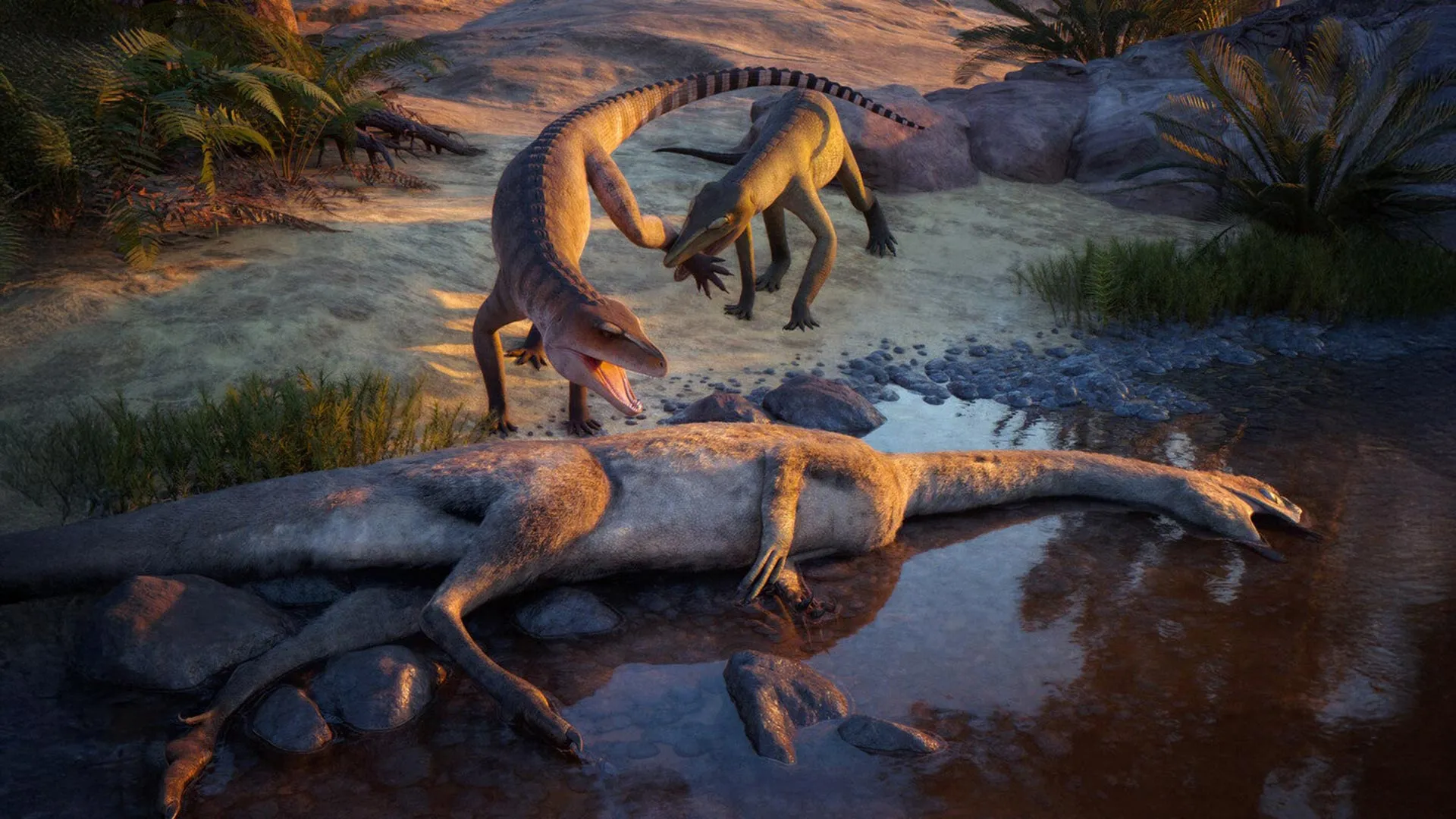
The discovery of Eosphorosuchus lacrimosa directly beside Hesperosuchus provides a rare, high-resolution snapshot of ancient ecological partitioning. With its shortened snout, heavily reinforced skull, and significantly larger jaw muscles, Eosphorosuchus was built to snap down on robust prey, contrasting sharply with the long-snouted, slender-jawed Hesperosuchus. Together, these intertwined fossils offer an unprecedented window into the dawn of functional diversification among proto-crocodilians, proving that even at the very inception of the Age of Reptiles, closely related predators were already carving out distinct survival strategies to avoid direct competition.
Detailed Chronology
The Late Triassic Stage: 210 Million Years Ago
To fully appreciate the significance of the Ghost Ranch fossil, one must step back across deep time to the late Triassic Period, roughly 210 million years ago. At this juncture in Earth’s history, the global supercontinent of Pangaea was beginning its slow, tectonic fragmentation. The climate across what is now northern New Mexico was humid, characterized by winding river systems, low-lying fern meadows, and seasonal floodplains.
In this ecosystem, two distinct mammalian-sized predators—each roughly the scale of a modern jackal or large fox—patrolled the damp riverbanks. Despite their similar overall body plans, featuring powerful hind limbs and reduced front arms, their cranial architecture pointed toward fundamentally divergent ecological destinies.
- Hesperosuchus agilis: This speed-adapted land predator utilized a long, slender snout well-suited for targeting swift, elusive prey along watercourses and riparian zones.
- Eosphorosuchus lacrimosa: Stationed nearby, this newly identified animal possessed a shorter, dramatically reinforced skull backed by hypertrophied jaw muscles, engineered for exerting immense bite force against larger or more robust quarry.
The lives of these two ancient reptiles were brought to a sudden, catastrophic halt. Researchers hypothesize that a flash flood or localized mudslide swept across the riverbank, overwhelming both animals simultaneously. Their carcasses were rapidly buried under a protective layer of sediment. Favorable chemical conditions within the local matrix initiated a process of permineralization that safeguarded their fragile bones through the subsequent rise and fall of the dinosaurs, the paleogene expansion of mammals, and deep geological shifting until their eventual excavation in the mid-20th century.
Excavation and Decades of Dormancy: 1948–2023
The fossilized block containing the entangled proto-crocodiles was unearthed in 1948 during expeditions to the legendary Ghost Ranch Bone Bed in Rio Arriba County, New Mexico—a site globally renowned for preserving thousands of specimens of the early carnivorous dinosaur Coelophysis bauri, alongside phytosaurs, lungfish, and early archosaurs.
Transported to the Yale Peabody Museum, the massive multi-ton rock sections were cataloged and integrated into the institution’s vast research collections. Yet, despite being physically accessible to the scientific community for approximately 75 years, the true taxonomic identity of the short-snouted specimen remained masked. Because early archosaur fossils from the Triassic are frequently distorted, crushed, or incomplete, researchers historically relied on external morphology visible on the rock’s surface. Both specimens from the Ghost Ranch block were routinely classified under the umbrella of Hesperosuchus.
The Modern Breakthrough: CT Scans and Digital Dissection
The turning point arrived when senior author Bhart-Anjan Bhullar, examining the Peabody’s historical holdings, noted anomalies in the facial structure of the second specimen. Recognizing that traditional surface examination was insufficient, the research team turned to non-destructive imaging technology.
Under the direction of Marilyn Fox, former senior preparator at the Peabody Museum, the fossilized block underwent high-resolution computed tomography (CT) scanning at the Yale Chemical and Biophysical Imaging Center. Miranda Margulis-Ohnuma, a Ph.D. student in Yale’s Department of Earth and Planetary Sciences and first author of the study, then took charge of the digital processing.
Using specialized 3D visualization software, Margulis-Ohnuma digitally "dissected" the fossil bone by bone, peering inside the rock matrix without causing physical damage to the delicate 210-million-year-old specimen. This digital peeling of the rock revealed hidden anatomical features—particularly within the internal architecture of the palate, braincase, and jaw articulation—that diverged sharply from known Hesperosuchus specimens. These structural novelties provided the rigorous anatomical data required to formally establish Eosphorosuchus lacrimosa as a novel genus and species.
Supporting Context & Metrics
Paleontological Context: The Ghost Ranch Bone Bed
Ghost Ranch serves as one of the premier paleontological windows into the late Triassic (spanning from 252 to 201 million years ago). The preservation quality at the site is attributed to rapid, catastrophic depositional events, such as catastrophic sheet-floods that swept diverse assemblages of fauna into localized depressions.
| Metric / Parameter | Detail / Value |
|---|---|
| Geological Age | Late Triassic Period (~210 million years ago) |
| Excavation Site | Ghost Ranch Bone Bed, New Mexico, USA |
| Repository | Yale Peabody Museum of Natural History |
| Fossil Matrix Size | Two large sections of rock, roughly equivalent to the volume of a standard automobile |
| Taxonomic Classification | Eosphorosuchus lacrimosa (New Genus and Species) |
| Primary Imaging Method | High-Resolution Computed Tomography (CT Scanning) |
| Key Co-existing Taxa | Hesperosuchus agilis, Coelophysis bauri |
| Publishing Journal | Proceedings of the Royal Society B |
Evolutionary Significance: The Dual Dynasties of the Triassic
The late Triassic was a crucible of evolutionary experimentation. Following the devastating end-Permian mass extinction, terrestrial ecosystems were wide open, allowing two major branches of the archosaur family tree to radiate outward:
- The Avian Lineage (Avemetatarsalia): This branch led directly to dinosaurs and, ultimately, modern birds. During the late Triassic, these animals were typically slender, bipedal, and delicate, occupying ecological roles akin to modern wading birds like herons.
- The Crocodilian Lineage (Pseudosuchia): This branch produced modern crocodilians (alligators, crocodiles, caimans, and gharials). However, their ancient ancestors bore little resemblance to today’s sluggish, ambush-hunting freshwater reptiles. Triassic pseudosuchians were predominantly fast-running, quadrupedal terrestrial predators with robust builds, functioning ecologically much like modern jackals, foxes, or wild dogs.
The discovery of Eosphorosuchus demonstrates that even within the pseudosuchian lineage, diversification occurred rapidly. Rather than occupying a single generalized predator niche, these proto-crocs were already refining their anatomical toolkits to exploit different prey items within the same physical habitat.
Official Statements
The research team emphasized both the evolutionary implications of the find and the untapped potential residing within historical museum archives:
"This speaks to the diversification of proto-crocs toward the beginning of the ‘Age of Reptiles,’" stated Bhart-Anjan Bhullar, associate professor of Earth and planetary sciences in Yale’s Faculty of Arts and Sciences (FAS), associate curator of vertebrate paleontology and vertebrate zoology at the Peabody Museum, and senior author of the study.
Elaborating on the broader landscape of the period, Bhullar added: "During this period, the late Triassic, there were two reptile dynasties vying for dominance: the line that would produce crocodiles and alligators on one side, and that which would produce birds, which of course are dinosaurs, on the other. The dinosaurs at this time were slim, delicate animals that walked on two slender legs almost like herons, and the crocodiles were fast-running, four-legged predators, low-slung and more heavily built—analogous to a jackal, a big fox, or a dog."
Highlighting the rarity of the preserved moment, Bhullar noted: "It’s a time-slice of a single moment 210 million years ago. These two individuals had to compete and interact with each other. They were quite possibly looking at each other when they died."
First author Miranda Margulis-Ohnuma, a Ph.D. student in Earth and planetary sciences in the Yale Graduate School of Arts and Sciences (GSAS), underscored the methodological triumph of the project:
"’Eosphorosuchus’ is one of only a handful of well-preserved early crocodile relatives, and its coexistence with ‘Hesperosuchus’ represents the ‘dawn’ of functional diversification in the lineage that would give rise to modern crocodiles. In addition to its unique anatomy and preservational history, the specimen demonstrates the potential of existing museum collections to continue revealing novel insights into the history of life."
Future Outlook
The formal description of Eosphorosuchus lacrimosa opens several promising avenues for future paleontological research:
- Re-evaluating Museum Archives: The success of CT-scanning decades-old fossil blocks without mechanical preparation serves as a powerful proof-of-concept. Paleontologists worldwide are expected to re-examine locked-away or misidentified archosaur specimens in institutional holdings, utilizing non-destructive digital imaging to uncover hidden biodiversity.
- Biomechnical Modeling of Triassic Predators: With detailed 3D digital models of both Hesperosuchus and Eosphorosuchus now available, researchers plan to conduct finite element analysis (FEA) to simulate bite forces, jaw stresses, and running speeds. This will provide quantitative data on how these animals partitioned resources and avoided direct competitive exclusion.
- Broader Implications for Mass Extinction Recovery: Understanding how pseudosuchians diversified during the late Triassic helps scientists model how ecosystems recover and restructure following global climatic disruptions—insights that remain critically relevant in modern ecological contexts.
As institutions continue to merge traditional fossil curation with cutting-edge digital visualization tools, the deep-time archives of museums like the Yale Peabody promise to yield many more hidden chapters from the foundational epochs of vertebrate evolution.