







Executive Overview
About 800 million years ago, the inner solar system was subjected to a prolonged, cataclysmic cosmic barrage. According to a landmark study led by researchers at the Southwest Research Institute (SwRI), this celestial storm was not a random convergence of rogue space rocks, but the delayed fallout of a single, colossal collision in the main asteroid belt.
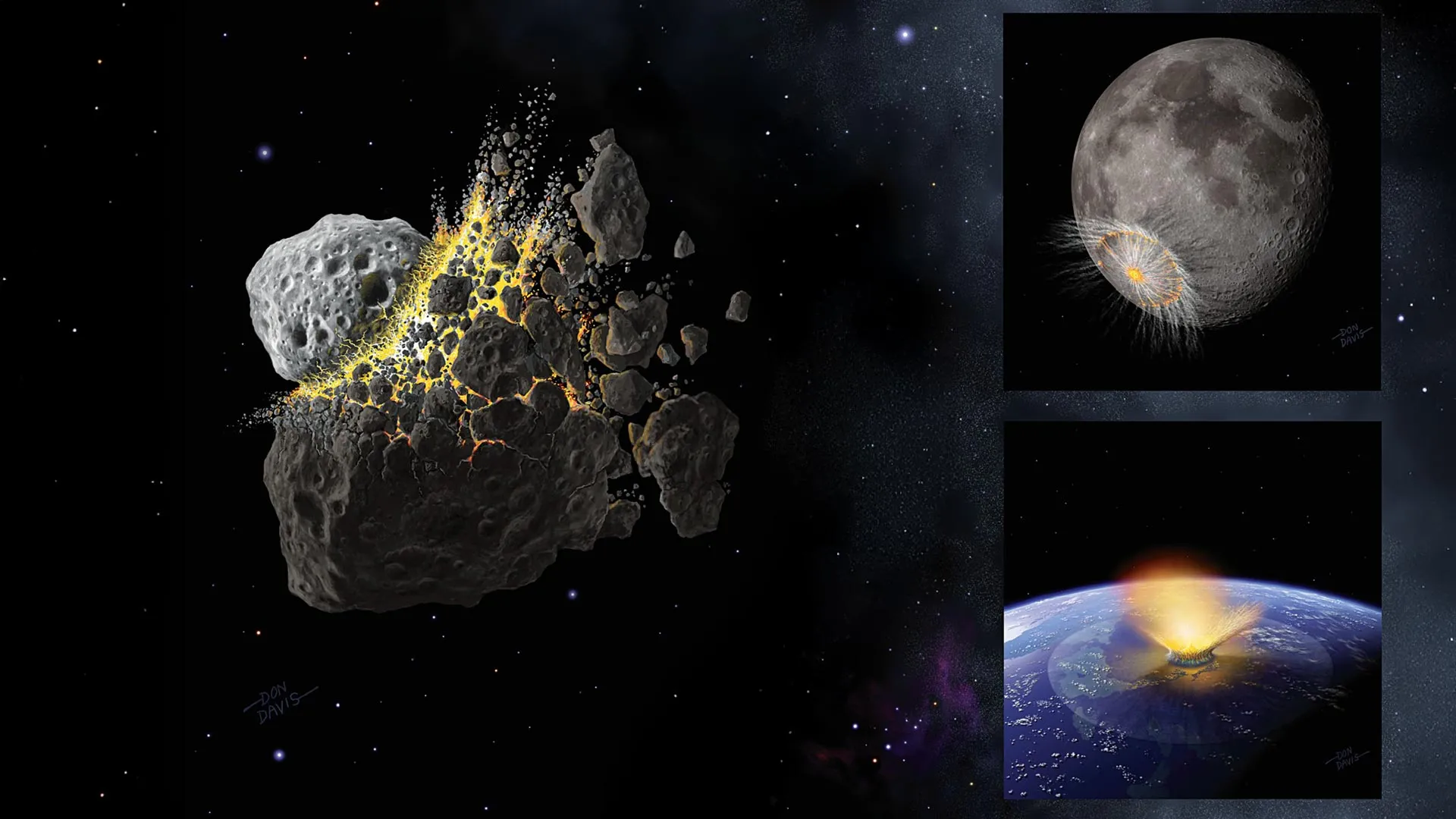
When a massive, primitive parent body broke apart to form what scientists now classify as the Eulalia asteroid family, it triggered a multi-tiered planetary bombardment. This cosmic shrapnel didn’t just pepper empty space; it was funneled directly toward Earth, the Moon, and Mars by the gravitational influence of Jupiter.
For decades, scientists have grappled with the limitations of Earth’s geological record. Because our home planet is geologically active—subject to plate tectonics, persistent weathering, and volcanic activity—the physical evidence of impacts older than 650 million years has been largely erased or buried. Consequently, understanding ancient threats has required a planetary detective story. By turning to the heavily cratered, geologically static surface of the Moon, researchers have been able to reconstruct a chapter of solar system history that may have fundamentally altered planetary climates, triggered seismic convulsions on Mars, and potentially catalyzed biological tipping points on Earth.
This comprehensive investigation explores the mechanics of the Eulalia family breakup, the gravitational escape hatches that hurled debris across the inner solar system, and the profound implications this ancient bombardment holds for our understanding of planetary evolution and the history of life.
Detailed Chronology: Unraveling the 800-Million-Year-Old Mystery
To understand the scope of the event that unfolded 800 million years ago, scientists had to work backward from existing lunar data, computer-driven dynamical models, and orbital mechanics. The timeline of this cosmic event unfolds across distinct phases:
Phase 1: The Pre-Collisional State (Prior to 800 Million Years Ago)
Long before the inner solar system experienced its surge in impacts, the main asteroid belt—located between Mars and Jupiter—contained a massive, carbon-rich parent object belonging to a class known as primitive carbonaceous chondrites. These bodies are essentially time capsules from the dawn of the solar system, containing some of the oldest materials, water-bearing minerals, and complex organic compounds known to science. Crucially, this specific parent body was positioned on the precipice of a powerful gravitational trap known as the J3:1 mean motion resonance with Jupiter.
Phase 2: The Catastrophic Disruption (Approximately 800 Million Years Ago)
A high-velocity collision shattered the parent body, instantly creating the Eulalia asteroid family. This was not a localized dusting; it was a total catastrophic disruption of a massive celestial body. Because of its precarious orbital location near the Jupiter resonance, the consequences were immediate and severe. Roughly half of the newly liberated fragments were instantly swept into the J3:1 resonance channel, which acted as a cosmic cannon, firing debris outward across the orbits of Mars, Earth, and the Moon.
Phase 3: The Immediate Heavy Bombardment (0 to 150 Million Years Post-Breakup)
For the first 100 to 150 million years following the Eulalia breakup, the inner solar system endured a relentless wave of impacts. The immediate injection of high-velocity fragments meant that rocky worlds were constantly struck by carbonaceous chondrite shrapnel. Because Earth possesses a significantly larger mass and stronger gravitational pull than the Moon, it bore the brunt of the onslaught. Mathematical estimates suggest that for every major object that impacted the lunar surface, approximately twenty similarly sized or larger projectiles slammed into Earth.
Phase 4: The Yarkovsky Tail (Hundreds of Millions of Years Later)
The bombardment did not stop when the initial wave of debris cleared. Even after the primary window closed, another 25% of the original Eulalia fragments gradually drifted into the J3:1 resonance over extended periods. This delayed delivery was driven by the Yarkovsky effect—a subtle thermal phenomenon where an asteroid absorbs sunlight and reradiates it as infrared energy. Because this heat is emitted unevenly as the asteroid rotates, it creates a minute, continuous thrust that slowly alters the object’s orbit over millions of years, feeding a persistent, long-tail asteroid shower into the inner solar system.
Supporting Context & Metrics: The Science of Cosmic Forensics
Reconstructing an event that occurred nearly a billion years ago requires an interdisciplinary approach blending orbital dynamics, high-powered computer simulations, and lunar mineralogy.
The Moon as an Archive
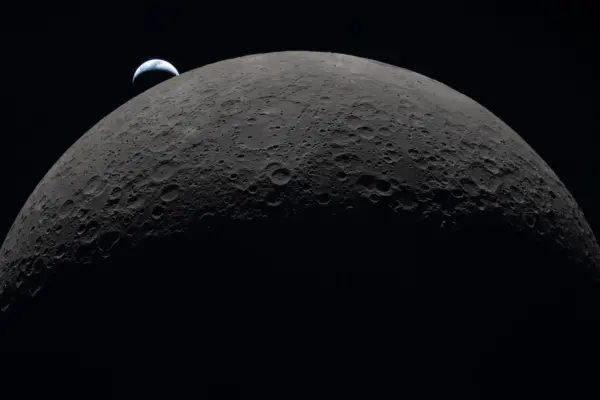
Unlike Earth, the Moon lacks plate tectonics, a dense atmosphere, and flowing water, meaning its surface retains an unblemished record of ancient impacts. Previous analyses of lunar craters, combined with isotopic dating of impact glass gathered during NASA’s Apollo missions, revealed a distinct spike in impact frequency around 800 million years ago.
Impact glass is formed when a hypervelocity collision generates extreme heat, instantly melting surrounding rock. As the molten material cools into glass, it preserves microscopic chemical and chronological signatures. By dating these glass samples, researchers established that the lunar surface experienced a profound bombardment spike during the Neoproterozoic era.
The J3:1 Resonance and the Yarkovsky Effect
The core mechanism behind this ancient shower lies in celestial mechanics:
- The J3:1 Resonance: In this orbital configuration, an asteroid completes exactly three orbits around the Sun for every single orbit completed by Jupiter. The repeated gravitational tugs from the gas giant destabilize asteroids in this band, transforming stable circular paths into highly eccentric, planet-crossing orbits.
- The Yarkovsky Effect: Serving as a slow-burn delivery system, this thermal recoil force gently nudged remaining Eulalia fragments into the resonance zone long after the initial impact, ensuring a prolonged, multi-stage bombardment rather than a single, brief cataclysm.
Scaling the Impact: Earth vs. the Moon
| Celestial Body | Relative Size / Gravity | Estimated Impact Frequency (Relative Scale) | Geological Retention of Ancient Impacts |
|---|---|---|---|
| The Moon | Small / Low Gravity | Baseline (1x) | High (Static surface preserves ancient craters) |
| Earth | Large / High Gravity | ~20x higher than the Moon | Very Low (Erase by plate tectonics, erosion, volcanism) |
| Mars | Intermediate | Moderate | Moderate (Preserved in ancient highlands, altered by wind/ice) |
Official Statements and Expert Analysis
The study, published in scientific literature, brings together leading authorities in solar system dynamics and planetary evolution.
Dr. William Bottke, an executive director in SwRI’s Solar System Science and Exploration Division in Boulder, Colorado, and director of the Center for Lunar Origin and Evolution (CLOE), emphasized the profound gap in our understanding of how impacts influence planetary systems.
"The role impacts have played in shaping the origin and evolution of life in our solar system is poorly understood," said Dr. Bottke. "The heavily cratered surface of the Moon serves as a reminder of the large impacts in Earth’s past, but so far, only the Chicxulub impact event 66 million years ago has been strongly linked to a specific effect on life, namely the mass extinction of the dinosaurs."
Contrasting the famous Chicxulub event—the colossal impact buried beneath Mexico’s Yucatán Peninsula that wiped out nonavian dinosaurs—with far older collisions, Bottke noted the extreme difficulty of reconstructing deep-time history:
"Our cosmic forensics team used collisional and dynamical models to link these to the formation of the Eulalia asteroid family, when a primitive carbonaceous chondrite-like object collided with another object. The location of the parent asteroid was key—it broke up on the brink of the gravitational 3:1 mean motion resonance with Jupiter."
By analyzing how these fragments were dispersed, the research team was able to draw direct lines between the main asteroid belt and the geological markers found on neighboring worlds. Bottke further highlighted the broader environmental implications:
"Given that the peak of this barrage coincides with a period of widespread cooling and major shifts in our biosphere, it is tempting to suggest that the former produced the latter. On Mars, these impacts would have triggered substantial episodes of seismic shaking and can be linked in time with a surge in volcanic activity. Together, this showcases how certain catastrophic collisions in the main belt could have had far-reaching consequences for the history of the terrestrial planets."
Future Outlook: Unlocking Deep-Time Planetary Histories
The revelation that a single asteroid breakup 800 million years ago could shower the inner solar system with debris for over a century opens entirely new avenues for planetary science.
Implications for Earth’s Biosphere and Climate
The timing of the Eulalia bombardment intriguing overlaps with the Neoproterozoic era on Earth—a time marked by radical climatic shifts, including extreme global glaciations (often theorized as "Snowball Earth" scenarios) and the dawn of complex multicellular life. While the SwRI study does not definitively prove that the asteroid shower caused these climatic and biological shifts, it provides a compelling correlation. Future research will focus on chemical and isotopic markers in ancient marine sediments to test whether extraterrestrial dust and impact ejecta played an active role in driving these environmental transformations.
Expanding Planetary Defense and Dynamical Modeling
Understanding how main-belt disruptions feed material into planet-crossing orbits enhances our broader comprehension of solar system architecture. By refining models of the Yarkovsky effect and mean-motion resonances, scientists can better map not only ancient impact surges but also modern near-Earth object (NEO) populations.
As space agencies look toward future lunar exploration—such as NASA’s Artemis program—returning more pristine samples from targeted lunar basins will allow researchers to test and refine these chronological models with unprecedented precision. The Moon, acting as our solar system’s ultimate archive, will continue to yield secrets about Earth’s violent, forgotten past, proving that the history of life on our planet is inextricably linked to the cosmic crossfire of the wider solar system.