





CAMBRIDGE, Mass. & PRINCETON, N.J. — In what neuroscientists are already hailing as a monumental turning point for the discipline, a large international research consortium led by teams at Harvard Medical School (HMS) and Princeton University has published the first complete map of every neural connection within the central nervous system of an adult organism.
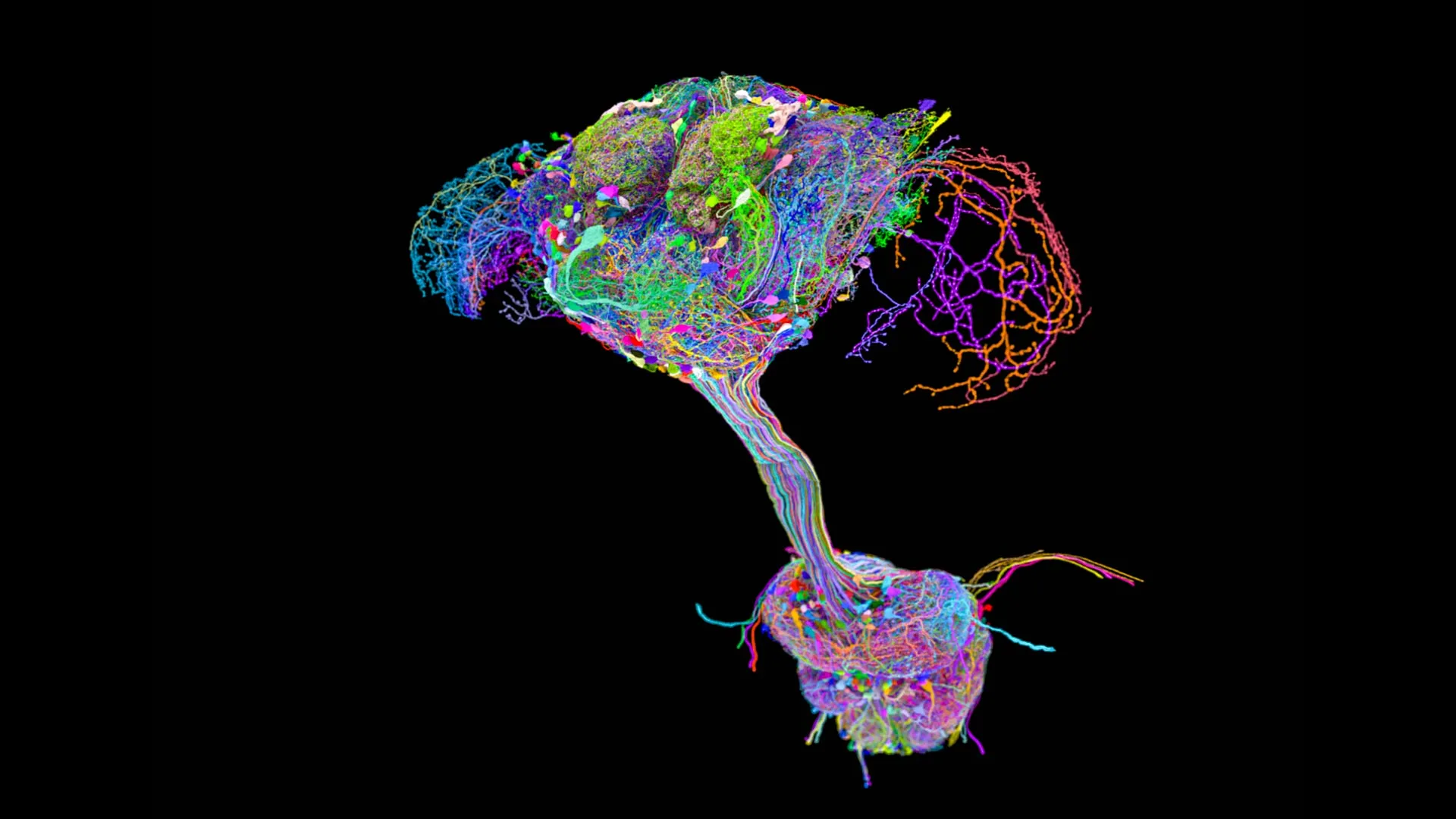
The breakthrough—detailing every single neuron and synapse across both the brain and the nerve cord of the common fruit fly (Drosophila melanogaster)—provides an unprecedented blueprint of an entire functioning central nervous system. Published in the journal Nature, this comprehensive wiring diagram, or "connectome," bridges a critical chamber in neurobiology by mapping how sensory inputs are translated into motor actions across a holistic biological architecture.
Releasing this monumental dataset to the global scientific community via an open-access platform, the researchers have effectively established a new foundational reference point for the study of behavior, neural processing, and the physiological underpinnings of thought itself.
Executive Overview: A New Epoch for Neuroscience
For decades, modern neuroscience has operated with a profound handicap: while genetic sequences for numerous organisms have been mapped to their base pairs, researchers have lacked complete, high-resolution wiring diagrams for even the simplest of brains. Without a comprehensive map of how individual neurons interconnect, understanding the physical basis of complex behaviors—such as navigation, social interaction, learning, and motor control—has remained an elusive goal.
The newly released connectome, known as the brain-and-nerve-cord (BANC) dataset, alters this paradigm entirely. By combining a previously published map of the fruit fly brain with a newly completed map of its nerve cord (the biological equivalent of a vertebrate spinal cord), the international consortium has unlocked a holistic view of the insect’s nervous system.
+-------------------------------------------------------------------------+
|                       THE BANC DATASET ARCHITECTURE                     |
+-------------------------------------------------------------------------+
|  [ Fruit Fly Brain ]          <=======>        [ Nerve Cord (VNC) ]     |
|  - ~160,000 Total Neurons                      - Controls legs, wings,  |
|  - Processes sensory info                       and motor output       |
|  - Directs high-level cognition                - Houses local circuits |
+-------------------------------------------------------------------------+
                                     ||
                                     /
      [ Complete 3D Synaptic Map Available Freely via FlyWire ]
The implications of this milestone extend far beyond entomology. By offering a complete window into how information flows from sensory organs through the central nervous system and out to motor appendages, the BANC dataset offers immediate insights that could reshape our understanding of mammalian neurology, inform the development of advanced artificial intelligence, and provide a roadmap for mapping larger, more complex nervous systems, including those of humans.
Detailed Chronology: How the FlyWire Consortium Built the Map
The creation of the BANC connectome was a monumental undertaking that spanned years, requiring the convergence of high-throughput electron microscopy, advanced artificial intelligence, and distributed human collaboration.
Slicing, Imaging, and Stitching
The project began with the physical preparation of a single adult female fruit fly. Researchers in the laboratory of Wei-Chung Allen Lee at Harvard Medical School meticulously sliced the insect’s central nervous system into thousands of ultra-thin serial sections. Each section was thinner than a fraction of a human hair, capturing the minute ultrastructure of the neural tissue.
Using high-resolution electron microscopy, the team captured millions of individual digital images of these cross-sections. Because manual reconstruction of millions of neurons and billions of individual synapses would take centuries of human labor, the project relied heavily on advanced artificial intelligence and machine learning tools. These algorithms aligned the sequential images, tracing the winding paths of individual axons and dendrites across slices to reconstruct a unified, three-dimensional digital model.
Bridging the Brain and the Nerve Cord
The mapping effort was executed in two primary, complementary streams that ultimately converged. In 2024, the FlyWire Consortium—spearheaded by Mala Murthy and Sebastian Seung at Princeton University—published a complete connectome of the fruit fly brain. Simultaneously, Lee’s laboratory at HMS focused on the fruit fly nerve cord (the ventral nerve cord, or VNC), which orchestrates the movement of the legs, wings, and other appendages while processing localized somatosensory feedback.
While each connectome was independently valuable, they remained functionally isolated. "The brain and nerve cord connectomes are each useful on their own, but until you can bridge the two, it’s hard to understand how information moves between the brain and the body," explains co-first author Helen Yang, a research fellow in neurobiology in the Wilson Lab at HMS.
By integrating the two datasets, the consortium successfully unified the command center with the execution apparatus. The resulting map details every single synaptic connection among the fruit fly’s roughly 160,000 central nervous system neurons, providing an end-to-end trace of neural signaling.
Supporting Context & Metrics: Why the Fruit Fly?
To the uninitiated, dedicating massive computational and human resources to mapping the nervous system of an insect might seem disproportionate. However, within the scientific community, Drosophila melanogaster occupies a uniquely vital niche as a model organism.
The Power of the Model
Fruit flies combine biological simplicity with behavioral complexity. Despite possessing a central nervous system roughly the size of a poppy seed, they execute an impressive repertoire of actions:
- Spatial Navigation: They track chemical gradients, avoid obstacles, and stabilize themselves in flight.
- Social Interaction: They engage in complex courtship rituals and aggressive displays.
- Learning and Memory: They form associative memories, avoiding stimuli linked to negative experiences while seeking out rewards.
Furthermore, fruit flies boast an extraordinarily sophisticated genetic toolkit. Researchers can target, manipulate, record from, and silence individual neurons or specific neural subpopulations with pinpoint genetic precision.
Quantitative Metrics of the BANC Dataset
- Total Neurons Mapped: ~160,000 central nervous system neurons.
- Imaging Resolution: Nanometer-scale electron microscopy capturing individual synaptic clefts.
- Data Accessibility: Fully public and interactive online via the FlyWire platform (
codex.flywire.ai/?dataset=banc). - Core Contributors: Dozens of institutions, labs, and consortia worldwide, backed by key federal and private funding bodies.
Official Statements and Expert Perspectives
The release of the connectome has generated widespread commentary across the international neuroscience community, highlighting both the immediate utility of the dataset and its long-term theoretical implications.
"We can see all of the neurons and their connections as a complete unit for the first time and ask, ‘What do we learn from that?’"
— Dr. Rachel Wilson, Co-Senior Author, Harvard Medical School
Dr. Wilson emphasized that having the complete map shifts the field from speculative modeling to empirical observation of network architecture. Her colleague, Dr. Wei-Chung Allen Lee, underscored the importance of the structural integration:
"It is really important to have a central nervous system connectome that is as complete as possible so we can link up the brain and body and start thinking about behavior holistically."
— Dr. Wei-Chung Allen Lee, Co-Senior Author, Harvard Medical School and Boston Children’s Hospital
From the Princeton node of the consortium, Dr. Mala Murthy highlighted the transformative nature of the BANC dataset for tracking systemic information flow:
"The new connectome represents a major advance for the field, with the ability to understand how circuits in the brain receive feedback from and control the actions of the body… For the first time, we can follow information flow from sensation to action across an entire nervous system."
— Dr. Mala Murthy, Co-Senior Author, Princeton University
Rethinking Motor Control: The Death of Central Command
One of the most surprising early discoveries yielded by the BANC dataset challenges a long-standing dogma in neurobiology. Traditional theories of motor control posited that the brain acts as a rigid, centralized commander, issuing direct, top-down commands for every muscle movement executed by an animal.
The fruit fly connectome paints a radically different picture. Upon analyzing the neural circuits governing the fly’s legs, wings, and mouthparts, the research team discovered that motor control is predominantly distributed rather than centralized.
For example, the neural circuitry required to coordinate the movement of a single leg resides largely within the local segmental circuits of the nerve cord for that specific leg. These local modules communicate laterally with adjacent leg circuits to negotiate walking gaits and postural adjustments, operating with a degree of autonomy that researchers previously did not suspect.
"Our findings suggest that control for actions is highly distributed in local modules that link up and work together in different ways," noted co-first author Alexander Bates. Dr. Lee added that the structural complexity revealed by the connectome shattered preliminary assumptions: "The connectome has shown us that most of our hypotheses are too simple. Now, we can develop more complex hypotheses and move forward with experiments to test them."
Future Outlook: Implications for Mammals, Medicine, and AI
As the scientific community begins mining the BANC dataset, researchers are already casting their gaze toward the horizon, outlining several major trajectories for future investigation.
1. Extending to Mammalian Models
A pivotal question facing neuroscientists is whether the distributed, modular control observed in fruit flies is an evolutionary strategy shared across the animal kingdom. Dr. Lee and other consortium members are already investigating whether similar local circuit architectures govern motor control and sensory processing in mice.
While mapping a mammalian brain with single-synapse resolution remains an immense challenge due to scale—the mouse brain contains roughly 70 million neurons, compared to the fly’s 160,000—the methodological pipeline developed for the fruit fly serves as a crucial proof of concept.
2. Refining the Map with Chemical Annotations
The current connectome provides an exhaustive structural map of physical connections, but the functional dialogue between neurons relies heavily on chemical signaling. The research team’s next phase involves overlaying neuropeptide and neurotransmitter data onto the BANC dataset, mapping the specific chemical keys and locks that modulate synaptic transmission across the entire nervous system.
3. Parallels and Lessons for Artificial Intelligence
Beyond biology and medicine, the BANC dataset holds profound value for the field of artificial intelligence. Modern AI agents and autonomous robots, despite their computational power, frequently struggle to match the adaptive, energy-efficient, and robust physical performance of a common fruit fly operating in a chaotic, unstructured environment.
"One thing that always amazes me is that this tiny little fly does a hell of a lot; even our best AI agents and robots can’t do everything that a fly does," observed Helen Yang. By analyzing the structural motifs, feedback loops, and distributed control architectures revealed by the connectome, AI researchers may uncover novel blueprints for designing artificial neural networks that navigate the physical world with biological grace.
4. An Open Scientific Resource
Supported by funding from the U.S. National Institutes of Health (NIH), the National Science Foundation (NSF), the BRAIN Initiative, and various philanthropic foundations, the project stands as a testament to the power of open-access, collaborative science. By releasing the data unconditionally to the global research community, the consortium has ensured that the fruit fly connectome will serve as a wellspring of discovery for generations of biologists, data scientists, and engineers to come.
As researchers worldwide begin querying the database, the BANC connectome marks not the end of an inquiry, but the dawn of a new era—one where the intricate wiring of a mind is no longer hidden in shadow, but laid open to the light of empirical science.