




Executive Overview
For millennia, the giant sequoias (Sequoiadendron giganteum) of California’s Sierra Nevada stood as timeless sentinels, weathering climatic shifts, droughts, and ordinary wildfires. Weighing as much as 15 blue whales and capable of surviving for more than 3,000 years, these ancient trees were long considered virtually fireproof. Their monumental size, thick, fibrous bark, and elevated canopies were marvels of evolutionary engineering, designed specifically to withstand the periodic, low-intensity fires native to their historic range.
That illusion of invincibility shattered during the catastrophic fire seasons of 2020 and 2021. Raging wildfires swept through the Sierra Nevada, laying waste to groves that had stood undisturbed for centuries and killing thousands of mature giant sequoias. The scale of the loss was unprecedented, raising alarm bells among conservationists, scientists, and land managers worldwide.
However, a groundbreaking study published in the journal Nature Communications offers a powerful message of hope backed by empirical science. Conducted by researchers at the University of California, Davis, in collaboration with the U.S. Geological Survey (USGS) and Sequoia and Kings Canyon National Parks, the study reveals that the devastation would have been exponentially worse without human intervention. Specifically, giant sequoias exposed to prescribed, controlled burns within the decade prior to the wildfires were nearly four times more likely to survive than their untreated neighbors.
By analyzing high-resolution satellite imagery, airborne lidar, and the outcomes for approximately 26,400 individual giant sequoias across 19 affected groves, the research team quantified the profound life-saving impact of proactive forest management. The findings demonstrate that prescribed burning is not merely a supplementary conservation tool; it is an absolute necessity for safeguarding the world’s largest living organisms against the escalating threat of extreme, climate-driven wildfires.
Detailed Chronology of the Crisis and the Study
The Unprecedented Devastation of 2020 and 2021
To understand the significance of the UC Davis study, one must first look back at the dark turning point for California’s old-growth forests. For more than a century, federal, state, and local land management agencies practiced aggressive fire suppression. While intended to protect forests and human communities, this policy resulted in a dangerous accumulation of dead wood, dense underbrush, and combustible ladder fuels.
When extreme droughts—intensified by long-term climate change—parched the Sierra Nevada, the stage was set for ecological disaster. In 2020, the Castle Fire tore through the southern Sierra, followed closely in 2021 by the KNP Complex Fire. These were not the gentle, ground-clearing fires to which giant sequoias were historically adapted. Fueled by decades of accumulated debris and driven by high winds and low humidity, these infernos burned with terrifying intensity.
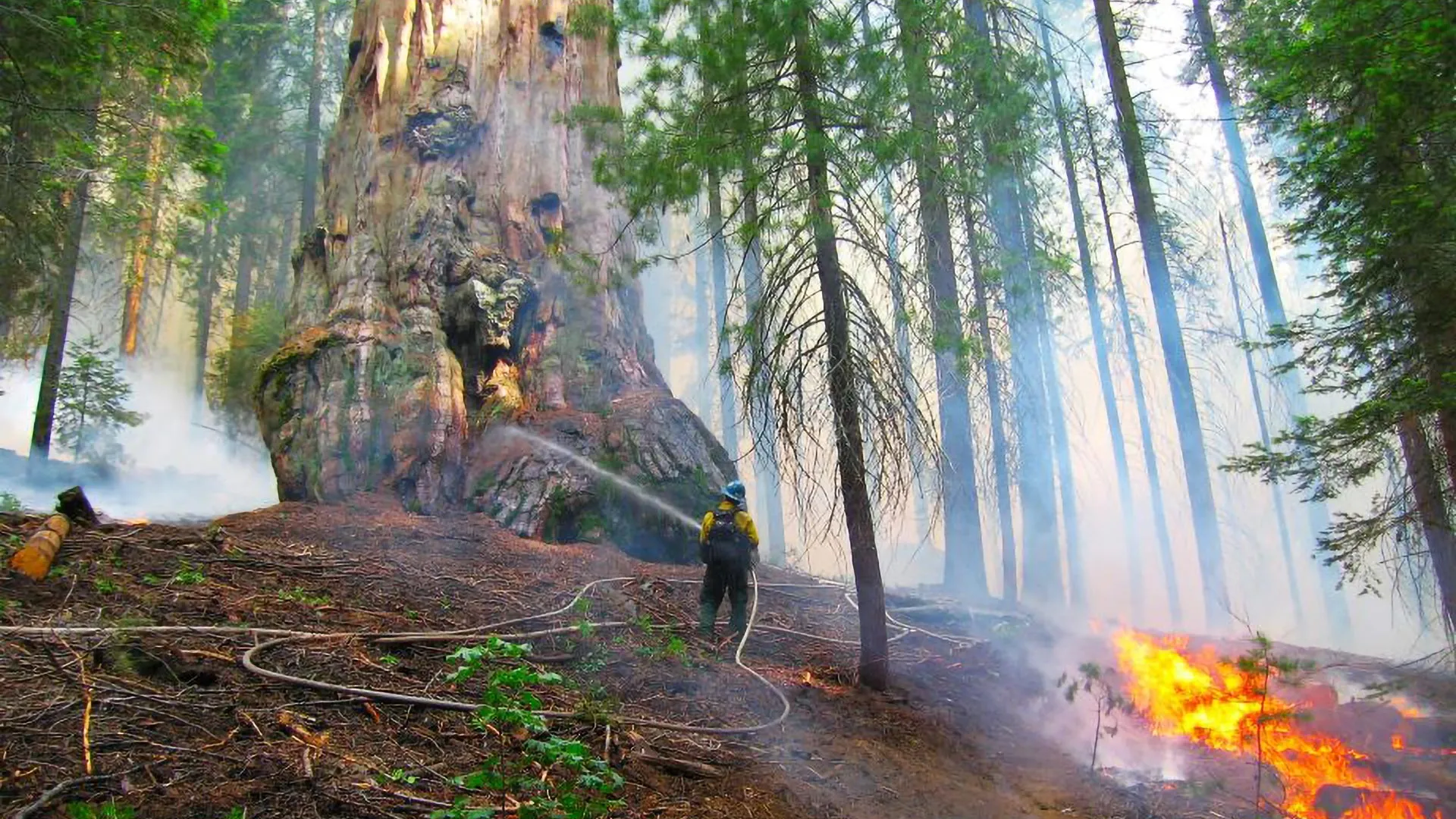
Flames climbed into canopies that had stood high above historical fire lines, scorching foliage, penetrating thick bark, and killing mature trees en masse. For scientists and park managers who had long trusted in the resilience of the species, the sight of ancient giants reduced to charred, skeletal ruins was deeply shocking. It became urgently clear that passive preservation was no longer an option.
Decades of Preparation: A Natural Laboratory
Fortunately, not all groves faced the flames on equal footing. Dating back to the 1960s, Sequoia and Kings Canyon National Parks have maintained one of the most robust and continuous prescribed fire programs in the United States. This foresight inadvertently created a vast, real-world laboratory.
Over decades, land managers systematically introduced controlled, low-intensity fires to select sections of the parks. Other sections, due to logistical constraints, administrative hurdles, or shifting priorities, went unmanaged for over a century, allowing hazardous fuel loads to accumulate unchecked.
This patchwork of varied fire histories provided the research team with a unique scientific opportunity. By examining how different tracts of forest fared when the Castle and KNP Complex fires swept through, researchers could directly compare the survival rates of trees in treated areas versus those in untreated areas under identical wildfire conditions.
Cutting-Edge Technology Meets Field Ecology
To conduct the study, lead author Dan Dixon—then a postdoctoral researcher in UC Davis Professor Yufang Jin’s laboratory—alongside a multidisciplinary team of scientists, deployed advanced remote sensing technologies. Traditional field surveys, while valuable, are often limited by the sheer scale, rugged terrain, and inaccessibility of Sierra Nevada sequoia groves.
To overcome these barriers, the research team combined airborne lidar (Light Detection and Ranging) with high-resolution PlanetScope satellite imagery. Airborne lidar uses laser pulses to map forest structure in meticulous 3D detail, allowing scientists to assess canopy height, fuel density, and structural changes before and after the fires. PlanetScope imagery provided frequent, high-resolution snapshots that captured the immediate aftermath and long-term vitality of the forest canopy.
By integrating these remote-sensing datasets with rigorous statistical modeling, the team tracked the fate of roughly 26,400 individual giant sequoias distributed across 19 distinct groves. This technological approach allowed the researchers to bypass the limitations of anecdotal observations and deliver precise, empirically backed conclusions regarding forest recovery and fire behavior.
Supporting Context & Metrics: The Numbers Behind Survival
The data extracted from the study paint a vivid and mathematically rigorous picture of the efficacy of prescribed burns. The metrics leave little room for debate: proactive fuel reduction radically alters fire outcomes for old-growth sequoias.
- Quadrupling Survival Rates: Giant sequoias that had been exposed to a prescribed burn within the 10 years prior to the 2020 and 2021 wildfires were nearly four times more likely to survive than nearby untreated trees.
- Massive Risk Reduction: Statistically, implementing a prescribed burn in the preceding decade reduced an individual giant sequoia’s odds of mortality by approximately 77%.
- Quantifying Lives Saved: Through advanced computer simulations, the researchers estimated that historical prescribed burns successfully prevented the deaths of approximately 1,900 giant sequoias during the Castle and KNP Complex fires.
- The Potential for Greater Preservation: The modeling also revealed a sobering counterfactual: if every sequoia in the affected groves had received similar prescribed burning treatments prior to the fires, an estimated 3,900 additional trees would have survived.
- Scale of the Study: The research encompassed an exhaustive analysis of 26,400 mature giant sequoias spread across 19 unique groves impacted by extreme fire events.
These metrics illustrate a clear cause-and-effect relationship. When surface fuels and ladder fuels—such as small trees, shrubs, and accumulated pine needles—are systematically cleared by controlled burns, wildfires lose their ladder to the crowns. Instead of roaring through the upper canopy with lethal intensity, fires are forced to remain on the forest floor, acting in the restorative, low-intensity manner that giant sequoias spent millions of years evolving to withstand.
Official Statements and Expert Insights
The implications of the UC Davis study extend far beyond academic circles, offering a clear roadmap for federal, state, and private forest managers tasked with stewarding western ecosystems.
Lead author Dan Dixon emphasized the critical role that human intervention must now play in preserving these ancient ecosystems.
"Prescribed burns are effective at reducing giant sequoia mortality, even for today’s extreme wildfires," Dixon stated. "If the goal is protecting giant sequoias, prescribed fire is an essential tool available to managers."
Reflecting on the psychological and ecological shock of the 2020 and 2021 fires, Dixon noted the unprecedented nature of the losses.
"These trees live for so long and have experienced so much variability of climate, differences in wildfire, drought—they’ve seen it all," Dixon observed. "Having so many die in just two years was unprecedented."
Professor Yufang Jin of UC Davis, who oversaw the research lab where the study was conducted, highlighted the timeliness of the findings in the context of modern forestry policy and climate adaptation strategies.
"This is a timely study given the history of fire suppression in these forests and the state’s increasing pace and scale of fuel thinning in recent years," Jin remarked. "By combining scalable, high-resolution remote sensing with a rigorous statistical framework, we were able to reveal insights on the effects of prescribed fires that go well beyond what traditional anecdotes or field surveys can tell us."
The collaborative nature of the study brought together institutions at the forefront of conservation science. Coauthors included Xiaoli Dong and Andrew Latimer from UC Davis; Adrian Das, David Soderberg, and Nathan Stephenson from the USGS Western Ecological Research Center; and Anthony Caprio from the Division of Resources Management and Science at Sequoia and Kings Canyon National Parks. Financial backing for the research was provided by the NASA Land Cover and Land Use Change Program, the California Strategic Growth Council, and the USDA National Institute of Food and Agriculture.
Future Outlook: Managing the Anthropocene Forest
The findings from the Nature Communications study arrive at a critical juncture for California’s forests. Anthropogenic climate change is fundamentally altering disturbance regimes across the globe. In the American West, rising temperatures, prolonged megadroughts, and shifting precipitation patterns have combined to create an extended fire season and unprecedented fuel aridity.
While giant sequoias possess remarkable natural adaptations that make them resilient to ordinary fire, no species on Earth is engineered to withstand the modern megafire fueled by a century of fire suppression and supercharged by a warming planet. The loss of thousands of mature trees—some of which sprouted during the Roman Empire—serves as a stark warning that passive conservation is a failing strategy.
Moving forward, land managers must scale up prescribed burning programs aggressively and strategically. Reintroducing fire to the landscape on a broad scale requires overcoming significant challenges, including logistical hurdles, narrow weather windows, funding constraints, and public concern over smoke emissions. However, as the UC Davis study decisively proves, the cost of inaction is infinitely higher.
To ensure that future generations can witness the majesty of the world’s largest trees, society must shift its relationship with fire. Rather than viewing all fire as an enemy to be eradicated, resource managers must utilize controlled fire as an active management tool to heal overgrown landscapes. By bridging historical ecological processes with modern remote-sensing science, humanity can help these ancient giants weather the storms of the modern era, ensuring that the Sierra Nevada’s living cathedrals endure for millennia to come.