







Executive Overview
For millennia, the bond between humans (Homo sapiens) and domestic dogs (Canis lupus familiaris) has been celebrated in literature, art, and daily life. Dog owners have long maintained an unwavering conviction that their canine companions truly understand them—sharing in their joy, offering comfort during times of sorrow, and recognizing anger or tension in the household. While behavioral science has accumulated substantial observational evidence supporting this intuition, the exact biological mechanisms that allow dogs to interpret the complex landscape of human facial expressions have remained largely elusive.
Now, a pioneering study published on August 7 in the Cell Press journal iScience has blown wide open the black box of canine cognition. By peering directly inside the working canine brain utilizing advanced neuroimaging and machine learning techniques, an international team of researchers has mapped out precisely how dogs process human smiles, frowns, and fearful expressions. The findings provide the first concrete neurobiological evidence that dogs not only distinguish between positive and negative human emotions, but can also mentally differentiate among several distinct negative states, including anger, fear, and sadness.
This milestone in comparative neurobiology offers profound insights into the evolutionary miracle of domestication. Unlike non-human primates, whose cognitive abilities stem from a shared evolutionary ancestor with humans, dogs took an entirely divergent path. Over tens of thousands of years of close association and selective co-habitation, dogs forged an extraordinary evolutionary adaptation. They rewired their neural architecture to become astute observers of human social cues, enabling a cross-species bridge of communication that is virtually unparalleled in the animal kingdom.
As researchers continue to decode the neural pathways of canine empathy and perception, these discoveries promise to reshape not only veterinary behavioral science and animal welfare, but also our everyday approach to training, communicating with, and caring for our domestic companions. This comprehensive report explores the methodology, implications, and future horizons of this transformative scientific breakthrough.
Detailed Chronology of the Research
The journey toward understanding the canine perception of human emotion spans decades of behavioral observation, but the specific neuroimaging experiments that culminated in the August 7 iScience publication required meticulous, multi-phase planning across several academic institutions.
Phase 1: Conceptualizing the Positive Bias
The research initiative originated under the direction of Laura Cuaya, initially at the National Autonomous University of Mexico and later expanded through strategic collaborations at the University of Vienna and Eötvös Loránd University in Hungary. The investigative team recognized a critical gap in existing literature: while behavioral studies frequently demonstrated that dogs react differently to happy human faces compared to neutral or threatening ones, nobody had mapped the exact neural signatures driving these behavioral shifts.
The team established their foundational hypothesis around human happiness. Because previous research suggested that positive human expressions carry exceptional biological and social value for domesticated dogs, the investigators decided to look first at how canine brains light up in response to a smile.
Phase 2: Scanning the Canine Mind (Experiment One)
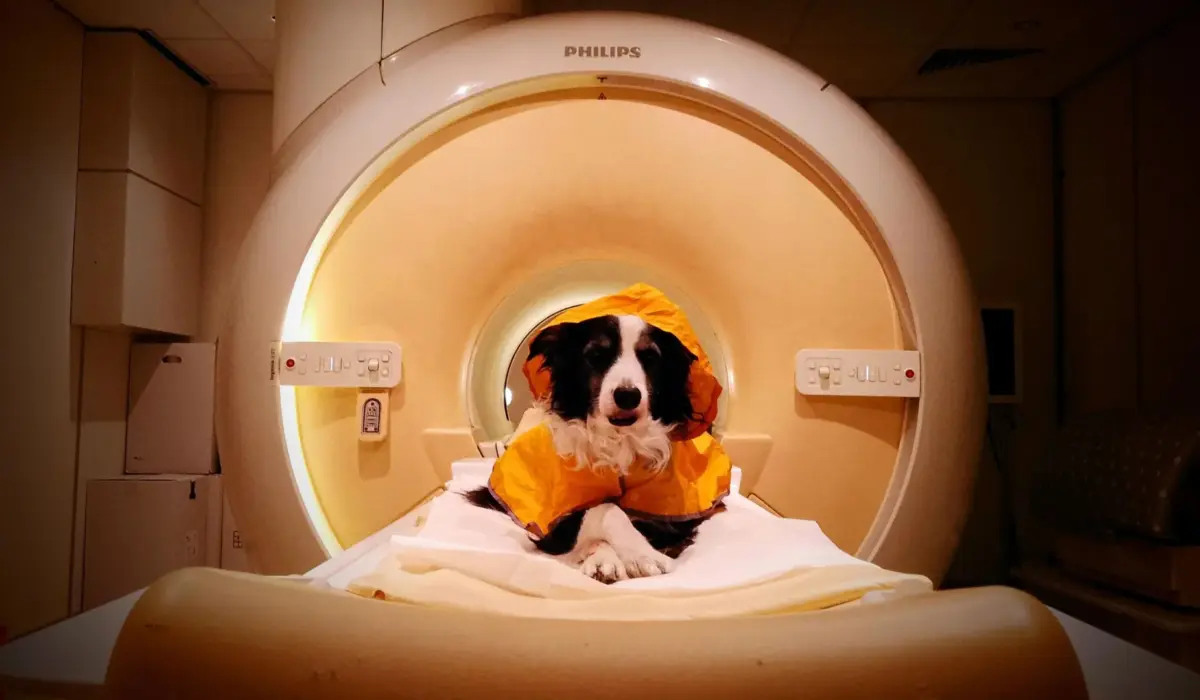
To observe neural activity directly, the researchers recruited a cohort of eight pet dogs. These animals were trained through positive reinforcement to remain remarkably still inside a functional magnetic resonance imaging (fMRI) scanner without the use of physical restraints or sedation—a testament to the patience of the dogs and the skill of the training team.
While inside the scanner, the dogs were shown a series of static images depicting unfamiliar human faces exhibiting either happy expressions or neutral expressions. As the scans were processed, a clear and compelling neural pattern emerged. When confronted with human smiles, the dogs exhibited a sharp increase in metabolic and electrical activity within two specific regions of the brain:
- The Temporal Cortex: An area universally associated with higher-level cognitive processing, visual integration, and the interpretation of complex sensory information.
- The Caudate Nucleus: A core component of the brain’s reward circuitry, traditionally linked to motivation, the anticipation of pleasure, and the processing of valuable stimuli.
Lead author Raúl Hernández-Pérez and his colleagues noted that the heightened activity in the caudate nucleus was especially revealing. It offered the first hard neural data suggesting that human smiles are not merely recognized as visual stimuli by dogs, but are processed as inherently rewarding and emotionally significant events.
Phase 3: Expanding the Emotional Palette (Experiment Two)
Having established how dogs process happiness, the research team sought to determine whether these same neural networks—the temporal cortex and caudate-nucleus network—reacted uniquely to a broader spectrum of emotional expressions.
For the second phase of the experiment, the cohort was expanded to twelve dogs. The animals were exposed to an expanded array of static facial images depicting four distinct human emotions: happiness, anger, fear, and sadness. To analyze the complex, multidimensional datasets generated by these scans, the researchers deployed sophisticated machine learning algorithms capable of parsing subtle patterns of neural activation across the entire canine brain.
Phase 4: Machine Learning and Whole-Brain Analysis
The application of machine learning to the fMRI data yielded groundbreaking results. First, the algorithm easily separated the neural responses triggered by happy faces from those triggered by any of the negative expressions. The network of the temporal cortex and caudate nucleus fired in a uniquely distinctive pattern whenever a smile appeared on the screen.
More importantly, a deeper, whole-brain analysis revealed distinct, non-overlapping patterns of neural activity when the dogs viewed fearful faces compared to angry or sad ones. This distinction marked a major milestone in cognitive ethology: it provided definitive proof that dogs do not lump all negative human emotions into a single, monolithic category of "bad" or "threatening." Instead, their brains encode specific signatures for distinct negative affective states.
Supporting Context & Metrics
To fully appreciate the weight of these scientific discoveries, one must examine the experimental parameters, neurological structures, and evolutionary context that underpin the study.
| Experimental Parameter | Experiment One | Experiment Two |
|---|---|---|
| Cohort Size | 8 pet dogs | 12 pet dogs |
| Stimuli Presented | Happy vs. Neutral human faces | Happy, Angry, Fearful, Sad human faces |
| Imaging Technology | fMRI (functional Magnetic Resonance Imaging) | fMRI combined with Machine Learning analysis |
| Key Regions Implicated | Temporal Cortex, Caudate Nucleus | Temporal Cortex, Caudate Nucleus, Whole-Brain Networks |
| Primary Discovery | Smiles trigger reward and cognitive processing centers | Dogs neurally distinguish fear from anger and sadness |
The Evolutionary Divergence: Primates vs. Canids
A central theme of the research involves the evolutionary pathways of social cognition. When scientists study how non-human primates process social signals, they are examining traits inherited from a common evolutionary ancestor shared with humans. The underlying cognitive machinery is homologous.
With dogs, however, the evolutionary timeline is entirely different. Canids diverged from the common ancestor of wolves and modern dogs tens of thousands of years ago. Through the crucible of domestication—whether through self-domestication around early human settlements or deliberate human breeding—dogs underwent radical physiological and behavioral transformations. They adapted their sensory systems to monitor human intent, posture, voice, and facial expressions with staggering accuracy.
Limitations of Static Imagery
While the use of static facial images allowed the researchers to isolate facial processing from other sensory inputs, the authors are careful to contextualize their findings. In real-world environments, dogs rarely rely on visual cues alone. Natural canine-human communication is multisensory, combining:
- Facial expressions and micro-expressions.
- Body language and posture.
- Vocal tones, intonations, and inflections.
- Olfactory signals (scents, pheromones, and stress-induced chemical markers).
Consequently, the neural responses observed in the fMRI scanner represent a stripped-down version of how dogs process human emotion in daily life. In an everyday household setting, these visual pathways are undoubtedly reinforced or modulated by auditory and chemical inputs.
Official Statements and Expert Insights
The implications of the iScience paper have resonated across the global scientific and veterinary communities. The primary researchers involved in the project emphasize both the academic novelty of the findings and their practical impact on animal welfare.
Reflecting on the motivations behind the work, first author Raúl Hernández-Pérez of the University of Vienna explains the core driver of the research:
"Humans are really good at picking up small details on the face, and so are dogs. This makes dogs very interesting. By studying their brains, we can understand what adaptations have developed to support their remarkable social and emotional understanding of humans."
Highlighting the significance of the reward circuitry identified during the smile-processing experiments, Laura Cuaya, senior author and researcher at the University of Vienna, notes:
"The activity in the caudate nucleus is particularly interesting. It suggests that happy human faces may have emotional significance for dogs." Cuaya, who initiated the research at the National Autonomous University of Mexico before expanding the collaboration to Eötvös Loránd University in Hungary, adds, "When we compare humans with primates, we are looking at abilities that may have come from a common ancestor. With dogs, the story is totally different. They followed a very different evolutionary path, yet through domestication, they developed the social abilities needed to understand and cooperate with us."
Addressing the broader philosophical and ethical dimensions of the study, Cuaya issues a direct appeal to pet owners and the general public:
"I would like people to see dogs as emotional beings. They have evolved with us to understand our expressions and cooperate with us, and recognizing that can change how we communicate with and care for them."
Future Outlook and Next Steps in Canine Neuroscience
The publication of this study marks not an endpoint, but a foundational springboard for a new wave of behavioral and neurological research into domestic animal cognition. The scientific community is already looking toward several critical avenues of future investigation.
1. Expanding Environmental Demographics
All of the dogs evaluated in the August 7 study were companion animals residing within human families. This raises intriguing questions regarding environmental influence versus innate domestication pressure. Future research initiatives will aim to examine free-ranging and street-dwelling dogs who navigate very different social landscapes, interacting with humans under conditions of scarcity or avoidance rather than close companionship. Comparative studies will help tease apart how much of this facial-processing ability is hardwired into the canine genome versus how much is shaped by individual lifetime experience in a human home.
2. Multisensory Integration Studies
To bridge the gap between laboratory fMRI scans and real-world behavior, upcoming projects plan to take a more holistic, dog-centered approach. Researchers are designing experimental paradigms that combine visual expressions with auditory cues (such as a happy laugh versus an angry shout) and olfactory markers. Understanding how the canine brain synthesizes these multiple sensory streams simultaneously will provide a far more comprehensive map of social interpretation.
3. Cross-Species Processing Parallels
Another ambitious goal for the research group is a direct comparative analysis between how dogs and humans process the same emotional datasets. By putting both species through comparable neuroimaging protocols, scientists hope to determine the precise degree of neural convergence that has occurred during our millennia of shared history.
Practical Implications for Animal Welfare
Beyond academic curiosity, these insights carry profound real-world value. As society increasingly recognizes dogs as sentient emotional participants in our daily lives, training methodologies rooted in intimidation, fear, or dominance are facing well-deserved scientific obsolescence. Knowing that dogs actively distinguish between our expressions of anger, fear, and sadness underscores the responsibility owners bear for the emotional climate of their homes. Chronic exposure to human distress, anger, or erratic emotional states registers clearly within the canine brain, potentially impacting the psychological well-being of our pets.
Ultimately, this pioneering research reinforces a timeless truth: when we look into the eyes of our dogs, we are looking at an animal that has spent thousands of years learning how to look right back into ours—not just seeing us, but truly understanding us.