









Executive Overview
In what may mark a watershed moment for modern astrophysics and fundamental physics, an international team of researchers has uncovered some of the most compelling evidence yet for one of quantum mechanics’ most counterintuitive predictions: that apparently empty space is not empty at all, and that the vacuum itself can actively bend and influence the path of light.
The phenomenon, known scientifically as vacuum birefringence, was first theorized nearly nine decades ago by Werner Heisenberg—one of the chief architects of quantum mechanics—along with his colleague Hans Heinrich Euler. Heisenberg and Euler’s foundational work suggested that a theoretically perfect vacuum is a churning soup of energy where "virtual particles" spontaneously and continuously blink into and out of existence. For nearly a century, however, proving this bizarre quantum property in a terrestrial laboratory has remained frustratingly out of reach due to the unimaginably intense physical conditions required to make the effect observable.
That barrier may have finally been bypassed by looking out into the deepest expanses of the cosmos.
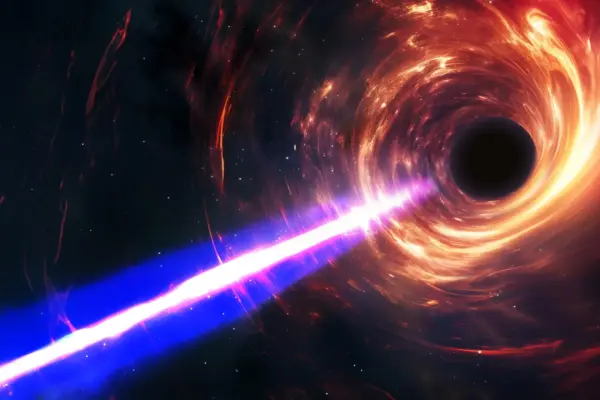
Led by researchers including Dr. Marcus Lower from Australia’s Swinburne University of Technology, a global scientific coalition has focused its analytical instruments on a rare and terrifying stellar remnant: a magnetar. Possessing the most powerful magnetic fields known to exist in the universe, this dead star provided the extreme laboratory environment necessary to force the quantum vacuum to reveal its hand. By combining cutting-edge X-ray space telescope data with precision ground-based radio astronomy and heavy supercomputing power, the team detected polarization signatures that strongly align with Heisenberg’s 1930s calculations.
The findings, recently published in the prestigious journal Nature under the title "Vacuum birefringence and the polarized X-ray emission of a radio magnetar," offer more than just a historical vindication for early quantum theorists. If definitively confirmed, this discovery opens an entirely new observational window into the quantum universe, granting physicists a novel method to test how standard models of physics behave under the most extreme gravitational and electromagnetic stress tests nature has to offer.
Detailed Chronology: Unraveling the 90-Year-Old Mystery
To understand the magnitude of the recent breakthrough, it is necessary to retrace a scientific journey that began on blackboards in Europe during the golden age of quantum physics and culminated in the data centers of modern Australia and the orbital mechanics of space-based observatories.
1. The Theoretical Dawn (1936)
In the mid-1930s, Werner Heisenberg and Hans Heinrich Euler expanded upon Paul Dirac’s relativistic quantum theory of the electron. They calculated that quantum electrodynamics (QED) permits a startling property of space: in the presence of an extraordinarily powerful magnetic field, the virtual particles—electron-positron pairs that constantly fluctuate within a vacuum—should polarize.
This polarization should, in theory, alter the refractive index of empty space itself. Just as a prism splits and bends light through glass because of the material’s optical density, an intense magnetic field should cause space to become birefringent (doubly refracting), forcing light waves oscillating in different directions to travel at slightly different speeds.
At the time, the prediction was purely academic. The magnetic field strengths required to produce a measurable vacuum birefringence effect were billions of times greater than anything human engineering could possibly generate. The theory was filed away as a brilliant, untestable artifact of early quantum mechanics.
2. The Search for Cosmic Laboratories
Decades passed, and while particle accelerators grew in power and precision, terrestrial magnetic fields remained far too weak to coax vacuum birefringence out of hiding. Physicists realized that if they ever wanted to observe the phenomenon, they would have to step away from the workbench and look to the stars—specifically, to neutron stars.
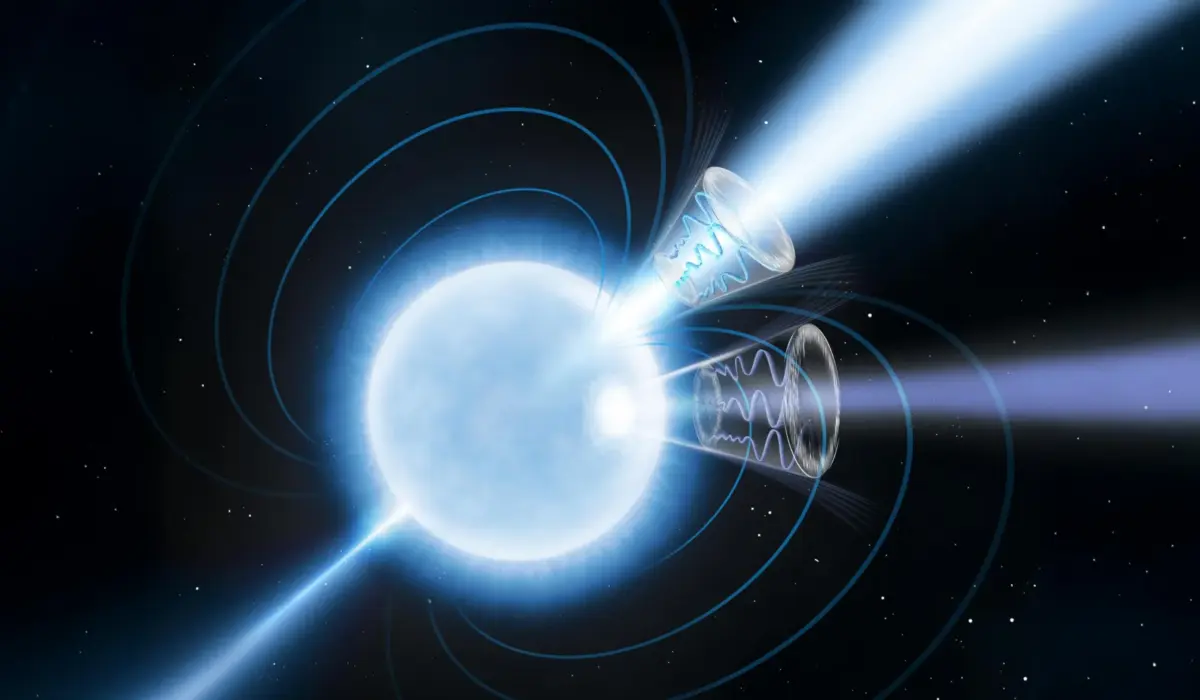
Neutron stars are the ultra-dense collapse remnants of massive stars that have gone supernova. Among them, a rare subclass known as magnetars features magnetic fields scaling up to quadrillions of gauss—magnitudes millions of times stronger than the most powerful steady magnetic fields ever produced in human laboratories. These cosmic objects effectively transform the space surrounding them into the ultimate high-energy physics testing grounds.
3. The Multi-Telescope Campaign
Enter the modern international research collaboration, which set its sights squarely on a specific magnetar designated 1E 1547.0-5408 (referred to simply as 1E1547).
Unlocking the secrets of 1E1547 required an unprecedented coordinated effort across multiple wavelengths of light, utilizing some of the most advanced scientific instruments humanity has deployed on Earth and in orbit:
- NASA’s Imaging X-ray Polarimetry Explorer (IXPE): Tasked with measuring the polarization—the directional oscillation—of X-rays streaming away from the magnetar.
- The NICER X-ray Telescope: Operating aboard the International Space Station to provide vital supplementary X-ray data and timing measurements.
- CSIRO’s Parkes Radio Telescope ("Murriyang"): Australia’s iconic national science agency radio telescope, used to capture precise radio frequency pulses from the spinning star.
4. Crunching the Cosmic Data
Dr. Marcus Lower captured critical radio observations utilizing Murriyang. The sheer volume and complexity of the multidimensional data necessitated heavy computational lifting. The raw observations were funneled into Swinburne University’s state-of-the-art Ngarrgu Tindebeek supercomputer, where sophisticated algorithms reconstructed the physical environment surrounding 1E1547.
By analyzing how both radio waves and X-rays behaved as the magnetar rotated on its axis, the research team isolated the telltale markers of quantum electrodynamical effects. The resulting analysis pointed directly toward the long-sought-after verification of vacuum birefringence.
Supporting Context & Metrics
To fully appreciate why this discovery represents a monumental leap forward, it is helpful to examine the hard numbers and the underlying physics that make magnetars unique.
The Scale of Extremes
- Magnetic Field Strength: To observe vacuum birefringence in a laboratory, scientists calculate a threshold known as the Schwinger limit. Magnetars routinely exceed this limit. The magnetic field surrounding a typical magnetar is roughly 100 million times stronger than the most powerful magnetic fields ever artificially generated on Earth.
- Temporal Origin: The core prediction of vacuum birefringence was formulated 89 years ago (in 1936), making it one of the oldest experimentally unverified tenets of quantum electrodynamics.
- Target Metrics (1E 1547.0-5408): The magnetar studied by the team possesses a rare geometric configuration. Analysis of its polarization state revealed that its magnetic and rotational axes are nearly aligned, and it is viewed from an exceptionally rare pole-on perspective. This alignment acts like a natural optical bench, reducing line-of-sight complications and isolating the quantum signature.
How Vacuum Birefringence Works in Practice
In classical physics, a vacuum is a void devoid of matter and energy. Quantum mechanics shatters this illusion via the Heisenberg uncertainty principle, which allows energy to fluctuate wildly on subatomic scales for microscopic fractions of time. These fluctuations manifest as virtual particle-antiparticle pairs that pop into existence and vanish instantaneously.
Normally, these virtual particles point in random directions, canceling each other out on a macroscopic scale. However, when an electromagnetic field of staggering proportions—such as that of a magnetar—engulfs the region, it forces these virtual particles to align.
When a photon (a particle of light) passes through this polarized sea of virtual particles, its interaction with the vacuum depends on its polarization angle. Light oscillating parallel to the magnetic field experiences a slightly different refractive index than light oscillating perpendicularly. As a result, the polarization vector of the light rotates as it propagates through space. By measuring this rotation in the X-rays and radio waves emitted by 1E1547, the research team captured the faint echo of Heisenberg’s 1930s equations playing out in real space.
Official Statements & Expert Insights
The implications of the discovery have resonated deeply throughout the global astrophysics and quantum physics communities.
Reflecting on the nature of the discovery, Dr. Marcus Lower of Swinburne University of Technology emphasized the symbiotic relationship between theoretical foresight and cosmic discovery:
"Detecting vacuum birefringence requires a magnetic field that is over 100 million times stronger than any we’ve ever made on Earth. Thankfully, nature has provided us with magnetars, which are the perfect cosmic laboratories to go looking for this effect."
Explaining how the unique geometry of magnetar 1E 1547.0-5408 made the breakthrough possible, Dr. Lower detailed the mechanics of the observation:
"Because of the magnetic field’s strength, Heisenberg’s virtual particles become aligned with the direction the field is pointing. By carefully tracking the direction the radio waves and X-rays oscillate as the magnetar rotates, the team found that the alignment of 1E1547’s magnetic and rotational poles were ideal for detecting vacuum birefringence."
Looking toward the horizon of future research, Dr. Lower expressed cautious optimism that the astronomical community stands on the precipice of closing a nearly century-old chapter in theoretical physics:
"With these future data on hand and our updated simulations, we may finally be able to complete the quest started by Heisenberg nearly 90 years ago."
Independent physicists not directly involved in the Swinburne-led study have echoed the sentiment, noting that if the signal withstands the rigorous peer-review and scrutiny of follow-up observations, it will provide an unprecedented testing ground for quantum electrodynamics in extreme regimes that cannot be replicated in particle accelerators like the Large Hadron Collider.
Future Outlook: The Next Frontier in Quantum Astrophysics
While the publication of the findings in Nature marks a major milestone, the work of the international research team is far from complete. Science demands replication, independent verification, and the systematic elimination of alternative explanations.
Distinguishing Quantum Signatures from Astrophysical "Noise"
One of the primary challenges moving forward is cleanly separating the subtle optical signature of vacuum birefringence from other complex physical processes occurring simultaneously in the violent magnetosphere of a neutron star. Magnetars are notorious for emitting chaotic stellar winds, relativistic particle jets, and high-energy thermal radiation that can muddy polarization data.
To overcome this, researchers are planning a series of advanced initiatives:
- Targeted Follow-Up Observations: Securing additional observation time with NASA’s IXPE and next-generation X-ray polarimeters to gather deeper, higher-resolution datasets on 1E1547 and other nearby magnetars.
- Next-Generation Computer Simulations: Upgrading hydrodynamic and QED simulation pipelines—building upon the work done on Swinburne’s Ngarrgu Tindebeek supercomputer—to model photon propagation through extreme magnetic fields with pinpoint accuracy.
- Expanded Cosmic Census: Surveying other known magnetars across the galaxy to determine whether vacuum birefringence polarization signatures are a universal feature of these objects or unique to specific magnetic geometries.
A New Tool for Exploring the Universe
Confirming vacuum birefringence does more than simply check a box on a 90-year-old physics to-do list. Once astronomers learn to reliably read the quantum polarization imprint left by vacuum birefringence, they will possess a brand-new diagnostic tool.
Much like spectroscopy allows scientists to determine the chemical composition of distant stars by looking at the light they emit, mastering the physics of vacuum birefringence could allow future astronomers to map out the hyper-intense magnetic fields of neutron stars with unprecedented precision. It bridges the microscopic world of quantum mechanics with the macroscopic grandeur of general relativity and stellar evolution.
As astronomers peer deeper into the dark corners of the cosmos, guided by powerful space telescopes and world-class supercomputers, humanity moves ever closer to fully understanding the hidden machinery of empty space—proving once and for all that, in the universe according to quantum mechanics, absolute emptiness is simply a myth.