








Executive Overview
In the intricate theater of molecular biology, few actors are as dynamic, enigmatic, and influential as transposons—popularly known as "jumping genes." Found across virtually all domains of life, from bacteria and plants to animals and humans, these genetic elements possess a remarkable capacity: they can excise themselves from their original genomic locations, travel through cellular spaces, and insert themselves into entirely new genomic contexts. For decades, evolutionary biologists recognized these mobile elements as critical drivers of evolutionary change, acting as internal engines of genetic innovation and adaptation. However, a foundational dogma of microbiology posited that while movement within a single cell was commonplace, crossing the formidable barrier into an entirely foreign cell—or across distinct species—required traditional vectors, operating essentially as genetic stowaways aboard viruses or plasmids.
A groundbreaking study led by microbiologist Jens Harder and his esteemed colleagues at the Max Planck Institute for Marine Microbiology has shattered this long-held assumption. Through meticulous investigation of a specialized methane-producing microbial community, the research team has documented an unprecedented phenomenon: jumping genes capable of traveling independently between entirely different microbial species.
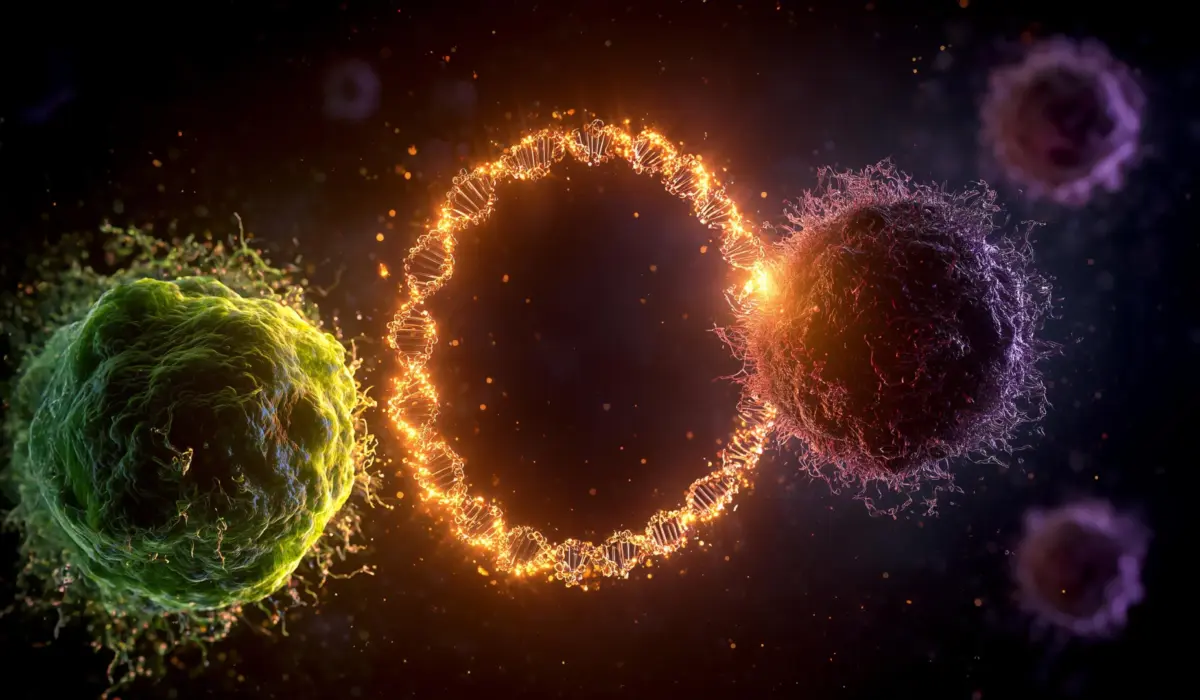
Even more astonishingly, these molecular voyagers achieve this cross-species transit not as passengers within viral capsids, but as naked, resilient rings of circular RNA.
This discovery not only illuminates a previously unknown horizontal gene transfer mechanism in the microbial world, but it also establishes a profound evolutionary bridge. The molecular strategy employed by these microscopic parasites—utilizing circular ribonucleic acid (RNA) to evade cellular degradation—mirrors sophisticated pathways found in human metabolic processes and cancer biology. Furthermore, understanding how nature engineers hyper-stable, circular RNA molecules offers tantalizing insights for the next generation of biotechnology, directly informing the design and stability of advanced RNA therapeutics and vaccines.
Detailed Chronology
Unmasking the Predator of the Methane Factory
The journey toward this paradigm-shifting discovery began not in a sterile, high-tech clinical laboratory, but deep within the complex, slow-growing ecosystems of a biogas-producing microbial community. Biogas production is a collaborative metabolic enterprise relying on intricate consortia of bacteria and archaea that break down organic matter into methane and carbon dioxide. Within these communities, scientists often find a delicate ecological balance governed by metabolic interdependence.
However, Harder and his team observed an unusual microbial hierarchy dominated by a very small, predatory bacterium bearing the provisional taxonomic designation Candidatus Velamenicoccus archaeovorus. This microscopic hunter possesses a specialized ecological niche: it preys upon other microorganisms that metabolize limonene—the organic compound responsible for the characteristic scent of oranges—converting it into the primary components of biogas.
As the researchers probed deeper into the structural architecture of the microbial community, they focused their attention on filaments of Methanothrix soehngenii, widely recognized as the single most important methane-producing archaeon on Earth. Interspersed within these vital filaments, the team noted a troubling anomaly: individual archaeal cells were dead, their structural integrity compromised. Suspecting that Ca. Velamenicoccus archaeovorus was the culprit behind this microbial execution, the research team set out to trace the weapon used by the predator. To definitively link the predator to the demise of its prey, they needed to find unmistakable molecular fingerprints of Ca. Velamenicoccus inside the dead cells of Methanothrix soehngenii.
The Hunt for the Mobile Intron
While scanning the genomic blueprint of the predatory bacterium Ca. Velamenicoccus archaeovorus, Jens Harder identified a fascinating genetic feature: an intron capable of functioning as a jumping gene. Introns are segments of genetic material that do not code for proteins; however, this particular mobile intron possessed self-splicing enzymatic properties, categorizing it as a ribozyme.
In the annals of molecular biology, intron RNA had never been detected existing independently outside the boundaries of a host cell. This unprecedented absence of extracellular observation fueled the researchers’ curiosity, transforming the mobile intron from a routine genomic curiosity into the prime suspect of their investigation.
To determine whether this genetic element could leave its cellular home, the team required tools of extraordinary sensitivity. Conventional microbiological techniques are ill-equipped to spot transient, low-abundance RNA molecules adrift in complex biological environments. Overcoming this technical hurdle, scientists at the Max Planck Institute for Marine Microbiology deployed state-of-the-art analytical methods specifically calibrated to detect infinitesimal quantities of RNA within bacterial cellular architectures.
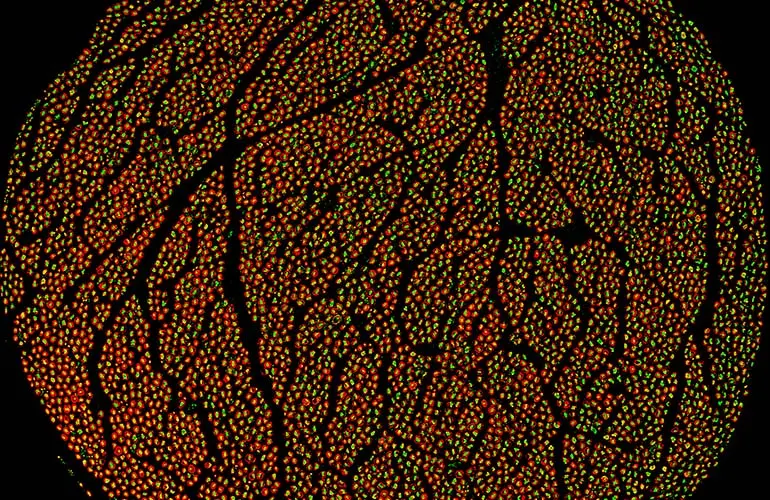
Utilizing custom-engineered nucleic acid probes designed to bind exclusively to the target intron sequence, the research team executed high-resolution fluorescence microscopy. The resulting microscopic images provided undeniable visual proof: intron RNA was clearly visible not only inside living cells of the predator Ca. Velamenicoccus archaeovorus, but also lingering within the dead cells of its prey, Methanothrix soehngenii.
The researchers had caught the mobile genetic element red-handed in the act of attempted replication. Yet, a dramatic biological twist accompanied the discovery. Because Ca. Velamenicoccus archaeovorus was an aggressive predator, it had efficiently killed its host cell before the genetic transfer could be successfully completed and integrated into a living, propagating genome. Consequently, the intron’s daring cross-species journey culminated in a dead end—a jump into an empty, lifeless cellular shell. Nevertheless, the physical presence of the RNA inside the foreign cell fundamentally altered the scientific understanding of horizontal gene transfer.
The Physics of Molecular Longevity
The discovery immediately raised a profound biochemical question: How did the intron RNA manage to survive the treacherous journey from one cell to another?
In standard cellular biology, ribonucleic acids function as fragile messengers. These long-chain polymeric molecules are tasked with transcribing genetic instructions from DNA and delivering them to the cell’s protein-synthesizing machinery, the ribosomes. Because of their vital yet transient regulatory roles, cellular messenger RNAs (mRNAs) are deliberately programmed for rapid destruction. Once their instructions are delivered, specialized cellular enzymes known as ribonucleases target the exposed, linear ends of the RNA chains, rapidly dismantling them to prevent chaotic metabolic signaling.
Because of this relentless enzymatic surveillance, dead cells are ordinarily barren landscapes devoid of intact ribonucleic acids; the moment a cell dies and its homeostatic mechanisms fail, endogenous enzymes swiftly shred its RNA inventory.
The intron RNA discovered by Harder’s team defied this universal biological rule. It survived the hostile extracellular environment—and persisted inside a dead host cell—because it possessed a structurally ingenious architecture: it formed a covalently closed, circular molecule completely devoid of open ends.
This ring-shaped topology acts as an impenetrable molecular shield. Without free 5′ or 3′ ends to latch onto, standard exonucleolytic enzymes are rendered completely ineffective, unable to initiate the cleavage process. Protected by its geometric design, the circular intron RNA floats through cellular debris with remarkable biochemical resilience, unlocking a mechanical pathway for interspecies migration that researchers had previously thought impossible.
Supporting Context & Metrics
To fully appreciate the gravity of the Max Planck team’s findings, it is necessary to examine the broader mechanics of mobile genetic elements, horizontal gene transfer, and the emerging science of circular RNA.
The Mechanics of Mobile Genetic Elements
Jumping genes, or transposons, account for a surprisingly vast percentage of genomes across the tree of life—comprising, for instance, nearly half of the human genome. They are broadly categorized into two classes:
- Class I Transposons (Retrotransposons): These elements replicate via an "copy-and-paste" mechanism, transcribing their DNA into an RNA intermediate, which is then reverse-transcribed back into DNA and inserted elsewhere in the genome.
- Class II Transposons (DNA Transposons): These utilize a "cut-and-paste" mechanism, excising themselves directly from the DNA sequence and integrating into a new locus.
Self-splicing introns represent a specialized evolutionary variant. As ribozymes, they possess intrinsic catalytic activity, allowing them to excise themselves from precursor RNA transcripts without the aid of external protein enzymes. The discovery that these ribozymes can adopt circular conformations and breach cellular boundaries introduces a completely novel vector class into evolutionary paradigms.
Horizontal Gene Transfer (HGT) Paradigms
For decades, microbial evolution was modeled primarily around vertical descent—genes passing strictly from parent to offspring. However, the discovery of Horizontal Gene Transfer (HGT) revealed that microorganisms frequently swap genetic material laterally across species lines, driving rapid adaptations such as antibiotic resistance.
Traditionally, HGT is classified into three canonical mechanisms:
- Transformation: The direct uptake of naked DNA from the extracellular environment.
- Transduction: The accidental packaging of host DNA into bacteriophage viruses, which then inject the genetic material into a new host.
- Conjugation: The direct, physical transfer of plasmid DNA through a microscopic bridge (pilus) connecting two bacterial cells.
The findings from Jens Harder’s laboratory suggest a fourth, highly unorthodox vector: RNA-mediated interspecies transit via circularized ribozymes. While the observed transfer ended in a dead cell, the mere physical migration of an intact, functional RNA ring into a foreign cellular membrane proves that environmental persistence of naked genetic material is far more sophisticated than textbook models allow.
Comparative Metrics of RNA Stability
| RNA Conformation | Structural Characteristic | Susceptibility to Exonucleases | Typical Half-Life in Cellular Environments | Primary Biological Function |
|---|---|---|---|---|
| Linear mRNA | Open 5′ and 3′ ends; single-stranded regions. | Extremely High (rapidly degraded). | Minutes to hours. | Protein translation instruction delivery. |
| Linear tRNA / rRNA | Complex folded structures with protected ends. | Moderate (shielded by proteins/folding). | Hours to days. | Structural and adapter roles in translation. |
| Circular RNA (circRNA) | Covalently closed loop; zero open ends. | Virtually Zero (resistant to standard exonucleases). | Extended (often persists for days or entire cell lifespans). | Gene regulation, metabolic modulation, and—as newly discovered—intercellular/interspecies transit. |
Official Statements
The implications of this discovery extend far beyond basic microbial ecology, bridging environmental microbiology with cutting-edge human medicine. In an official release discussing the findings, lead researcher Dr. Jens Harder contextualized the broader significance of circular RNA stability:
"The stability of intron RNA in its ring form is a distinctive feature. In humans, circular RNA molecules influence many metabolic processes, and their role in tumor development is currently the subject of intensive research," stated Jens Harder, highlighting the deep evolutionary conservation of molecular stability mechanisms.
Furthermore, Harder emphasized the direct translational potential of observing how nature stabilizes RNA for transport:
"Applications in RNA vaccines, for example against the Covid virus and certain forms of cancer, are also in the pipeline. Our study has shown that in microorganisms, jumping genes can be transferred to other species via their circular RNA."
Biologists within the broader Max Planck network have similarly praised the methodological rigor required to capture such transient molecular events. By pushing the boundaries of nucleic acid probe technology, the research team has established a new technical benchmark for detecting low-abundance transcripts in complex, multi-species environments. Experts note that these visualization techniques will likely become standard operating procedure for laboratories studying microbial dark matter and environmental virology.
Future Outlook
The unveiling of circular RNA-mediated gene transfer opens an expansive new frontier in microbiological research, evolutionary theory, and biotechnology. As the scientific community digests these findings, several critical avenues of inquiry are set to shape the future of the discipline.
1. Rewriting Evolutionary Timelines and Microbial Ecology
The documentation of jumping genes migrating as naked circular RNA rings forces evolutionary biologists to recalculate the vectors of horizontal gene transfer. If self-splicing introns can regularly escape their microbial hosts encased in protective rings, researchers must now investigate how frequently these genetic parasites successfully complete their journeys into living recipient cells. Determining the frequency of successful integration events will reveal whether this mechanism plays a minor role in microbial adaptation or stands as a major, overlooked highway of genetic exchange.
2. Implications for Human Health and Oncogenesis
As Dr. Harder noted, circular RNA is not merely a microbiological curiosity; it is a critical player in human cell biology. Naturally occurring circular RNAs are abundantly expressed in human tissues, where they act as molecular sponges for microRNAs, regulate transcription, and influence complex metabolic pathways. Aberrant circular RNA expression profiles have been directly correlated with various human pathologies, including neurodegenerative disorders and aggressive tumor development. By studying how primitive microbial systems engineer, protect, and stabilize circular RNA rings, biomedical researchers may gain invaluable insights into how similar molecules behave—and misbehave—within human cellular environments.
3. Engineering the Next Generation of RNA Therapeutics
Perhaps the most immediate and commercially significant impact of this research lies in the field of biotechnology and pharmacology. The global rollout of mRNA-based vaccines demonstrated the unprecedented potential of RNA therapeutics, yet it also exposed a persistent Achilles’ heel: the inherent fragility of linear RNA molecules. Maintaining mRNA stability requires ultra-cold storage chains and sophisticated lipid nanoparticle delivery systems to prevent premature enzymatic degradation.
Nature, through millions of years of evolutionary pressure, has solved this stability problem by inventing covalently closed circular RNA topologies. By examining the structural motifs that allow predatory microbial introns to survive harsh extracellular environments without enzymatic dismantling, bioengineers can draw direct inspiration for synthetic drug design.
Future iterations of RNA vaccines, gene therapies, and anti-cancer treatments could incorporate engineered circular RNA scaffolds modeled after these robust microbial jumping genes. Such advancements could dramatically enhance shelf-life, reduce cold-chain dependency, and improve the intracellular delivery efficiency of life-saving pharmaceutical compounds.
Conclusion
What began as an investigative probe into the dark corners of a methane-producing microbial community has blossomed into a landmark discovery. By capturing a jumping gene in transit—protected by its own bulletproof circular RNA ring—Jens Harder and his colleagues at the Max Planck Institute have rewritten our understanding of genetic mobility. As science continues to decode the elegant survival strategies of the microbial world, we are reminded that even the smallest parasites possess ingenious molecular solutions that can ultimately revolutionize human medicine and reshape our understanding of life on Earth.