








Executive Overview
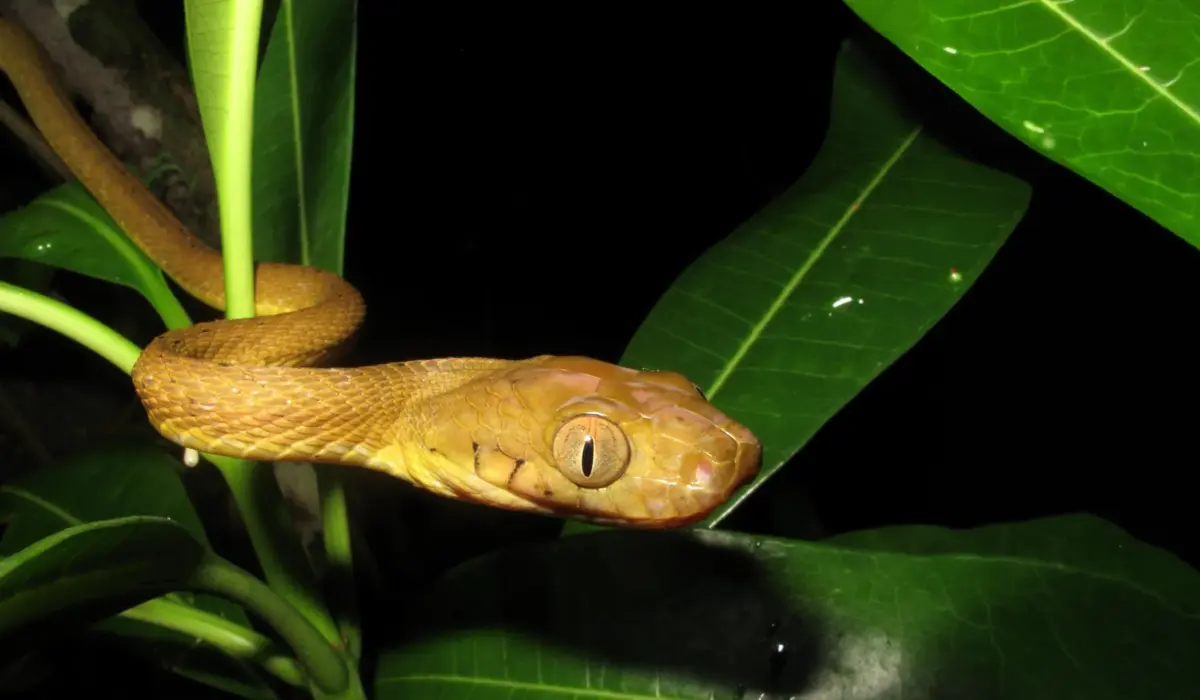
The brown tree snake (Boiga irregularis) stands as one of the most infamous and catastrophic examples of an invasive species in modern ecological history. Native to the coastal regions of Australia and parts of the South Pacific, this nocturnal, mildly venomous predator accidentally hitched a ride to the U.S. territory of Guam aboard military cargo planes sometime in the aftermath of World War II.
The consequences of its introduction have been nothing short of apocalyptic for the island’s endemic wildlife. Lacking evolutionary defenses against a nocturnal, arboreal hunter, many of Guam’s native forest bird species have been driven entirely to local extinction. Beyond its devastating ecological toll, the snake wreaks daily havoc on human infrastructure, causing hundreds of widespread power outages annually by climbing utility poles and short-circuiting electrical equipment. In certain concentrated pockets of the island, population densities have reached staggering, unprecedented extremes—climbing as high as 30,000 snakes per square mile.
For decades, this explosive colonization has baffled evolutionary biologists and wildlife management experts alike. Conventional ecological theory dictates that when a population is established by only a tiny founding handful of individuals, it suffers from a severe genetic bottleneck. This restriction strips the gene pool of vital diversity, usually leading to intense inbreeding depression. Under normal circumstances, such a genetic restriction compromises a species’ immune system, diminishes its environmental adaptability, and makes rapid population growth mathematically and biologically improbable.
Yet, the brown tree snake completely shattered these expectations, scaling up to plague proportions with breathtaking speed. Now, a groundbreaking University at Buffalo-led study published on July 24 in Science Advances has finally unmasked the secret behind this biological anomaly. Utilizing state-of-the-art long-read genomic sequencing, researchers have discovered that the brown tree snake possesses a vast, previously hidden reservoir of structural genetic variation. This unexpected biological resilience allowed the invaders to bypass the crippling effects of inbreeding, adapt swiftly to a foreign ecosystem, and mount one of the most successful biological invasions in recorded history.
Detailed Chronology: From Accidental Stowaway to Island Dominance
To fully grasp the magnitude of the recent genetic findings, one must trace the timeline of the brown tree snake’s invasion of Guam—a trajectory marked by human oversight, ecological collapse, and scientific bewilderment.
The Post-WWII Arrival
In the chaotic wake of World War II, massive quantities of military equipment, cargo, and supplies were transferred throughout the Pacific theater. Somewhere amidst this logistical whirlwind, a small number of brown tree snakes—perhaps only a pregnant female or a tiny mating pair—found refuge inside the cargo hold of a military transport plane. When the aircraft touched down on Guam, the snakes disembarked into a pristine, naive ecosystem completely devoid of natural predators, competitors, or pathogens that could keep their numbers in check.
The Silent Takeover (1950s–1970s)
During the first two decades following their introduction, the snakes maintained a relatively low profile while quietly multiplying across the southern half of the island. By the late 1960s, however, the ecological fallout became glaringly apparent. Ornithologists and local residents noted a catastrophic collapse in Guam’s native bird populations. Out of 12 native forest bird species, 10 were ultimately wiped out entirely, transforming lush forest canopies into eerie, silent environments devoid of birdsong.
The Infrastructure Crisis and Ecological Saturation (1980s–Present)
As their primary prey items vanished, the snakes did not starve; instead, they adapted their diets to include lizards, small mammals, and domestic pets, while successfully utilizing electrical grids as highways. By the 1980s, the snakes were causing frequent island-wide blackouts by bridging electrical transformers with their serpentine bodies.
Despite decades of intensive eradication efforts by federal and local agencies—including the U.S. Geological Survey (USGS) and specialized rapid response teams—the population remained stubbornly entrenched. Government agencies tracked the spread, established quarantine protocols at ports of departure to prevent the snakes from hopping rides to other vulnerable islands like Hawaii or the Commonwealth of the Northern Mariana Islands, and tested various control measures. Yet, the core population on Guam continued to thrive, maintaining densities that defied every established tenet of population genetics.
Supporting Context & Metrics: Unveiling the Invisible Genome
The core mystery of the Guam invasion centered on a fundamental paradox of population genetics: How could a population derived from a microscopic founding group avoid the lethal accumulation of deleterious mutations caused by inbreeding? The answer lay not in what scientists were looking at, but how they were looking.
The Limitations of Traditional Sequencing
For decades, population genetics relied heavily on sequencing technologies designed to detect single nucleotide polymorphisms (SNPs)—minor alterations involving individual DNA base pairs, such as an adenine (A) mutating into a guanine (G), or a thymine (T) shifting to a cytosine (C). While these traditional tools were revolutionary for their time, they operated much like a scholar reading two historical manuscripts letter by letter through a magnifying glass.
Using this narrow lens, early genetic evaluations of the brown tree snake suggested moderate to low genetic diversity, reinforcing the puzzle of how they survived the bottleneck. However, this method suffered from a massive blind spot: it was fundamentally incapable of detecting large-scale structural variants (SVs)—longer stretches of DNA involving 50 base pairs or more that have been deleted, duplicated, inverted, or translocated across chromosomes.
The Power of Long-Read Sequencing
To pierce this veil, a collaborative team of researchers from the University at Buffalo and the USGS deployed advanced long-read sequencing technology. Unlike older methods that chop DNA into microscopic fragments, long-read sequencing reads continuous, extended stretches of the genome. This technological leap allowed scientists to map major structural rearrangements across the entire genome.
"It’s like looking at portions of two books letter by letter with a magnifying glass and thinking they’re the same, but not realizing entire paragraphs have been moved around or duplicated," explains Dr. Levi Gray, a postdoctoral researcher in the Krabbenhoft lab and former USGS researcher who studied the Guam snake problem. "Older sequencing technology didn’t allow us to easily see that DNA in one individual might be in a completely different place on the chromosome than in another. How we define genetic diversity and how we actually measure it is shaped largely by the technology of the day."
Staggering Metrics: 19,000 Structural Variants
When the research team analyzed DNA samples supplied by the USGS Brown Tree Snake Rapid Response Team, the results were staggering. The analysis uncovered more than 19,000 structural variants scattered throughout the brown tree snake genome.
To put this in perspective, these structural modifications altered nearly eight times more of the total genome than all single-base pair changes combined. The brown tree snake was not genetically impoverished at all; rather, its genome was structurally dynamic, packed with hidden genetic variations that traditional assays had entirely missed.
Furthermore, these structural variants were not distributed randomly. A significant concentration of these genomic rearrangements was located within genes tied directly to immune function and olfaction (the sense of smell).
Olfaction and Behavioral Adaptation
The concentration of structural variations in olfactory genes sheds light on both the snake’s predatory prowess and a fascinating behavioral mystery on Guam. Brown tree snakes depend heavily on their forked tongues to sample airborne chemical cues, navigating and hunting with acute precision.
In their native Australian and South Pacific ranges, brown tree snakes are known to occasionally engage in cannibalism. Yet, on Guam—despite population densities reaching 30,000 snakes per square mile—widespread cannibalism is notably absent. The research team hypothesizes that the heightened, structurally diverse olfactory system of these snakes enables them to chemically recognize one another as close kin (siblings or near-relatives due to inbreeding) rather than as viable prey items. This chemical self-recognition prevents destructive intra-species predation, allowing the high-density population to sustain itself cooperatively without tearing itself apart from within.
Official Statements and Expert Insights
The study, which bridges theoretical genetics with urgent conservation challenges, has drawn commentary from leading researchers across institutions.
Dr. Trevor Krabbenhoft, associate professor in the UB Department of Biological Sciences and the corresponding author of the study, emphasizes the paradigm shift prompted by their findings:
"The brown tree snake is maybe not wildly diverse, but it has important sources of genetic diversity that have been underappreciated. Our findings force us to rethink how we evaluate the adaptability of invasive populations that appear to clear genetic hurdles with ease."
Dr. Christopher Osborne, formerly a PhD student in Krabbenhoft’s laboratory and now an aquatic biologist at the State University of New York (SUNY) Oswego, points out the dual-edged nature of the discovery. While the news complicates eradication efforts, it offers an unexpected beacon of hope for conservationists fighting to save endangered species:
"It’s possible that endangered species may have more flexibility in their genes than we realize. We’re now getting a better understanding of unappreciated sources of genetic diversity that may explain how some inbred species can still respond to their environment."
Dr. Levi Gray expands on the methodological breakthroughs required to reach these conclusions:
"We had to look beyond the standard SNP markers. By capturing structural variants that span dozens or thousands of base pairs, we revealed a hidden layer of genomic architecture. The question moving forward is whether this diversity was brought along from the native range or forged in the crucible of the invasion itself."
Future Outlook: Implications for Conservation and Biosecurity
The publication of this study in Science Advances marks both a closing chapter in a long-standing ecological mystery and the opening of a complex new frontier in wildlife management. The implications ripple across two distinct battlegrounds: invasive species containment and endangered species conservation.
Implications for Invasive Species Management
For biosecurity agencies like the USGS Rapid Response Team, the U.S. Department of Agriculture (USDA), and local Pacific island governments, the discovery is sobering. Greater genetic flexibility means that the brown tree snake is inherently more resilient and adaptable than historical models assumed.
If structural variants provide a genetic buffer against environmental stress and inbreeding depression, eradication programs must account for this hidden resilience. Traditional control methods—such as trapping, poisoning, and aerial deployment of dead mice laced with acetaminophen—must remain aggressive and adaptive. Furthermore, understanding the precise genetic architecture of the Guam population underscores the critical importance of strict biosecurity protocols at ports and airports throughout the Pacific to prevent these resilient genes from establishing footholds in ecologically vulnerable regions like Hawaii.
A Ray of Hope for Endangered Species
Paradoxically, the mechanisms that make the brown tree snake a devastating invader may offer a biological lifeline to endangered species teetering on the brink of extinction. Many conservation programs manage species—such as the California condor, the black-footed ferret, or various island endemic birds—that have been bottlenecked down to handfuls of surviving individuals due to human encroachment and habitat loss.
For decades, conservation geneticists have watched these small populations with apprehension, fearing that inbreeding depression would inevitably seal their doom. However, if species possess unmeasured reserves of structural genetic variation hidden within their genomes, they may possess far greater evolutionary plasticity than standard genetic tests indicate. By adopting long-read sequencing technologies to evaluate endangered genomes, conservationists may identify hidden avenues of resilience, guiding more effective breeding and reintroduction programs.
The Next Scientific Frontier: Origin of the Variants
As the research team looks toward future studies, a major unresolved question remains: Did the 19,000 structural variants emerge after the invasion began as a stress-induced genomic response, or were they already present in the small founding population that boarded a military cargo plane in the mid-20th century?
To resolve this chronological puzzle, researchers plan to sequence and analyze brown tree snake populations across their native Australian and South Pacific ranges. Comparing the native genomes against the Guam invaders will clarify whether severe population bottlenecks actively accelerate the generation of structural variants or if the snakes simply won a genetic lottery by packing the right structural cards in their founding hand.
Until those answers materialize, the brown tree snake remains an imposing testament to nature’s adaptability—a masterclass in how life finds a way, even when constrained by the tightest genetic bottlenecks.