









EXECUTIVE SUMMARY
In a groundbreaking leap forward for behavioral neurobiology, an interdisciplinary research team spanning Heinrich Heine University Düsseldorf (HHU), the University of Cologne, and Goethe University Frankfurt has successfully mapped and manipulated the specific neural circuits that govern the division of labor within honeybee (Apis mellifera) colonies. Published in the prestigious journal Proceedings of the National Academy of Sciences (PNAS), this landmark study illuminates how a complex, highly efficient society operates entirely without a central authority, monarchical decree, or top-down managerial oversight.
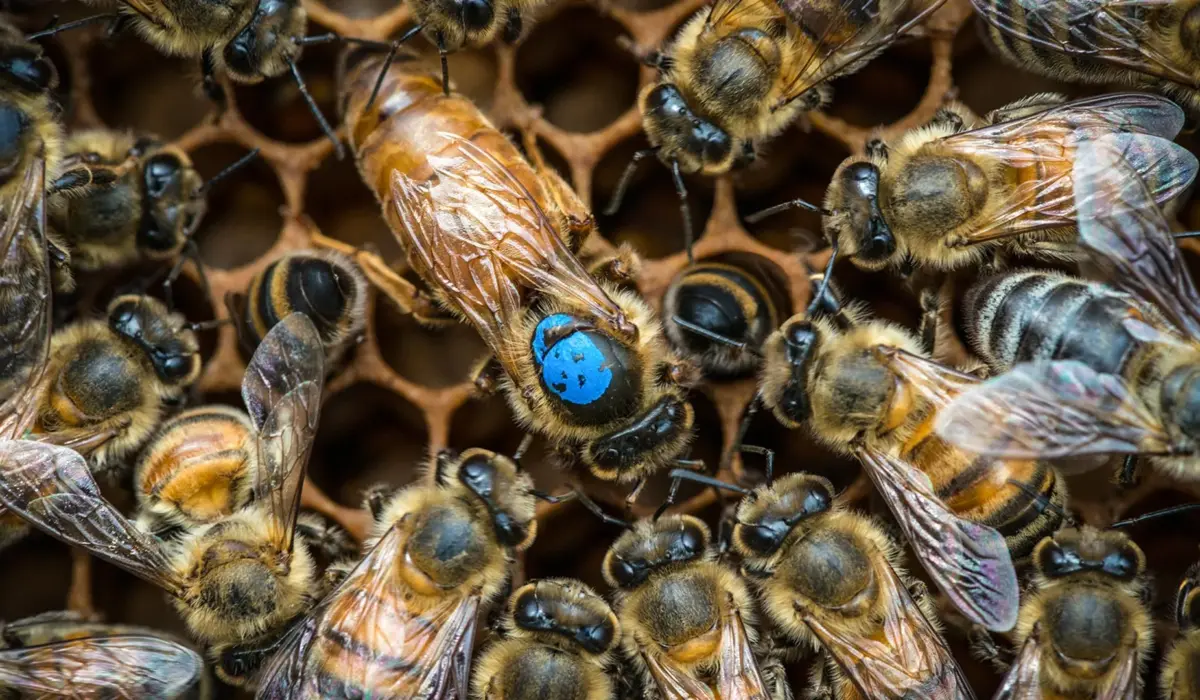
For centuries, naturalists and scientists alike have marveled at the decentralized organizational brilliance of social insects. While human civilizations rely heavily on conscious deliberation, bureaucratic planning, and explicit job assignments to maintain infrastructural continuity, honeybee colonies achieve industrial-scale coordination through instinctual, age-dependent role transitions. Young bees begin their adult lives as nursemaids tending to the royal queen and fragile larvae; as they mature, they transition into construction workers, architects, and guards; finally, in the twilight of their lives, they venture out into the perilous open world as foragers.
Until now, the exact neurobiological mechanisms orchestrating this programmatic progression remained shrouded in mystery. By zeroing in on a master regulatory gene known as doublesex and selectively silencing localized neural circuits, Professor Dr. Martin Beye’s research group at HHU, alongside their collaborators, achieved a monumental feat: they artificially reversed the behavioral clock of older worker bees. By dialing down electrical activity in targeted brain networks, seasoned foragers abandoned their outdoor duties and reverted to the nurturing, domestic behavior characteristic of days-long-old neonate bees.
This deep dive examines the chronological progression of this breakthrough research, contextualizes its significance within the broader landscape of evolutionary biology, highlights key quantitative metrics of the study, presents official commentary from the principal investigators, and projects the far-reaching future implications of decoding the neural architecture of social cooperation.
1. DETAILED CHRONOLOGY: UNRAVELING THE NEURAL CODE OF THE HIVE
The path to decoding the neural foundations of division of labor was not forged overnight. It represents the culmination of years of rigorous genetic tracking, behavioral observation, and cutting-edge neuro-manipulation techniques.
Phase I: The Genetic Fingerprint and Prior Discoveries
The foundational building blocks of this latest breakthrough were laid by Professor Dr. Martin Beye and his team at HHU’s Institute of Evolutionary Genetics. While investigating the genetic underpinnings of developmental pathways and social behaviors, the team focused their attention on doublesex, a remarkably conserved gene known across many species for its role in sexual differentiation.
During baseline observations, the researchers noticed an unexpected anomaly: when the doublesex gene was genetically deactivated or disrupted in older worker bees, the insects underwent a profound psychological and behavioral regression. Rather than maintaining their age-appropriate foraging duties, these older workers returned to the brood nest to feed and care for the queen—a nursing task typically restricted to the youngest members of the colony.
This behavioral U-turn provided the crucial smoking gun. It strongly suggested that doublesex was not merely a passive marker of biological sex or anatomical development, but an active, ongoing regulator of age-dependent social behavior in adult workers.
Phase II: Mapping the Circuitry
Recognizing that doublesex does not operate in a vacuum—and knowing it expresses itself heavily within specific, localized neural pathways inside the insect brain—Professor Beye joined forces with neurobiologists and behavioral geneticists at the universities of Cologne and Frankfurt/Main.
The collaborative team faced a formidable technological challenge: how to isolate the precise neural circuits influenced by doublesex without disrupting the broader physiological health of the organism. The bee brain, though compact, is a marvel of evolutionary engineering, packing roughly one million interconnected neurons into a space smaller than a grass seed.
Phase III: Targeted Neural Silencing and Behavioral Reversal
To test whether these specific circuits directly controlled task allocation, the researchers deployed a sophisticated chemogenetic strategy. They engineered a system where the doublesex gene directed the cellular production of a targeted inhibitory protein designed to suppress neural activity.
By administering a specific dietary substance to the experimental bees, the researchers were able to trigger this protein, selectively damping down electrical communication exclusively within the doublesex-linked neural circuits. The rest of the brain remained fully functional, ensuring that the bees could still walk, fly, and process sensory information normally.
The results were astonishing. When these targeted circuits were chemically inhibited, older worker bees experienced a complete motivational shift. Discarding their roles as exterior foragers, they re-entered the nursery chambers and resumed tending to the queen. When the chemical inhibitor was withheld, the bees immediately reverted to their normal, age-appropriate duties. For the first time in history, scientists had seized direct, causal control over the job assignments of an animal society through precise neural manipulation.
2. SUPPORTING CONTEXT & METRICS: THE SCALE OF THE HIVE
To fully appreciate the magnitude of this discovery, it is vital to examine the biological and structural metrics that define a honeybee colony (Apis mellifera).
The Architecture of an Insect Metropolis
- Neural Density: A single worker bee brain contains approximately 1,000,000 neurons. Despite this microscopic scale, these circuits process complex spatial mapping, olfactory communication (via the waggle dance), and intricate social hierarchies.
- The Temporal Polyethism Timeline: Worker bee life history is strictly partitioned into distinct temporal phases, known scientifically as temporal polyethism:
- Days 1–21 (The Nursery Phase): Young bees remain deep inside the dark, temperature-controlled hive, cleaning cells, feeding larvae, and grooming the laying queen.
- Days 21–40 (The Maintenance & Defense Phase): Middle-aged workers take on architectural duties—secreting beeswax, building honeycomb, processing incoming nectar, and guarding the hive entrance against intruding wasps and robber bees.
- Days 40+ (The Foraging Phase): Aged workers spend the remainder of their lives exposed to environmental hazards, flying miles away from the hive to harvest pollen, nectar, and water.
Methodological Metrics of the PNAS Study
- Three-Institution Collaboration: The study pooled the specialized expertise of Heinrich Heine University Düsseldorf, the University of Cologne, and Goethe University Frankfurt/Main.
- Targeted Intervention: Rather than utilizing blunt instruments like whole-brain lesions or systemic neurotoxins, the team targeted micro-circuits expressing the doublesex transcription factor, achieving cellular-level precision.
- Reversibility: The chemogenetic switch proved entirely reversible, demonstrating that the neural circuits governing task allocation are not permanently hardwired into a fixed state at birth, but remain dynamically responsive to internal neurochemical modulation.
3. OFFICIAL STATEMENTS & EXPERT PERSPECTIVES
The publication of these findings in PNAS has drawn widespread acclaim from the international scientific community, positioning neurogenetics at the forefront of sociobiology.
Dr. Jana Seiler, lead author of the study from Heinrich Heine University Düsseldorf, highlighted the precision of the behavioral turnaround during a press briefing:
"The older worker bees then resumed caring for the queen, which only younger bees would do otherwise. When the circuits were not inhibited, the bees exhibited their normal, age-dependent behavior. In this way, we were able to control which tasks the worker bees performed."
Dr. Seiler’s observations underscore the foundational nature of the discovery: behavior is not merely a psychological abstraction or a vague cultural byproduct, but the direct, mechanical output of distinct electrical pathways firing—or failing to fire—within the brain.
Expounding on the broader evolutionary and philosophical implications of the research, Professor Dr. Martin Beye emphasized that unlocking the neural architecture of the bee brain sheds light on biological cooperation as a whole:
"The ability to control the social behavior of bees offers us new opportunities to explore the fundamentals of innate behavioral diversity and social cooperation. The solution to the secret of how bees and other animals cooperate so well without a blueprint for work is likely hidden in the brain’s neural circuits."
Beye noted that while human societies require explicit legal frameworks, job descriptions, organizational charts, and verbal negotiations to divide labor, nature has engineered an astonishingly elegant decentralized alternative: a biological operating system where shifting neurochemical balances automatically distribute the workforce precisely where it is needed most.
4. FUTURE OUTLOOK: HORIZONS IN NEUROBIOLOGY AND BEYOND
As the dust settles on this landmark PNAS publication, the research consortium is already looking ahead to the next frontier of questions. The successful mapping of doublesex-linked circuits opens up several exciting pathways for future scientific exploration:
Decoding the Sensory Inputs of Behavioral Shifts
One of the most pressing questions remaining is how external colony needs—such as an urgent spike in the demand for water carriers or an immediate need for more undertaker bees to remove corpses—communicate with these internal neural circuits. Do pheromonal cues from the queen or brood directly alter the electrical excitability of doublesex neurons, triggering premature aging or behavioral regression in the workforce? Future studies will likely deploy real-time calcium imaging and electrophysiological recordings inside active, transparent observation hives to watch these circuits fire in real time.
Comparative Neurogenetics Across Eusocial Species
While Apis mellifera is the poster child for insect sociobiology, the mechanisms discovered by the German research team may have profound evolutionary implications for other eusocial insects, such as ants, wasps, and termites. Investigating whether homologous genes and parallel neural circuits govern division of labor across vastly different evolutionary lineages could reveal whether nature utilizes a universal neurochemical toolkit to build complex societies.
Biomedical and Biotechnological Parallels
Though honeybees and humans are separated by hundreds of millions of years of divergent evolution, the fundamental principles of neural circuit organization, gene expression, and behavioral plasticity share deep evolutionary conservation. Understanding how a single genetic switch and its associated neural network can completely reorganize an animal’s social role offers conceptual models for understanding neurodevelopmental plasticity, behavioral disorders, and the neurobiological basis of complex, coordinated group dynamics.
Conclusion
The research led by HHU, Cologne, and Frankfurt has fundamentally altered our understanding of how life organizes itself from the bottom up. By proving that the intricate division of labor within a bustling honeybee colony is governed by tangible, malleable neural circuits, the team has bridged the gap between genetics, neurobiology, and sociology. As science continues to peer deeper into the micro-architecture of the insect brain, we move ever closer to answering one of nature’s most enduring questions: how countless autonomous parts can seamlessly unite to form an intelligent, harmonious whole.