










Executive Overview
For over half a century, modern astrophysics has confronted one of its most stubborn and baffling enigmas: the origin of ultrahigh-energy cosmic rays (UHECRs). These subatomic travelers slam into Earth’s upper atmosphere with a fury that defies easy explanation, packing kinetic energies millions of times greater than anything achievable by humanity’s most powerful particle accelerators, such as the Large Hadron Collider (LHC). Among these ghostly interlopers, a select few have achieved legendary status in the scientific community. The "Oh-My-God particle," detected in 1991, and more recently the "Amaterasu particle," captured by the Telescope Array in Utah in 2021, represent the absolute zenith of observed cosmic violence.
Yet, for all their awe-inspiring power, these particles have historically pointed to a geographic and physical impossibility. When researchers trace the arrival trajectory of anomalies like the Amaterasu particle backward through the cosmos, they often lead directly to cosmic voids—vast, empty regions of space completely devoid of galaxies, massive stars, or any known celestial machinery capable of accelerating matter to such staggering velocities. This mismatch between theoretical source requirements and observed arrival vectors has left theoreticians grasping for solutions.
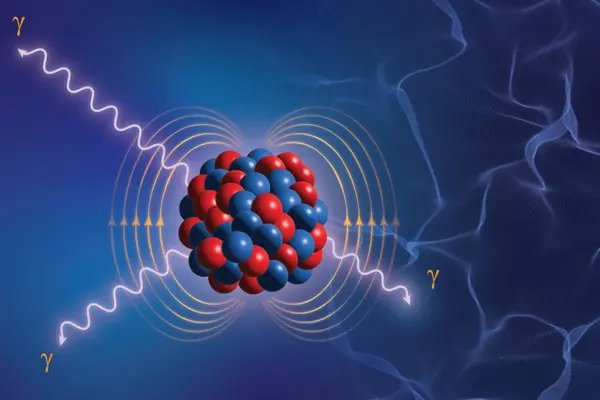
Now, a groundbreaking study led by researchers at Penn State, in collaboration with international institutions including the Yukawa Institute for Theoretical Physics in Japan and Virginia Tech, offers a compelling paradigm shift. Published in Physical Review Letters, the new research posits that the highest-energy cosmic rays may not be isolated protons or light atomic nuclei, but rather ultraheavy atomic nuclei—elements significantly heavier than iron.
Through complex computer simulations and advanced theoretical modeling, the research team demonstrated that these ultraheavy nuclei possess unique physical properties that allow them to endure the grueling, billion-light-year journey across intergalactic space with less energy degradation than their lighter counterparts. If confirmed, this discovery fundamentally alters how astrophysicists hunt for the most violent accelerators in the universe, bridging the gap between localized cosmic explosions and the mysterious signals captured by detectors on Earth.
Detailed Chronology: Sixty Years of Tracking the Unseen
To understand the magnitude of the Penn State breakthrough, it is necessary to retrace the history of ultrahigh-energy cosmic ray research, a timeline defined by escalating scales of energy and persistent observational mysteries.
The Dawn of UHECR Detection (1960s–1990s)
The hunt for ultrahigh-energy cosmic rays began in the 1960s, when physicists first realized that cosmic radiation did not stop at standard galactic energy thresholds. Instead, a continuous, albeit vanishingly sparse, flux of particles arrived from deep space carrying macroscopic amounts of energy.
The field reached a cultural and scientific watershed on October 15, 1991, at Dugway Proving Ground in Utah, operated by the Fly’s Eye cosmic ray detector. Researchers recorded a particle with an astonishing energy of approximately 320 exa-electron volts ($textEeV$). Dubbed the "Oh-My-God particle," this single proton-equivalent possessed the kinetic energy of a baseball traveling at roughly 60 miles per hour, compressed entirely into a subatomic particle. At the time, standard astrophysical models struggled to account for how a single particle could be accelerated to $99.9999999999999999999995%$ the speed of light within the confines of known cosmic engines.
The Mystery Deepens: The Amaterasu Event (2021)
Three decades later, detectors had grown exponentially in scale and sensitivity. In 2021, the Telescope Array collaboration—spanning over 700 surface detector stations across 700 square kilometers of the Utah desert—registered a similarly monumental event. Named the "Amaterasu particle" after the Japanese sun goddess, this particle registered an estimated energy of 240 $textEeV$.
While its energy matched the elite tier of the Oh-My-God particle, the Amaterasu event introduced a baffling spatial puzzle. When scientists mapped the particle’s arrival direction back through the celestial sphere, it pointed squarely into the Local Void—an expansive, low-density region of the universe containing virtually no luminous matter, magnetic structures, or high-energy sources capable of acting as an accelerator. Standard physics dictated that a proton or light nucleus traveling from such a void should either not exist there in the first place or should have been deflected and degraded beyond recognition by intergalactic magnetic fields. The standard model of cosmic-ray propagation was broken.
The Penn State Breakthrough (Present)
Addressing this impasse, the Penn State-led research team shifted the focus from where the particles came from to what the particles actually were. By modeling the interactions of ultraheavy atomic nuclei during their transit through the cosmic web, the researchers discovered a loophole in the traditional degradation models. Their findings, published in Physical Review Letters, suggest that the heavy nuclear composition of certain UHECRs grants them enhanced survivability across cosmological distances, reconciling the directional anomalies that have plagued astronomers for decades.
Supporting Context & Metrics: The Physics of Cosmic Extremes
To appreciate the scale of these phenomena, one must examine the metrics that define ultrahigh-energy cosmic rays and the mechanisms governing their propagation.
Defining the Scale of Energy
In modern particle physics, energy is measured in electron volts ($texteV$). A standard household battery supplies energy on the scale of single-digit electron volts. The Large Hadron Collider accelerates protons to roughly $6.5 text tera-electron volts$ ($textTeV$, or $10^12 text eV$).
Ultrahigh-energy cosmic rays, by contrast, cross the threshold of $1 text exa-electron volt$ ($textEeV$, or $10^18 text eV$). The particles studied by Murase and his colleagues exceed $100 text EeV$. To put this into perspective:
- Energy Magnitude: These particles are roughly $10$ million times more energetic than the beam particles inside the LHC.
- Macroscopic Equivalency: The Amaterasu particle’s $240 text EeV$ is equivalent to the kinetic energy of a fast-moving tennis ball concentrated into a single atomic nucleus.
The Greisen-Zatsepin-Kuzmin (GZK) Limit
For decades, ultrahigh-energy cosmic rays faced a theoretical hurdle known as the GZK limit, independently formulated in 1966 by Kenneth Greisen, Vadim Kuzmin, and Georgiy Zatsepin. The GZK theorem states that protons and light nuclei traveling over distances greater than approximately 50 to 100 megaparsecs ($160$ to $320$ million light-years) will inevitably interact with the Cosmic Microwave Background (CMB)—the residual thermal radiation left over from the Big Bang.
These interactions lead to photopion production, causing protons to rapidly shed energy. Consequently, standard models dictate that ultrahigh-energy protons observed on Earth must originate relatively close to our cosmic neighborhood. The Local Void problem associated with the Amaterasu particle arose precisely because no GZK-compliant sources existed in the direction from which it arrived.
How Ultraheavy Nuclei Bypass the Rules
The new Penn State simulations demonstrate that atomic nuclei heavier than iron change the survival calculus. While lighter nuclei and protons readily interact and disintegrate under CMB bombardment over long distances, ultraheavy nuclei exhibit different interaction cross-sections and energy-loss rates.
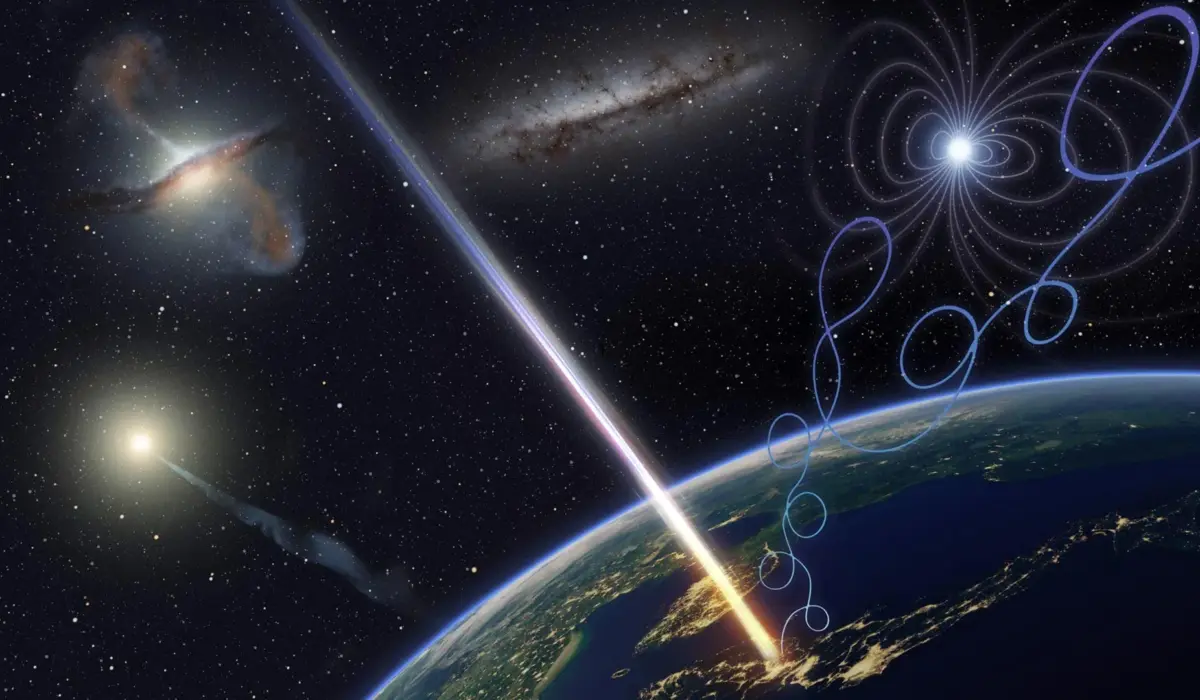
According to the team’s calculations, ultraheavy nuclei can sustain their extreme energies over greater cosmological distances than previously assumed. Furthermore, because they carry a higher electric charge ($Z$) than protons, their trajectories are subject to stronger deflections by intergalactic magnetic fields. This magnetic lensing effect can smear out the apparent arrival directions of these particles, offering a natural explanation for why an ultraheavy particle might appear to originate from an empty cosmic void while actually having been birthed in a distant, violent cataclysm millions of light-years away.
Official Statements and Expert Insights
The research team emphasizes that while ultraheavy nuclei do not account for every ultrahigh-energy cosmic ray detected on Earth, their inclusion solves critical discrepancies in the observational data.
"Ultrahigh-energy cosmic rays can only be accelerated by some of the most powerful sources in the universe," stated Kohta Murase, professor of physics and of astronomy and astrophysics in the Penn State Eberly College of Science, who led the research team. "When we detect individual cosmic-ray particles such as the Amaterasu particle here on Earth, we can often use their energies, arrival directions and expected magnetic deflections to infer their possible cosmic sources."
Addressing the historical context of the field, Murase noted the persistence of the puzzle:
"The origins and acceleration mechanisms of ultrahigh-energy cosmic rays have been among the biggest mysteries in the field for more than 60 years, since the first example was reported."
Elaborating on the mechanics revealed by their computer simulations, Murase explained:
"Our research showed that at energies comparable to that of the Amaterasu particle, ultraheavy nuclei lose energy more slowly than protons or intermediate-mass nuclei, making them better able to survive cosmic distances and reach Earth at extreme energies. We are not saying that all ultrahigh-energy cosmic rays are ultraheavy nuclei. But if some of the highest-energy events are ultraheavy nuclei, that would impact how we search for their sources."
Regarding the astrophysical engines capable of forging such dense, heavy elements and hurling them across space, Murase pointed to some of the most destructive events in the cosmos:
"The most promising sites for producing and accelerating such ultraheavy nuclei are massive star deaths involving explosive collapse into black holes or strongly magnetized neutron stars, as well as binary neutron-star mergers known to be powerful gravitational-wave emitters. These violent cosmic phenomena can also power gamma-ray bursts that are among the most energetic explosions in the universe."
Murase also highlighted how this hypothesis resolves another long-standing observational quirk:
"A contribution from these sources could also help explain a possible difference seen between the northern and southern skies in the ultrahigh-energy cosmic-ray spectrum. If ultraheavy nuclei contribute significantly at the highest energies, future data should indicate a composition heavier than iron."
Collaborative Effort
The published study represents an intensive synthesis of theoretical astrophysics and computational modeling. Alongside Murase, the research team included B. Theodore Zhang, a postdoctoral researcher at Kyoto University’s Yukawa Institute for Theoretical Physics at the time of the research and a former Penn State postdoctoral researcher; Mukul Bhattacharya, an Eberly Postdoctoral Fellow at Penn State during the project; and Nick Ekanger and Shunsaku Horiuchi, both affiliated with Virginia Tech during the study.
Future Outlook: Testing the Ultraheavy Hypothesis
As astrophysics enters a multi-messenger era—where scientists simultaneously track electromagnetic radiation, gravitational waves, and high-energy particles—testing the Penn State team’s predictions has become a primary objective for next-generation observatories.
Next-Generation Observatories
Proving that ultraheavy nuclei make up a significant fraction of the ultrahigh-energy cosmic-ray spectrum requires detectors capable of distinguishing particle masses at extreme relativistic speeds. Traditional surface detectors struggle to determine whether an air shower generated in the upper atmosphere was initiated by a single proton or a complex, heavy atomic nucleus.
However, upcoming and proposed facilities are poised to bridge this technological gap:
- AugerPrime: The ongoing upgrade to the Pierre Auger Observatory in Argentina—the world’s largest cosmic-ray detector—incorporates upgraded surface detectors, underground muon detectors, and faster electronics. These enhancements are specifically designed to measure the mass composition of ultrahigh-energy cosmic rays with unprecedented precision.
- The Global Cosmic Ray Observatory (GCOS): Proposed as a massive, next-generation worldwide initiative, GCOS aims to unify global efforts to capture ultra-rare, ultrahigh-energy events with an aperture significantly larger than any existing array.
Theoretical Frontiers
On the theoretical front, researchers plan to refine their models of stellar collapse, magnetar formation, and binary neutron star mergers. By coupling magnetohydrodynamic simulations of gamma-ray bursts with nuclear network calculations, theorists hope to map the exact nucleosynthesis pathways that produce ultraheavy elements in extreme environments, tracing them from their birth inside collapsing stars all the way to their turbulent arrival in Earth’s atmosphere.
Ultimately, the revelation that ultraheavy particles may pilot the highest-energy cosmic rays opens a vital new chapter in astrophysics. By decoding the scars these particles carry from their intergalactic journeys, scientists are moving closer to charting the most violent accelerators in the universe, transforming cosmic-ray astronomy from a study of anomalies into a precise map of cosmic history.