






Executive Overview
Uranium, a dense and naturally occurring radioactive heavy metal, is typically sequestered deep within geological formations, locked safely inside mineral lattices within soil and rock. However, anthropogenic activities—most notably uranium mining, milling, and industrial extraction—alongside natural geochemical weathering, can fundamentally alter this heavy metal. Under specific environmental conditions, these processes oxidize uranium, transforming it into soluble species that easily dissolve in water. Once rendered mobile, this dissolved uranium poses significant ecological and public health threats. It can readily infiltrate groundwater aquifers, migrate through agricultural watersheds, and contaminate drinking water supplies, exerting high chemical toxicity and radiological hazards on ecosystems and human populations alike.
For decades, environmental engineers and radiochemists have sought reliable, sustainable methods to immobilize aquatic uranium. Now, an international research team has unlocked a groundbreaking piece of this puzzle. Scientists at the Helmholtz-Zentrum Dresden-Rossendorf (HZDR) in Germany, in close collaboration with Wismut GmbH and researchers from the University of Granada in Spain, have demonstrated for the first time that indigenous soil and groundwater bacteria can convert dissolved, mobile uranium into a secure, stable chemical compound. Crucially, this microbial transformation is unlocked when glycerol is introduced as an organic food and carbon source.
Published in the prestigious journal Nature Communications, this discovery upends previous chemical dogmas. The research reveals that bacteria can drive uranium into a unique pentavalent oxidation state—long believed to be strictly transient and unstable—and bind it into a robust mineral phase that persists even in the presence of atmospheric oxygen. This breakthrough offers a transformative conceptual foundation for future bioremediation technologies, pointing toward nature-based solutions for cleaning up legacy uranium contamination across the globe.
Detailed Chronology of the Discovery
The journey toward this microbiological breakthrough spans laboratory experimentation, deep-mine sampling, and cutting-edge synchrotron analyses. It represents a masterclass in multidisciplinary environmental science, bridging microbiology, geochemistry, and advanced materials characterization.
Sourcing the Subterranean Microbes
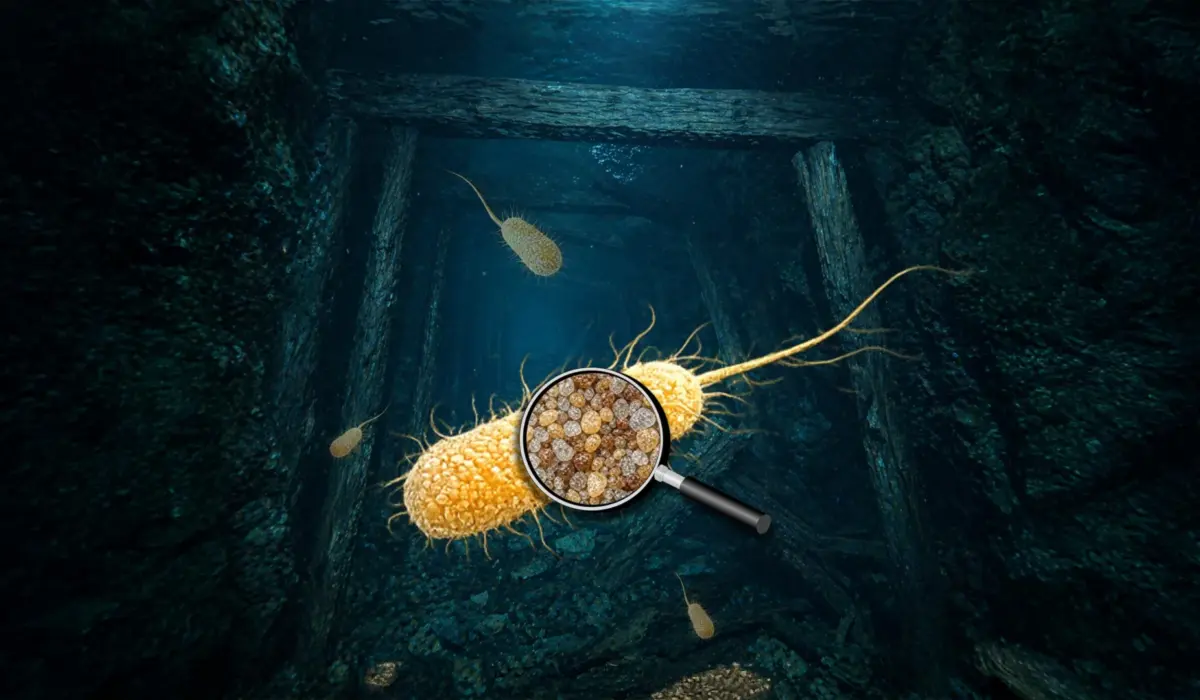
To replicate authentic environmental stressors, the research team turned to an extreme habitat: a flooded uranium mine in the Ore Mountains of Germany, operated by the environmental restoration company Wismut GmbH. At a depth of approximately 2,000 meters beneath the surface, these flooded mine shafts exist in anoxic (oxygen-depleted) or microaerophilic conditions, housing specialized microbial communities that have evolved to survive in the presence of heavy metals and low nutrient availability.
Researchers collected mine water samples rich in dissolved uranium and populated by these hardy, native bacterial consortia. Back in the laboratory, the team sought to recreate the subterranean geochemical environment. They placed the water samples into strictly controlled, oxygen-free chambers and introduced a carefully measured, controlled amount of glycerol—a simple organic polyol that serves as an efficient metabolic carbon and energy source. In natural settings, glycerol can be generated through various ecological pathways, such as the enzymatic breakdown of wood and plant fats by fungi and other microorganisms.
The 130-Day Microbial Transformation
Once the glycerol was introduced, the dormant subterranean bacteria awakened, using the carbon source to fuel their metabolic processes. As the microorganisms metabolized the glycerol, they fundamentally altered the chemistry of their surrounding aqueous environment. The researchers monitored the chemical evolution of the system over extended timeframes, tracking the concentration of heavy metals in real time.
The results surpassed expectations. Over a period of 130 days, the concentration of uranium dissolved in the water plummeted dramatically. Chemical assays revealed that roughly 95% of the aqueous uranium had been removed from the liquid phase. Only about five percent of the original dissolved uranium remained in the water samples.
Initial hypotheses pointed toward bioaccumulation: the researchers suspected that the bacterial cells were actively pulling the toxic metal out of solution and incorporating it directly into their cellular architecture, particularly within their complex cell walls. Subsequent microbiological and chemical analyses confirmed this suspicion, proving that the bacteria were indeed accumulating massive quantities of uranium within and upon their cell walls.
Unlocking the Pentavalent Enigma
Having confirmed where the uranium was residing, the team faced a more profound chemical question: What exact molecular configuration had the uranium assumed under the influence of the bacteria? To decode the atomic structure of the microbially processed uranium, the researchers deployed advanced spectroscopic and microscopic techniques.
The investigation required high-resolution experiments at the Rossendorf Beamline (ROBL), which is operated by HZDR at the European Synchrotron Radiation Facility (ESRF) in Grenoble, France. This state-of-the-art synchrotron facility allows scientists to probe matter at the atomic level using intense X-ray beams. Complementary analytical studies were simultaneously conducted at the University of Granada.
Chemists use the term "valency" (or oxidation state) to describe the bonding capacity of an atom—essentially how many chemical "hands" an atom has available to form bonds with other elements. Naturally occurring uranium typically exhibits a valency of 4 (relatively insoluble, tetravalent uranium) or 6 (highly mobile, hexavalent uranyl ions). While pentavalent uranium ($U^5+$) is theoretically possible, it has historically been categorized as a fleeting, highly unstable intermediate state that rapidly disproportionates into tetravalent and hexavalent forms.
When the international team analyzed the biomass recovered from their experiments, the spectroscopic data revealed an astonishing anomaly: an unusually high proportion of the uranium embedded in the bacterial cell walls was in the rare pentavalent state. This observation fundamentally challenged conventional thermodynamic and geochemical models, proving that biological systems can stabilize oxidation states that are otherwise ephemeral in abiotic environments.
The Birth of a Stable Mineral Phase
Digging deeper into the molecular architecture, the researchers discovered that this pentavalent uranium did not exist in isolation. Instead, it had bonded with available iron and oxygen ions within the matrix to form a specific mineral compound: $textFeU^(V)textO_4$.
This compound represents a rare and largely uncharacterized phase in uranium mineralogy. To contextualize its discovery, the research team looked back at prior environmental forensics. In 2020, independent soil analyses of regions in Croatia contaminated by historical uranium-depleted ammunition revealed traces of this exact $textFeU^(V)textO_4$ compound. Strikingly, geochemical tracking showed that even after 25 years of exposure to atmospheric weathering and oxygen, the compound had remained remarkably stable.
However, prior to the HZDR and University of Granada study, the exact natural mechanisms governing the formation of $textFeU^(V)textO_4$ remained a complete mystery. Nobody knew that living microorganisms played a direct, pivotal role in synthesizing this mineral.
In a final series of experiments, the researchers exposed the dried bacterial biomass containing the newly formed compound to atmospheric oxygen. Counter-intuitively, rather than degrading or re-oxidizing back into a mobile form, the amount of $textFeU^(V)textO_4$ actually increased. This definitive proof of oxygen stability confirmed that bacterial processing can permanently lock mobile, toxic uranium into a secure, immobile solid phase that resists remobilization.
Supporting Context & Metrics
To appreciate the significance of this breakthrough, one must examine the broader metrics of uranium contamination, remediation costs, and the chemical parameters governing actinide behavior in the hydrosphere.
The Global Challenge of Uranium Contamination
Uranium is mined extensively for nuclear energy production, defense applications, and medical isotopes. However, legacy mining sites, poorly managed tailings piles, and industrial processing facilities have left a persistent ecological footprint worldwide.
- Aquatic Mobility: In its hexavalent state ($textUO_2^2+$), uranium forms highly soluble carbonate and sulfate complexes in natural waters. These complexes migrate easily through sandy soils, fractured bedrock, and subsurface aquifers.
- Toxicity Profile: Uranium is both a heavy-metal chemical toxin and a radiological hazard. Chemically, it targets the proximal tubules of the kidneys, leading to renal dysfunction and failure. Radiologically, its alpha emissions pose significant carcinogenic risks if ingested through contaminated drinking water or food chains.
- Remediation Costs: Traditional remediation approaches—such as pump-and-treat systems, chemical precipitation, and excavation—are exceptionally costly, often running into the tens of millions of dollars per site, and frequently fail to remove low concentrations of dispersed, dilute uranium plumes.
Key Experimental Metrics from the Study
- Duration of Reduction: 130 days of controlled anaerobic incubation with glycerol.
- Aqueous Extraction Efficiency: ~95% reduction of dissolved uranium in the liquid phase, leaving only 5% remaining in solution.
- Oxidation State Captured: Pentavalent uranium ($textU^5+$), an oxidation state historically considered transient and chemically unstable.
- Final Mineral Product: $textFeU^(V)textO_4$, an iron-uranium-oxygen mixed oxide compound proven stable over multi-decadal timescales.
Official Statements from Key Researchers
The collaborative nature of this international research endeavor brought together top-tier experts in terrestrial microbiology, radiochemistry, and synchrotron analysis. The lead scientists shared their perspectives on the significance of the findings:
"There are bacteria that can metabolically utilize the heavy metal, uranium, which is toxic for humans. Our group’s investigations had already revealed that bacteria can use uranium dissolved in water for their metabolism when they have access to glycerol as a food source."
— Dr. Evelyn Krawczyk-Bärsch, Senior Scientist in HZDR’s Terrestrial Microbiology Research Group and Co-Author
Dr. Krawczyk-Bärsch emphasized that while the metabolic affinity of certain extremophiles for heavy metals has long been a subject of academic curiosity, bridging the gap between basic microbiology and real-world mineral synthesis represents a major conceptual leap forward.
"We wanted to create natural conditions for the bacterial community already existing in the mine water because at a depth of approximately 2,000 meters there is usually little or no oxygen in the mine. After 130 days, only around five percent of the uranium dissolved in the water remained in the samples. We suspected that the bacteria had incorporated the uranium in their cell walls. We already knew about accumulation processes from the literature."
— Dr. Antonio M. Newman-Portela, Former Doctoral Candidate at HZDR and the University of Granada, Lead Author
Dr. Newman-Portela highlighted the unexpected nature of the analytical results, noting that uncovering the stabilization of pentavalent uranium required pushing analytical equipment to its absolute limits:
"Uranium usually occurs with a valency of 4 or 6. Pentavalent uranium does exist, but it is rare or only transient. Until now, it had been seen in an unstable oxidation state. So, the findings of our study were extremely surprising because in the biomass analyzed from our experimental runs, an unusually high proportion of the uranium identified was also pentavalent uranium."
Looking toward the horizon, Dr. Krawczyk-Bärsch outlined the cautious optimism shared by the team regarding future applications:
"Our study has revealed for the first time that bacteria supplied with glycerol as a carbon source can convert toxic uranium dissolved in water into a stable chemical compound. We still have to investigate to what extent bacteria might help to render uranium harmless for remediation purposes."
Future Outlook and Remediation Potential
While the laboratory results published in Nature Communications mark a monumental scientific milestone, the transition from controlled bench-scale experiments to field-scale environmental restoration requires careful, methodical, and extensive follow-up research.
Roadmap for Future Research
- Unraveling Biochemical Pathways: The research team plans to conduct in-depth multi-omic and biochemical analyses to identify the exact enzymatic pathways and cell-wall proteins responsible for stabilizing the pentavalent uranium. Understanding the molecular machinery will allow scientists to optimize the process.
- Geochemical Interactions in Complex Environments: Real-world contaminated groundwater is rarely a clean laboratory solution; it contains complex mixtures of competing ions, organic pollutants, and variable pH levels. Future studies will test the bacterial-glycerol system under diverse geochemical conditions.
- Field Pilot Testing: Should laboratory and mesocosm trials continue to yield positive results, the long-term goal will be designing controlled, in-situ bioremediation field trials at legacy mining sites, such as those managed by Wismut GmbH in Germany.
Transforming Environmental Engineering
If successfully scaled, this microbial approach could revolutionize the remediation of uranium-contaminated aquifers and mining basins. By stimulating native microbial populations with safe, biodegradable organic additives like glycerol, environmental engineers could theoretically prompt subsurface ecosystems to lock mobile, toxic uranium into insoluble, oxygen-resistant mineral barriers.
This approach minimizes physical soil disruption, reduces the energy footprints associated with pumping and treating massive volumes of water, and harnesses the self-healing power of Earth’s ancient microbial networks. Ultimately, the work led by HZDR, Wismut GmbH, and the University of Granada demonstrates that nature itself may hold the most elegant keys to neutralizing our most persistent industrial pollutants.