










Executive Overview
For millennia, sea silk stood at the absolute zenith of human luxury. Shimmering with an incandescent, metallic golden glow that seemed to catch fire in the sunlight, this gossamer fabric was so rare and coveted that it was reserved strictly for emperors, popes, and the wealthiest monarchs of antiquity. Often woven from the secreted anchor filaments of giant marine bivalves, true sea silk possessed a near-mythical reputation. It was famed for being lighter than silk, warmer than wool, and so impossibly fine that a pair of gloves crafted from it could supposedly be folded inside the shell of a walnut.
Yet, like many treasures of the ancient world, this extraordinary material was driven to the precipice of oblivion. Decades of severe marine pollution, habitat degradation, and over-harvesting pushed Pinna nobilis—the Mediterranean pen shell responsible for the historic fiber—toward functional extinction. Today, the species is strictly protected under European Union law, rendering authentic sea silk virtually impossible to produce outside of a few guarded secrets held by a dwindling number of traditional artisans on the island of Sardinia.
Now, a breakthrough spanning marine biology, materials science, and historical preservation has changed the narrative. A multidisciplinary research team led by Professor Dong Soo Hwang of the Pohang University of Science and Technology (POSTECH), alongside Professor Jimin Choi of the Environmental Research Institute, has successfully recreated the legendary golden fiber. By turning their attention from the endangered Mediterranean clam to the commercially farmed pen shell Atrina pectinata found in Korean coastal waters, the researchers have not only manufactured a near-identical structural replica of ancient sea silk but have also decoded the biological mystery of why its color refuses to fade over centuries.
Published in the prestigious journal Advanced Materials, this milestone offers far more than a triumph of historical reenactment. By transforming discarded seafood industry waste into a high-value, fade-resistant, and dye-free textile, the POSTECH team has laid the groundwork for a revolutionary approach to sustainable fashion and advanced optical materials.
Detailed Chronology of a Marine Marvel
To understand the magnitude of the POSTECH breakthrough, one must trace the long, winding history of sea silk—a narrative that bridges classical antiquity, medieval craftsmanship, and modern molecular engineering.
Antiquity and the Roman Era
The written record of sea silk stretches back over two millennia. During the height of the Roman Empire, luxury goods from the edges of the known world flooded into the capital, but few commanded the astronomical prices of byssus. Harvested primarily from the Pinna nobilis—a massive Mediterranean pen shell capable of growing up to four feet in length—the material was gathered by specialized divers known as sommozzatori. These clams anchored themselves to the rocky seabed using dense bundles of proteinaceous threads, which secreted a liquid that solidified upon contact with seawater.
Once harvested, washed, spun, and combed, these golden filaments yielded a yarn that could be woven into garments of breathtaking beauty. Because of its extreme scarcity—requiring the harvesting and processing of thousands of individual mollusks for a single garment—sea silk was often worth more than its weight in gold. Roman historians and naturalists, including Pliny the Elder, remarked upon its ethereal qualities, noting that garments made from it were worn almost exclusively by triumphing generals, Roman emperors, and foreign dignitaries as symbols of absolute power.
The Medieval and Ecclesiastical Legacy
As the Roman Empire faded, the production of sea silk migrated to the coastal communities of the Mediterranean, most notably Sardinia, where local women preserved the arduous, generational art of harvesting, spinning, and knitting the fiber. Throughout the Middle Ages, sea silk was adopted by the Roman Catholic Church. Because the fabric was fire-resistant to a degree and shimmered with a divine, unearthly light, it was frequently used to create vestments for high-ranking clergy, papal altar cloths, and reliquary wrappings.
Perhaps the most famous surviving relic associated with this tradition is the Holy Face of Manoppello, a miraculous image preserved in a sanctuary in Italy. For centuries, theologians, art historians, and scientists have studied the veil, with several researchers proposing that the translucent, shimmering fabric upon which the image rests is woven from ancient sea silk.
The Modern Collapse
For generations, the craft survived as an intimate cottage industry. However, the twentieth and twenty-first centuries brought ecological catastrophe to the Mediterranean Sea. A combination of climate change, infectious protozoan pathogens, anchoring damage, and rampant coastal pollution decimated Pinna nobilis populations across their native range. By the early 2020s, the species was classified as critically endangered. Recognizing the imminent threat of extinction, the European Union enacted stringent bans on harvesting the clam, effectively freezing the legal production of sea silk in its historical homeland and turning existing artifacts into untouchable museum pieces.
The POSTECH Breakthrough
Enter the modern era of biomimetic engineering. Recognizing that the ecological realities of the Mediterranean precluded any large-scale revival of Pinna nobilis, Professor Dong Soo Hwang and Professor Jimin Choi looked eastward. They identified a biological cousin already abundant in Asian waters: Atrina pectinata, a pen shell species extensively cultivated for the seafood industry along the coast of South Korea.
While Atrina pectinata is valued primarily for its meat, its byssus threads—the very structural tethers it uses to anchor itself against oceanic currents—were routinely discarded as low-value organic waste. The POSTECH team hypothesized that these overlooked filaments might share the remarkable biochemical architecture of their Mediterranean predecessor.
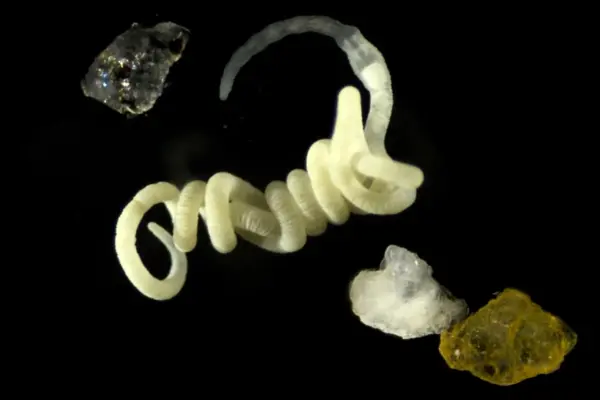
Through meticulous physical and chemical analysis, the researchers confirmed their hypothesis. By developing an innovative chemical processing and mechanical alignment technique, they successfully transformed the discarded byssus of Atrina pectinata into a shimmering, flexible, and durable golden yarn that mirrors the legendary sea silk of antiquity down to the microscopic level.
Supporting Context & Metrics
The triumph of the POSTECH research lies not merely in duplicating an ancient textile, but in solving a profound scientific mystery: how a biological material can maintain a brilliant, metallic golden luster for hundreds of years without the aid of chemical dyes, mordants, or heavy metal treatments.
Decoding Structural Coloration
Traditional textiles achieve their colors through pigmentation—absorbing certain wavelengths of light while reflecting others using synthetic or natural dyes. Over time, exposure to ultraviolet radiation, moisture, and oxidation causes these chemical bonds to break down, resulting in fading, discoloration, and dullness.
Sea silk operates on an entirely different scientific principle known as structural coloration. Rather than relying on pigments, the golden hue of sea silk is an optical illusion generated by the physical architecture of the material itself.
Using advanced microscopy and spectroscopic analysis, the research team discovered that sea silk’s iridescent glow is produced by layered, spherical protein structures dubbed "photonin." These sub-micron structures interact with incoming light waves, scattering and refracting them in a manner strikingly similar to how soap bubbles or the iridescent wing scales of morpho butterflies create vibrant colors.
The Precision-Color Correlation
A major discovery of the study was the direct mathematical and structural correlation between protein organization and color intensity. The researchers found that the more precisely and uniformly these spherical photonin proteins are aligned within the fiber, the stronger, purer, and more vivid the golden reflection becomes.
When light strikes the precisely ordered protein matrices of the sea silk, constructive interference amplifies the golden wavelengths while canceling out others. Because this color is hard-coded into the physical geometry of the protein scaffolding rather than applied via fugitive dyes, it exhibits unprecedented resistance to photobleaching and environmental degradation. This fundamental property explains how historical artifacts crafted centuries ago have managed to retain their celestial brilliance in European treasuries and museums to this day.
Official Statements and Expert Insights
The implications of this research have sent ripples through both the academic community and the industrial design sector. In official communications detailing the breakthrough, the lead researchers emphasized the paradigm-shifting nature of their work.
"Structurally colored textiles are inherently resistant to fading," noted Professor Dong Soo Hwang during a press briefing following the publication in Advanced Materials. "Our technology enables long-lasting color without the use of chemical dyes or toxic heavy metals. This opens up entirely new horizons for sustainable fashion, high-performance optical coatings, and advanced materials engineering."
The research team highlighted that the integration of marine bivalve byssus into high-end textile manufacturing addresses two critical global challenges simultaneously: the mitigation of seafood processing waste and the reduction of the textile industry’s notorious carbon and chemical footprint.
Co-author Professor Jimin Choi of the Environmental Research Institute elaborated on the ecological significance of sourcing materials from aquaculture waste streams:
"Every year, tons of useful organic byproducts from shellfish farming are discarded without a second thought. By upcycling these marine proteins into high-value, culturally significant materials, we demonstrate a circular bio-economy model that bridges ancient heritage with modern ecological stewardship."
Independent materials scientists not involved in the study have praised the rigorous interdisciplinary approach. By successfully translating a rare natural phenomenon into a scalable manufacturing process, the POSTECH team has provided a blueprint for bio-inspired engineering—proving that nature often holds the most sophisticated technological blueprints.
Future Outlook: From Ancient Relics to Modern Sustainable Fashion
As the global textile industry faces mounting pressure to reform its environmental practices, the breakthrough achieved by the POSTECH team arrives at a critical juncture. Traditional textile dyeing is one of the world’s most polluting industries, consuming vast quantities of fresh water and discharging toxic chemical effluents into rivers and oceans.
By proving that high-performance, fade-resistant, and visually stunning textiles can be produced using structural proteins derived from marine waste, the researchers have opened a pathway toward a cleaner, greener industrial future.
Commercializing Marine Bio-Textiles
The immediate path forward involves scaling the processing techniques developed in the POSTECH laboratories. While mass production of sea silk was previously bounded by the biological limits of endangered wild clams, the use of farmed Atrina pectinata offers a stable, scalable supply chain. Aquaculture facilities already harvest these pen shells for consumption; capturing the byssus threads that would otherwise be discarded transforms a waste management challenge into a lucrative secondary revenue stream for coastal farming communities.
Expanding Applications Beyond Fashion
Beyond luxury garments and sustainable apparel, the underlying principles of photonin structural coloration have profound implications for high-tech industries:
- Cosmetics: Developing brilliant, shimmering makeup pigments that do not require mineral mining or synthetic dyes.
- Automotive and Aerospace Coatings: Creating exterior paints and finishes that will never fade under harsh solar radiation, reducing the need for repainting and maintenance.
- Anti-Counterfeit Technology: Engineering complex, structurally colored security threads for currency, passports, and luxury goods that are virtually impossible to replicate using conventional printing techniques.
Conclusion
The resurrection of sea silk is much more than a nostalgic nod to antiquity. It is a powerful testament to the synergy between historical inquiry and cutting-edge science. By decoding the molecular architecture of a forgotten marine treasure, Professor Dong Soo Hwang, Professor Jimin Choi, and their team at POSTECH have bridged a multi-century gap in human craftsmanship. In doing so, they have transformed a fragile relic of emperors and popes into a vibrant beacon of sustainable innovation for the twenty-first century and beyond.