









Executive Overview
In a discovery that pushes the evolutionary timeline of one of nature’s most effective predatory tools back half a billion years, an international team of paleontologists has unearthed the earliest known evidence of spider fangs. Led by researchers from Yunnan University in China and the United Kingdom’s University of Leicester, the study focuses on Urokodia, a diminutive, multi-legged marine creature that swam the primordial oceans during the early Cambrian Period, roughly 518 million years ago.
Published in the prestigious journal Nature, the breakthrough coincides with the 42nd anniversary of the excavation of the Chengjiang fossil site in Yunnan Province, southern China—a globally renowned Konservat-Lagerstätte famed for its extraordinary preservation of soft-bodied organisms. Utilizing cutting-edge X-ray tomography, the research team peered inside the mummified remains of stone-encased fossils to reveal delicate, pincer-like appendages positioned directly behind the creature’s stalked eyes.
These structures represent the primordial precursors to the chelicerae—the specialized mouthparts that eventually evolved into the venomous fangs of modern spiders, the crushing pincers of scorpions, and the harvesting appendages of ticks and horseshoe crabs. This landmark finding not only bridges a monumental gap in invertebrate evolutionary history but also underscores the enduring legacy of chelicerates, an invertebrate supergroup comprising over 100,000 described species that transitioned from ancient, shallow seas to conquer virtually every terrestrial ecosystem on Earth.
Detailed Chronology: Tracing the Evolutionary Timeline
To understand the magnitude of the Urokodia discovery, paleontologists must look deep into the geological record, navigating a timeline that spans more than half a billion years of biological innovation, environmental upheaval, and anatomical adaptation.
The Cambrian Explosion and the Rise of Marine Predators
The story begins during the early Cambrian Period, an epoch characterized by an unprecedented evolutionary burst of complex multicellular life known as the Cambrian Explosion. Prior to this era, Earth’s ecosystems were dominated by microbial mats and simple benthic organisms. Within a geologically brief window, nearly all major animal phyla made their sudden appearance in the fossil record.
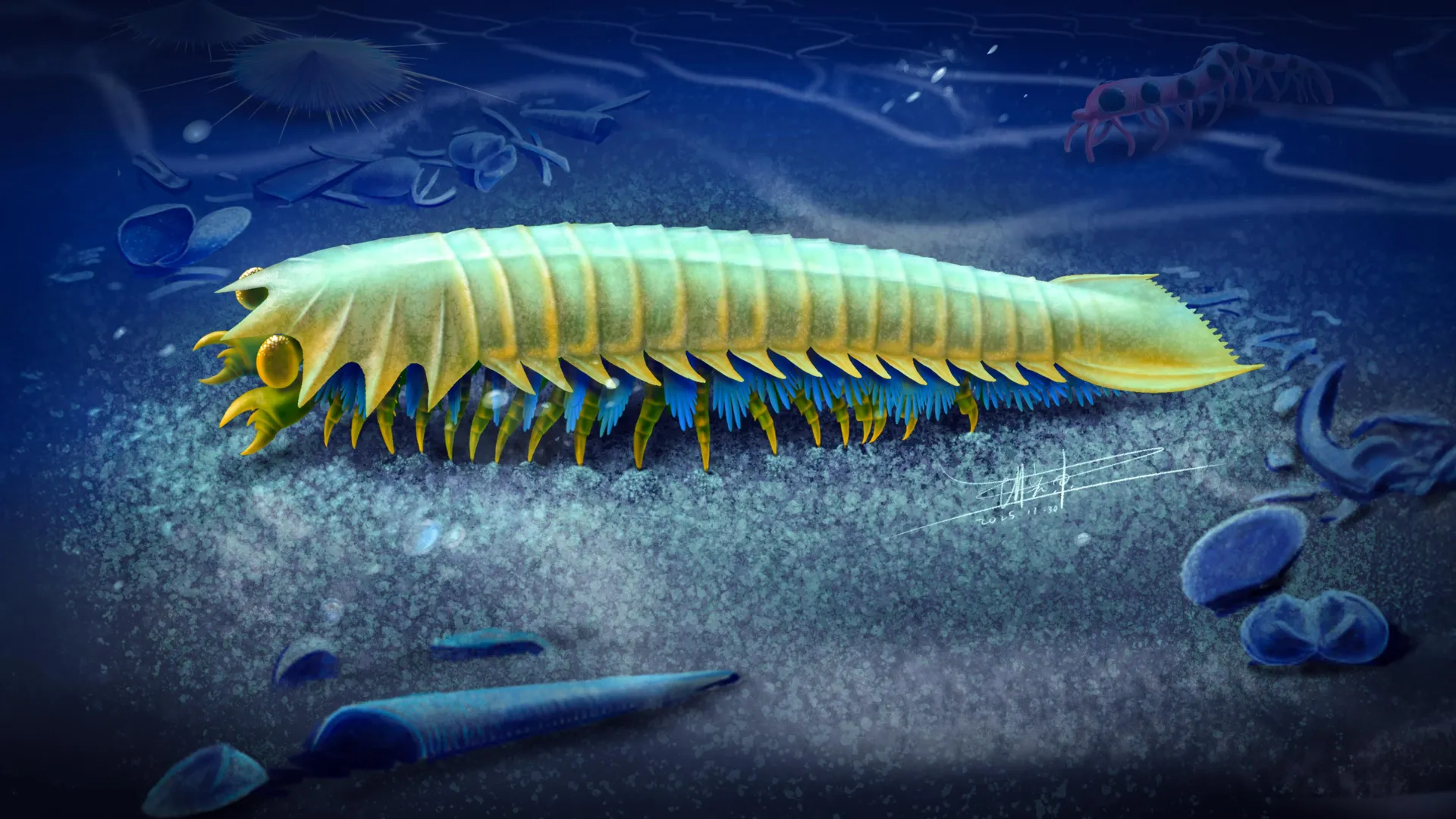
It was within this tumultuous, high-oxygen marine ecosystem that Urokodia thrived. Measuring a modest two to three centimeters in length, the creature bore a segmented exoskeleton, jointed limbs adapted for crawling along the seafloor, and prominent, stalked eyes that scanned the ancient waters for food. Despite its unassuming size and a morphology that bears little superficial resemblance to a modern tarantula or scorpion, Urokodia occupied a crucial node on the phylogenetic tree.
The Evolution of the Chelicerae
At the heart of the Yunnan-Leicester study is the adaptation of anterior limbs into specialized predatory tools. In ancestral arthropods, the limbs lining the body were largely uniform, serving dual purposes of locomotion and basic food manipulation. However, as selective pressures intensified in the Cambrian seas, evolutionary advantages favored specialization.
In Urokodia, the limbs situated immediately behind the eyes underwent a radical transformation, developing into distinct pincer-like structures. These proto-chelicerae allowed the organism to grasp, manipulate, and tear apart prey with unprecedented precision. Over tens of millions of years, as lineages diverged and some populations migrated from marine environments onto land, these primitive pincers underwent further modification. In arachnids, they hollowed out, developed internal venom glands, and sharpened into the hypodermic-like fangs that characterize modern spiders today.
The Terrestrial Invasion
While Urokodia remained strictly aquatic—evidenced by leg structures that likely functioned as primitive book gills akin to those found in modern horseshoe crabs—its descendants laid the groundwork for a terrestrial invasion. When early chelicerates finally stepped onto land, they did so equipped with pre-adapted hunting mechanics. The fossil record demonstrates that these ancient arachnid ancestors were already apex predators within their micro-habitats hundreds of millions of years before the first vertebrates crawled ashore.
Supporting Context & Metrics: The Anatomy of a Paleontological Marvel
The significance of the Chengjiang fossil deposit cannot be overstated. Unlike typical fossilization processes that preserve only hard mineralized tissues like bones, teeth, and shells, the fine-grained mudstones of Yunnan Province created an anoxic, low-bacteria environment capable of capturing the soft anatomy of organisms in exquisite detail.
Quantitative Breakdown of the Research and Findings
| Metric / Parameter | Detail / Value |
|---|---|
| Geological Age | ~518 Million Years Ago (Early Cambrian Period) |
| Fossil Locality | Chengjiang Fossil Site, Yunnan Province, China |
| Key Organism | Urokodia (marine invertebrate) |
| Organism Length | 2 to 3 centimeters |
| Taxonomic Group | Chelicerata (ancestral lineage to spiders, scorpions, ticks) |
| Total Described Chelicerate Species | >100,000 extant species |
| Core Technology Used | X-ray Tomography (CT scanning) |
| Anniversary Milestone | Published on the 42nd anniversary of the Chengjiang site’s discovery |
| Associated Ecosystem Diversity | Over 200 different animal species preserved at the site |
The Power of X-Ray Tomography
For decades, paleontologists studying fossils like Urokodia faced a frustrating technological bottleneck. While the external morphology of the animals was often visible on the rock surface, the internal structures and soft tissues hidden within the matrix remained inaccessible without destroying the specimen.
The research team overcame this barrier by employing advanced X-ray tomography. By bombarding the rock samples with high-resolution X-rays and digitally reconstructing the differential density of the fossilized organic carbon against the surrounding sedimentary rock, the scientists were able to "virtually dissect" the mummified specimens. This non-destructive imaging technique exposed the micro-anatomy of the pincer-like limbs in three dimensions, confirming their structural homology to modern chelicerae.
Official Statements and Expert Insights
The collaborative nature of the research brought together leading minds in evolutionary biology, paleontology, and geology from institutions across China and the United Kingdom.
Professor Yu Liu of Yunnan University, who also serves as a Visiting Professor at the University of Leicester and led the investigation, described the electrifying moment of discovery:
"আমরা যখন শত শত মিলিয়ন বছর ধরে পাথরের নিচে চাপা থাকা এই জীবাশ্মগুলোর নরম অ্যানাটমি প্রকাশ করার জন্য এক্স-রে টমোগ্রাফি বিশ্লেষণ ব্যবহার করছিলাম, তখন হঠাৎ করেই আমরা প্রাণীটির সামনের দিকে পিন্সারের মতো অঙ্গগুলি লক্ষ্য করলাম। আমরা অবিলম্বে বুঝতে পেরেছিলাম যে এটি একটি অত্যন্ত রোমাঞ্চকর জীবাশ্ম এবং প্রকৃতপক্ষে বিচ্ছু এবং মাকড়সার মতো জীবন্ত চেলিসেরেটদের একটি দূরবর্তী পূর্বপুরুষ।"
(“We were using X-ray tomography analysis of these fossils to reveal their soft anatomy buried in the rocks for hundreds of millions of years, when suddenly we noticed the pincer-like limbs at the front of the animal. We knew immediately that this was a very exciting fossil and indeed a distant ancestor of living chelicerates like scorpions and spiders.”)
Co-author Professor Mark Williams from the University of Leicester School of Geography, Geology and the Environment emphasized the broader ecological context of the discovery, highlighting the richness of the prehistoric habitat:
“Urokodia was part of an ancient ecosystem of over 200 different types of animals living in the seas over 500 million years ago. These spectacularly preserved fossils provide real insights into how life was evolving on our planet at the very dawn of animals.”
Funding and institutional support for the project were spearheaded by the Department of Science and Technology of Yunnan Province (Grant 202401BC070012) alongside the Yunnan Revitalization Talent Support Program, reflecting the regional and global commitment to advancing foundational scientific research in evolutionary paleontology.
Future Outlook: Unresolved Questions and Next Steps
While the identification of proto-chelicerae in Urokodia marks a monumental milestone, evolutionary biologists emphasize that this discovery is merely the opening chapter in a much larger narrative.
Mapping the Early Arthropod Tree of Life
With the successful application of high-resolution X-ray tomography on Chengjiang specimens, the research team aims to turn its analytical lens toward other enigmatic Cambrian fossils. Key questions remain regarding the exact genetic and developmental triggers that transformed simple jointed limbs into specialized predatory weapons. By scanning additional specimens from Yunnan and comparable Lagerstätten sites—such as the Burgess Shale in Canada—paleontologists hope to construct a granular, step-by-step phylogenetic transition map tracking the evolution of arthropod mouthparts.
Changing Public Perceptions of Arachnids
Beyond academic implications, discoveries of this scale offer a powerful reminder of nature’s deep continuity. Despite cultural anxieties fueled by cinematic depictions—from the lethal reputation of the Black Widow to science-fiction tropes like Spider-Man or horror films centered on arachnophobia—the vast majority of chelicerates pose zero threat to humans. Their evolutionary machinery, perfected over half a billion years, was sculpted for a singular purpose: subduing microscopic and small invertebrate prey within complex, shifting ecosystems.
As analytical techniques continue to evolve, unlocking secrets locked within stone for 518 million years, humanity gains a clearer, more profound appreciation for the ancient architects of the natural world—proving that the story of modern predators began long before the first foot touched dry land.