









Executive Overview
More than ten million years ago, long before the first modern humans set foot on the continent, South America was a realm of biological extremes. During the Miocene epoch—a dynamic geological period spanning millions of years—a vast, sprawling mega-wetland and inland lake system covered a significant portion of the continent’s northern tropical latitudes. This ancient aquatic labyrinth supported an ecosystem of staggering proportions, playing host to gargantuan turtles, massive prehistoric fish, and a menagerie of extraordinary predators that prowled its lush, humid shores.
While the landscape was shared by a terrifying array of competitors—including giant anacondas, saber-toothed metatherian mammals, towering flightless "terror birds," and sebecids, an unusual lineage of heavily armored, terrestrial, predatory crocodylians—new research reveals a startling ecological hierarchy. Despite the intense competition for resources in this prehistoric Eden, true crocodylians occupied a uniquely dominant position. According to a landmark study recently published in the Journal of Vertebrate Paleontology, these aquatic apex predators were the undisputed heavyweight champions of the region, outcompeting their mammalian counterparts and steering the dynamics of the entire food web.
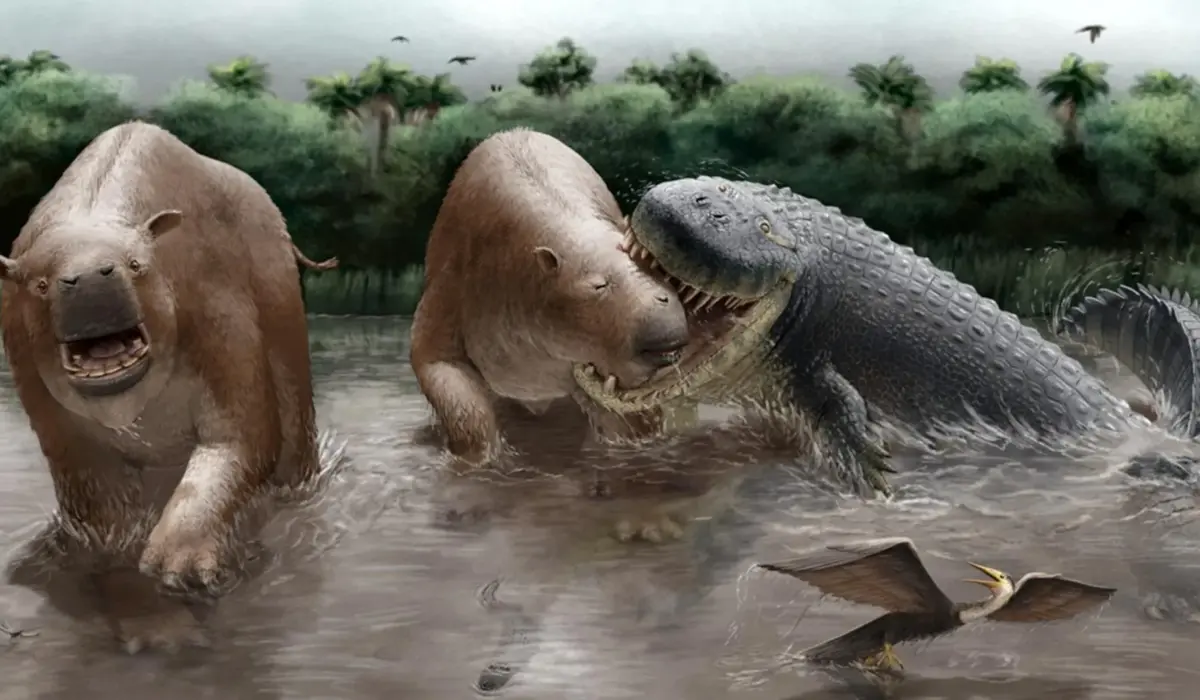
Driven by a staggering abundance of colossal herbivores, South America’s Miocene wetlands functioned as a primal crucible where gigantism was the evolutionary norm. At the very pinnacle of this complex trophic pyramid sat Purussaurus neivensis, a colossal caiman relative that stretched up to seven meters in length and tipped the scales at nearly two metric tons. Far from being mere opportunistic scavengers or passive giants, recent fossil analyses featuring direct bite-mark evidence indicate that Purussaurus and its kin exerted top-down control over the ecosystem, actively regulating herbivore populations and shaping the evolutionary trajectories of contemporary species.
Detailed Chronology: The Miocene Epoch in South America
To understand the reign of South America’s ancient crocodylians, one must look back to the Miocene epoch, which stretched from roughly 23 million to 5.3 million years ago. During the Middle Miocene (specifically between 16 million and 10.5 million years ago, the primary window investigated in the recent study), South America was effectively an isolated island continent. Cut off from North America by seaways, its fauna evolved in splendid, bizarre isolation, producing an array of endemic mammals and reptiles found nowhere else on Earth.
The Rise of the Pebas and Pebas-to-Amazon Transition
Geologically, northern South America during this epoch was dominated by the Pebas System—a massive, long-lived wetland complex characterized by extensive swamp, lake, and restricted marine incursions. This environment was not a single, uniform lake, but a dynamic, shifting mosaic of aquatic habitats, meandering rivers, and seasonally flooded forests.
As geological forces slowly shifted, the landscape transitioned into the Amazonian mega-wetland system. This continuous aquatic expanse provided an ideal habitat for cold-blooded giants. The warm, equatorial climate maintained stable, high temperatures year-round, allowing ectothermic species like crocodylians and giant turtles to achieve phenomenal body sizes. Waterways teemed with aquatic life, while the surrounding shores supported dense, tropical vegetation capable of sustaining gargantuan plant-eating mammals.
The Evolutionary Golden Age of South American Fauna
This unique geography fostered an unprecedented adaptive radiation of both prey and predators. On land, the landscape was dominated by an astonishing diversity of megaherbivores:
- The Giant Ground Sloths: Massive predecessors of modern sloths, some lineages of which were already adopting robust, heavy-set body plans suited for browsing forest margins.
- Glyptodonts: Heavily armored, car-sized relatives of modern armadillos equipped with bony dome shells and spiked tail clubs, serving as walking fortresses against predators.
- Bizarre Native Ungulates: South America’s hoofed mammals evolved along completely independent lines from their Eurasian and African counterparts. Among them were the toxodontids—massive, barrel-chested herbivores resembling a cross between a rhinoceros and a hippopotamus—and the astrapotheres ("lightning beasts"), which featured stout pillars of limbs, tusks, and potentially a short, muscular trunk.
Some of these ancient ungulates reached astronomical proportions, routinely exceeding a metric ton in body weight. This nearly limitless bounty of large-bodied prey created a hyper-productive ecosystem capable of sustaining an unusually high density of apex predators. Yet, among the glittering array of carnivores, it was the crocodylians that ultimately seized the ecological crown.
Supporting Context & Metrics: Decoding the Apex Predator
For decades, paleontologists debated how such a diverse suite of apex predators could coexist in the same ecosystem without driving each other to immediate extinction through competitive exclusion. The South American Miocene hosted a veritable murderer’s row of carnivores:
- The Terror Birds (Phorusrhacids): Towering, flightless birds standing up to three meters tall, equipped with massive, axe-like hooked beaks designed to deliver devastating crushing blows to prey.
- Sebecids: Terrestrial, hoof-clawed crocodylomorphs possessing laterally compressed, serrated teeth akin to those of carnivorous dinosaurs, allowing them to slice through thick-skinned prey on dry land.
- Saber-Toothed Mammals: Apex mammalian predators equipped with elongated, dagger-like canine teeth, specialized for precision killing of large herbivores.
- Anacondas and Giant Boids: Massive constrictor snakes capable of dominating riparian zones and ambushing medium-to-large mammals at the water’s edge.
Despite this fierce competition, quantitative analyses of the ecosystem’s carrying capacity reveal a mathematical reality of the ancient food web: the sheer volume of available prey was simply too vast for mammalian carnivores alone to consume.
The Metrics of Purussaurus neivensis
At the apex of this food web stood Purussaurus neivensis, a genus and species of giant caiman whose dimensions stagger the imagination.
| Biological Metric | Purussaurus neivensis Estimate | Modern Saltwater Crocodile Comparison |
|---|---|---|
| Maximum Length | ~7.0 meters (23 feet) | ~5.0–6.0 meters (rarely exceed 6m) |
| Estimated Body Mass | ~1,800 kilograms (approx. 4,000 lbs) | ~1,000 kilograms |
| Estimated Bite Force | Up to 69,000 Newtons (approx. 15,500 lbf) | ~16,400 Newtons |
| Primary Ecological Role | Apex aquatic ambush predator / Keystone ecosystem regulator | Opportunistic apex predator |
With a skull robustly built to withstand immense torsional stress, Purussaurus was not merely adapted to eating fish or small vertebrates. Its bone-crushing bite force enabled it to tackle the largest megaherbivores of the Miocene, dragging them from the muddy banks into the watery depths.
The Scientific Breakthrough: Reading the Fossil Record
Historically, understanding the predatory dynamics of extinct ecosystems relied heavily on "ghost lineages," functional morphology, and comparative anatomy—inferring what an animal could eat based on the shape of its teeth and skull. However, this approach leaves ample room for speculation.
The turning point in the recent study came from a meticulous, direct examination of physical evidence preserved in museum archives: fossilized herbivore bones bearing distinct bite and tooth marks. By analyzing these ancient trauma points across specimens dating from 16 million to 10.5 million years ago, researchers bypassed theoretical models in favor of empirical forensic paleontology. The spacing, depth, and morphological signature of the bite marks matched the dental arrays of Purussaurus, providing indisputable proof of active predation events rather than mere scavenging.
Official Statements and Expert Insights
The study, which sheds brilliant new light on tropical paleoecology, reflects the collaborative efforts of international paleontologists utilizing modern analytical frameworks on classic museum collections.
"There was so much prey available that mammalian predators couldn’t have eaten it all," explains Dr. Oscar Wilson, lead author and postdoctoral researcher at the University of Helsinki. “When you look at the sheer biomass of the Miocene ungulates, ground sloths, and glyptodonts, the energetic requirements of the ecosystem demanded high-output carnivory. Mammalian predators played a major role, but they had distinct physiological limitations.”
Dr. Wilson emphasizes that crocodylians held a distinct ecological advantage in the tropical wetland matrix. Because they were ectothermic (cold-blooded), their metabolic efficiency was vastly superior to that of endothermic (warm-blooded) mammalian carnivores. They required significantly less food relative to their body weight to survive, yet when they hunted, their massive size allowed them to monopolize the largest caloric packages available in the ecosystem.
"Our new study shows that crocodylians in particular were the region’s most important predators, especially when it came to hunting large prey," Dr. Wilson continues. “The frequency and distribution of marks likely made by Purussaurus suggests that it was far more than just a background component of these tropical ecosystems—it was a primary driver of trophic dynamics.”
Other paleontologists tracking the research note that the presence of Purussaurus likely exerted what modern ecologists call top-down control or trophic cascades. By regularly culling the populations of giant ungulates and sloths, these ancient crocodylians would have indirectly influenced vegetation patterns, nutrient cycling, and the demographic structure of herbivore herds across northern South America. Rather than simply coexisting with other large predators in a neutral space, Purussaurus actively shaped the evolutionary playground of the Miocene.
Future Outlook: Unveiling the Secrets of South America’s Deep Past
The publication of this study in the Journal of Vertebrate Paleontology marks a major milestone, but it also opens the door to critical new avenues of scientific inquiry. As paleontological techniques grow increasingly sophisticated, researchers are poised to extract even deeper secrets from South America’s fossiliferous strata.
Emerging Research Directions
- Micro-Wear and Isotopic Analysis: Future studies aim to combine bite-mark forensics with stable isotope analysis of tooth enamel. By examining carbon and oxygen isotopes preserved in Purussaurus teeth, scientists hope to reconstruct the precise dietary shifts of these giant crocodylians across seasonal wet and dry cycles.
- CT Scanning and Bite Mechanics: Advanced three-dimensional digital modeling and finite element analysis (FEA) are being deployed on virtual reconstructions of Purussaurus skulls. This technology will allow researchers to simulate prehistoric feeding events down to the kilopascal, mapping exact stress distributions during bone-crushing bites.
- Comparative Neotropical Paleoclimatology: Understanding how Miocene crocodylians responded to past episodes of regional climate change provides invaluable context for modern conservation biology. As contemporary tropical wetlands face unprecedented anthropogenic pressures and climatic shifts, studying how ancient apex predators adapted—or ultimately succumbed—to environmental transformations offers critical ecological foresight.
Conclusion
The prehistoric wetlands of Miocene South America were a world of hyper-abundant life and brutal, unyielding competition. Yet, amidst an astonishing cast of saber-toothed mammals, towering terror birds, and armored herbivores, it was the giant crocodylian Purussaurus neivensis that reigned supreme. Through a combination of unmatched physical scale, metabolic efficiency, and devastating predatory capability, these river-sea titans left an indelible mark on the fossil record—reminding modern science of the profound, structuring power that true apex predators hold over the shaping of the natural world.