








Executive Overview
Polycythemia Vera (PV) and related Philadelphia-negative myeloproliferative neoplasms (MPNs)—such as essential thrombocythemia (ET) and myelofibrosis (MF)—represent a complex spectrum of chronic blood cancers. Driven primarily by somatic mutations like JAK2V617F, CALR, and MPL, these conditions are characterized by unchecked cellular proliferation, chronic systemic inflammation, oxidative stress, and a markedly elevated risk of thrombotic complications, cardiovascular morbidity, and disease progression to myelofibrosis or acute myeloid leukemia (AML).
For decades, standard-of-care management has focused on cytoreduction, phlebotomy, and anti-platelet therapy. While interferon-alpha (IFN-$alpha$) has emerged as a paradigm-shifting, disease-modifying therapy capable of reducing the malignant clone size and inducing deep molecular responses, real-world clinical hurdles remain steep. Substantial treatment discontinuation rates, driven largely by therapy-related toxicities and systemic side effects, highlight an urgent, unmet clinical need.
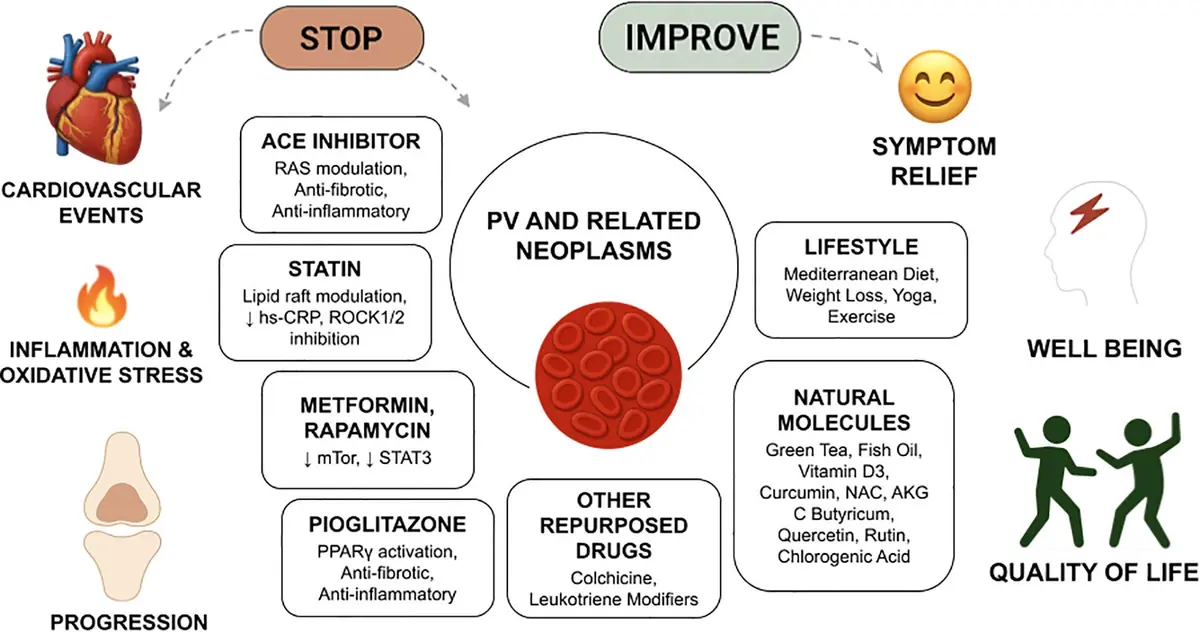
In a comprehensive review published in Frontiers in Hematology, researchers Gökhan Mergen and Professor Hans C. Hasselbalch propose a bold, two-pronged therapeutic framework. They argue that optimizing long-term outcomes—maximizing both survival and quality of life (QoL)—requires moving beyond monotherapy. Instead, they advocate for a multi-faceted strategy that integrates repurposed cardiovascular and metabolic drugs, targeted natural compounds, rigorous lifestyle interventions, and carefully managed combination therapies alongside standard disease-modifying agents.
Detailed Chronology & Evolving Paradigms in MPN Management
The conceptual shift toward multi-targeted, combinatorial approaches in MPNs has evolved significantly over the last two decades, bridging breakthroughs in molecular pathobiology, oncology, and metabolism:
- Early 2000s—The Statin Hypothesis: The foundational rationale for investigating lipid-lowering agents in hematologic malignancies was first articulated, highlighting the pleiotropic effects of statins beyond cholesterol reduction, including the disruption of lipid-raft-localized JAK2 signaling.
- The Rise of Interferon-Alpha: Clinical evidence increasingly validated IFN-$alpha$ as a disease-modifying agent capable of preserving healthy hematopoietic stem cell function and reducing JAK2V617F allele burden, though adherence challenges spurred the search for supportive adjuncts.
- Discovery of Inflammatory and Metabolic Drivers: Emerging research illuminated the pathological feedback loops between the hyperactive JAK/STAT pathway, localized bone marrow renin-angiotensin systems (RAS), and systemic chronic inflammation (e.g., NF-$kappa$B activation).
- Recent Clinical Trials and Dietary Interventions (2021–Present): Landmark studies—such as the NUTRIENT trial examining the Mediterranean diet, investigations into GLP-1 receptor agonists, and retrospective cohort analyses of metformin and leukotriene modifiers—provided clinical signals supporting lifestyle and metabolic modulation to curb disease progression and symptom burden.
Supporting Context & Molecular Metrics: Targeting the Pathological Web
The pathophysiology of MPNs extends far beyond the malignant hematopoietic clone. It encompasses a complex microenvironment defined by chronic inflammation, oxidative stress, metabolic dysregulation, and epigenetic alterations.
[Malignant Clone: JAK2V617F / CALR]
       │
       ├──> Hyperactive JAK/STAT Signaling ──> Proliferation & Clonal Expansion
       ├──> ROS Accumulation & DNA Damage ──> Genomic Instability & Transformation
       └──> Systemic Inflammatory Milieu ───> Fibrosis, Thrombosis, & Symptom Burden
1. Cardiovascular and Metabolic Drugs as Anti-Neoplastic Adjuncts
- ACE Inhibitors: Beyond regulating systemic blood pressure, ACE inhibitors disrupt a localized, hyperactive bone marrow renin-angiotensin system. By blocking the conversion of Angiotensin I to Angiotensin II, they mitigate direct mitogenic stimuli on hematopoietic progenitors and leverage established anti-fibrotic properties.
- Statins: Statins inhibit HMG-CoA reductase, depleting isoprenoids required for protein prenylation. Crucially, they disrupt cholesterol-rich membrane lipid rafts where constitutively active JAK2V617F proteins localize, selectively inducing apoptosis in malignant cells while sparing healthy counterparts.
- Metformin & Pioglitazone: Activating AMP-activated protein kinase (AMPK) and inhibiting mTORC1, metformin provides a vital downstream brake on the PI3K/AKT/mTOR signaling axis. Pioglitazone, a PPAR-$gamma$ agonist, demonstrates compelling preclinical efficacy in reducing splenomegaly, decreasing reticulin fiber formation, and mitigating fibrotic bone marrow microenvironments.
- Colchicine: Operating at low anti-inflammatory doses (0.5 mg daily), colchicine disrupts the NLRP3 inflammasome, reduces neutrophil extracellular trap (NET) formation, and dampens thrombotic risk.
2. Emerging Pharmacological Frontiers and Natural Compounds
- Leukotriene Modifiers: Inhibiting 5-lipoxygenase (e.g., zileuton) or blocking cysteinyl leukotriene receptors (e.g., montelukast) addresses the leukotriene over-activation implicated in tumorigenesis and thrombosis. Clinical case reports suggest significant molecular responses when combined with standard regimens.
- Alpha-Ketoglutarate (AKG) & N-Acetylcysteine (NAC): AKG targets platelet hyperreactivity, chronic inflammation, and epigenetic dysregulation as a TET cofactor. NAC combats reactive oxygen species (ROS) accumulation, mitigating DNA double-strand breaks and genomic instability.
- Plant-Derived Polyphenols (EGCG, Quercetin, Curcumin): Molecular docking studies reveal that green tea catechins (EGCG), curcumin, and dietary flavonoids possess strong binding affinities for the mutated JAK2V617F pseudo-kinase domain, exhibiting anti-proliferative and anti-inflammatory properties that complement conventional therapies.
3. Lifestyle Interventions and Metabolic Health
- Mediterranean Diet & Weight Management: The NUTRIENT pilot trial established the feasibility of the Mediterranean diet in MPN patients, demonstrating marked reductions in total symptom scores (MPN-SAF TSS). Furthermore, retrospective data on GLP-1 receptor agonists highlight profound reductions in all-cause mortality, venous thromboembolism, and progression to myelofibrosis.
- Structured Exercise & Yoga: Online yoga programs and home-based exercise rehabilitation trials (such as MPN-FIT) confirm that physical activity significantly improves functional capacity, reduces inflammatory cytokines like TNF-$alpha$, and alleviates fatigue, anxiety, and depression.
Official Statements and Expert Perspectives
The integration of repurposed medications and lifestyle modifications into hematologic oncology represents a paradigm shift in how clinicians view chronic cancer management.
"Taking into account that PV and related neoplasms are chronic blood cancers… there is an urgent unmet need to initiate stem-cell targeting treatment with IFN-$alpha$ alongside treatment targeting the chronic inflammatory state, which not only drives the malignant MPN-clone but also likely accelerates development of atherosclerosis… and second cancers," emphasize review authors Gökhan Mergen and Professor Hans C. Hasselbalch.
The authors emphasize that while single-agent therapies often fall short of eradicating the malignant clone or fully neutralizing systemic inflammation, rational combination therapies must be designed with an understanding of pathway overlap. For instance, while combining agents that share identical downstream suppressive profiles (such as certain statin-ruxolitinib combinations) has yielded mixed preclinical results, pairing ruxolitinib with agents that target independent, persistent pathways—such as BET inhibitors (pelabresib), metabolic modulators (metformin), or stem-cell-directed therapies (IFN-$alpha$)—holds immense promise for deepening molecular responses and improving patient longevity.
Future Outlook: A Two-Pronged Strategic Roadmap
To successfully translate these diverse therapeutic modalities into everyday clinical practice without overwhelming patients with polypharmacy or iatrogenic toxicity, Mergen and Hasselbalch propose a pragmatic, two-pronged approach:
- Immediate Clinical Translation Based on Biomarkers: Readily applicable, low-risk interventions—such as managing cardiovascular risk factors, correcting vitamin deficiencies, encouraging structured physical activity, adopting Mediterranean dietary patterns, and utilizing low-dose anti-inflammatory adjuncts—should be systematically integrated into personalized care plans under close medical supervision.
- Rigorous Clinical Trials for Emerging Combinations: Dedicated, well-powered randomized controlled trials must be conducted to validate emerging combination strategies (e.g., interferon pairings with metabolic modulators or targeted supplements) to formally quantify their impact on event-free survival, leukemic transformation rates, and patient-reported quality of life.
By bridging molecular pathobiology with accessible lifestyle and pharmacological adjuncts, the oncology community moves closer to a truly comprehensive, patient-centric model of care—transforming polycythemia vera from a relentless chronic threat into a managed, highly resilient state of long-term survival.