








Executive Overview
Dementia currently casts a long and lengthening shadow over global public health, affecting approximately 55 million people worldwide—a figure projected to surge to an alarming 150 million by the year 2050. Beyond the profound personal and emotional toll inflicted on patients and their families, this impending demographic wave carries a staggering global economic burden estimated at $16.9 trillion.
At the center of this health crisis stands Alzheimer’s Disease (AD), the leading cause of progressive cognitive decline. Traditionally, diagnosing AD and its precursor stages, such as Mild Cognitive Impairment (MCI), has relied heavily on late-stage clinical observations, resource-intensive imaging like Positron Emission Tomography (PET), or invasive cerebrospinal fluid (CSF) sampling. By the time conventional diagnostics confirm significant neuropathology, critical windows for therapeutic intervention have often closed.
However, a groundbreaking multi-center study published in Communications Medicine offers a paradigm-shifting alternative. Led by an international team of researchers—including Giorgio Colombo, Kwaku Minta, and senior supervisor Victor R. Schinazi—the study evaluates the Spatial Performance Assessment for Cognitive Evaluation (SPACE). Administered via an intuitive iPad interface as an age-friendly serious game, SPACE tests the spatial navigation abilities of 300 individuals recruited from memory clinics and community cohorts in Singapore.
The findings are compelling: spatial navigation impairments—specifically in path integration and perspective-taking—serve as highly sensitive, non-invasive digital markers capable of accurately differentiating between subtle stages of cognitive impairment. Furthermore, the researchers introduced a streamlined iteration, sSPACE, which trims administration times to under 11 minutes while retaining exceptional diagnostic accuracy. This innovation promises to decentralize early memory screening, moving it out of specialized clinical settings and into the hands of primary care providers, community centers, and even home-based environments.
Detailed Chronology of the Clinical Evaluation
The clinical validation study was structured meticulously to bridge the gap between theoretical neuroscience and practical, scalable neurological care.
Participant Recruitment and Screening
The investigation evaluated 300 participants (average age 74 years; 41% male) drawn from dual pipelines: memory clinics at the National University Hospital (NUH) and St. Luke’s Hospital in Singapore (representing ongoing cohort studies such as HARMONISATION and SINGER), alongside healthy controls recruited directly from these sites and the wider community.
To ensure safety and validity, stringent eligibility criteria were applied. Participants had to be over 50 years old and capable of walking a 10-meter distance unassisted. Individuals with severe visual or auditory impairments, histories of epilepsy, seizures, or acute cardiac events were excluded. Ethical oversight was rigorously maintained under approval from the National Healthcare Group (NHG) Domain Specific Review Board (DSRB) in Singapore.
Comprehensive Clinical and Biomarker Profiling
Upon enrollment, participants underwent a comprehensive testing regime spanning approximately three hours. This included:
- Sociodemographic and Health Questionnaires: Assessing education, lifestyle habits, medical histories, tablet experience, and self-reported spatial abilities via the Santa Barbara Sense of Direction (SBSOD) scale.
- Global Clinical Dementia Rating (CDR): Determining impairment severity across six cognitive and functional domains (memory, orientation, judgment, community affairs, home/hobbies, and personal care). Scores categorized participants from normal (0) to severe dementia (3). Due to low sample sizes in the advanced bracket, moderate (2) and severe (3) categories were consolidated.
- Clinical Consensus Diagnoses: Supported by the Vascular Dementia Battery (VDB), structural neuroimaging (multimodal MRI assessing cerebrovascular disease), and cutting-edge blood biomarkers (such as plasma p-tau217 quantified via SIMOA immunoassay to gauge amyloid PET positivity risk).
- Neuropsychological Batteries: Including the Montreal Cognitive Assessment (MoCA), Questionnaire for Cognitive Decline in the Elderly (QDRS), Trail Making Tests (TMT-A/B), Animal Fluency, Digit Cancellation, and dual-task paradigms.
The SPACE Assessment Paradigm
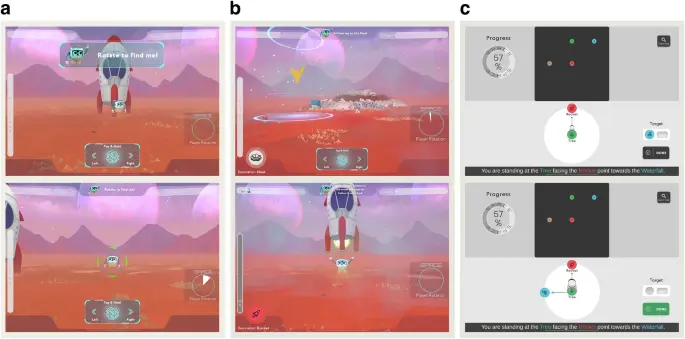
Following clinical evaluations, participants engaged with the SPACE platform—a gamified assessment where players assume the role of an astronaut exploring a planet. The test suite comprises five core domains:
- Training Phase: A warm-up phase tracking rotation and basic visuospatial movement, measuring the time required to master the digital interface.
- Path Integration: Tracking self-motion and updating position/orientation along a triangular trajectory without external guides.
- Egocentric Pointing: Accurately indicating the direction of unseen landmarks from a first-person perspective.
- Cognitive Mapping: Reconstructing a top-down structural layout of environmental landmarks.
- Associative Memory: Recalling items scanned at specific landmarks during the journey.
- Perspective Taking: Mentally calculating spatial bearings and relationships between landmarks from imagined viewpoints.
Supporting Context & Metrics: Unmasking the Data
The statistical analyses yielded a treasure trove of quantitative validation, illustrating the superior discriminative power of spatial navigation tasks.
Robust ANOVA Group Differences
Analyzing task performance across CDR categories via robust one-way ANOVAs revealed statistically significant differences in:
- Training Time: ($F_3, 296 = 14.7, p < 0.001$), with cognitively impaired individuals taking progressively longer to master the interface, reflecting deteriorating visuospatial-motor integration.
- Path Integration Distance Error: ($F_3, 296 = 7.0, p = 0.004$), highlighting how degradation in the medial entorhinal cortex and hippocampus impairs dead-reckoning and self-motion tracking.
- Perspective Taking Error: ($F_3, 296 = 11.0, p < 0.001$), demonstrating the failure of patients to successfully execute coordinate transformations and mental viewpoint shifts.
Diagnostic Classification Performance (AUC)
Using logistic regressions, researchers compared demographic-only models (age, gender, education) against combined models incorporating SPACE metrics. The results underscored dramatic improvements in diagnostic accuracy:
- CDR 0 vs. CDR 1: The demographic baseline yielded an Area Under the Curve (AUC) of 0.76. Incorporating SPACE skyrocketed the AUC to 0.94 ($p_textDeLong < 0.001$), with sensitivity jumping to a flawless 1.00 and specificity reaching 0.85.
- CDR 0.5 vs. CDR 1: The baseline AUC of 0.70 increased significantly to 0.91 ($p_textDeLong < 0.001$), achieving a sensitivity of 0.95 and specificity of 0.73.
- Cross-Validation: Utilizing 10-fold cross-validation and Leave-One-Out Cross-Validation (LOOCV), models maintained robust, generalizable performance with AUCs consistently clustering between 0.80 and 0.89 across clinical contrasts.
Benchmarking Against Traditional Neuropsychological Tools
When stacked against traditional gold-standard screens, SPACE held its ground admirably. DeLong tests with Bonferroni corrections showed that SPACE performed equivalently to or better than established modalities like the TMT-B, Digit Cancellation, and QDRS, particularly excelling in the critical transition zones between questionable (CDR 0.5) and mild (CDR 1) impairment stages.
Official Statements and Expert Insights
The integration of gamified spatial testing into cognitive neurology marks a conceptual leap forward. The research team emphasizes that the brain’s navigation network—anchored by the hippocampus, entorhinal cortex, and retrosplenial cortex—is among the very first neural substrates assaulted by Alzheimer’s pathology, often long before generalized memory failure becomes obvious in social interactions.
"Spatial navigation tasks tap into a distributed neurocognitive network that is exceptionally vulnerable in the earliest preclinical and prodromal phases of neurodegenerative disease," notes the research collective. "By translating these complex laboratory paradigms into an engaging, accessible tablet-based format, we bridge the chasm between high-end academic neuroscience and scalable clinical screening."
Independent clinical reviewers have lauded the methodology for its ecological validity. Unlike abstract card-sorting tasks or memorization drills, spatial navigation mimics real-world challenges—such as navigating a grocery store or finding one’s way home—making performance metrics inherently reflective of a patient’s functional autonomy.
Future Outlook: Decentralizing Memory Screening
Despite the resounding success of the trial, the authors candidly acknowledge certain limitations. The cross-sectional design prevents definitive tracking of longitudinal cognitive decline, and validation in fully unsupervised home environments remains ongoing. Furthermore, while the cohort represented Singapore’s multi-ethnic demographic profile well, global cross-cultural replication is necessary.
Nevertheless, the advent of sSPACE—the truncated 11-minute assessment focusing solely on training time and perspective-taking—heralds a transformative future for public health policy. By eliminating the need for bulky VR headgear or lengthy clinical appointments, sSPACE opens the door to unsupervised, remote screening via personal tablet devices.
Integrating digital navigation signatures with emerging blood-based biomarkers (such as plasma p-tau217) and genetic profiling creates an unprecedented blueprint for preventive neurology. Health systems worldwide can soon envision a future where individuals routinely check their brain health on an iPad app at home, flagging subtle entorhinal deficits years before clinical dementia strikes. Such proactive identification will empower clinicians to deploy disease-modifying therapies precisely when they can do the most good, ultimately preserving autonomy, easing caregiver strain, and bending the curve on the global dementia crisis.